I closed the door of my private office behind me and stood still for several seconds.
Normally, the room settled me.
Dark walnut shelves covered two walls. A long window looked over the lights of Los Angeles, and on my desk sat the quiet evidence of the life I had built—contracts, financial reports, photographs from charity dinners, awards I had stopped noticing years ago.
That evening, none of it impressed me.
PART 3 — What a Family Chooses to Hide
For almost a minute, neither Claire nor I moved.
Harrison’s name sat at the bottom of the page in ordinary black type.
Nothing about it looked dramatic.
That was what unsettled me most.
Real secrets rarely announced themselves.
They hid inside routine documents, familiar signatures, old assumptions.
I picked up the phone.
“Ask Harrison to come back.”
Claire touched my arm.
“Dad.”
I looked at her.
“Don’t decide what this means before you ask him.”
“I haven’t.”
But I knew from her expression that she wasn’t convinced.
Perhaps she knew me better than I wanted to admit.
Harrison returned.
His face was calm until he saw the trust authorization lying on my desk.
Then he stopped.
“Where did you find that?”
Claire answered.
“In Mom’s archived papers.”
He closed the door behind him.
I pointed to his name.
“Why did you have administrative authority over Anne’s trust?”
Harrison did not sit.
“Because Mrs. Bennett asked me to.”
“For what purpose?”
“Household-related disbursements.”
“What kind?”
“Staff bonuses. Emergency assistance. Occasionally educational expenses for employees’ children. Gifts at Christmas.”
I looked at Claire.
She seemed equally surprised.
“Why didn’t I know about this?”
Harrison’s expression softened.
“Because she didn’t want it to become something people had to ask you for.”
That irritated me more than it should have.
“She thought I wouldn’t help?”
“No.”
He shook his head.
“She thought you would help too much.”
I stared at him.
He almost smiled.
“Mrs. Bennett once said that if someone told you their car needed a new transmission, you’d buy them another car and accidentally make them feel indebted for the next decade.”
Despite everything, Claire made a sound that was almost a laugh.
“That does sound like Mom.”
I did not laugh.
But I couldn’t deny it.
Harrison continued.
“She wanted a modest fund. Quiet. Practical. Something employees could access without feeling as though they were asking the owner of the house for charity.”
“And you administered it?”
“Only mechanically. Mrs. Bennett made the decisions.”
“What about Daniel’s loan?”
Harrison’s brow furrowed.
“What loan?”
I watched him carefully.
“The Hawthorne guarantee.”
He looked from me to Claire.
“I don’t know what you’re talking about.”
Claire put the copy in front of him.
He read it.
For the first time that evening, Harrison looked genuinely shocked.
“This isn’t right.”
“You’re listed as an authorized administrator.”
“Not for loans.”
“Could you have executed this?”
“No.”
“Could someone using your credentials?”
He ran one hand over his face.
“Possibly.”
“That isn’t very reassuring.”
“No, sir.”
He pulled out his phone.
“The trust administration used a bank portal back then. Mrs. Bennett had primary authority. You had secondary. I had restricted transaction access. I could prepare a transfer, but anything above twenty-five thousand required another approval.”
“Whose?”
“Yours or hers.”
Claire leaned forward.
“Could Mom’s old authorization token have been used?”
Harrison looked at her.
“Yes.”
Her face drained of color.
She had used that same token months earlier.
A device our family had treated like an old key in a drawer might have been the thread connecting years of hidden decisions.
“Who had physical access to it when Anne was alive?” I asked.
“Mrs. Bennett kept it in her study.”
“And after?”
Harrison hesitated.
“You asked me to gather financial documents for the family office. Claire handled personal files. Daniel took some of Mrs. Bennett’s correspondence.”
“I took her letters,” Claire said. “Not financial papers.”
I stood.
“Call Daniel.”
Claire looked at the clock.
“He’s in Santa Barbara.”
“Then he can join by video.”
She didn’t argue.
Daniel answered her call from what appeared to be a hotel room.
At forty, he looked more like Anne than I did.
Same dark eyes.
Same habit of pressing his lips together when concerned.
He greeted Claire first.
Then he noticed me sitting beside her.
“Dad.”
“Daniel.”
His expression sharpened.
“What happened?”
Claire looked at me.
I nodded for her to begin.
She told him about Rosa.
The delayed salaries.
The reserve account.
Her attempt to keep his loan current.
As she spoke, Daniel’s face changed from confusion to disbelief.
“You used payroll money?”
“I didn’t know payroll had been included.”
“Claire.”
“I know.”
“No, I don’t think you do.”
His anger was controlled but unmistakable.
“You should have told me.”
“I tried to protect you.”
“By letting someone who works for Dad wonder whether she could pay rent?”
“I didn’t know that was happening!”
Daniel pushed away from the screen and walked across the hotel room.
When he returned, his voice was quieter.
“This is exactly why secrets don’t stay small.”
The irony did not escape me.
“That’s an interesting observation from someone who hid a loan from me for seven years.”
Daniel’s face hardened.
There it was.
The old pattern.
One sentence from me, and every vulnerable thing in the room disappeared behind defenses.
Claire looked down.
Harrison became intensely interested in the bookshelves.
Anne’s voice returned to me.
You make people present you with finished versions of themselves.
I exhaled.
“That came out differently than I intended.”
Daniel looked surprised.
I rarely corrected myself that quickly.
“Let’s start again,” I said.
“Did you believe your mother guaranteed the loan?”
“Yes.”
“Did you ever speak to her about it?”
A pause.
“Not directly.”
“Why not?”
“Because she told me through someone else.”
“Who?”
Daniel looked toward Harrison’s image on his own screen.
“Peter.”
Nobody spoke.
“Peter who?” Claire asked.
“Peter Alden.”
The name was familiar.
Very familiar.
Peter Alden had been Anne’s cousin.
For more than twenty years, he had worked as an accountant and later a financial adviser to several members of her family.
He wasn’t part of my business.
That had been important to Anne.
She liked having one financial person in her life who did not report to me.
Peter had attended our wedding anniversary parties.
He had eaten Thanksgiving dinner in this house.
He had stood three rows behind us at Anne’s funeral.
“He arranged the loan?” I asked.
Daniel nodded.
“He said Mom didn’t want you involved because she knew you and I were already fighting about the studio.”
“Did he show you the guarantee?”
“Not then.”
“Did you sign anything?”
“My company’s loan documents. Nothing involving Hawthorne.”
“Where did the money go?”
“Directly to the studio’s bank.”
“How much did you receive?”
“Four hundred thousand.”
Claire frowned.
“The guarantee is for seven hundred and fifty.”
Daniel stared at her.
“What?”
She lifted the document toward the camera.
“Seven hundred and fifty thousand dollars.”
“No.”
His answer was immediate.
“My company received four hundred.”
I felt the shape of the mystery change again.
This was not simply a forged guarantee created to help my son.
There was another three hundred and fifty thousand dollars somewhere.
“Naomi,” I said.
She had been listening through the speaker.
“I’m already looking.”
Keys clicked rapidly.
“Give me the original loan reference.”
Claire read it aloud.
Another minute passed.
Then Naomi spoke.
“I found the disbursement history.”
“And?”
“The loan was issued in two tranches.”
“How much?”
“Four hundred thousand went to Daniel’s company.”
Daniel nodded.
“And the second?”
Naomi hesitated.
“Three hundred and fifty thousand went to a company called Alden Residential Holdings.”
Claire closed her eyes.
“Peter.”
“Yes.”
Daniel sat down slowly.
“I didn’t know.”
For the first time in years, I believed those words immediately.
I had spent too much time assuming Daniel’s reluctance to talk to me meant he had something to hide.
Now I saw another possibility.
Sometimes silence did not mean guilt.
Sometimes it meant a person had been given a version of the truth that seemed complete enough not to question.
“Is Peter still managing anything connected to Hawthorne?” I asked.
“No,” Naomi said. “He hasn’t had formal access since Anne died.”
“Then why are payments still being made?”
“The loan was converted into a private note five years ago. The note was assigned to a small investment partnership.”
“Which one?”
“I’ll trace it.”
Harrison finally sat.
“I should have seen this.”
I looked at him.
“Should you?”
“Yes.”
“Why?”
“Because Mrs. Bennett trusted me to watch the account.”
“You said you only processed transactions.”
“That doesn’t mean I had to stop thinking.”
The echo of his earlier words was unmistakable.
For a moment, none of us seemed eager to blame anyone else.
That was new for my family.
Claire looked at Harrison.
“Did you know Peter had access to Mom’s study?”
“Yes. Often.”
“Could he have used her token?”
Harrison’s expression tightened.
“Possibly.”
Daniel shook his head from the screen.
“Peter told me Mom had personally approved everything.”
“Maybe she approved your four hundred thousand,” Claire said. “Just not the other amount.”
That possibility changed the emotional weight of the room.
Perhaps Anne had helped Daniel after all.
Perhaps the lie had been added around a truth.
Those were often the hardest deceptions to untangle.
“Do we have anything written by Anne about Daniel’s loan?” I asked.
Claire shook her head.
“I haven’t found anything.”
Harrison looked up suddenly.
“I may know where to look.”
We all turned toward him.
“Mrs. Bennett kept personal trust correspondence separately from legal files.”
“Where?”
“In the morning room.”
Claire frowned.
“We cleared the morning room after Mom died.”
“Not the desk.”
“The desk is still there.”
“No. Inside the desk.”
I stood.
The morning room had been Anne’s favorite space.
It faced the eastern garden and caught the earliest sunlight. She drank coffee there, wrote letters there, read there.
After she died, I stopped entering it.
Claire eventually changed the flowers, opened the curtains, and kept the room tidy.
But nobody used it.
We walked there together.
Daniel remained connected through Claire’s phone.
The room smelled faintly of cedar and old paper.
Anne’s writing desk stood beside the windows.
Harrison crouched in front of it.
“There was a false panel in the bottom drawer.”
Claire blinked.
“You’re joking.”
“Your mother enjoyed knowing one thing nobody else knew.”
That, too, sounded like Anne.
Harrison removed the drawer.
Pressed two wooden tabs.
A narrow panel lifted.
Inside was a bundle of envelopes tied with a faded blue ribbon.
Claire sat down abruptly.
“Oh.”
There was something almost sacred about seeing Anne’s handwriting again.
Not a scanned signature.
Not a legal document.
Her handwriting.
Real and impatient and slightly slanted.
Several envelopes were labeled with names.
CLAIRE.
DANIEL.
RICHARD.
And one simply read:
HOUSE.
I reached for mine.
Then stopped.
“Which one first?”
Claire pointed to HOUSE.
“I think we’ve spent enough years opening things in the wrong order.”
I untied the ribbon.
Inside the HOUSE envelope was a short letter and a typed ledger.
Anne’s letter began:
Richard,
If you’re reading this, you’ve probably discovered that I made the household fund more complicated than you liked.
I smiled despite myself.
Claire covered her mouth.
“She knew you so well.”
I kept reading.
Anne explained that she had created a private assistance account for employees of the estate.
Not charity, she insisted.
A recognition fund.
If someone had worked in our home for years and suddenly faced a broken car, tuition bill, funeral flight, licensing course, or temporary emergency, she wanted help to exist without a humiliating conversation.
She had funded it entirely from Hawthorne income.
Then I reached the paragraph about Daniel.
Daniel came to me because he needed help and because he was too proud to come to you. You will be tempted to be angry with him for the second part before asking yourself why the first part felt easier with me.
I stopped reading.
Claire looked at me.
“You okay?”
“Keep going,” Daniel said quietly through the phone.
So I did.
Anne had agreed to back four hundred thousand dollars.
Only four hundred.
She had instructed Peter Alden to prepare the paperwork.
She had not authorized seven hundred and fifty thousand.
She had even written a sentence in the margin of her personal ledger:
PETER SAYS BANK PREFERS LARGER FACILITY. I SAID NO. DANIEL NEEDS A BRIDGE, NOT AN ANCHOR.
Daniel turned away from the camera.
For a moment all we could see was the window behind him.
“She did help me.”
“Yes,” I said.
His voice broke slightly.
“I spent seven years thinking she saved my business and didn’t want me to mention it.”
“She probably did save it.”
I paused.
“But she wanted you to know exactly what she had done.”
Claire unfolded the typed ledger.
“Dad.”
“What?”
“There are employee names here.”
Dozens of them.
Some I recognized immediately.
Others had retired years earlier.
Small amounts appeared beside each name.
A mechanic certification course.
A plane ticket to Guatemala for a funeral.
Dental work.
Community college tuition.
A replacement refrigerator after an apartment flood.
Then Claire found Rosa.
ROSA MARTINEZ — CAMILA EDUCATION ACCOUNT.
We stared at it.
“What is that?” Daniel asked.
Claire kept reading.
Anne had set aside a modest annual amount for educational grants available to children of long-term household employees.
Camila had been listed as one of the first eligible children.
The account had never been activated.
Anne died before the program formally began.
I sank into her chair.
All evening I had believed Camila had walked into my hallway because our family had failed her mother for three months.
Now I understood the failure reached further back.
My wife had spent years making sure people inside our home were seen.
When she died, I had preserved her paintings, her jewelry, her garden, her furniture.
But I had not preserved the part of her life that existed in relationships.
I had inherited a house and misplaced its memory.
Naomi’s voice came through my phone.
“I found the investment partnership that owns the loan note.”
The room became still again.
“Who owns it?”
“Peter Alden is one of two partners.”
Claire shook her head slowly.
“So he’s receiving the payments.”
“Yes.”
“Payments we thought were keeping Daniel’s loan current.”
“Yes.”
I looked at Anne’s letter.
“Can we prove the guarantee was altered?”
“We’ll need original documents and likely a forensic review,” Naomi said. “But Anne’s contemporaneous ledger is important. The bank archive may have scanned versions. We can handle this through counsel.”
No drama.
No midnight confrontation.
No police arriving at the mansion.
Just paperwork.
Records.
Questions.
The slow reconstruction of truth.
Strangely, that felt more serious.
Daniel spoke from the phone.
“I want to repay the four hundred thousand.”
I looked at him.
“You’ve already repaid most of it.”
“I mean whatever Mom’s trust actually covered. Everything legitimate.”
“We’ll calculate it.”
“And Claire shouldn’t carry the rest.”
Claire protested.
“This isn’t about me.”
“It became about you when you started moving money around because you were trying to protect me.”
“I made that choice.”
“Yes.”
Daniel leaned closer to the camera.
“And I’m telling you that you don’t have to keep making it.”
Something softened in Claire’s face.
For years, she had been the one who fixed things.
Anne died, Claire organized the house.
Daniel struggled, Claire protected him.
I disappeared into work, Claire remembered birthdays.
Everyone called her reliable.
Nobody asked what reliability cost her.
“Why did you do it?” I asked her.
She looked at me.
“Really?”
“Really.”
Her eyes filled.
“Because after Mom died, this family became a collection of people trying not to worry one another.”
Nobody answered.
She continued.
“You worked more. Daniel stopped talking about the studio. I kept telling everyone I was fine. Every time something went wrong, I thought, Mom would have fixed this.”
Her voice trembled.
“So I tried.”
I looked around Anne’s morning room.
At the flowers.
At the letters.
At the carefully hidden account she had created because she understood that dignity sometimes depended on assistance being quiet.
“You weren’t supposed to become your mother.”
Claire wiped her eyes.
“I know that now.”
“No.”
I shook my head.
“I mean nobody had the right to expect you to.”
She stared at me.
“I did.”
The admission was difficult.
“I expected you to keep everything running because it made my life easier.”
“Dad—”
“Let me finish.”
She did.
“I thought providing for the family meant making sure none of you ever had to worry about money.”
I glanced toward Daniel’s face on the screen.
“But I made it hard for you to bring me anything money couldn’t immediately solve.”
Daniel said nothing.
That silence was answer enough.
“I don’t know how to change that overnight,” I said.
“You don’t have to,” Claire replied.
“No. But I have to start.”
We remained in Anne’s room until almost midnight.
By then, decisions had been made.
Naomi would freeze the unauthorized reserve account and reconcile every household payment.
An outside payroll company would independently confirm employee compensation.
No family member, including me, would be allowed to authorize changes alone.
Counsel would contact Peter through proper channels and request the complete loan file.
Claire would surrender Anne’s old authorization device.
Not as punishment.
Because no one should have been able to use it in the first place.
Harrison offered his resignation.
I did not accept it.
Not yet.
“You failed to escalate something you knew was wrong,” I told him.
“Yes.”
“That requires consequences.”
“I understand.”
“But I also want to know exactly what happened before I decide what those consequences are.”
He nodded.
It was almost one in the morning when Claire and I were finally alone in the hallway.
She looked exhausted.
“Are you furious with me?”
“Yes.”
She gave a tired laugh.
“At least you’re honest.”
“I’m also grateful you told me the truth tonight.”
“I should have told you months ago.”
“Yes.”
She leaned against the wall.
“Can both things be true?”
“What things?”
“That I did something wrong and that I was trying to help?”
I thought of Rosa.
Of Daniel.
Of Anne’s account.
Of Harrison following instructions while ignoring his own doubts.
“Yes,” I said.
“I think most difficult things are true in more than one direction.”
Claire looked toward her mother’s portrait.
“She would have hated this mess.”
“She would have organized it before breakfast.”
That made us both laugh.
Quietly.
For the first time all evening, the mansion felt less cold.
The next morning, I arrived in the kitchen at seven.
Several employees visibly stopped talking.
I could hardly blame them.
News traveled quickly in houses.
Rosa was pouring coffee into a thermos.
She looked surprised to see me.
“Good morning.”
“Good morning, sir.”
“Could we talk for a minute?”
Worry immediately entered her face.
I hated that.
“Nothing bad,” I added.
She nodded.
We stepped into the breakfast room.
Camila was not there; Rosa had already dropped her at school.
I told Rosa what I could.
That her salary had been improperly withheld.
That other accounts were being reviewed.
That Claire had authorized a financial hold she should never have authorized.
That Harrison had failed to escalate it.
That I had failed to supervise the system.
I did not burden her with family details that were not hers to carry.
When I finished, Rosa was quiet.
“Will anyone lose their job because I said something?”
The question surprised me.
“You didn’t cause this.”
“I know. But people will say—”
“They won’t.”
I softened my tone.
“No one will be punished for raising a payroll problem. Ever.”
She studied me.
Then nodded.
“Thank you.”
“There is something else.”
I told her about Anne’s education fund.
Rosa’s eyes widened.
“Mrs. Bennett did that?”
“She intended to.”
“She used to ask me about Camila.”
“I didn’t know.”
“She remembered when Camila started kindergarten.”
I looked toward the window.
“Apparently, my wife knew a lot about what happened in this house that I didn’t.”
Rosa smiled faintly.
“She listened.”
Two words.
That was all.
They followed me for the rest of the day.
That afternoon, counsel called.
Peter Alden had agreed to provide the original loan file.
He claimed the discrepancy was an administrative restructuring approved verbally by Anne.
We had no reason to accept that explanation, but we also had no need to accuse him before examining the evidence.
By evening, Naomi had found something else.
She came to the mansion in person.
That alone told me it mattered.
She placed a bank archive on my desk.
“Peter didn’t create the larger guarantee alone.”
I looked at the approval page.
A second authorization appeared beside Anne’s disputed signature.
My own name was not there.
Neither was Harrison’s.
It belonged to someone I had never considered.
MARGARET ALDEN BENNETT.
I frowned.
“Who is that?”
Claire, standing beside me, went completely still.
“Dad.”
I turned toward her.
Her face had gone pale.
“Margaret was Grandma Bennett’s legal name.”
“My mother?”
Claire nodded.
My mother had died twelve years earlier.
Before Anne.
Before Daniel’s studio.
Before the loan.
“That isn’t possible.”
Naomi opened another archival record.
“The authorization wasn’t entered when the loan was issued.”
“When was it entered?”
“Three months after your mother’s death.”
I stared at the screen.
Someone had not merely altered Anne’s guarantee.
Years earlier, someone had used the identity of my dead mother to strengthen it.
And for the first time, the secret no longer seemed to belong only to Anne’s side of the family.
It had crossed directly into mine.
On the final page of the archive was a handwritten note from the bank’s internal reviewer.
One sentence.
Short enough to read twice before its meaning settled in.
SECOND FAMILY AUTHORIZATION DELIVERED BY R. BENNETT.
Claire whispered, “Dad… who is R. Bennett?”
I knew.
There was only one person in our family who had used that initial on formal documents.
My younger brother.
Robert.
A man I had trusted with my mother’s affairs for more than thirty years.
PART 4 — The House We Learned to Come Home To
My brother Robert lived less than six miles away.
For years, that distance had somehow been enough for us to become strangers who still knew one another’s birthdays.
He was sixty-two, two years younger than I was, and had spent most of his career outside the family business.
Where I liked plans, Robert liked possibilities.
Where I believed in written agreements, he believed a handshake often said more.
Our father used to joke that if he gave me a hundred dollars, I would invest it, while Robert would invite ten people to dinner and somehow convince the restaurant to let him pay next week.
When our mother became ill, Robert handled much of her daily life.
Doctors.
Medication.
Insurance forms.
Household bills.
I had paid most of the expenses.
Robert had done most of the showing up.
That difference had created resentments neither of us ever properly discussed.
And now his initial sat on a document supporting a loan connected to a signature belonging to our dead mother.
Claire watched me from across the office.
“What are you going to do?”
“Call him.”
“Tonight?”
“Yes.”
She seemed nervous.
“Do you want me to stay?”
I almost said no automatically.
Then I stopped.
“Yes.”
That one word felt unexpectedly important.
For years, privacy had been my method of control.
I handled difficult conversations alone, then told the family what they needed to know after I had resolved them.
Perhaps that was part of how we had arrived here.
I called Robert.
He answered cheerfully.
“Richard. Twice in one month. Should I buy a lottery ticket?”
“Can you come over?”
His tone changed.
“What happened?”
“I need to ask you about Mom’s estate.”
A silence.
Then, “I’ll be there in twenty minutes.”
He arrived in nineteen.
Robert entered the office wearing loafers, khakis, and a navy sweater over a wrinkled shirt.
He kissed Claire on the forehead.
“Hello, kiddo.”
“Hi, Uncle Robert.”
Then he looked at me.
“This feels serious.”
“It is.”
I placed the archived authorization on the desk.
He put on his glasses.
For nearly a minute, he read without speaking.
Then he removed the glasses.
“Oh.”
It was the worst possible answer.
Not because it proved guilt.
Because it proved recognition.
“You know this document,” I said.
“I know part of it.”
“Start talking.”
Claire looked at me.
I corrected myself.
“Please.”
Robert noticed.
One eyebrow rose.
Apparently, my efforts at personal growth were visible.
He sat.
“Peter called me about seven years ago.”
“Peter Alden?”
“Yes.”
“He said Anne wanted to help Daniel save his studio, but the bank wanted another family guarantor.”
“So you used Mom?”
“No.”
The answer was immediate.
“I would never have forged Mom’s name.”
“Then why does your initial appear here?”
“Because I delivered documents.”
“What documents?”
“A copy of Mom’s old family trust authorization.”
I stared at him.
“You gave Peter authorization belonging to a dead woman?”
“No. I gave him an old trust document to prove historical ownership.”
“Why?”
“Because he said the bank was asking how Hawthorne assets had moved between generations.”
“And you didn’t think to ask Anne?”
“I did.”
“You spoke to her?”
“No. Peter said she was traveling.”
Claire and I exchanged a glance.
Boston.
“What exactly did Peter tell you?”
Robert leaned back.
“That Anne had agreed to guarantee four hundred thousand for Daniel. He said the bank was doing due diligence because the Hawthorne trust had inherited some holdings originally connected to Mom’s family investments.”
“Mom had no connection to Hawthorne.”
“I know that now.”
“You knew it then.”
Robert sighed.
“I knew she wasn’t a beneficiary. I didn’t know how Anne had structured every account.”
“So you handed over documents.”
“Yes.”
“Did you sign anything?”
“A cover receipt.”
“Using R. Bennett?”
“Yes.”
Naomi, who had joined us by video, spoke through the laptop.
“Do you remember the wording?”
“No.”
“Could it have been interpreted as an authorization?”
Robert looked genuinely disturbed.
“I suppose.”
“You kept a copy?”
“No.”
Of course he didn’t.
Robert had never kept anything he could misplace instead.
I stood and walked toward the window.
Los Angeles glittered below us.
A city of lights, every window containing a different version of someone’s life.
Behind me, Robert said quietly, “Richard, I didn’t forge Mom’s signature.”
“I believe you.”
He was silent.
“You do?”
“Yes.”
I turned.
“But you did something careless because somebody you knew asked you for help.”
His jaw tightened.
“You’ve never done that?”
The question could have become an argument.
Twenty years ago, it would have.
Ten years ago, too.
Probably even the week before.
Instead, I sat down.
“Yes.”
Robert blinked.
“Yes, what?”
“Yes, I have.”
The fight disappeared before it began.
Claire leaned back in her chair.
Robert studied me suspiciously.
“Are you dying?”
“No.”
“Did you join a monastery?”
“Robert.”
“I’m just trying to understand the personality change.”
Claire laughed.
I almost did.
Then I told him about Rosa.
Not every detail.
Enough.
I told him about Claire’s reserve account.
Daniel’s loan.
Anne’s letter.
Peter’s expanded guarantee.
By the time I finished, Robert was staring at the floor.
“So one careless document I handed over may have helped Peter borrow another three hundred and fifty thousand dollars.”
“We don’t know exactly what happened yet.”
“But it might have.”
“Yes.”
Robert removed his glasses and rubbed his eyes.
“I thought I was helping Daniel.”
Claire spoke softly.
“So did I.”
They looked at each other.
That sentence seemed to describe most of the disaster.
Everybody had been helping.
Nobody had been talking.
The next several weeks were far less dramatic than the mystery might have suggested.
They were filled with accountants.
Lawyers.
Archived emails.
Bank records.
Phone calls.
Spreadsheets.
The dull machinery by which complicated truths are usually discovered.
And slowly, a clear picture emerged.
Anne had indeed guaranteed four hundred thousand dollars for Daniel’s studio.
Peter had then persuaded the lender to create a larger credit facility using additional documents he claimed represented broader family backing.
Robert’s delivery of our mother’s historical trust papers gave those claims an appearance of legitimacy.
A second approval had been entered later under a misleading label.
Three hundred and fifty thousand dollars had gone to Peter’s property company.
Some had been repaid.
Some had not.
After Anne died, Peter arranged for the remaining obligations to be rolled into a private note controlled by a partnership in which he held an interest.
For years, Daniel had been making payments believing every dollar related to the help his mother had given him.
When Daniel struggled, Claire quietly stepped in.
When Claire needed funds without telling me why, she created the reserve.
When the reserve collected the wrong category of expenses, employee wages were delayed.
When Harrison noticed, he accepted Claire’s assurance that I had approved it.
At every stage, someone made a decision that seemed temporary.
Small.
Fixable.
Just for now.
By the time Camila stopped me in my hallway, seven years of those temporary choices had become one large lie no single person fully understood.
Peter eventually agreed, through attorneys, to unwind the disputed portion of the note and repay funds after an independent review.
There was no dramatic scene.
I never went to his house.
I never shouted at him.
When we finally spoke, it was in a conference room with two attorneys present.
Peter looked older than I remembered.
“I always intended to repay it,” he said.
I believed he might even believe that.
“That sentence has caused a lot of damage in my family,” I replied.
He looked down.
“I know.”
“No. I don’t think any of us knew.”
That was all.
For once, I did not need the satisfaction of winning the conversation.
I needed the records corrected.
The money restored.
The truth written down where nobody could quietly change it again.
Claire repaid every dollar that had been diverted from household accounts, even though I told her I could do it myself.
“I need to,” she said.
So I let her.
Daniel repaid the legitimate balance of Anne’s original support from the proceeds of a new contract his studio had finally won.
But we structured it properly.
No shame.
No secrets.
No whispered arrangements through relatives.
He came to my office with his accountant and sat across from me like an adult son rather than a defendant.
At the end, he closed the folder.
“I spent years thinking you were waiting for the studio to fail.”
I looked at him.
“I was.”
He laughed once.
“At least you’re consistent.”
“No.”
I shook my head.
“I mean I was waiting for it to fail because I thought failure would prove you should have joined my company.”
“That sounds more like you.”
“I know.”
He waited.
“I was wrong.”
Daniel stopped smiling.
I had apologized to business partners before.
Clients.
Employees.
My wife.
But apologizing to my son was different.
Maybe because parents spend so many years being necessary that admitting they were wrong can feel like giving away authority.
I no longer wanted that kind of authority.
“I made your choices feel like a referendum on me,” I said.
“They weren’t.”
“No.”
“You just wanted a different life.”
Daniel looked down at his hands.
“I wanted you to be proud of it.”
“I am.”
His eyes lifted.
“Now?”
“No.”
I smiled.
“I think I was proud much earlier. I was simply too stubborn to recognize pride when it wasn’t attached to obedience.”
Daniel’s expression changed.
That conversation did not repair seven complicated years.
But it opened a door.
Sometimes that is what repair looks like at first.
Not reconciliation.
An unlocked door.
Claire resigned from all financial oversight of the estate.
She continued organizing family gatherings, though now only because she wanted to.
The first time she told me she couldn’t host Thanksgiving because she had a design project in Chicago, she looked almost guilty.
“Then we won’t have Thanksgiving here,” I said.
She stared at me.
“That’s it?”
“What did you expect?”
“A twenty-minute discussion about tradition.”
“I can still give you one.”
“No, thank you.”
We both laughed.
Robert began keeping copies of documents.
This became such a running family joke that Claire gave him a portable scanner for his birthday.
He responded by scanning the birthday card and emailing it back to her.
Harrison’s situation was harder.
He came to my office after the financial review ended.
“I still believe I should resign.”
I considered him across the desk.
“You ignored warning signs.”
“Yes.”
“You relied on authority instead of judgment.”
“Yes.”
“You allowed an employee to go unpaid after you knew there was a problem.”
His face tightened.
“Yes.”
“That cannot happen again.”
“It won’t.”
“How do you know?”
“Because if anyone ever tells me something is approved but refuses to explain why it is right, I’ll ask someone else.”
It was a good answer.
Not perfect.
Good.
I had learned to value those.
I told him he could remain as estate manager if he accepted new financial controls and completed compliance training alongside everyone else who supervised household staff.
Including me.
He looked surprised.
“You’re taking the training?”
“I own the house.”
“Yes.”
“That apparently does not mean I automatically know how to run it responsibly.”
A small smile appeared.
“No, sir.”
“You enjoyed that sentence.”
“A little.”
For the first time in weeks, the office felt normal.
But the most important conversation happened with Rosa.
I asked her to meet with me in the garden one Friday afternoon.
Not in my office.
I was beginning to understand how much rooms could shape a conversation.
The roses Anne had planted along the east wall were blooming.
Rosa sat across from me at a small table.
“I wanted you to know the review is finished.”
She nodded.
“Harrison told us some things changed.”
“They have.”
Payroll would now be handled through an independent service.
Every employee would receive direct electronic confirmation of hours, wages, deductions, and deposits.
Any missing payment would automatically be reported to both the controller and an external payroll administrator.
No one family member could place a hold on compensation.
Not Claire.
Not Harrison.
Not even me.
Rosa listened carefully.
“That sounds good.”
“There is also back pay and interest for everyone affected.”
“You already paid me.”
“I paid the wages. The review calculated additional compensation for the delay.”
She looked uncomfortable.
“I don’t want special treatment.”
“It isn’t special.”
I had learned that distinction from her daughter.
“It is part of correcting the mistake.”
After a moment, she nodded.
“Okay.”
“There is something else.”
I placed Anne’s letter on the table.
Not the original.
A copy of the section concerning the employee education fund.
“Anne intended this program to continue.”
Rosa read slowly.
When she saw Camila’s name, her hand stopped.
“She really wrote this?”
“Yes.”
Tears filled her eyes, but she smiled.
“Mrs. Bennett used to ask Camila what she wanted to be.”
“What did she say?”
“At six? A veterinarian.”
“That sounds reasonable.”
“At seven, an astronaut.”
“Ambitious.”
“At eight, a pastry chef.”
“And now?”
Rosa laughed.
“A lawyer.”
I thought of the little girl standing in my hallway.
“That seems extremely plausible.”
The fund was eventually reestablished, but differently than before.
Not as a private act of generosity controlled by one person.
An independent committee administered it.
Employees received written information about eligibility.
Their children could apply for tutoring, vocational courses, college assistance, certification programs, or other educational support.
No favors.
No whispering.
No need to know the owner.
Anne had wanted people to keep their dignity.
Transparency, I realized, protected dignity better than secrecy ever had.
Several months passed.
Life returned to something resembling normal.
But the house changed.
Or perhaps I did.
I began eating breakfast in the kitchen twice a week.
Not as some grand gesture.
At first, it was awkward.
People stopped talking when I entered.
Someone always asked whether I needed anything.
Eventually, they stopped.
I learned that Elena’s son played trumpet.
That Miguel, who maintained the gardens, hated roses despite being extraordinarily good at growing them.
That our chef, Martin, had been secretly changing my supposedly healthy breakfast muffins because he thought the original recipe tasted “like sweetened cardboard.”
He was correct.
I also learned how many invisible decisions went into making a large home function.
A broken water heater at six in the morning.
A delivery arriving at the wrong gate.
A guest allergic to shellfish.
A linen order delayed.
A sick employee needing coverage.
These things had always been solved before they reached me.
I had mistaken not seeing work for work not being difficult.
One Tuesday afternoon, I came home early.
As I crossed the entry hall, I heard laughter.
A familiar pink backpack sat beside the small sofa.
Camila was at the dining table doing homework while Rosa finished her shift.
She looked up.
“Oh. Hi.”
No accusation this time.
“Hello, Camila.”
She returned to her notebook.
I walked past.
Then stopped.
“How’s school?”
“Fine.”
“What are you working on?”
“An essay.”
“About?”
“Someone who changed your opinion about something.”
I leaned against the chair.
“And who did you choose?”
She looked at me as though the answer should have been obvious.
“My mom.”
“Good choice.”
“She says I can’t write that she is always right because nobody will believe me.”
Rosa, folding napkins nearby, laughed.
“I said no such thing.”
“You said people aren’t always right.”
“That is different.”
Camila looked back at me.
“My mom says being wrong isn’t the bad part.”
“What is?”
“Pretending you’re not.”
For a moment I wondered whether Rosa had deliberately taught her that lesson because of everything that had happened.
Then I realized children simply notice more than adults imagine.
“You have a smart mother.”
“I know.”
Rosa smiled.
A few weeks later, our family gathered for dinner in Anne’s morning room.
Claire suggested it.
For years, none of us had wanted to use the room because preserving it felt like preserving her.
Now that seemed backward.
Anne had loved rooms full of people.
So we opened the windows.
Robert brought wine.
Daniel brought bread from a bakery near his studio.
Claire brought nothing and proudly announced that she had finally learned not to organize everyone else’s contribution.
We set one extra vase of flowers in the middle of the table.
Not as a shrine.
Just because Anne would have liked them.
During dinner, Robert told a story about our mother that Daniel had never heard.
Claire admitted she was considering expanding her business to San Francisco.
Daniel said his studio had won a public library project.
I tried not to offer immediate advice.
I failed twice.
Claire kicked me lightly beneath the table.
“Growth takes time,” she whispered.
I whispered back, “So does patience with grown children.”
She smiled.
After dinner, Daniel stayed behind.
We stood in the hallway beneath the family portraits.
He looked up at Anne’s picture.
“Do you ever think about how all of this started because Mom tried to help me?”
“Yes.”
“Do you wish she hadn’t?”
I thought carefully.
“No.”
Daniel looked surprised.
“I wish she had told me.”
I put my hands in my pockets.
“And I wish I’d been the kind of father she believed you could tell.”
He was quiet.
Then he placed a hand on my shoulder.
“You can be now.”
Four words.
Nothing dramatic.
But I carried them with me.
Nearly a year after the evening Camila confronted me, the estate held its annual summer lunch for employees and their families.
We had always held one.
I had rarely attended for more than twenty minutes.
That year, I stayed.
Camila arrived wearing yellow sneakers and carrying a folder.
She found me near the garden.
“I have something for you.”
“What?”
She handed me a sheet of paper.
At the top, in careful handwriting, was:
MY SCHOOL SPEECH — PROMISES.
I raised an eyebrow.
“Should I be nervous?”
“Probably.”
Rosa called from several feet away.
“Camila.”
“What? He should know.”
I laughed.
“Can I read it?”
“Yes.”
The speech was about trust.
Not about money.
Not really.
Camila had written that a promise was “when somebody gives you a little piece of the future and asks you to believe it will still be there when you arrive.”
I read the sentence twice.
“That is very good.”
“I got an A.”
“I can see why.”
At the end, she had written:
Sometimes grown-ups break promises because they are careless, confused, scared, or trying to fix something without asking for help. My mom says an apology matters when the next thing you do is different.
I looked toward Rosa.
She pretended to be deeply interested in a tray of lemonade.
“You wrote all this?”
“Mostly.”
“Mostly?”
“My teacher fixed the commas.”
“Teachers are useful that way.”
Camila grinned.
Then she pointed toward the final line.
This time her handwriting was larger.
THE BEST PROMISE IS THE ONE PEOPLE CAN SEE YOU KEEPING.
I folded the paper carefully.
“May I keep this?”
She shrugged.
“I made a copy.”
Of course she had.
As she ran toward a group of children near the lawn, I looked at the house.
The same marble staircase.
The same portraits.
The same enormous windows catching the late afternoon sun.
For decades, I had believed the mansion represented everything I had accomplished.
Security.
Success.
A place where my family would never lack anything.
But I had eventually learned that a house could contain every material comfort and still become fragile if the people inside it stopped telling one another the truth.
Claire’s mistake had not begun with greed.
Daniel’s silence had not begun with dishonesty.
Robert’s carelessness had not begun with malice.
Harrison’s failure had not begun with indifference.
Even Peter, before his choices became indefensible, had probably told himself he was borrowing time rather than taking what wasn’t his.
That did not erase responsibility.
Understanding why someone made a bad decision did not magically make the decision good.
But understanding allowed us to repair more than the account balance.
It showed us the pattern.
We had all been trying to spare one another difficult conversations.
In doing so, we had created harder ones.
I heard footsteps behind me.
Rosa.
“Sir?”
“Yes?”
“I wanted to tell you something.”
She glanced toward Camila.
“We’re moving next month.”
My first thought was worry.
“Is everything all right?”
She smiled.
“Everything is good.”
She and her sister had saved enough for a deposit on a small two-bedroom apartment closer to Camila’s school.
“It has a balcony,” Rosa said.
“Camila already has plans for tomatoes.”
“I hope she understands tomatoes require patience.”
“She does not.”
“That may be a difficult lesson.”
Rosa laughed.
Then she grew thoughtful.
“I used to think about leaving this job.”
I waited.
“Not because of the work. Because after Mrs. Bennett died, the house felt different.”
“How?”
“Quieter.”
I looked toward Anne’s morning-room windows.
“Yes.”
“It feels less quiet now.”
I swallowed.
“I’m glad.”
Rosa started to walk away.
“Rosa.”
She turned.
“Thank you for staying long enough to tell me something was wrong.”
She shook her head.
“I didn’t.”
I frowned.
She smiled.
“Camila did.”
Across the lawn, her daughter was explaining something very seriously to Daniel, who appeared to be losing an argument to a nine-year-old.
I laughed.
“Yes.”
“She certainly did.”
That evening, after everyone left, I walked through the mansion alone.
Past the kitchen.
Past the breakfast room.
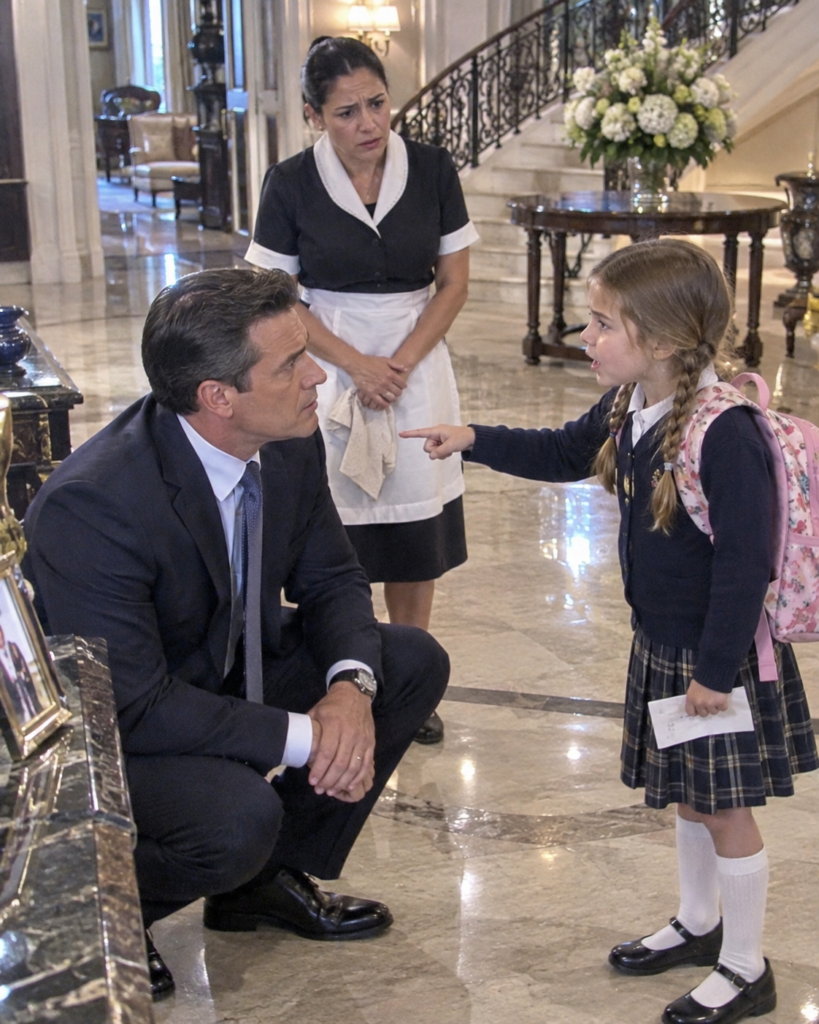
Past the hallway where Camila had once stood with a pink backpack hanging from one shoulder and accused me of breaking a promise I did not know had been made in my name.
I stopped at the bottom of the staircase.
Anne’s portrait looked down from the wall.
For years, I had measured responsibility by what I could provide.
Money.
Safety.
Opportunity.
Answers.
Now I understood responsibility could also mean asking questions before assuming everything was fine.
It meant allowing people to bring you unfinished problems.
It meant admitting ignorance before ignorance became neglect.
It meant building systems strong enough that doing the right thing did not depend entirely on one person’s character.
Most of all, it meant recognizing that trust wasn’t restored in a single grand gesture.
It returned in ordinary moments.
A paycheck arriving when promised.
A daughter admitting she could not fix everything.
A son asking for advice without fearing judgment.
A brother keeping a copy of a document.
An estate manager questioning an instruction.
A housekeeper speaking without worrying that honesty would cost her job.
A little girl believing an adult’s answer because experience had taught her she could.
My phone buzzed.
A message from Claire.
FAMILY DINNER SUNDAY. MY PLACE. YOU ARE NOT ALLOWED TO BRING WORK.
A second message arrived.
Daniel: OR FINANCIAL ADVICE.
Then Robert:
CAN HE BRING DESSERT?
Claire answered:
ONLY IF HE BUYS IT. WE ARE NOT EATING HIS COOKING.
I typed:
I HAVE STAFF WHO CAN—
Three dots immediately appeared from all three of them.
I deleted the sentence.
Then wrote:
Fine. I’ll buy dessert.
Claire responded with a heart.
I slipped the phone into my pocket.
The house was quiet.
But no longer lonely.
Before going upstairs, I noticed something on the small table beside the entryway.
Camila’s school speech.
She must have left the original after all.
I opened it once more.
The best promise is the one people can see you keeping.
I folded it and carried it to my office.
Not to lock it away.
Not to hide it inside a drawer where nobody would find it for seven years.
I placed it in a simple frame beside my desk.
The next morning, Naomi noticed it during our meeting.
“What’s that?”
“A reminder.”
“Of what?”
I looked at the childish handwriting behind the glass.
“That numbers tell you whether something was paid.”
Naomi waited.
I smiled.
“People tell you whether it mattered.”
And from then on, I tried harder to listen to both.