My husband and my mother had hated each other for 27 years.
At nearly every family gathering, their dislike was impossible to miss.
There were clipped answers.
Forced smiles.
Long silences.
And, eventually, one of them would find an excuse to leave the room.
But they never told me why.
For most of my marriage, I believed their feud was simply one of those family conflicts that had grown too old for anyone to remember how it started.
I was wrong.
The truth had been buried for 27 years.
And I discovered it at my mother’s funeral.
My husband, Joe, and my mother, Margaret, had disliked each other almost from the day they met.
Mom never called him “son.”
Joe once told me he would rather work on Christmas morning than spend another holiday at her house.
At family dinners, they barely spoke.
If one entered a room, the other often found a reason to leave.
Whenever I asked what had happened between them, I received the same answer.
“We just don’t get along.”
“We’re from different worlds.”
For years, I accepted that explanation.
Mom was a successful businesswoman. Joe had grown up in a poor family.
I assumed their different backgrounds had simply created a personality clash.
But I never cared about their differences.
They were both important to me.
I wanted them to find a way to tolerate each other.
Once, after an especially vicious argument, I heard Mom hiss at Joe:
“You know exactly what you did.”
Joe immediately went silent.
I looked from one to the other.
“What is she talking about?”
Neither answered.
That was the moment I should have pushed harder.
Instead, I eventually stopped asking.
Life continued.
Twenty-seven years passed.
Then my mother died at 78.
Her funeral was filled with relatives, old friends and people whose lives she had touched over the years.
I was overwhelmed by grief.
There were flowers everywhere.
Quiet conversations.
People telling stories about Mom.
I tried to stay with everyone, but at one point I noticed Joe had disappeared from the reception area.
I went looking for him.
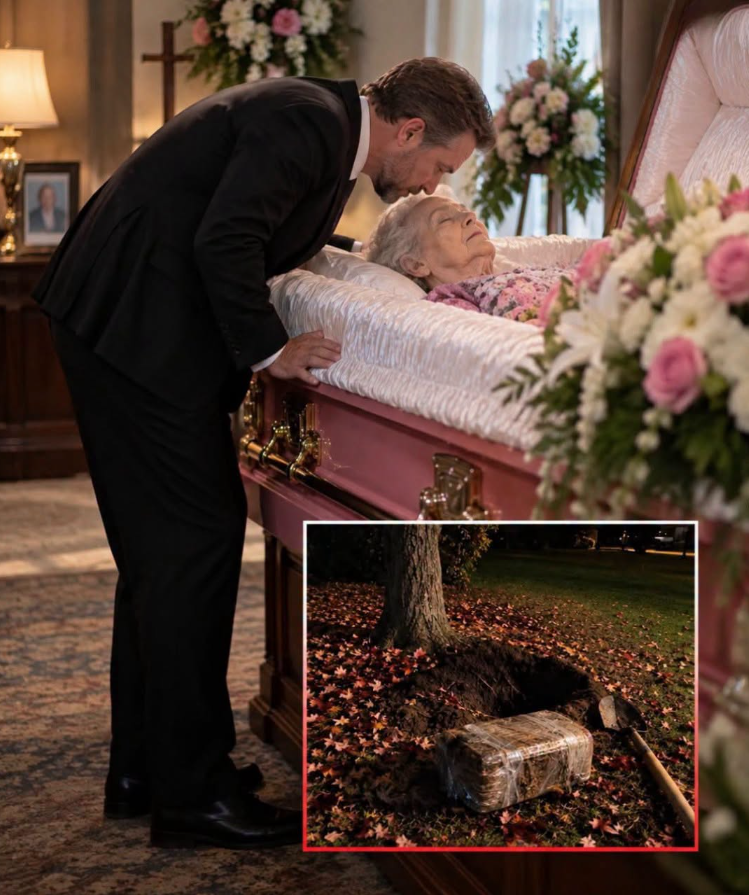
I found him alone beside my mother’s open coffin.
I stopped outside the doorway.
Then I heard him speak.
“I kept our secret, Margaret.”
My entire body went still.
Joe reached out and touched the edge of the coffin.
“No one ever found out,” he whispered.
My heart began pounding.
Then he said something that made my stomach tighten.
“It’ll stay buried under the red maple in your yard forever.”
I stepped backward before he could see me.
The red maple.
I knew exactly what he meant.
The tree stood behind my mother’s house.
Mom had planted it 27 years earlier, shortly after my daughter Emily was born.
She treated that tree almost like another child.
She wouldn’t allow landscapers to work too close to it.
When its roots cracked part of the walkway, she refused to move it.
Once, she nearly screamed at Emily for digging around its trunk with a toy shovel.
At the time, I thought Mom was simply sentimental.
But suddenly, everything about that tree felt different.
That night, after the funeral guests had gone home, I drove to Mom’s empty house.
I couldn’t stop thinking about Joe’s words.
The red maple stood behind the house beneath the pale light from the porch.
It looked enormous.
Older than I remembered.
I went into the garage and found a shovel.
Then I walked outside.
I began digging.
For twenty minutes, I found nothing but roots, damp soil and stones.
I started to wonder whether grief and suspicion had simply made me imagine something that wasn’t there.
Then the shovel struck something hard.
Metal.
I froze.
I dug more carefully.
Almost two feet beneath the tree, I uncovered a rusted metal container wrapped tightly in several layers of old plastic.
My hands began shaking.
I carried it onto the porch.
For a moment, I simply stared at it.
Then I opened the container.
What I found inside changed everything I thought I knew about my family.
There were hospital records.
A newborn bracelet.
Faded footprints.
A tiny pink hat.
And letters.
Letters exchanged between Joe and my mother.
I sat on the porch floor and began reading.
The hospital records were from the night Emily was born.
It had been an emergency delivery.
I had nearly died.
At the time, I remembered only fragments of that night—the fear, the pain, the doctors, the exhaustion.
I had been told that my baby had survived.
Emily was the daughter I brought home.
The daughter I raised.
The daughter who became the center of my life.
But the records contained something I had never been told.
I read one line.
Then I read it again.
And again.
Two female infants had been delivered.
One survived.
The other did not.
Emily had been a twin.
I had given birth to two daughters.
One had lived.
The other had died.
For nearly three decades, my husband and my mother had known.
And neither had told me.
I could barely breathe.
Then I opened the letters.
That was when I realized the secret was even more complicated than I had imagined.
Mom had initially agreed to keep the truth from me while I recovered.
The delivery had nearly cost me my life.
She believed I needed time.
But the letters showed that she eventually changed her mind.
Again and again, she urged Joe to tell me.
She wanted me to know that Emily had been born with a twin.
Joe refused.
Every time.
He claimed he was protecting me.
He told Mom that I had already suffered enough and that knowing another baby had died might destroy me.
But the letters continued.
Mom begged him to tell me.
Joe continued refusing.
Years became decades.
The secret became heavier.
And somewhere along the way, the two of them began blaming each other for carrying it.
Their resentment became the visible scar of a truth they had buried together.
I was still holding the documents when I called 911.
I didn’t know what to believe anymore.
The years of deception had made me question everything.
Was the hospital record real?
Had something else happened that night?
Why had they hidden an entire child from me?
Why had they buried the evidence?
And why had the red maple become so important to my mother?
When officers arrived, I explained what I had found.
Officer Ramirez contacted the hospital.
The records were confirmed.
There had been no mistake.
I had delivered twin girls that night.
The second baby had not survived.
There was no criminal conspiracy behind the birth record.
No secret adoption.
No insurance fraud.
No hidden financial arrangement.
The truth was heartbreaking, but simple.
I had lost a daughter before I ever had the chance to know her.
And the people closest to me had decided I couldn’t handle the truth.
When Joe arrived, I confronted him.
This time, there was nowhere left for him to hide.
I held the hospital records in my hands.
“Why?”
That was all I could say.
Joe finally admitted the truth.
His greatest fear had never been money.
It hadn’t been an attorney.
There wasn’t an insurance dispute.
No mortgage problem.
No secret investment.
No contested estate.
No court order.
There had been no legal reason to keep the truth from me.
He had simply been afraid.
Afraid that if I learned our baby had died, I would never recover.
Afraid that the grief would destroy our marriage.
And, eventually, afraid that admitting the truth after so many years would be even worse than the original decision.
“I thought I was protecting you,” he said.
But I couldn’t accept that explanation as an excuse.
He had made a decision for me.
Then he had repeated that decision every year for 27 years.
Mom had eventually wanted me to know.
Joe had refused.
And both of them had allowed the secret to grow until it became part of their relationship.
I told Joe to leave.
Not because I didn’t understand his fear.
I did.
But understanding why someone hurt you doesn’t erase the damage.
An apology couldn’t give me back the 27 years I had lost.
It couldn’t give me the chance to grieve my daughter when I should have.
It couldn’t change the fact that I had spent almost three decades believing Emily was my only child.
Two days later, I sat in Mom’s kitchen with Emily.
She was 27 years old.
I placed the tiny pink hat on the table.
Then I told her the truth.
She stared at it for a long time.
Her face changed as the reality settled in.
She had grown up believing she was an only child.
Now she learned that she had once had a twin sister.
Her first question wasn’t about the secret.
It wasn’t about Joe.
It wasn’t even about why the family had hidden the truth.
She asked one simple question.
“Did she have a name?”
I looked down at the records.
Nothing in the box suggested that the baby had ever been given one.
So Emily and I made the decision together.
We gave her one.
Anna.
For the first time, the baby who had existed only in old medical records became more than a line on a page.
She had a name.
Anna.
We also began to understand the red maple differently.
For years, I had thought Mom’s attachment to that tree was simply sentimental.
But now I wondered whether it had always been something more.
She had planted it shortly after Emily’s birth.
She had protected it fiercely.
She had refused to let anyone disturb the ground around it.
Perhaps the tree had become her private memorial.
A place where she could remember the granddaughter she had never been able to openly acknowledge.
The secret had been buried there.
But so had her grief.
And perhaps, in her own way, Mom had been visiting that memory every time she stood beneath the branches.
Joe and I remain separated.
Emily still speaks with him, but their relationship has changed.
There are questions between them now.
Questions that may never have simple answers.
As for Michael—no.
There was no Michael.
There was only Anna, the daughter I never knew long enough to hold.
And there was the family I thought I understood until one whispered sentence at a funeral forced me to look beneath the surface.
Last Sunday, Emily and I went outside together.
We stood beneath the red maple.
For a long time, neither of us said anything.
Then we planted white flowers beneath the tree.
Emily pushed her hands into the soil.
I watched her.
And for the first time, nobody told her to stop.
No one warned her to leave the roots alone.
No one told her there were things buried there that she wasn’t supposed to know.
We simply stood together.
Mother and daughter.
Remembering another daughter.
A sister.
Anna.
The red maple had guarded a secret for 27 years.
But it also guarded a place where grief had quietly lived for all those years.
My mother had believed silence was a form of protection.
Joe had believed secrecy was the only way to keep me safe.
They were both wrong.
Because grief does not disappear when you hide it.
It simply waits.
And sometimes, the truth you fear will break you is actually the truth you need in order to finally heal.