PART 1 — The Garden They Called an Eyesore
The letter arrived on a Tuesday morning.
I was washing my father’s coffee pot at the kitchen sink when I heard him open the envelope. The paper rustled once, and then the room fell strangely quiet.
Dad sat at the kitchen table, his reading glasses resting halfway down his nose, staring at a single sheet of paper. He read it, turned it over, checked the blank back, and read the front again.
“Dad? What is it?”
Instead, he placed the letter on the table and carefully flattened it with both palms, just as he pressed soil around a newly planted seed.
“Says here,” he finally said, “I’ve got unmaintained agricultural use in a residential zone.”
I stared at him.
“What?”
He pushed the letter toward me.
It came from the county’s Code Enforcement Division. There was an official seal, a case number, and several paragraphs of formal language.
The message was simple.
Someone had complained about my father’s vegetable garden.
An inspector would visit on Thursday, August 14, and if the property violated County Ordinance 14-207, Dad could be ordered to remove part of it.
I read the notice twice.
Then I looked through the kitchen window.
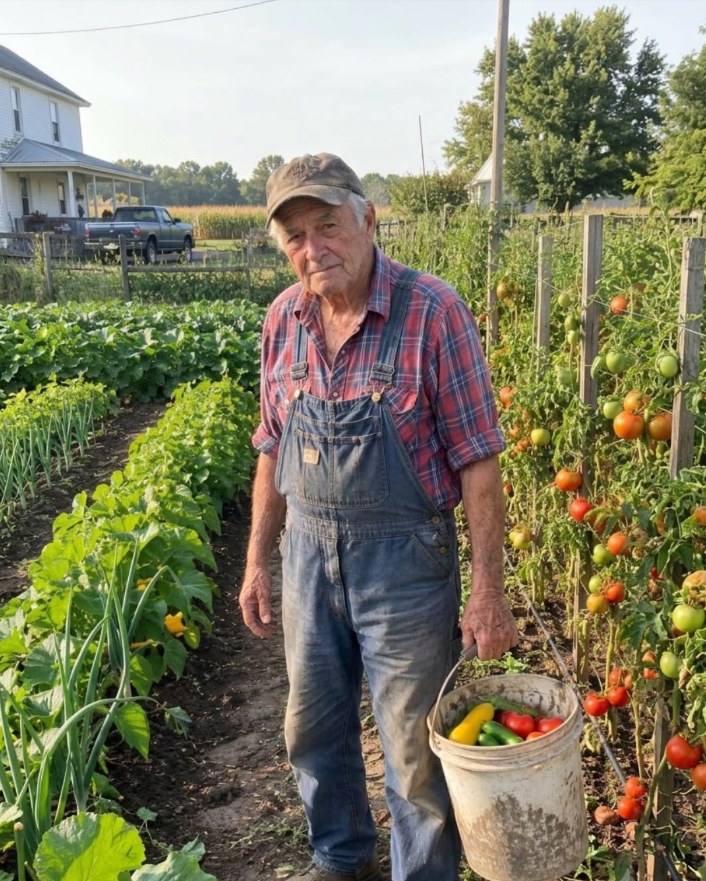
Beyond the back porch and clothesline, past the old red shed, stretched the garden my father had tended for decades.
Half an acre of vegetables.
Nine rows of green beans climbing handmade strings.
Nearly three hundred tomato plants supported by stakes and cages.
Potatoes, squash, onions, beets, carrots, and cucumbers.
Two long rows of sweet corn, already taller than I was.
And along the edge, the strawberry patch my mother had planted thirty years earlier.
There wasn’t a weed anywhere.
My father sometimes went outside before sunrise to pull weeds so small most people wouldn’t have noticed them.
“Unmaintained?” I repeated.
Dad shrugged.
“That’s what they say.”
“Dad, this is probably the best-maintained garden in the entire county.”
He removed his glasses and slipped them into his shirt pocket.
“Well,” he said, “somebody sees it differently.”
My father’s name is Arne Lindqvist.
He was seventy-nine years old, born in 1947 in the same house where he still lived. His father had been born on that land before him.
Dad spent thirty-four years working at the local paper mill. When it closed, he drove a school bus for another twelve years.
After retirement, he devoted himself to the one thing he’d always loved.
Growing things.
My mother, Marta, had died three years earlier.
Pancreatic cancer took her just four months after her diagnosis. She and Dad had been married for fifty-one years.
I expected him to give up the garden after losing her.
I even thought he might sell the house and move into a senior apartment closer to town.
Instead, the garden grew larger.
Dad lived alone and barely ate enough to justify cooking. Oatmeal for breakfast, a sandwich at lunch, and perhaps fish and potatoes for dinner.
Yet every summer, he grew enough vegetables to feed dozens of families.
A couple of years earlier, I’d asked him about it.
“Dad, who are all those beans for?”
He’d been kneeling beside a tomato plant, tying its stem to a stake with a strip of old bedsheet.
“People,” he answered.
Nothing more.
I assumed he gave vegetables to neighbors or brought them to church.
I never pressed him.
Looking back, I wish I had.
Because the garden wasn’t the only thing I didn’t understand.
Our new neighbor was named Brent Hollis.
He’d moved into the old Swenson property the previous spring.
The Swensons had lived beside my parents for forty years. Mr. Swenson had even taught me to ride a bicycle on the gravel road between our houses.
After he died, his children sold the property.
The old white farmhouse was demolished, and Brent built an enormous modern house in its place.
Gray siding. Black window frames. A three-car garage. A flawless green lawn.
And a second-floor deck overlooking my father’s entire garden.
Whenever I visited on Sunday mornings, Brent seemed to be standing on that deck with a coffee mug, staring down at the vegetables.
He particularly disliked the corn.
At seven feet tall, it blocked much of his view of the valley.
“He doesn’t seem too fond of your garden,” I told Dad once.
Dad barely looked up.
“Takes all kinds.”
I’d met Brent only once before the complaint.
It was June, and I was helping Dad harvest the first strawberries.
Brent appeared on his deck.
Dad straightened, wiped his hands on his overalls, and approached the fence.
“Morning,” he called.
“Morning,” Brent replied.
“Arne Lindqvist. Been meaning to welcome you to the neighborhood.”
“Brent Hollis.”
Dad lifted a small green basket filled with fresh strawberries.
“First ones of the season. My wife planted these. Best strawberries in the county. You’re welcome to them.”
Brent examined the basket, then my father’s clothes, then the rows of vegetables.
“No, thanks. I’m not big on fruit.”
Dad lowered the basket.
“Well, the offer stands. Tomatoes will be ready in July. Beans in August. Just holler.”
Brent nodded and disappeared into his house.
I watched the glass door close.
“That was rude,” I muttered.
“He was busy,” Dad said.
“He was standing on his deck doing absolutely nothing.”
“Maybe he was busy thinking.”
Dad returned to the strawberries.
“Man’s allowed to think.”
That was my father.
He could find something generous to say about almost anyone.
But when the county letter arrived, I had no doubt who’d complained.
“It’s Brent,” I said angrily. “Nobody else can even see this garden. He’s been staring at your corn all summer.”
Dad remained silent.
“He moved here five months ago, and now he thinks he can tell you what to do with land that’s been in our family for a century?”
“County says he can.”
“The county is wrong.”
I grabbed my phone.
A coworker knew a property attorney named Doug Pratt. I was ready to call him immediately.
“Kristin,” Dad said.
I kept searching for the number.
“Kristin.”
Something in his quiet voice made me stop.
“Let’s hear what the inspector has to say first.”
“They’re going to make you tear it out!”
“Maybe. Maybe not.”
“How are you so calm?”
Dad looked toward the garden.
“Been growing things for seventy years,” he said. “You learn that some things can’t be rushed. Plant the seed. Wait. See what comes up.”
I wrote Doug Pratt’s name and telephone number on the back of the county envelope anyway.
Just in case.
Thursday morning, I took time off from my job as a dental hygienist in Cedar Falls and drove to Dad’s house before seven.
He was already outside, picking beans.
“The inspector’s coming at nine,” I reminded him.
“I know.”
“Maybe you should change into a clean shirt.”
He looked down at his faded blue work shirt.
“What’s wrong with this one?”
“Nothing, Dad.”
I sat on the porch with my coffee and watched him work.
The rising sun turned the garden golden. Bees moved between squash blossoms, and a robin searched for worms near the bean rows.
It was beautiful.
And someone had called it a public nuisance.
At 8:55, a small white county vehicle pulled into the driveway.
The inspector was a young man named Tyler Ostrowski, perhaps twenty-seven, with glasses, short hair, and a clipboard.
He was polite.
He shook our hands and addressed Dad as “sir.”
“Mr. Lindqvist, thanks for meeting with me. Sorry to bother you.”
“No bother,” Dad replied. “Want some coffee?”
Tyler seemed surprised.
“No, thank you.”
He spent the next half hour walking around the garden.
He photographed the rows, measured the cultivated area, and made notes.
Dad followed quietly.
I stayed close behind, prepared to argue.
At the tomatoes, Tyler stopped.
He studied the hundreds of carefully supported plants.
“Sir, how much time do you spend maintaining this?”
Dad considered the question.
“Six or seven hours a day.”
“Every day?”
“Every day God gives me.”
Tyler wrote something down.
Then he glanced toward Brent’s house.
When we returned to the porch, his expression had changed.
“Mr. Lindqvist, I’m sorry,” he began. “But the ordinance requires a special permit for agricultural use exceeding a quarter acre in an R-2 residential zone.”
“My father’s been growing vegetables here his whole life,” I said.
“I understand. But the zoning changed in 2019. Existing gardens were allowed to continue unless a formal complaint triggered review.”
“And somebody complained,” Dad said.
Tyler nodded.
“I have to issue a notice of violation. You’ll have thirty days to bring the property into compliance.”
“What does that mean?” I demanded.
“You’ll need to reduce the cultivated area below a quarter acre, remove the excess planting, or obtain a special permit.”
“How long does a permit take?”
“Usually around six months. And the fines could accumulate while the complaint remains open.”
I felt my face grow hot.
“You’re telling a seventy-nine-year-old man to destroy half a garden he’s spent his entire life maintaining?”
Tyler looked miserable.
“I’m sorry.”
I was ready to say much more.
Then Dad rested one hand on my arm.
I stopped.
He stood, his knees cracking, and approached the inspector.
“Thank you for coming out,” Dad said, offering his hand. “I know you’re doing your job.”
Tyler shook it.
“Thank you, sir.”
Dad held on for another moment.
“Would you do me one favor before you make your final decision?”
“If I can.”
“Come back Saturday morning. Six o’clock.”
Tyler blinked.
“This Saturday?”
“This Saturday.”
“Can I ask why?”
Dad looked toward the garden.
“There’s something I want you to see.”
Tyler hesitated, then nodded.
“All right. Six Saturday morning.”
After the inspector left, I turned to Dad.
“What happens Saturday?”
He picked up his bucket.
“Saturday’s Saturday.”
And he returned to his beans.
That evening, I made a decision of my own.
I walked next door.
Brent answered wearing a golf shirt and khakis, holding a glass of wine.
“Can I help you?”
“I’m Kristin Lindqvist. Arne’s daughter.”
His expression shifted slightly.
“You filed the complaint against my father’s garden.”
“Yes,” he said. “Through the proper channels.”
“Why?”
“Because it’s an eyesore. I paid a lot of money for this house. I didn’t pay to look at a farm.”
“It’s a vegetable garden. And it’s been here longer than your house.”
“The zoning laws are clear.”
“You could’ve spoken to him.”
“I don’t need to. That’s what the county is for.”
I thought about Dad standing at the fence with his basket of strawberries.
“He tried to welcome you,” I said. “He offered you strawberries my mother planted before she died.”
Brent’s expression hardened.
“Look, I see his truck leaving before sunrise every week. He loads boxes into it. That’s not a hobby. He’s probably selling produce without a license.”
I stared at him.
“You don’t know anything about my father.”
“I don’t need to.”
He closed the door.
When I returned, Dad was sitting on the porch, shelling peas.
“Well?” he asked.
“He thinks you’re running some kind of illegal vegetable business.”
Dad laughed.
A genuine laugh.
I hadn’t heard him laugh like that since before Mom died.
“An operation,” he said. “That’s a good one.”
“It’s not funny.”
“Little bit funny.”
Then I mentioned the truck.
“He says you leave early every Friday with boxes of vegetables.”
Dad’s hands paused.
“Where do you go on Fridays?” I asked.
He split another pea pod.
“You’ll see.”
“Dad.”
“Saturday,” he said. “Everybody will.”
I spent that night in my childhood bedroom.
At 4:15 Friday morning, a truck engine woke me.
I went to the window.
Dad was loading banana boxes into his old green pickup.
Eleven boxes.
Tomatoes, beans, potatoes, and squash.
He secured a tarp over them, checked the ropes, and drove away into the darkness.
He returned around nine-thirty with an empty truck bed.
He came into the kitchen, washed his hands, and poured coffee as though nothing unusual had happened.
“Morning,” he said.
I stared at him.
“Morning.”
He blew across his coffee.
“Get some sleep tonight,” he advised. “Big day tomorrow.”
I still didn’t understand.
But by Saturday morning, everything I thought I knew about my father was about to change.
PART 2 — The People Who Came at Six
I set my alarm for five Saturday morning.
I was awake at four-thirty.
Not his usual little pot.
It sat on the counter, steaming.
“People,” Dad replied.
That word again.
He took his bucket and went outside.
The morning was wrapped in thick fog.
I could barely see the corn beyond the porch. Everything farther away dissolved into white.
Dad was a faint shape among the bean rows, already working.
At 5:55, Tyler’s county car appeared through the mist.
He parked near the driveway and walked toward the porch wearing a jacket over his sweatshirt.
“Morning,” he said. “I’m here.”
I offered him coffee.
This time, he accepted.
“Where’s your father?”
I pointed toward the garden.
“And what exactly am I supposed to see?”
“I wish I knew.”
Across the fence, Brent was already on his deck.
He wore a dark blue bathrobe and held his usual coffee mug.
When he spotted Tyler, he lifted the mug slightly, almost like a toast.
Tyler ignored him.
Then, precisely at six, headlights appeared down Ridge Road.
An old red Ford pickup pulled onto the shoulder.
A white Chevrolet followed.
Then a blue Dodge with a cracked windshield.
A brown Corolla.
A station wagon.
A minivan.
More vehicles kept coming, their headlights emerging one after another from the fog.
I began counting.
Eleven.
Fourteen.
Seventeen.
They parked in a long line beside the road.
Doors opened.
People climbed out.
An elderly man in suspenders and a feed-store cap.
A young mother with a baby strapped against her chest and a toddler holding her hand.
A man wearing a Walmart vest.
Two teenage boys carrying a laundry basket.
A woman in medical scrubs.
An elderly lady leaning on a cane.
A man with a prosthetic leg.
Families with children still wearing pajamas beneath their jackets.
Every person carried something.
An empty grocery bag.
A bucket.
A cardboard box.
A basket.
A little red wagon.
They greeted one another softly and walked up the driveway.
Then they entered my father’s garden.
Without instructions.
Without confusion.
As though they’d done it a hundred times before.
The elderly man went to the potatoes.
The teenage boys headed straight for the corn.
The woman in scrubs began picking tomatoes.
The young mother settled near the strawberry patch while her toddler gathered berries and ate half of them.
The woman with the cane walked toward Dad.
He straightened, greeted her warmly, and handed her his already-full bucket of beans.
He’d been picking them for her.
Tyler stood motionless beside me.
His pen hovered above the clipboard.
“What is this?” he whispered.
I couldn’t speak.
The answer was unfolding right in front of me.
All those vegetables.
All those early mornings.
All those hours Dad spent on his knees.
Who are all those beans for?
People.
My eyes filled with tears.
Nobody was taking too much.
Each person gathered what they needed and left the rest.
There were no prices.
No cash register.
No signs asking for payment.
Just people helping themselves to food my father had grown.
I looked up at Brent.
His coffee mug was no longer raised.
He gripped the railing and stared at the garden below.
Then one final vehicle appeared.
A silver minivan.
It drove slowly to the end of the line and stopped.
For a moment, nobody emerged.
Then the driver’s door opened.
A small elderly woman stepped out.
She was about seventy, with gray hair clipped back, a loose tan raincoat, and worn white sneakers.
She carried two faded cloth grocery bags.
She walked slowly up the driveway, keeping her eyes lowered.
There was something hesitant about every step.
Halfway up, she looked toward the garden.
Then beyond it.
Toward Brent’s deck.
She stopped.
One grocery bag slipped from her arm and fell onto the gravel.
She didn’t reach for it.
She simply stared.
On the deck, Brent slowly lowered his coffee mug.
His face changed.
He disappeared into the house.
Moments later, he came hurrying around the side, barefoot in his bathrobe.
He crossed his immaculate lawn, stepped over the low corner of the fence, and pushed through the corn.
He stopped several feet from the woman.
“Mom?”
Her face crumpled.
“Brent,” she whispered. “What are you doing here?”
“I live here.”
He pointed toward the gray house.
“That’s my house.”
She looked up at it.
“I didn’t know,” she said. “You never told me exactly where. You never invited me.”
Brent stared at her.
“What are you doing here?”
She looked down at the empty grocery bags.
She couldn’t answer.
She didn’t have to.
Brent glanced toward the people harvesting vegetables.
Then back at his mother.
“No,” he whispered.
“Brent—”
“You’re here for food?”
She lifted her chin.
“Every Saturday,” she answered. “For a year and a half.”
He stepped backward.
“Why? Mom, I send you money.”
“You send me two hundred dollars a month,” she said. “And I’m grateful, honey. I truly am.”
“Then why are you here?”
“Because my pension is eleven hundred dollars. My rent is eight hundred. My heart medicine costs three hundred and forty after insurance.”
Her voice trembled.
“Then there’s electricity, the phone, and car insurance. It doesn’t add up, Brent. It hasn’t added up since your father died.”
“You should’ve told me.”
“How could I?”
Tears began rolling down her cheeks.
“You worked so hard to escape the life we had. You went to college, worked two jobs, built your company. You were so proud of that new house and your new car.”
She pressed the grocery bags against her chest.
“I didn’t want to drag you back into the old days.”
“Mom, you’re my mother.”
“I know. But I didn’t want you remembering our empty cupboards every time you looked at me.”
Brent stood barefoot on the gravel.
His mouth opened, but no words came.
By then, Dad had approached from the garden.
The woman noticed him.
“Arne,” she said tearfully. “I’m sorry. I didn’t know he was your neighbor.”
“Morning, June,” Dad replied. “Nothing to apologize for.”
Brent turned sharply.
“You know my mother?”
“She’s been coming every Saturday for a year and a half,” Dad said. “Likes yellow squash and the little red potatoes. Says they remind her of what her mother used to grow.”
June laughed weakly through her tears.
Brent stared between them.
“I reported this garden,” he said.
“I know,” Dad answered.
“I tried to get the county to make you tear it out.”
“I know that too.”
“And you knew my mother came here?”
“Didn’t know she was your mother. I just knew she was June, a widow living near the Dollar General who liked yellow squash.”
Dad lowered his bucket.
“People don’t have to explain who they are to get a bag of beans.”
Brent looked around at the garden.
At the people picking food.
At his mother’s empty bags.
He seemed to shrink.
Then he sat down on the driveway.
Right there in his expensive bathrobe.
He buried his face in his hands.
June approached him and gently touched his hair.
“Honey,” she whispered. “It’s okay.”
“No,” he said. “It isn’t.”
The garden had grown quiet.
People stopped working and watched from between the rows.
Brent lifted his head.
“When I was a kid,” he began, “we lived in a trailer on County Road 9.”
His voice was rough.
“My father drove a delivery truck until he injured his back. After that, he couldn’t work. My mother grew vegetables because we couldn’t afford enough food.”
June closed her eyes.
“She made me pick beans every summer. Hours in the heat. I went to school with dirt under my fingernails, and the other kids called me Bean Boy.”
He gave a bitter laugh.
“Six years. Bean Boy. Because we ate beans all the time. Green beans, beans and rice, even bean sandwiches.”
He looked at his house.
“I promised myself I’d never be poor again. Never have dirt under my nails again. Never let anyone look at me and see that trailer.”
His eyes returned to Dad.
“So I built that house. And every morning, I’d stand on the deck and look down at your garden.”
He swallowed.
“All I saw was County Road 9. My mother’s garden. The empty cupboards. Everything I spent my life trying to escape.”
His shoulders shook.
“And she was here the whole time. Getting food from the very garden I wanted destroyed.”
Nobody moved.
Then Dad slowly lowered himself onto the gravel beside Brent.
His knees cracked loudly.
For a while, they sat together without speaking.
Finally, Dad said, “In 1982, the paper mill laid off two hundred workers.”
Brent looked at him.
“I was one of them.”
Dad nodded toward me.
“I had a wife and a five-year-old daughter. A mortgage. No job. Every mill in the valley was cutting workers.”
He rubbed his dirt-stained hands.
“That winter was terrible. One week, all we had left was crackers and peanut butter.”
I felt my throat tighten.
“Marta would give Kristin part of her own food and pretend she’d already eaten.”
I didn’t remember.
I had been too young.
“One morning,” Dad continued, “I opened the front door and found a box on the porch.”
He looked down.
“Potatoes. Onions. Canned beans. Tomatoes. Flour. A whole ham.”
There had been a note.
From the neighbors. Pass it on.
“Another box came the next Friday,” Dad said. “And the next. Every week until I found work again in May.”
“Who brought them?” Brent asked.
“Never found out. Marta thought it was the Swensons.”
He pointed toward Brent’s property.
“They lived where your house stands now. Good people. Quiet people. Old Mr. Swenson would’ve denied it if we’d asked.”
Dad smiled faintly.
“But Marta made me promise something when I found work again.”
He paused.
“She said, ‘Arne, we’re going to pass it on. As long as we live. We’re never letting anybody on this road open their cupboards and find nothing.’”
He gestured toward the garden.
“So she made it bigger.”
Every year, they planted more.
Every Saturday, anyone who needed food could come and take vegetables.
No forms.
No questions.
No judgment.
Every Friday before sunrise, Marta delivered boxes to people who couldn’t come.
The elderly.
The disabled.
The sick.
And those who were too embarrassed to ask.
“For forty years,” Dad said. “She kept it going.”
His voice grew unsteady.
“Then she got sick.”
He stared at his hands.
“The last thing she ever said to me was, ‘Arne. The Fridays. Don’t you dare stop the Fridays.’”
A long silence followed.
“So I didn’t,” he whispered.
I was crying openly.
Forty years.
My mother had spent forty years feeding people in secret.
And I had never known.
I’d left home for college, built my own life, and returned for holidays and occasional visits.
I’d seen the garden.
I’d eaten its vegetables.
But I’d never truly asked what it meant.
Tyler placed his clipboard on the porch railing.
“How many families?” he asked.
Dad thought for a moment.
“About forty on Saturdays. Sometimes more. Eleven houses on Fridays. Anything left goes to the food pantry at St. Luke’s.”
“Forty families?”
“Give or take.”
Tyler looked across the garden.
Then he picked up his clipboard.
He stared at the violation notice for several seconds.
Carefully, he tore the half-completed sheet from the pad.
He folded it and placed it in his pocket.
“Mr. Lindqvist,” he said, “the complaint describes unmaintained agricultural use.”
Dad nodded.
“That’s what it said.”
“Well, in my professional opinion, this is the most carefully maintained property I’ve ever inspected.”
Tyler swallowed.
“I don’t see an unmaintained-property violation here. I’ll document that finding. And I’ll help you apply for the proper community garden exemption.”
Dad looked up.
“Thank you, son.”
Tyler shook his head.
“My grandmother used to receive vegetables from somebody like you. I never knew who brought them.”
His eyes shone.
“I’ll find out what paperwork you need. I’ll walk it through the county myself.”
Brent stood.
He wiped his face with his sleeve and turned toward Tyler.
“I want to withdraw my complaint,” he said. “Officially. Whatever I need to sign.”
“I’ll bring the form Monday,” Tyler replied.
Brent faced my father.
“Mr. Lindqvist, I’m sorry. I don’t know what else to say.”
Dad looked up from the gravel.
“Help me stand. My knees aren’t what they used to be.”
Brent immediately reached down.
He helped Dad to his feet and steadied him until he could stand on his own.
“Thank you,” Dad said.
Brent’s voice broke.
“Is there anything I can do?”
Dad studied him for a moment.
Then he bent, picked up his dented metal bucket, and held it out.
“Beans are on the left. Nine rows. Your mother likes squash, but she could use beans too.”
Brent stared at the bucket.
“Pick from the bottom up,” Dad added. “The ones near the ground are ready first.”
For a moment, Brent didn’t move.
I could almost see the memories passing through him.
The trailer.
The schoolyard.
The cruel nickname.
The dirt he had scrubbed from his hands as a boy.
Then he reached out.
He took the bucket.
“Bottom up,” he repeated quietly.
“Bottom up,” Dad said.
And Brent Hollis walked into my father’s garden.
Barefoot.
Still wearing his expensive blue bathrobe.
He knelt beside the first row of beans.
And for the first time in thirty years, he began picking them.
His mother stood nearby, crying silently.
Around them, the others returned to their work.
The fog slowly lifted.
Sunlight spread across the corn and tomatoes, turning the entire garden gold.
I walked down from the porch and put my arm around Dad.
“You could’ve told me,” I whispered.
“About your deliveries. About Mom. About all of this.”
“You never asked.”
“I did ask once. I asked who all the beans were for.”
Dad glanced at me.
“And what did I say?”
“People.”
“Well,” he replied, “that was the answer.”
I laughed through my tears.
Then I told him about the lawyer.
“I was going to fight the county. I was ready to take Brent to court.”
“I know.”
“Why didn’t you let me?”
Dad watched Brent picking beans.
“Lawyer might’ve found a way to win,” he said. “But Brent would’ve spent the rest of his life standing on that deck hating this garden.”
He shook his head.
“A lawyer can stop a man from complaining. Can’t make him stop hurting.”
He nodded toward the bean rows.
“Sometimes you’ve got to let people see the whole thing. Then they decide what kind of person they want to be.”
“What if he still wanted the garden gone?”
Dad shrugged.
“Then we’d have called your lawyer.”
I laughed again.
He smiled.
“But your mother always said most people aren’t mean. Most are just afraid of something they haven’t really looked at.”
That morning, I finally understood.
Dad hadn’t invited Tyler back to win an argument.
He’d invited him to see what the garden was really growing.
And it wasn’t just vegetables.
PART 3 — What My Mother Passed On
The following Friday, I rode with Dad.
My alarm rang at 3:45 in the morning.
When I came downstairs, he was already packing vegetables into banana boxes.
Eleven boxes.
“You coming?” he asked casually.
Like he’d been expecting me all along.
“I’m coming.”
He showed me how to arrange everything.
Potatoes at the bottom.
Squash above them.
Then beans.
Tomatoes on top, cushioned with newspaper so they wouldn’t bruise.
We loaded the pickup together.
The sky was still dark when we pulled away.
Dad waited until we reached the main road before switching on the headlights.
“Don’t want to wake the neighbors,” he explained.
Our first stop was a little blue house on Elm Street.
A ninety-one-year-old man named Walt lived there.
He couldn’t drive anymore and needed a walker to move around.
Dad carried a box to the porch and set it beside the door.
He didn’t knock.
He tapped twice on the window.
A light came on inside.
An elderly hand appeared behind the glass and waved.
“Walt’s been getting vegetables for nine years,” Dad told me. “Since his wife passed. Marta brought him a pie after the funeral, and he cried so hard she kept coming back.”
We continued to a trailer park.
A young woman named Dee lived there with three children while her husband was hospitalized.
Then an apartment building where four elderly residents shared the same floor.
Dad climbed three flights of stairs carrying a box.
He was breathing hard when he came down.
“I’m carrying the next one,” I told him.
He didn’t argue.
Our next stop was a small house with a wheelchair ramp.
A man named Curtis waited on the porch.
He’d lost both legs in Afghanistan.
He was holding a thermos of coffee.
“Arne,” he called. “Who’s this?”
“My daughter. Kristin.”
Curtis looked at me.
“Your mother used to bring me peach pie every August. When the peaches were good.”
His expression softened.
“I miss her.”
“So do I,” I whispered.
We visited seven more houses before stopping at St. Luke’s.
Sister Rosemary met us at the church kitchen and embraced Dad.
“You’re a saint, Arne.”
“Oh, hush,” he said.
We unloaded the remaining boxes.
By then, sunrise was turning the hills pink and gold.
I thought we were going home.
But Dad took another road.
He drove up the hill behind the church and turned into the cemetery.
He parked beneath a large oak tree.
Then he reached behind the seat and retrieved a small paper bag.
I followed him through the wet grass.
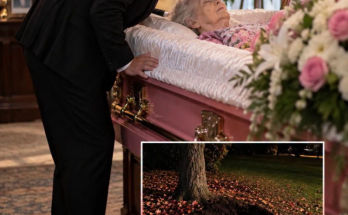
We stopped at my mother’s grave.
The headstone read:
MARTA ELISE LINDQVIST
1949–2023
SHE PASSED IT ON.
I’d visited that grave many times.
Somehow, I’d never really noticed the final words.
Dad opened the bag.
Inside was a single tomato.
Large.
Red.
Perfect.
The finest one from the garden.
He placed it carefully on top of the headstone.
“Eleven houses this week, Marta,” he said.
He stood quietly for a moment.
“And St. Luke’s. Forty-two families on Saturday. That’s a record.”
My eyes filled again.
“The neighbor’s going to be all right,” Dad continued. “June’s boy. He’s coming around.”
He rested his palm against the stone.
“You’d like him, I think. Once he lets you.”
Then his voice dropped.
“I haven’t missed a Friday.”
He swallowed.
“Not one.”
He stood there a little longer.
Then he turned and walked back toward the truck.
I remained beside Mom’s grave.
I touched the tomato once.
And followed him home.
That was a year ago.
Since then, almost everything has changed.
Tyler Ostrowski helped Dad secure the community garden permit in six weeks instead of six months.
He personally guided the paperwork through the county offices.
The garden now has an official name.
The Marta Lindqvist Community Garden.
Tyler made the wooden sign himself in his garage.
It stands beside the driveway.
He visits most Saturdays with his girlfriend, and they pick tomatoes for her grandmother.
Brent withdrew his complaint the following Monday.
But he didn’t stop there.
In October, construction workers arrived at his gray house.
At first, I worried he was building a taller fence.
Instead, they tore up half of his immaculate lawn.
Brent came to Dad’s back door.
“I want to make the garden bigger,” he said. “On my side of the property. If that’s okay.”
Dad stared at him.
“My mother thinks we could plant pole beans along the fence,” Brent continued. “She says we’d double the yield. And she’s got some pretty strong opinions about squash.”
Dad looked toward the torn-up grass.
“Your mother’s right about squash,” he said.
They built a gate between the properties that autumn.
Brent insisted on doing the work himself.
He wasn’t particularly good with tools.
It took three weekends, and he hit his thumb with the hammer more times than I could count.
But eventually, there was a wooden gate with an iron latch.
It hung a little crooked.
Dad loved it.
“That’s how you know somebody made it by hand,” he said.
June moved into Brent’s house in November.
She resisted at first.
She didn’t want to be a burden.
She said she liked her apartment near the Dollar General.
Brent kept asking.
“Mom, I’ve got four empty bedrooms. And a garden that needs somebody who knows what they’re doing.”
She finally agreed.
By Thanksgiving, she was living in a bedroom overlooking the vegetables.
Every morning now, Brent and June stand together on the deck.
He drinks coffee.
She drinks tea.
They point at the garden and debate where the tomatoes should go next spring.
Neither of them frowns at it anymore.
Brent also began joining Dad on the Friday deliveries.
Not every week.
He still had his business and sometimes traveled.
But most Fridays, around 3:45 in the morning, he’d arrive in jeans and a sweatshirt.
He drove the truck.
Dad sat beside him and gave directions.
Brent carried the heavy boxes.
All three flights of stairs when necessary.
Dad finally let someone else do the lifting.
They talked during those drives.
About gardening.
About the old paper mill.
About County Road 9.
About Brent’s father and the injury that had changed their family’s life.
And about Marta.
“He’s a good boy,” Dad told me one afternoon.
“Just took him a while to stop running.”
In May, my father turned eighty.
A couple of months earlier, he’d suffered a heart problem.
Doctors placed a stent, and he spent four days in the hospital.
He complained about only one thing.
Nobody was home to plant his peas.
But he was wrong.
Brent planted them.
So did June.
And Tyler.
And the teenage brothers, Marcus and Devon.
And Ashley, the young mother who came on Saturdays with her children.
Even Curtis helped from his wheelchair, giving instructions from the end of the rows.
They planted peas, beans, onions, and potatoes.
They prepared the tomato cages.
They tied the climbing strings.
They worked until every row was ready.
When I brought Dad home from the hospital, he stepped onto the back porch and stopped.
The garden lay before him.
Freshly turned soil.
Straight rows.
Small green shoots.
Everything cared for.
He stood there for a long time.
“Well,” he whispered. “Would you look at that.”
I put my hand on his arm.
“You’ve got help now, Dad.”
He nodded slowly.
“I see that.”
He lowered himself into his old metal lawn chair.
I sat beside him.
“Your mother worried about this,” he said after a while.
“About what?”
“Who’d keep it going after we were gone.”
He looked across the garden.
“I told her I’d figure something out.”
Then he chuckled.
“Never figured it’d be the fellow who tried to tear it out.”
This morning was another Saturday.
I arrived at five-thirty.
I come every Saturday now.
Every single one.
I bring a second coffee urn because Mother’s old thirty-cup pot isn’t enough anymore.
The valley was covered in the same soft fog as that first Saturday.
At six, headlights appeared along Ridge Road.
One vehicle.
Then another.
Then another.
I counted.
Twenty-three cars.
A new record.
People emerged carrying bags, boxes, buckets, and baskets.
They walked into the garden as the sun began to rise.
June was gathering yellow squash.
Naturally.
She still preferred the little red potatoes to the big ones.
Tyler was helping his girlfriend pick tomatoes.
Ashley was in the strawberry patch with her little girl, who seemed determined to eat more berries than she collected.
At the far end of the beans stood my father.
Eighty years old now.
His old dented bucket in one hand.
He moved more slowly than before.
Sometimes he needed to stop and rest.
But he was still there.
Still tending the rows.
Still making sure everyone had enough.
And in the next row, kneeling beside him, was Brent.
He wore faded jeans with holes at the knees.
His fingernails were permanently stained with dirt.
He didn’t bother trying to scrub them spotless anymore.
Then a car I didn’t recognize pulled into the driveway.
It had Texas plates and a cracked windshield.
A young couple climbed out with a little boy, perhaps seven years old.
They stood beside the car, uncertain.
The father looked exhausted.
The mother held the child’s hand tightly.
They watched the people moving through the garden but didn’t approach.
I recognized that hesitation.
I’d seen it in June.
In people who needed help but wished they didn’t.
Brent noticed them too.
He stood, brushed dirt from his knees, and walked toward the driveway.
“Morning,” he said. “First time?”
The father nodded.
“Somebody at the gas station told us about this place,” he said. “Said people could come here and…”
His voice faded.
Brent smiled.
“They can. Come on.”
He led them toward the shed and picked up an empty bucket.
The little boy stared at the vegetables.
Then he looked up at Brent.
“Mister, whose garden is this?”
Brent considered the question.
He glanced toward my father, who was slowly straightening at the end of the bean rows.
“It’s Mr. Lindqvist’s garden,” Brent answered. “And his wife’s. She started it a long time ago.”
The boy looked toward the beans.
“Who are all the beans for?”
Brent smiled.
Not the tight, uncomfortable smile I’d seen when he first moved next door.
A real one.
He knelt until he was level with the child.
“People,” he said.
The boy thought about that.
“Like us?”
“Exactly like you.”
Brent handed him the bucket.
“Beans are on the left. Nine rows. Pick from the bottom up. The ones near the ground are ready first.”
The boy nodded solemnly.
Then he walked into the garden, knelt at the first row, and began picking beans.
Across the rows, Dad caught my eye.
He didn’t say anything.
He simply raised one hand in a small wave.
Then he bent back toward his work.
I stood on the porch with my coffee, watching twenty-three carloads of people move quietly through the morning fog.
They gathered what they needed.
They left enough for whoever came next.
And somewhere on the hill behind St. Luke’s, a headstone stood beneath an oak tree.
Sometimes there was a tomato resting on it.
The words carved into the stone were simple.
SHE PASSED IT ON.
My mother had spent forty years feeding people without asking for recognition.
My father had kept her promise after she died.
And the man who once wanted to destroy their garden was now helping it grow.
For years, I thought the garden was simply where my parents raised vegetables.
I know better now.
It was where my mother turned a stranger’s kindness into a promise.
Where my father kept that promise alive.
Where a frightened man finally stopped running from his childhood.
And where people who arrived with empty bags could leave with food, dignity, and the knowledge that somebody cared.
My mother passed it on.
My father passed it on.
Brent passed it on.
And now, so do we.