PART 1: THE DAY MY WORLD COLLAPSED
My husband died in combat. Three days later, I gave birth to our daughter without him.
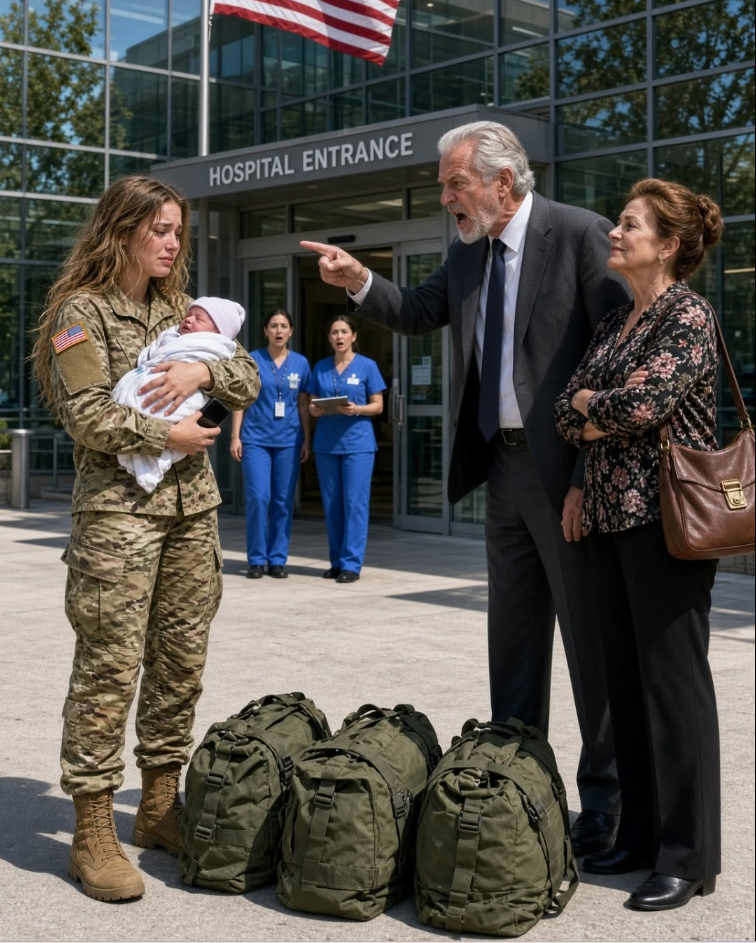
Outside the hospital, my father threw my bags onto the pavement and shouted, “Take the baby and leave. You’re not coming home.”
They expected me to cry, beg, and surrender the money my husband had left behind.
Twenty minutes later, my husband’s commanding officer arrived with two military police officers.
Wednesday Morning — 7:40 a.m.
Six days earlier.
A thick blanket of fog covered our small industrial town in Ohio.
Inside my parents’ living room, the smell of burned coffee mixed with the stale air of a house I’d never truly considered home.
I was thirty-eight weeks pregnant.
Sleeping had become difficult, especially on the worn secondhand sofa where I’d been staying during David’s deployment.
Moving back with my parents was supposed to be temporary.
Instead, every day felt like another punishment.
Then I heard tires rolling across the gravel driveway.
Two vehicle doors closed.
Heavy footsteps approached the porch.
The sound was unmistakable.
Measured.
Deliberate.
Military boots.
As the wife of a combat engineer, I’d spent months preparing myself not to imagine the worst.
David worked in route clearance.
I understood the dangers.
But knowing the risks was different from hearing those footsteps outside my door.
Before the visitors could knock, my father opened it.
Richard Vance was a broad man who believed every room belonged to him.
He controlled his struggling mechanic shop through intimidation, and he treated his family much the same way.
Standing beyond him were two military representatives.
An Army captain in formal uniform.
And a chaplain wearing a small silver cross.
My heart seemed to stop.
I pushed myself upright.
“Sit down, Lauren.”
Richard thrust an arm backward, blocking my path.
He didn’t even look at me.
“I’ll handle this,” he grunted.
But the captain wasn’t there to speak with my father.
His eyes moved past Richard and settled on me.
“Non-commissioned officer Ellis.”
The words cut through the room.
I moved around the coffee table.
Despite the pain in my lower back and the weight of my pregnancy, my body responded to years of military training.
I straightened my shoulders.
Lifted my chin.
And stood at attention.
The captain and chaplain stepped inside.
Richard backed away, visibly irritated that nobody had asked his permission.
The chaplain removed his cap.
The captain held a sealed dark folder.
“The Secretary of the Army has asked me to express his deep regret.”
I heard the words.
But the world seemed to shift beneath my feet.
There had been a night operation.
A route-clearance mission.
An improvised explosive device.
Sergeant First Class David Ellis had been killed in action.
My husband.
The man I’d married.
The father of the child moving inside me.
Gone.
A sharp ringing filled my ears.
The room blurred.
Then our daughter kicked hard against my ribs.
I pressed my hands against my sides and forced myself to remain upright.
I wouldn’t collapse in front of the uniform.
From the kitchen, Martha appeared.
My mother pressed a dish towel against her face and produced a loud, theatrical sob.
She hadn’t asked about David’s safety once during his seven-month deployment.
Yet now she behaved as though nobody could possibly understand her grief.
The officers waited respectfully.
I swallowed against the tightness in my throat.
“Thank you for coming to notify me, gentlemen.”
My voice sounded unfamiliar.
Flat.
Controlled.
The chaplain nodded.
Then they left.
I watched their government SUV disappear into the fog.
Only when the vehicle was gone did Richard close the door.
He turned toward me.
I expected concern.
Perhaps a hand on my shoulder.
Something.
Instead, his eyes moved toward my pregnant belly.
Then toward the driveway.
His expression became strangely thoughtful.
“Go lay down.”
His voice carried a sweetness I’d rarely heard from him.
“Don’t stress the baby. We’ll handle all the paperwork from here.”
For one exhausted moment, I almost believed he was offering help.
I was wrong.
Richard wasn’t thinking about his grieving daughter.
He was thinking about the $400,000 he believed David’s death would bring into our family.
The Commander Arrives
Thursday afternoon, another government vehicle pulled into the driveway.
This time, it was a polished black SUV.
Major Thomas Sterling, David’s battalion commander, stepped out wearing his combat uniform.
Sergeant First Class Elena Rostova followed him.
She was our assigned casualty assistance officer.
They entered the cramped living room carrying a thick folder of military documents.
Major Sterling sat on the edge of the worn sofa.
He kept his back straight and his boots firmly planted.
He didn’t begin by discussing money.
He began by telling me how my husband had died.
David’s unit had encountered a devastating ambush during a night operation.
Forty young soldiers were trapped in a muddy ditch behind razor wire.
Enemy fire struck the ground around them.
Their escape route was blocked.
David could have remained behind cover.
Instead, he moved toward the wire.
Using bolt cutters, he opened a passage while exposed to enemy fire.
He suffered multiple wounds.
But he kept working until the trapped soldiers could escape.
Forty men survived because my husband refused to abandon them.
“Every unit needs a breacher, NCO,” Sterling said.
He looked directly at me.
There was no pity in his eyes.
Only respect.
A tear finally slipped down my cheek.
David had given his life to save forty others.
I wished I could have heard that story somewhere other than my parents’ miserable living room.
But Richard couldn’t even allow us a moment of silence.
As Rostova began explaining the Servicemembers’ Group Life Insurance benefit, he leaned forward.
The standard amount under discussion was $400,000.
Richard’s expression changed immediately.
“So, what’s the actual payout?” Richard grunted, rubbing his calloused thumb over his index finger. “How much is the army cutting a check for the kid’s neck?”
I stared at him.
Martha hurried into the room.
“Richard is just thinking ahead,” Martha yelled, wiping her hands on a dish towel as she stepped into the room.
She pointed toward me.
“Look at her. She’s huge. She’s hormonal and her brain is total mush right now with the grief. We are going to need to manage all those assets for her for the baby’s sake.”
Manage the assets.
I understood exactly what they meant.
Richard’s mechanic shop was drowning in debt.
My older brother Derek hadn’t held steady employment in three years.
My parents saw David’s death benefits as a way to rescue their finances.
Major Sterling slowly turned toward Richard.
His expression became cold.
Rostova placed the folder firmly on the coffee table.
“These are classified military death benefits,” Rostova stated, her voice devoid of any human warmth.
She leaned toward my father.
“By federal law, we only discussed this financial information with non-commissioned officer Ellis. Nobody else.”
Richard’s face darkened.
He wasn’t accustomed to being told he had no authority.
But the officers didn’t argue.
They simply ended the meeting.
Outside, Sterling paused beside me.
“You have my number, Ellis.”
I nodded.
“He saved it in my phone.”
At the time, I didn’t realize how important that number would become.
The Money My Parents Had Already Taken
To understand Richard’s obsession with David’s insurance, you need to understand what he’d done to me before.
I joined the Army at nineteen.
It was my chance to escape a childhood dominated by financial pressure and emotional manipulation.
But only one month into basic training, Richard called.
“Family is drowning here,” Richard grunted over the line.
“The shop needs a lifeline. You owe us for putting a roof over your head.”
I was young.
I still believed I had to earn my parents’ love.
So I arranged an automatic transfer.
Four hundred dollars every month.
The money went directly from my military pay into Richard’s business account.
Account ending in 4471.
The payments continued for sixty months.
Twenty-four thousand dollars.
I thought I was helping save the family business.
Instead, the money helped support Derek, who spent his days sleeping late, drinking beer, and playing video games.
My parents never thanked me.
They still called me selfish.
Ungrateful.
A disappointment.
Three years before David’s death, their attitude became painfully obvious during our wedding rehearsal dinner.
We were celebrating in a rented VFW hall.
Martha had been drinking.
She tapped a plastic fork against her cup until everyone looked toward her.
“Military men,” Martha slurred, swaying slightly on her heels.
“They just go off, blow up, and leave behind young widows for the family to take care of.”
The room fell silent.
David remained calm.
“I will do my best to avoid stepping on a mine, Martha,” he replied, his voice dead flat.
Later, Richard cornered him outside near a chain-link fence.
“So,” Richard spat, chewing on a wooden toothpick. “Who was holding the bank cards in this setup? You or her?”
David looked him straight in the eye.
“Lauren holds the cards. She knows the regulations better than I do.”
Richard didn’t like that answer.
He was used to controlling money by controlling people.
David refused to participate.
Two weeks after our honeymoon, I sat at my computer in Fort Campbell and canceled the automatic payments to account 4471.
The money stopped.
Martha responded by refusing to speak to me for five weeks.
When she finally called, she was furious.
“You think you are untouchable now just because you have a husband backing you up?” Martha hissed through her teeth.
“You arrogant little brat. Do not come crawling back.”
David understood what I was only beginning to accept.
My parents valued what they could take from me more than they valued my happiness.
David’s Final Protection
One month before his deployment, David was packing his military equipment in our kitchen.
He placed a thick green tactical folder on the counter.
“What is this?”
“Your armor,” David said softly.
He tapped its cover.
“Inside are the SGI protocols, federal regulations, beneficiary rights, and Major Sterling’s personal cell number.”
He placed the folder inside my olive-green medical bag.
“Your father is a ruthless hustler, Lauren.”
His expression became serious.
“If something happens out there, if I do not come back, he is going to circle like a buzzard. If he tells you he is going to manage your assets, you pull this weapon out.”
Then he added:
“Do not let him touch it ever.”
I promised.
I didn’t know those would become some of the most important words my husband ever said to me.
The Night Our Daughter Was Born
Friday, 3:00 a.m.
My water broke.
The pain began almost immediately.
By late afternoon, complications had developed.
Our baby’s heart rate was falling.
Doctors decided an emergency C-section was necessary.
As the nurses prepared to take me into surgery, Martha stood near the doorway holding my medical bag.
David’s folder was inside.
I reached toward her.
I wanted my mother.
For one frightened moment, I needed someone familiar to hold my hand.
She stepped away.
“I hate blood. You know how I get in hospitals.”
Then she turned toward the waiting room.
Taking my bag with her.
The operating-room doors closed.
Bright lights shone overhead.
Cold air brushed my skin.
The surgical instruments made sharp metallic sounds.
I was terrified.
Then Captain Rachel Thorne, an obstetric nurse, took my hand.
“Squeeze my hand,” Thorne whispered, her voice a calm anchor in the chaos. “Keep breathing. Just call his name. Bring him in here with you.”
David.
I whispered his name.
Again.
And again.
Until the sound became a prayer.
At 7:52 p.m., a newborn cried.
Eevee.
Our daughter.
When they placed her against my chest, I began sobbing.
David would never hold her.
Never hear her laugh.
Never watch her take her first steps.
But a part of him was still here.
Saturday morning, I was recovering in the hospital.
The medication made everything feel distant.
My body ached.
My thoughts were slow.
Then Richard entered.
He didn’t ask about Eevee.
He didn’t ask how I felt.
He looked around the room.
“Looking for a phone charger,” he muttered, mostly to himself.
My olive-green medical bag sat on a visitor’s chair.
I watched him open it.
His hands moved past the clothing and diapers.
Then he reached into the middle compartment.
He pulled out David’s green folder.
I tried to speak.
Only a weak sound escaped.
Richard turned toward me.
He noticed my unfocused eyes.
Then smiled.
He pulled a chair beside the bed.
“I’ll just hold on to this for safekeeping.”
He tucked the folder beneath his arm.
“You’re hopped up on painkillers, kid. Your brain is a mess right now,” he whispered, patting the blanket near the knee. “Let your old man handle those officers and the paperwork. Your mother cleaned out the spare room for you and the baby. We got the crib set up. You just need to come home and rest. We’ll take care of everything.”
For one exhausted moment, I wanted to believe him.
I wanted my parents to be different.
I wanted somewhere safe to take my daughter.
So I closed my eyes.
And Richard walked away with the folder.
He believed he’d finally gained control.
But that night, a message arrived from the last person I expected.
My brother Derek.
“Watch your back.”
Then another message appeared.
“Dad had Uncle Ray over at the shop drinking pounders of Bush Light. Heard them talking loud in the office. Dad says David’s Sgi payout is more than enough to clear the bank lean on the garage. They got it all mapped out.”
My blood ran cold.
A third message followed.
“Mom told him if you put up a fight and refuse to sign the transfer papers, they are just going to drive home. She said to leave you dumped at the hospital to figure it out yourself. No car, no ride. You’ll cave.”
I stared at the screen.
My parents were planning to abandon me and my newborn daughter unless I gave them control over David’s $400,000 death benefit.
And suddenly, everything became clear.
They weren’t preparing to help me recover.
They were preparing to break me.
PART 2: THE CALL THAT DESTROYED MY FATHER’S PLAN
Saturday night, I lay awake in my hospital bed with Derek’s messages glowing on my phone.
My daughter slept beside me.
I read the messages again.
My mother was helping him.
Three days after a C-section.
With a newborn.
The cruelty was difficult to comprehend.
For years, I’d tried to convince myself that my parents were simply difficult people.
Richard was controlling.
Martha was manipulative.
But somewhere beneath their behavior, I wanted to believe they loved me.
Now I understood.
They were willing to use my husband’s death and my daughter’s birth as financial leverage.
I placed my phone beside the bed.
Closed my eyes.
And began breathing slowly.
Four seconds in.
Four seconds out.
Tactical breathing.
A familiar technique from military training.
As my heartbeat settled, I began thinking clearly.
Richard had stolen the folder.
But the folder wasn’t the money.
SGLI benefits were governed by federal procedures and beneficiary designations.
My father couldn’t simply claim the payout because he possessed printed documents.
He could threaten me.
He could lie.
He could attempt to manipulate military personnel.
But he didn’t have legal authority over David’s benefits.
And I was finished allowing him to pretend otherwise.
The Attempt to Take My Benefits
Sunday morning, Sergeant First Class Rostova entered my hospital room.
Her expression was serious.
“We had a security breach,” Rostova stated, clipping her words short.
I sat straighter against the pillows.
She explained that Richard had contacted her office the previous afternoon.
He claimed he was my authorized financial proxy.
He wanted the military death benefit redirected from my designated credit union account into a civilian business account.
I already knew which one.
“Account ending in 4471.”
Rostova nodded.
The same account that had received $24,000 from my military pay years earlier.
But Richard had gone further.
He’d claimed I was emotionally unstable following my husband’s death.
He’d mentioned the emergency surgery.
He’d suggested that grief and postpartum trauma left me incapable of managing my finances.
Then he’d asked how to obtain authority over the insurance money.
“He cited your recent emergency C-section. He heavily implied you were suffering from acute postpartum trauma and severe grief. He asked my office for the specific administrative protocols required to legally redirect the insurance funds due to your medical incapacitation.”
I felt sick.
My father wasn’t simply asking for money.
He was trying to make the military believe I lacked the ability to manage my own affairs.
“I shut him down immediately,” Rostova said, her tone absolute zero. “Major Sterling’s orders are crystal clear. Nobody signs those federal release forms but you. He hits a brick wall every time he calls.”
I looked toward Eevee.
My daughter was sleeping peacefully.
David had anticipated this.
He’d known exactly what Richard might attempt.
And he’d made certain there were people who understood the situation.
Later that afternoon, Richard returned.
He carried cheap cafeteria food, apparently hoping the gesture would make him appear concerned.
He didn’t ask about my recovery.
Instead, he placed a printed document on my bedside tray.
A generic power-of-attorney form.
“Sign this.”
He pointed at the signature line.
“Look, you just focus on being a mom. I will handle the military brass and sort out the paperwork. It is too much stress for you right now.”
I studied the document.
He wanted me to sign away control.
Then he’d use that authority to pursue David’s money.
A blue pen rested beside the paper.
I picked it up.
Richard watched closely.
For a moment, he looked almost pleased.
He believed the pain, exhaustion, and grief had finally worn me down.
I held the pen above the signature line.
Then let it fall.
“I am going to think about it.”
His smile disappeared.
“We leave at 10 a.m. tomorrow,” Richard barked, his voice dropping the fake fatherly act completely. “Have your mind made up by then.”
He stormed out.
Martha followed him.
I watched the door close.
Then I reached for my phone.
My Own Plan
At eleven that night, I contacted Corporal Sarah Jenkins.
Sarah was a fellow service member and a neighbor on base.
She was someone I trusted.
“Need a ride? Bring the Honda to the Blanchfield main entrance parking lot. Oh, 9:30 hours tomorrow. Do not be late.”
She replied with a thumbs-up emoji.
My transportation was arranged.
Then I sent a message to Rostova.
“What is the exact Provos Marshall protocol for revoking the civilian sponsorship of a family member currently accessing a federal military installation?”
My parents were on base as civilian visitors under my sponsorship.
I intended to revoke that permission.
If they insisted on threatening me, they would do it without the protection of my cooperation.
For the first time since David’s death, I felt something other than grief.
I felt prepared.
Richard believed he had created a situation in which I had no choice.
No car.
No home.
No husband.
A newborn to protect.
A painful surgical incision.
He thought I’d surrender rather than face those difficulties.
But he had forgotten who I was.
Before becoming his daughter in need of temporary shelter, I was a trained soldier.
And before David died, he’d made sure I knew exactly whom to call.
Monday Morning — 9:30 a.m.
Sunlight streamed through the hospital windows.
I was dressed and preparing for discharge when Martha entered.
She carried two canvas duffel bags.
She dropped them near my bed.
I immediately noticed that the newborn supplies she’d promised were missing.
No diapers.
No formula.
None of the items she’d supposedly purchased.
“Left all that stuff at the house. You can use it when you come visit.”
Her meaning was obvious.
Everything she’d offered came with conditions.
Captain Thorne entered carrying my discharge paperwork.
She reviewed my incision care, medication instructions, lifting restrictions, and warning signs.
Richard interrupted her.
“Yeah, yeah, we got it.”
He waved dismissively.
“I’ll be managing all her affairs from here on out. She just needs to get in the truck.”
Thorne’s expression tightened.
But she remained professional.
Richard extended his hand toward me.
He wanted the signed power-of-attorney form.
I didn’t give him anything.
The document was still unsigned.
His face hardened.
He looked at Eevee.
Then at me.
“All right, then,” Richard growled, his voice dropping to a grally, menacing whisper. “We’re only going part of the way.”
I said nothing.
The trip down the hospital corridor was painful.
Each step strained my healing incision.
I held Eevee securely against my chest and continued toward the exit.
The automatic doors opened.
Warm air rushed over us.
Richard’s old Chevrolet Silverado waited in the loading area.
Its engine idled roughly.
And on the dashboard, clearly visible through the windshield, lay David’s green tactical folder.
My father had placed it there deliberately.
He wanted me to see that he still possessed my husband’s documents.
Martha stood beside the passenger door with her arms crossed.
Richard walked to the truck bed.
He grabbed my two duffel bags.
Then threw them onto the pavement.
The bags hit the concrete with a heavy thud.
He slammed the tailgate.
Turned toward me.
And delivered the words he’d apparently been waiting to say.
“Grab the kid and walk. You’re not coming back to this house.”
Martha stood beside him.
She offered no objection.
No concern for her granddaughter.
No thought for the fact that I’d undergone emergency surgery only days earlier.
Richard stared at me.
He expected me to break.
He wanted me to beg for a ride.
To promise I’d sign his documents.
To hand over control of David’s benefits in exchange for somewhere to sleep.
Instead, I adjusted Eevee’s blanket.
Reached into my pocket.
And took out my phone.
Richard frowned.
I selected Major Sterling’s number.
The call connected almost immediately.
“Sterling.”
I looked directly at my father.
“Major Sterling.”
I kept my voice steady.
“I am currently standing outside the main lobby of Blanchfield Hospital. My parents are physically present on this installation under civilian sponsorship granted by me.”
Richard’s expression changed.
“I am officially revoking that sponsorship.”
Then I continued.
“Effective immediately. Furthermore, my father is currently in unauthorized possession of my late husband’s military death benefit files located on the dashboard of his vehicle.”
The major didn’t hesitate.
“Understood, NCO,” Sterling replied.
Then came his instruction.
“Hold your position. 20 minutes.”
The call ended.
I returned the phone to my pocket.
Richard burst out laughing.
“Good,” Richard barked, a greasy smirk stretching across his face. “Tell that officer boy to drive his shiny government SUV down here and pick you up. I give you 10 minutes to regret this little stunt.”
He pointed toward the truck.
“10 minutes, Lauren. If you don’t get your ass in this cab by then, that folder is going straight into the heavy floor safe back at my shop. Good luck paying rent with no paperwork.”
I didn’t answer.
My incision hurt.
The sun was growing warmer.
Eevee shifted against my chest.
But I stood still.
Five minutes passed.
Then ten.
Richard checked his watch.
Martha began looking around nervously.
Fifteen minutes.
The loading area remained busy with hospital staff and visitors.
Eighteen minutes.
Richard finally pushed away from his truck.
“All right, you stubborn brat. We’re done.”
He pulled out his keys.
Turned toward the driver’s door.
“Don’t come crying to us when you’re broke.”
Then a siren sounded.
Two military police vehicles entered the loading area.
Their tires rolled sharply across the pavement.
They positioned themselves near Richard’s Silverado.
My father’s hand froze around his keys.
The hospital doors opened behind me.
Major Thomas Sterling stepped outside.
Sergeant First Class Rostova followed with a military tablet.
Two military police officers accompanied them.
The surrounding conversations grew quiet.
Sterling walked directly toward me.
He stopped three feet away.
Straightened.
And raised his hand in a crisp salute.
“Non-commissioned officer Ellis.”
I adjusted my daughter and returned the salute.
Then the major turned toward my father.
The Man Who Thought He Owned Everything
“Mr. Vance.”
Sterling’s voice was firm.
“Sergeant Ellis has officially revoked your installation sponsorship. You and your wife are currently trespassing on restricted federal military property. The MPs will now escort you off this post.”
Richard stepped backward.
His face lost its color.
“Now wait a damn minute,” Richard stammered, raising a grease stained hand.
“She ain’t got the right to do that. I’m her father. This is a family matter.”
Sterling didn’t move.
“She already did,” Sterling snapped back, cutting him off like a falling guillotine. “This is a federal installation, not your living room.”
Staff Sergeant Cole stepped forward.
He was broad-shouldered, calm, and entirely unimpressed by my father’s attempts at intimidation.
“Mr. Vance,” Cole stated, his voice a flat mechanical drone of pure law enforcement. “We are responding to a reported theft of sensitive military casualty documents. You are currently in unauthorized possession of legal property belonging to a United States service member. That property is sitting right there on the dashboard of your vehicle.”
Richard looked toward the truck.
Then at the police vehicles.
Then at me.
His confidence had vanished.
“Lauren, come on.”
His voice cracked.
“Tell them she’s hormonal. She’s confused from the surgery. I’m just trying to help you out. Tell them this is a huge mixup.”
I looked at the man who’d taken $24,000 from my military pay.
The man who’d treated David’s death as a financial opportunity.
The man who’d just abandoned his recovering daughter and newborn granddaughter outside a hospital.
I felt no need to shout.
“Hand them back the tactical folder, Dad.”
For several seconds, he stood motionless.
Then he lowered his head.
Walked to the truck.
Reached through the driver’s window.
And retrieved the green folder.
He handed it to Cole.
Cole checked it before returning it to me.
The familiar canvas rested against my hand.
David’s final protection.
Back where it belonged.
Martha leaned toward the open passenger window.
Her face twisted with anger.
“Do not come crying to us when you blow through all that cash,” Martha shrieked, her voice cracking over the rumble of the idling engine. “You are dead to this family.”
Her words no longer frightened me.
Cole tapped the roof of the truck.
“Move it out, Mr. Vance. Now.”
The military police escorted my parents away from the hospital.
I watched the Silverado disappear.
For the first time in my life, Richard couldn’t force me to follow him.
David’s Final Letter
Ten minutes later, Sarah arrived in her silver Honda Civic.
She saw the bags on the pavement.
Without asking questions, she picked them up and loaded them into her trunk.
Then she helped me settle into the car.
Eevee rested safely in her borrowed child seat.
The air-conditioning cooled my face.
I finally allowed myself to relax.
Then I opened the green folder.
The benefit documents were still there.
Nothing had been signed.
Nothing had been altered.
But behind the paperwork, I discovered a brown envelope.
David’s handwriting appeared on the front.
My heart tightened.
It was his final letter.
The kind of letter soldiers sometimes prepare before dangerous deployments.
Someone had torn open the envelope.
Richard.
He’d even violated the privacy of my husband’s farewell.
I unfolded the paper carefully.
David had written:
“If you are reading this, the worst happened, but you are still standing. I know you are. I left this folder as your shield. But here is the truth, Lauren.”
My eyes blurred.
I continued reading.
“Major Sterling has strict orders from me. I told him not to intervene with your father. Not unless you were the one who made the call.”
My hands began trembling.
Then came the words that changed the way I understood everything.
“I could have locked them out completely before I deployed, but you needed to do it. You had to be the one to pull the trigger. Nobody can protect your perimeter forever.”
And finally:
“You have to learn to defend it yourself. I love you. Protect our girl.”
I pressed the letter against my chest.
And cried.
David had known what my parents might do.
He’d prepared the documents.
He’d trusted Sterling.
But more importantly, he’d trusted me.
He believed I could protect myself.
And now I had.
The man I’d loved was gone.
But his faith in me remained.
And I would never allow Richard or Martha to take that away.
PART 3: THE FAMILY I CHOSE TO PROTECT
One week after the confrontation outside Blanchfield Army Community Hospital, the installation commander finalized the restrictions against my parents.
Richard and Martha Vance were permanently barred from entering the military installation.
They could no longer arrive unannounced.
For the first time, there was an official boundary they couldn’t bully their way through.
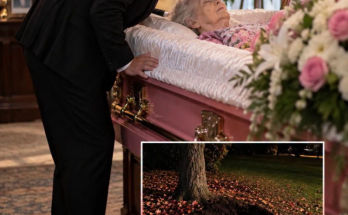
David’s funeral.
The Final Salute
The cemetery was quiet beneath a gray sky.
Cold wind moved across the neatly trimmed grass.
Rows of white headstones stretched into the distance.
I stood in my Class A uniform, holding myself upright despite the ache in my chest.
Hundreds of soldiers had gathered to honor my husband.
Men who’d served beside him.
Men who’d known his courage.
Some of the men whose lives he’d saved.
I looked at them and thought about the forty soldiers who’d escaped that ambush because David refused to leave them behind.
He’d given them the chance to go home.
To see their families.
To continue their lives.
And now I had to bury him.
The rifle volley shattered the silence.
Then the bugler began playing Taps.
The notes drifted across the cemetery.
I pressed my lips together.
I wanted to remain strong.
But grief doesn’t obey military discipline forever.
The honor guard approached David’s casket.
They folded the American flag with slow, precise movements.
One fold.
Then another.
Until the flag became a tight triangle of blue and white stars.
Major Sterling accepted it.
He approached me.
Then lowered himself onto one knee.
When he placed the folded flag in my hands, its weight felt almost impossible to bear.
It was more than cloth.
It represented the man I’d loved.
His service.
His sacrifice.
The life we’d planned.
And the daughter he’d never meet.
I held the flag against my chest.
Beyond the major’s shoulder, I noticed someone standing near the back of the gathering.
Derek.
My older brother.
He wore an inexpensive, wrinkled suit and looked uncomfortable among the soldiers.
But he’d come.
And I’d allowed him to attend.
He was the only member of the Vance family I’d invited.
Derek had warned me when Richard and Martha were planning to exploit my vulnerability.
He hadn’t asked for money.
He hadn’t demanded anything in return.
He’d simply told me the truth.
That mattered.
For years, my parents had insisted that blood made us family.
But standing beside David’s grave, I understood that loyalty mattered far more.
Richard and Martha were absent.
They would have no place in my daughter’s life simply because they shared our blood.
They had made their choices.
And I had made mine.
I thought that would be the end of our relationship.
I was wrong.
The Thanksgiving Invitation
Late November brought bitter cold to Ohio.
By then, Eevee and I were settled into a quiet apartment.
Our home smelled of baby lotion, warm milk, and freshly brewed coffee.
For the first time in years, I could wake up without wondering what my parents would demand from me.
There were no arguments about money.
No threats.
No accusations that I was selfish or ungrateful.
Only the ordinary challenges of caring for a newborn while grieving the man I’d loved.
Then my phone rang.
Martha.
I stared at the screen.
We hadn’t spoken in two months.
I let the phone ring several times before answering.
“Hi, sweetie.”
Her voice was so cheerful that, for a moment, I wondered whether she’d forgotten everything that had happened.
“We are doing a big turkey for Thanksgiving next week,” Martha continued, her tone bright and breezy. “Your father is ready to let bygones be bygones. He wants you to bring the baby over. He still thinks someone needs to look at those insurance bank statements just to make sure you aren’t getting taken advantage of by the government.”
I closed my eyes.
There it was.
The same demand.
The same obsession.
Only now it was wrapped in a holiday invitation.
A small part of me still wanted to believe things could change.
I imagined a normal Thanksgiving.
Turkey.
Mashed potatoes.
Family gathered around a table.
Grandparents holding their granddaughter because they loved her, not because they wanted access to her father’s money.
But Martha kept talking.
“We are roasting a huge turkey for Thanksgiving next week. Your father is ready to let bygones be bygones. He wants you to bring the baby over.”
She paused.
Then added:
“He still thinks someone needs to look at those insurance bank statements, though.”
And finally:
“Just to make sure the government isn’t taking advantage of you.”
I recognized the strategy.
They were offering affection as a way to regain access.
The invitation wasn’t really about Thanksgiving.
It was about the money.
I could have ended the call immediately.
Instead, I decided to give them one final opportunity.
Not because I owed them another chance.
But because I wanted to know whether they could respect even the simplest boundary.
I agreed to meet them in a public place.
“Saturday, Riverside Public Park, exactly 1 hour.”
Then I made the conditions clear.
“Sarah is coming with me. And absolutely no mention of money. You bring it up. The visit ends.”
Martha agreed.
Her enthusiasm returned immediately.
But I wasn’t convinced.
Twenty Minutes
Saturday morning was freezing.
A sharp wind blew across the gray river.
Dead leaves scraped along the paths at Riverside Park.
I chose the location deliberately.
Neutral ground.
No house where Richard could lock a door.
No property he could claim authority over.
No private room where he could intimidate me.
Sarah drove with me.
She remained near her Honda Civic, about sixty feet from the picnic bench.
She could see us clearly.
My parents arrived five minutes late.
Richard wore his usual stained work jacket.
His hands remained deep in his pockets.
Martha hurried toward me, smelling strongly of inexpensive vanilla perfume.
For the first fifteen minutes, the visit was almost pleasant.
She held Eevee.
Admired her tiny fingers.
Commented on how much she’d grown.
Richard stood nearby, kicking at the frozen dirt.
For a moment, I wondered whether they might actually keep their promise.
Then he cleared his throat.
I looked toward him.
He shifted his weight.
“So,” Richard grunted, shifting his heavy weight from one boot to the other. “I don’t need my name on anything, but you really need to let me see the account statements. Just one quick look at the rooting numbers to make sure the military didn’t screw you on the federal taxes.”
I felt nothing.
No surprise.
No disappointment.
I’d expected it.
I looked at my watch.
Twenty minutes.
That was how long they’d managed to pretend my daughter mattered more than David’s money.
I stood.
Then held out my arms toward Martha.
She hesitated.
Her grip on Eevee tightened slightly.
I calmly took my daughter back.
Adjusted her blanket.
And looked at my parents.
“You had exactly one hour to spend with your granddaughter.”
Richard frowned.
“You burned it in 20 minutes to spy on my bank accounts. We are officially done.”
His face reddened.
He pointed toward Sarah’s car.
“That officer boy put you up to this, didn’t he?” Richard snarled, his voice echoing off the bare skeletal oak trees. “That Sterling guy brainwashed you into turning your back on your own blood. You’re letting the military run your life.”
I looked at him.
For years, he’d blamed everyone else whenever I made a decision he couldn’t control.
When I stopped sending money, it was David’s fault.
When I refused the power of attorney, it was the military’s fault.
When I revoked his installation sponsorship, it was Sterling’s fault.
He couldn’t accept the possibility that I was making my own choices.
I adjusted Eevee’s hat.
Then answered.
“It was me.”
Two words.
Nothing more.
I turned and walked toward Sarah.
Behind me, Richard continued shouting.
I didn’t look back.
My boots crunched against the frozen gravel.
The wind was cold against my face.
But I felt lighter than I had in years.
For twenty-seven years, I’d carried the belief that I owed my parents unlimited access to my life.
That refusing them made me selfish.
That love required obedience.
That family meant enduring whatever they chose to do.
Walking away from Riverside Park, I finally released that belief.
They had been given a chance.
They had chosen money again.
And I was finished.
May — A Different Life
Now it’s May.
The bitter Ohio winter has ended.
The trees are green.
Warm mornings have returned.
My maternity leave is over.
My military uniform fits again.
And Eevee is growing faster than I can believe.
Sarah and her husband, Michael, helped me move the final boxes into my apartment.
We now live in neighboring units.
Some mornings, Sarah stops by with coffee.
Sometimes Michael helps carry groceries.
When I need support, I know whom to call.
Nobody asks for control of my bank accounts in exchange.
Nobody treats kindness as a debt I must repay.
And nobody uses my grief as an opportunity.
Our home is peaceful.
Eevee sleeps in her crib.
Her tiny clothes fill the dresser.
David’s photograph rests where I can see it every morning.
I still miss him.
I miss his voice.
His laugh.
The way he stood beside me when my parents tried to make me feel small.
I miss the life we should have shared.
There are days when the grief arrives without warning.
A song.
A familiar scent.
A soldier walking past in uniform.
The sight of a father carrying his baby.
Sometimes I cry.
And I’ve learned that crying doesn’t make me weak.
David would never have wanted me to confuse strength with refusing to feel pain.
He wanted me to survive.
To protect our daughter.
To build a life where she would never have to earn love by surrendering her independence.
In the top drawer of my bedroom dresser, I keep his green tactical folder.
The canvas has softened around the edges.
Inside are the military regulations, beneficiary information, emergency contacts, and documents he gathered before his final deployment.
For a while, I carried it everywhere.
I thought the folder itself was what protected me.
But I understand it differently now.
The documents gave me information.
Major Sterling and Rostova gave me support.
Sarah gave me friendship.
Derek gave me a warning when I needed it.
But the decision to protect myself had to come from me.
David knew that.
He’d written it in his final letter.
“Nobody can protect your perimeter forever.”
At first, those words made me cry.
Now they remind me of what I’ve become.
Richard and Martha believed I would always return to them.
They believed they could threaten me with homelessness, guilt, and rejection until I surrendered.
They thought I needed their permission to live my own life.
They were wrong.
I no longer measure family by blood.
I measure it by loyalty.
By honesty.
By the people who show up when everything falls apart.
The people who protect your dignity rather than exploit your vulnerability.
The people who love your child without expecting access to your money.
David gave his life protecting forty soldiers.
He also spent his final weeks preparing to protect me.
I couldn’t save him.
But I could honor what he wanted for our daughter.
A safe home.
A mother who knows her worth.
A life free from manipulation and fear.
Sometimes, late at night, I sit beside Eevee’s crib and watch her sleep.
I see David in the shape of her eyes.
In her tiny expressions.
In the way she curls her fingers around mine.
I tell her about him.
About his courage.
His kindness.
And the forty men who survived because he refused to leave them behind.
One day, she’ll understand the full story.
She’ll learn that her father was a hero.
But she’ll also learn something equally important.
Love doesn’t require surrendering your boundaries.
Forgiveness doesn’t erase consequences.
And sharing blood with someone doesn’t give them the right to hurt you.
I used to believe David’s green folder was my shield.
Now I know it was only there until I learned to stand on my own.
Richard and Martha no longer control my future.
Their threats no longer frighten me.
Their approval is no longer something I need.
I have my daughter.
I have the people who stood beside us.
And I have the strength David always believed I possessed.
I am the steel shield now, and absolutely nothing will ever breach this perimeter again.
Forgiveness doesn’t mean granting access.
THE END.