PART 1
My name is Nathan Moretti.
In Chicago, people knew that name. More importantly, they knew exactly what happened when someone failed to pay me what they owed.
Apartment 4B was three months behind on rent.
So I decided to deal with the problem myself.
I knocked hard on the door.
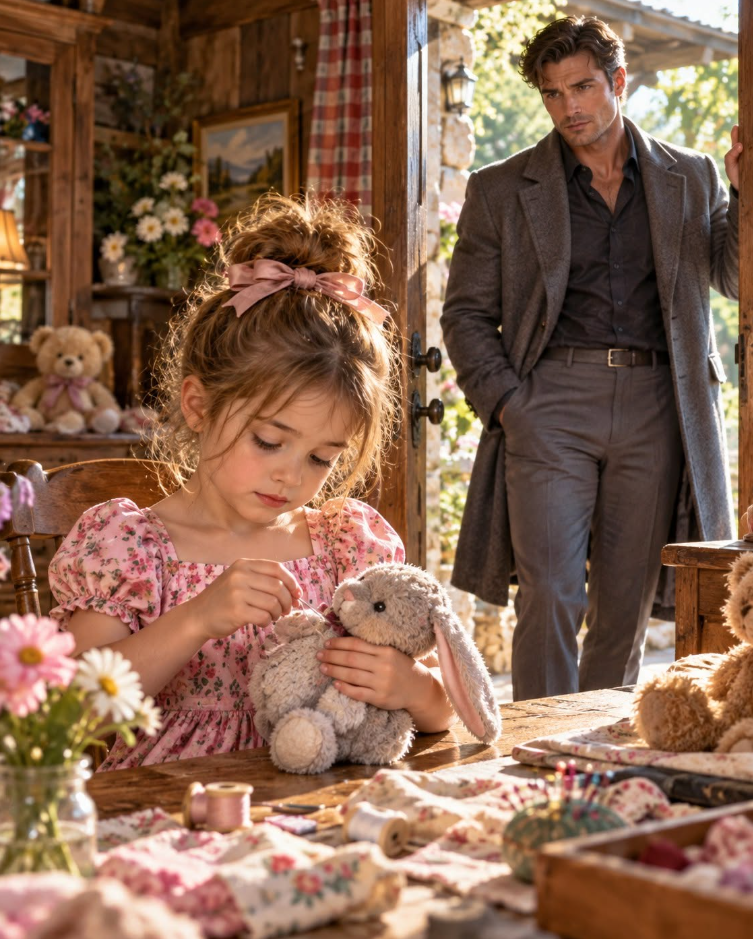
She looked about seven years old, painfully thin and exhausted, with strands of brown hair falling across her face. Tiny specks of blood dotted her fingertips.
“Where’s your mother?” I asked.
“She’s sick.”
I stepped inside.
Medicine bottles crowded a table. The refrigerator was nearly empty. An old sewing machine sat beside the wall.
“What’s your name?”
“Lily.”
“And the rent?”
She hurried away, then returned with a crumpled envelope clutched between her hands.
Inside were forty-three dollars.
“I’m making the rest,” she said.
I stared at her in disbelief. “You’re making it?”
She nodded toward the sewing machine. “People downstairs pay me to sew things.”
Then she returned to her seat and resumed working.
Her little feet struggled to push the pedal down.
The needle darted up and down.
Then it pierced her fingertip.
She flinched in pain.
A bead of blood appeared.
Lily wiped it on her shirt and kept sewing.
“Stop.”
She shook her head. “Mom needs medicine.”
Thirty years vanished in an instant.
I remembered what it felt like to have nothing. I remembered my own mother hunched over a sewing machine, counting coins while pretending everything would somehow turn out all right.
I pulled several hundred-dollar bills from my wallet.
Then I glanced toward the closed bedroom door.
“I need to speak to your mother.”
Lily jumped to her feet.
“No.”
The terror in her voice immediately caught my attention.
“Why not?”
She swallowed hard. “Mom said if Mr. Moretti ever came here, I couldn’t let him see her.”
My hand froze.
Before I could ask another question, something crashed inside the bedroom.
I moved toward the door.
Lily grabbed my sleeve. “Please don’t.”
Then I heard a woman’s weak voice.
“Nate?”
I went completely still.
Nobody called me Nate anymore.
I opened the bedroom door.
A sick woman lay beneath a thin blanket.
Older. Frail.
But I knew those eyes.
“Sarah?”
Then I noticed something behind her.
The sewing machine.
A tiny silver rose had been carved into its wooden base.
My mother’s mark.
The very same machine she had sold thirty years earlier.
The same night Sarah disappeared from my life.
I slowly turned my gaze toward Sarah.
Then toward Lily.
Seven years old.
Sarah saw the question forming on my face, and whatever strength she had left seemed to drain away.
“Nate,” she whispered, “there’s something you don’t know.”
For the first time in my life, I wasn’t the dangerous man in the room.
I was the man terrified of the answer.
PART 2 — THE SECRET THAT CHANGED EVERYTHING
For several seconds, nobody spoke.
The room smelled of antiseptic, old fabric, and the dampness that came from a building where the heating system barely worked. A weak lamp illuminated Sarah’s face, revealing hollows beneath her cheekbones and strands of gray in the dark hair I remembered as glossy and black.
I had imagined seeing her again a thousand times.
In some versions, she begged me to forgive her.
In others, she stood in front of me and explained why she’d left.
Sometimes, in the darkest hours of the night, I imagined finding her in a place where she could no longer hurt me.
But I had never imagined this.
Sarah lying in a rundown apartment, too weak to sit up properly, while a seven-year-old girl injured herself trying to keep them alive.
I looked at the child.
Then back at Sarah.
“How long?” I asked.
My voice sounded unfamiliar, even to me.
Sarah closed her eyes.
“Please, Nate. Not in front of Lily.”
That answer frightened me more than any confession could have.
I had spent thirty years learning to recognize lies, fear, and desperation. I had watched men with armed guards behind them crumble under the weight of a single question.
Yet one whisper from this woman had turned me into a boy again.
“Lily,” I said gently, “would you wait in the living room for a minute?”
She shook her head and moved closer to her mother.
“I promised I wouldn’t leave her alone.”
Sarah reached for the girl’s hand.
“It’s all right, sweetheart. Mr. Moretti isn’t going to hurt me.”
Lily studied my face as though trying to decide whether her mother was telling the truth.
Then she looked at the money still clutched in my hand.
“Can we use that to buy her medicine?”
The question struck harder than an accusation.
“Yes,” I answered. “We’ll get whatever she needs.”
“Even if we still owe the rent?”
“Even then.”
She didn’t smile. She didn’t thank me.
She simply nodded and returned to the sewing machine, apparently determined to finish the piece of cloth she had been working on.
That was when I noticed the needle still had a thread caught beneath it, and a small red stain had spread across the fabric.
I turned back to Sarah.
“Tell me what’s going on.”
Her eyes filled with tears.
“She’s your daughter, Nate.”
The words seemed to suck every bit of air out of the room.
I stared at her.
For a moment, I genuinely couldn’t understand what she had said. The sentence entered my mind, collided with everything I believed about my life, and refused to make sense.
“My daughter?”
Sarah nodded.
“Lily is your daughter.”
I took a step backward.
“No.”
It wasn’t a threat. It wasn’t even anger.
It was the instinctive denial of a man who had built his entire life around a truth he had never questioned.
Sarah began to cry silently.
“I wanted to tell you.”
“Then why didn’t you?”
My voice rose despite my effort to control it.
“Why did you disappear? Why did you leave me believing you were gone forever? Why did I spend thirty years thinking you had chosen a different life?”
Sarah pressed a trembling hand against her chest.
“Because I was told you were dead.”
I stopped.
“What?”
“Three days after I left you, a man came to my apartment. He told me there had been a shooting. He said you’d been caught in the middle of it and that you hadn’t survived.”
I stared at her.
“I was in Milwaukee that week.”
“I know that now.”
“Who told you this?”
She hesitated.
“Your father.”
For the first time that night, my fear gave way to something colder.
My father, Anthony Moretti, had been dead for twelve years. But even from his grave, his name could still make people lower their voices.
He had raised me to believe that weakness invited destruction. Love, he said, was a luxury that made a man careless. Trust was a weapon other people could use against you.
When I fell in love with Sarah at twenty-two, he considered it an act of rebellion.
She had been a seamstress’s daughter, studying nursing at a community college while working evenings at a small restaurant. She had no influential family, no money, and no interest in the world my father wanted me to inherit.
She also possessed something he could never understand.
She believed I could become a different man.
And for a while, I believed it too.
I remembered the tiny apartment we shared, the cheap coffee, the broken heater, and the nights we spent talking about opening a restaurant that would belong to us alone.
I remembered my mother, Elena, secretly giving Sarah grocery money whenever my father refused to help us.
Most of all, I remembered the night Sarah vanished.
I had returned to our apartment and found the closets empty, the drawers open, and a note on the kitchen table.
I’m sorry, Nate. I can’t do this anymore.
No explanation.
No address.
Nothing.
I searched for her until my father convinced me she had taken money from him and left Chicago voluntarily.
He showed me a bank withdrawal bearing her signature.
He told me she’d been seen boarding a bus.
And because I was young, angry, and foolish enough to believe that blood guaranteed honesty, I accepted his explanation.
Now, thirty years later, Sarah lay in front of me with a child who had my eyes.
I looked at Lily again.
Her brown hair fell across her forehead. Her chin was narrow, and when she concentrated on guiding the cloth beneath the needle, she pressed her lips together in exactly the same way I did.
I had seen that expression in the mirror every morning for decades.
“How old is she?” I asked.
“Seven.”
“When was she born?”
“October eighteenth.”
I calculated the dates automatically.
The night Sarah disappeared, she had been gone for three days when I found the note.
But before that, there had been a weekend when she complained of exhaustion and refused the wine I had poured for her. I had teased her about becoming responsible.
She had smiled and said she might have a reason to be.
I had forgotten that conversation.
Or perhaps I had buried it because remembering it hurt too much.
I sank onto the edge of the bed.
“Why didn’t you come looking for me when you discovered you were pregnant?”
Sarah wiped her cheeks with the back of her hand.
“I tried.”
She described going to the restaurant where I worked, only to be told I had left the city. She had called the apartment repeatedly, but the number had been disconnected. She returned to the address my father had given her and found strangers living there.
She had even gone to the police, believing perhaps that someone could help her locate me.
Instead, she said, a man approached her outside the station.
He wore an expensive suit and spoke with the calm confidence of someone who knew exactly how much trouble he could cause.
He told her that I had died and that my family would never accept the child.
Then he placed an envelope in her hands.
Inside was money and a letter supposedly written by me.
Sarah had kept it for years.
I held out my hand.
She hesitated before reaching beneath the blanket and retrieving a small, faded envelope from a drawer.
The paper had softened at the folds.
My name was written across the front.
I recognized the handwriting immediately.
It looked like mine.
But something was wrong.
I opened it.
Sarah,
Whatever we had is over. My father has made it clear that I will not abandon my future for a woman who cannot understand my responsibilities.
Do not contact me again.
Nathan.
I read the letter twice.
The words were cruel enough to sound plausible coming from the young man I had been when I was desperate to prove myself to my father.
But the signature was too careful.
And the letter contained a phrase I had never used.
I turned it over.
There was a faint watermark along the bottom edge.
The paper came from the stationery my father used in his private office.
My stomach tightened.
“Did you keep the envelope it came in?”
Sarah pointed to the drawer.
I searched through its contents until I found an old receipt, a hospital bracelet, and several folded pieces of paper.
Beneath them lay a second envelope.
The return address belonged to an office that had once managed my father’s private affairs.
I knew the address.
The building had been sold years ago, but the company name remained familiar.
More importantly, I recognized the initials at the bottom of the envelope.
V.M.
Vincent Moretti.
My father’s younger brother.
My uncle had managed several of our family’s businesses before disappearing from Chicago twenty years earlier. I had been told he retired somewhere in Arizona after a dispute over money.
I had never bothered to investigate.
Now I wondered how many other stories my father had written for me.
“Why didn’t you show me this sooner?” I asked.
Sarah looked at me with a sadness that made my anger feel shameful.
“Because I didn’t know whether you were alive. And because, after a while, I stopped believing that it mattered.”
She explained that she had raised Lily alone. For the first few years, she worked wherever she could, taking sewing jobs during the day and cleaning offices at night.
She had eventually saved enough to rent a small apartment.
Then her health began to deteriorate.
At first, the doctors thought it was exhaustion. Later, tests revealed a serious illness that required more treatment than she could afford.
She had lost her job after missing too many shifts.
Her savings disappeared into medical bills.
The landlord had been patient for a while, but patience couldn’t pay his mortgage.
When she could no longer afford childcare, Lily began staying with her.
And when Sarah’s hands became too weak to sew, the little girl tried to take over.
“She shouldn’t be doing that,” I said, looking toward the living room.
“I know.”
Sarah’s voice cracked.
“I tell her every day. But she watches me count the pills. She hears me crying when I think she’s asleep. She knows when the refrigerator is empty. She thinks if she works hard enough, she can fix everything.”
She turned her face away.
“I have tried to make her understand that none of this is her fault.”
I looked at the door.
Lily was sitting on the floor now, carefully wrapping a strip of cloth around her injured finger.
Seven years old.
Trying to become an adult because the adults around her had failed.
Something inside me broke.
I had spent years making sure nobody in Chicago could ignore my power. I had built buildings, acquired businesses, and collected debts from people who believed they could escape their obligations.
Yet I had somehow failed to find the one person whose absence had shaped my entire life.
And now her daughter was bleeding over forty-three dollars.
I stood.
“We’re going to the hospital.”
Sarah shook her head immediately.
“No.”
“This isn’t a negotiation.”
“I can’t afford another bill.”
“I didn’t ask you to pay.”
“I don’t want your money.”
The old stubbornness was still there, buried beneath the exhaustion.
I understood it better than she realized.
PART 2
Sarah had never wanted to be rescued. She had wanted a partner, someone who would stand beside her without making her feel small.
“Then don’t take my money as charity. Take it as something I should have given you thirty years ago. Let me make sure Lily is safe. Let me get you treatment. You can hate me afterward if that’s what you need.”
“I never hated you, Nate.”
“Then why did you stay away?”
She glanced toward Lily.
“Because I was afraid that if I found you, your father would take her away from me.”
Before I could respond, she began coughing.
At first, it was a dry, shallow cough. Then it became violent enough that she doubled over, struggling to breathe.
Lily rushed into the bedroom.
“Mom?”
Sarah tried to wave her away, but her hand trembled uncontrollably.
I reached for my phone.
“Call an ambulance?” my driver asked when I spoke to him.
“Yes. Now.”
Then I turned to Lily.
“Get your mother’s coat.”
The girl hurried to the closet.
While we waited, I noticed a small photograph taped to the wall beside the bed.
It showed Sarah holding a newborn wrapped in a pale yellow blanket.
Her face was exhausted but radiant.
I stood before it, unable to look away.
On the back, in Sarah’s handwriting, were four words.
Your daughter, Lily. October.
I touched the edge of the photograph.
For seven years, my child had existed somewhere in this city while I went about my life believing my past was buried.
She had taken her first steps without me.
Said her first words without me.
Lost her first tooth, celebrated birthdays, and learned to thread a needle without me.
I had missed everything.
And there was no amount of money that could buy those years back.
When the paramedics arrived, Sarah was barely conscious.
Lily refused to let go of her hand.
“I’ll be right behind you,” I promised.
She looked up at me.
“Are you going to leave us?”
The question was quiet.
It was also the most devastating thing anyone had ever asked me.
“No,” I said. “I won’t.”
I had made promises before and broken them.
This time, I intended to prove it.
At the hospital, Sarah was taken into an examination room while a nurse brought Lily to a waiting area.
I sat beside my daughter.
She kept her hands folded in her lap, hiding the injured fingers beneath her sleeves.
A nurse eventually returned with antiseptic, bandages, and a small packet of crackers.
Lily accepted the food but didn’t eat immediately.
“Can I take some to Mom?”
“Your mother will have food,” I assured her.
“But what if she gets hungry later?”
“We’ll make sure she has everything she needs.”
She studied me with an expression that was far too serious for her age.
“People always say that.”
I had no answer.
So I took off my jacket, folded it across the back of her chair, and sat down beside her without speaking.
For once, I understood that words were not enough.
An hour later, a physician came to speak with me.
Sarah had a severe infection and was dangerously dehydrated. Her underlying condition needed further testing, and the doctors wanted to admit her for treatment.
“Will she be all right?” I asked.
“We need to see how she responds. But bringing her in when you did was important.”
I nodded and arranged for the hospital to receive whatever payment and authorization it required.
Then I called my attorney, Thomas Bell.
“I need you to find everything you can about Sarah’s disappearance thirty years ago. Every document, every bank record, every person who spoke to her on behalf of my father.”
“How far do you want me to go?”
“Until there’s nothing left to find.”
I paused.
“And Thomas?”
“Yes?”
“Find Vincent Moretti.”
There was a long silence.
“I thought he was dead.”
“So did I.”
After ending the call, I returned to the waiting room.
Lily had fallen asleep in the chair, her head tilted awkwardly against the wall. One hand rested on the packet of crackers, and the other was still wrapped in fresh bandages.
I lifted her carefully and carried her to a small family room the hospital had offered us.
She stirred when I laid her on the couch.
“Mom?”
“She’s getting help.”
“Promise?”
“I promise.”
She closed her eyes again.
I sat beside her until morning.
For the first time in thirty years, I did not think about money, territory, or the men who waited for my instructions.
I thought about a little girl who had never known her father.
And I wondered whether she would ever forgive me for being absent from a life I hadn’t even known existed.
The following morning, Sarah was awake.
Her color had improved slightly, although she still looked terribly weak.
I entered her room carrying two cups of coffee and a small bag of pastries.
She looked at the bag.
“You always did think food could solve everything.”
“Usually works better than apologies.”
“Not this time.”
“No,” I admitted. “Probably not.”
I set the coffee on the table.
For several minutes, we sat in silence.
Then she asked the question I had been dreading.
“What’s going to happen now?”
I looked through the glass partition at Lily, who was drawing pictures with a nurse.
“That’s up to you.”
She gave a bitter little laugh.
“You used to say that when you wanted someone to think they had a choice.”
The accusation landed exactly where it was meant to.
I had become a man who gave orders and expected obedience. Somewhere along the way, I had convinced myself that control was the same thing as safety.
“I won’t force you to do anything,” I said. “I’ll arrange for your treatment. I’ll make sure you and Lily have a safe place to stay. After that, you decide what you want.”
“And if I want you to leave?”
“I’ll leave.”
She searched my face.
“Even if Lily is your daughter?”
I swallowed.
“Especially then. She deserves a mother who feels safe.”
For the first time, Sarah’s expression softened.
Not into forgiveness.
Just recognition.
“You’ve changed,” she said.
“I don’t know if I have.”
“At least you’re finally admitting it.”
I leaned forward.
“Sarah, I need to know what happened after you received that letter.”
She stared at the ceiling for a long time before answering.
“I believed you had rejected me. But I didn’t believe you’d written those words. Not at first.”
She told me that she had gone to my father’s office the next day.
He had received her in a private room, listened to her explanation, and then told her she had misunderstood the situation.
He claimed I had accepted a position out of state and wanted to begin a new life without complications.
When Sarah mentioned the pregnancy, he offered her money.
She refused it.
He then told her that if she truly loved me, she would leave me alone.
He said my future depended on separating myself from people who might drag me down.
“I told him you would never abandon your child,” Sarah said.
Her voice grew weaker.
“He looked me in the eye and said that a child raised outside our family would be safer than one raised inside it.”
I frowned.
“What did he mean?”
Sarah shook her head.
“I don’t know. I was young. I was frightened. And he made it clear that he had people who could make my life very difficult.”
She had left his office convinced that I was either dead or had willingly turned my back on her.
For years, she kept hoping I would find her.
Eventually, hope became another burden she could not afford to carry.
“I didn’t stay away because I stopped loving you,” she whispered. “I stayed away because I was afraid that loving you would put Lily in danger.”
I looked down at my hands.
My father had been a hard man, but I had never believed he would deliberately separate me from my child.
Now I wasn’t sure I knew anything about him.
Before I could ask another question, my phone vibrated.
Thomas.
I answered immediately.
“I found something,” he said.
“What?”
“The man who delivered the letter to Sarah was paid through a company controlled by Vincent Moretti. I traced several payments through old accounting records.”
My jaw tightened.
“And Vincent?”
“I located an address in Arizona. He’s alive. He’s been living under his own name, and he appears to have kept records from the old family business.”
“Get him on the phone.”
“I’ve already tried. He refused to speak to me.”
I looked at Sarah.
“Then I’ll speak to him myself.”
Vincent answered on the fourth attempt.
His voice was older than I remembered, but the guarded tone remained unchanged.
“Nathan.”
“Uncle Vincent.”
A pause.
“I wondered when you’d call.”
“You knew I’d eventually find out?”
“I knew the truth had a way of surviving longer than the people who tried to bury it.”
I gripped the phone.
“Did you help my father keep Sarah away from me?”
He exhaled slowly.
“Yes.”
The simplicity of the answer made my anger flare.
“Why?”
“Because I was a coward.”
I had expected excuses. A denial. Perhaps a carefully rehearsed story about family loyalty.
I hadn’t expected that.
Vincent continued.
“Your father told me that Sarah was a distraction. He said you were about to inherit responsibilities that would require your complete attention. He believed you would eventually thank him for removing the problem.”
“She was pregnant.”
“I know.”
“You knew?”
“I learned the truth a few days after she disappeared. Your father told me she had been paid to leave. He said the child wasn’t yours.”
“And you believed him?”
“No.”
The word hung between us.
“Then why did you help him?”
“Because I had spent my entire life afraid of your father. I told myself I was protecting the family. I told myself that what he was doing was cruel but necessary.”
Vincent’s breathing sounded rough.
“Those were lies, Nathan. I knew they were lies even then.”
I wanted to scream at him.
Instead, I asked, “Do you have proof?”
“I kept copies of the payments. Letters. Instructions. Your father was meticulous, but he trusted me to destroy the records. I couldn’t bring myself to burn them.”
“Where are they?”
“In a storage unit in Phoenix. I’ve kept them for thirty years.”
“Why?”
“Because every time I thought about destroying them, I imagined the child who might have been born. I imagined you discovering the truth one day.”
His voice broke.
“I told myself I was saving something that could still be used to make things right.”
I closed my eyes.
“Why didn’t you contact me?”
“Because by the time I found the courage, your father had convinced you that Sarah had stolen from him. I knew you would see me as an accomplice, because I was one.”
He was right.
I would have.
“I want those records,” I said.
“They’re yours.”
“No. They’re Sarah’s. And Lily’s. I’ll collect them, but I won’t bury them again.”
Vincent was silent.
Then he said something that changed the direction of my anger.
“There’s another thing you need to know. Your father didn’t just want Sarah gone. He was afraid of what she knew about him.”
“What did she know?”
“Not enough to understand it herself. But your father believed she’d overheard a conversation about money being moved through several of his businesses. He thought she might tell you.”
I remembered Sarah’s brief visits to my father’s office. She had sometimes brought him documents I needed signed when I was working late.
She had never been interested in the business.
But she had been observant.
“What money?”
“I don’t know all the details. That’s in the records.”
I ended the call with a promise to contact Vincent again after reviewing the documents.
Then I returned to Sarah’s room.
She was sitting upright, looking out the window.
I told her what Vincent had said.
When I finished, she stared at me.
“I remember something,” she whispered.
“What?”
“The night I disappeared, your father called me to his office. He said he needed me to deliver a package to you. I refused because I was already on my way home.”
She frowned, searching her memory.
“He became furious. He told me that some things were more important than love, and that I had no idea what I was interfering with.”
“What was in the package?”
“I never saw it.”
She rubbed her forehead.
“But when I left the building, I noticed two men waiting beside a black car. One of them was Vincent.”
That meant Vincent had been there when my father made his decision.
The truth was no longer a private family tragedy.
It was a chain of deliberate choices, each one made by someone who had decided my life belonged to them.
I had spent decades continuing the very legacy that had destroyed my chance at a family.
And now I had to decide what kind of man would raise the daughter I had just discovered.
Three days later, Sarah was stable enough to leave the hospital.
The doctors had developed a treatment plan, and a specialist would continue evaluating her condition. Her recovery would take time, but for the first time in months, she had access to consistent medical care.
I arranged a furnished apartment in a quiet building I owned near the hospital.
It had two bedrooms, a proper kitchen, working heat, and windows that looked out over a small courtyard.
When Sarah saw it, she stopped in the doorway.
“I can’t live here.”
“Why not?”
“Because I can’t repay you.”
“You don’t owe me anything.”
She gave me a tired look.
“You still don’t understand, do you?”
I remained silent.
“I spent thirty years trying to build a life without you. I worked until my hands hurt. I learned how to stretch a dollar until there was nothing left to stretch. I raised Lily while telling her that we would be all right.”
Her voice trembled.
“I don’t want her to grow up thinking that everything can be solved by someone rich arriving with a check.”
I looked around the apartment.
She was right.
I had tried to fix the situation the only way I knew how: by paying for it.
But Lily didn’t need a father who treated her life like another debt to settle.
She needed someone who would show up.
Someone who would listen.
Someone who would remain when the novelty of guilt had worn off.
“I understand,” I said slowly. “Then let me offer you a choice. You can stay here while you recover, and we’ll put everything in writing. No conditions. No demands. You won’t owe me rent, and you won’t owe me gratitude.”
Sarah considered that.
“And Lily?”
“I’ll be there when she wants me. If she doesn’t, I’ll wait until she’s ready.”
She looked toward the bedroom, where Lily was arranging her few belongings in a drawer.
“I can’t promise she’ll trust you.”
“I don’t expect her to.”
“And I can’t promise I’ll forgive you for the things you did before you knew the truth.”
“I wouldn’t ask you to.”
For a long moment, Sarah simply watched me.
Then she nodded.
“We’ll try.”
It was not forgiveness.
But it was a beginning.
Lily took longer to trust me.
At first, she called me Mr. Moretti.
She thanked me whenever I brought groceries, as though politeness could protect her from disappointment.
She refused expensive clothes and became visibly uncomfortable whenever I mentioned buying her toys.
So I stopped.
Instead, I learned what she liked.
She loved drawing. She liked pancakes without syrup and hated peas. She collected smooth stones from the courtyard and kept them in a glass jar beside her bed.
She also loved sewing.
Not because she wanted to earn money, but because Sarah had taught her that making something with her hands could turn an ordinary piece of fabric into something beautiful.
I bought a new sewing machine for the apartment, but I left it in its box until Sarah said she was ready.
Then I asked Lily if she would show me how it worked.
She looked at me as though I had suggested teaching a fish to ride a bicycle.
“You don’t know how to sew?”
“No.”
“Didn’t your mother teach you?”
I smiled sadly.
“She tried.”
Lily thought about that.
Then she pulled a chair beside hers.
“Okay. But you have to listen.”
“I will.”
She showed me how to thread the needle, how to guide the cloth, and how to keep my fingers away from the moving parts.
My first attempt produced a crooked line that looked like a road after an earthquake.
Lily stared at it.
Then she laughed.
It was a small sound, uncertain at first, but genuine.
I had heard men laugh at my jokes, women laugh at my stories, and business partners laugh because they were afraid not to.
I had never heard anything quite like my daughter’s laughter.
I wanted to preserve it forever.
Instead, I asked her to show me again.
Over the next few weeks, I visited regularly.
Sometimes we sewed.
Sometimes we read books together.
Sometimes Lily sat at the kitchen table doing homework while I worked through business documents nearby.
She began leaving drawings for me on the counter.
The first showed three stick figures beneath a yellow sun.
PART 3
One was labeled MOM.
One was labeled LILY.
Not DAD.
I kept the drawing in my office.
I had to earn it.
Thomas eventually traveled to Arizona and returned with two boxes of documents.
The contents were worse than I had imagined.
There were copies of payments to intermediaries, letters written by my father, and records showing that money had been moved through shell companies connected to our businesses.
Some of the transactions were old enough that the people involved were dead. Others appeared to have been legitimate transfers that my father had concealed for reasons that were still unclear.
But the documents concerning Sarah were unmistakable.
One letter instructed Vincent to ensure that she believed I had died.
Another authorized payment to the man who delivered the forged letter.
A third contained a handwritten note from my father.
She must remain away from Nathan. If the child is his, that makes the matter more important, not less.
I read that sentence until the words blurred.
My father had known.
He had known Sarah was carrying my child.
And he had deliberately ensured that I would never meet her.
I took the papers to Thomas.
“Can any of this be verified?”
“Some of it. The bank records are strong evidence. The letters will require authentication, and we’ll need to be careful about what we disclose.”
“Then do it properly.”
Thomas watched me.
“Are you sure you want to open this up? Some of the companies involved are still connected to your businesses.”
“I don’t care.”
“You could lose contracts. People may start asking questions about your other operations.”
I looked at the documents.
For most of my adult life, I had treated the family name as something sacred, something that had to be protected at any cost.
Now I understood that the name itself meant nothing if it was built on lies.
“Anything illegal gets turned over to the authorities,” I said. “Anything that belongs to someone else gets returned. I want an independent review of the accounts.”
Thomas nodded slowly.
“And the family records?”
“Give Sarah copies of everything that concerns her. Lily deserves to know the truth when she’s old enough to understand it.”
He gathered the papers.
“What about Vincent?”
I considered that.
“I won’t protect him from the consequences. But I won’t pretend he was the only person responsible, either.”
My father had made the original decision.
Vincent had helped him.
And I had spent years benefiting from a system that rewarded silence.
If I wanted to become a different man, I had to stop choosing which truths were convenient.
The first public consequence came two months later.
An independent audit uncovered financial irregularities in several businesses my father had controlled. Some transactions required further investigation, and I cooperated with the authorities rather than using my lawyers to delay the process.
I sold two nightclubs that had become liabilities and closed a company whose accounts could not be adequately explained.
People called me reckless.
Others said I was trying to clean up my image.
I didn’t bother correcting them.
For the first time, I understood that being feared and being respected were not the same thing.
Fear made people obey.
Respect gave them a reason to trust.
I had spent thirty years building the first.
I was beginning to learn the second.
Vincent eventually agreed to give a formal statement about his role in Sarah’s disappearance. He apologized to her directly, although she did not forgive him.
She listened, thanked him for telling the truth, and asked him not to contact her again.
That was her decision.
I respected it.
There were no dramatic confrontations, no sudden reconciliation, and no convenient speech that made everything right.
Some damage could be acknowledged without being undone.
I was learning to live with that.
Six months after I first knocked on Apartment 4B, Sarah invited me to dinner.
Not at a restaurant.
Not in one of my expensive dining rooms.
In the apartment where she and Lily now lived, with a kitchen table that had a slight wobble and curtains Lily had helped choose.
When I arrived, a small paper sign was taped to the door.
WELCOME HOME.
I stared at it for several seconds.
Lily opened the door.
“You came!”
“I said I would.”
She grabbed my hand and pulled me inside.
Sarah stood by the stove, looking healthier than she had in months. Treatment had been difficult, and there were still days when she needed rest, but the color had returned to her face.
The smell of roasted chicken filled the apartment.
A bowl of potatoes sat on the counter beside a plate of vegetables.
There was even a small cake.
I looked at Lily.
“What’s the occasion?”
She shrugged.
“Mom said we should celebrate.”
“Celebrate what?”
Sarah glanced at our daughter.
“That we’re still here.”
We sat down together.
Lily talked about school, her favorite teacher, and a classmate who had tried to convince everyone that the moon was made of cheese.
Sarah laughed so hard that she had to put down her fork.
I watched them and felt a strange ache in my chest.
This was what I had missed.
Not the birthdays or the photographs or the first steps, although those mattered.
It was the ordinary moments.
The conversations that didn’t need to be recorded.
The arguments about vegetables.
The way a family could occupy a small room and somehow make it feel larger than any mansion.
After dinner, Lily brought out a piece of blue fabric.
“I made something for you.”
She handed it to me.
It was a simple handkerchief, stitched along the edges with uneven blue thread.
My initials were embroidered in one corner.
N.M.
The letters leaned slightly to the right.
I held it carefully.
“You made this?”
“With Mom’s help.”
“It’s beautiful.”
She looked pleased, then suddenly shy.
“Can I ask you something?”
“Anything.”
She lowered her eyes.
“Why didn’t you come find us before?”
The room became quiet.
Sarah set down her cup.
I could have given Lily the easy answer.
I could have told her that I didn’t know she existed, that other people had lied to me, and that none of it had been my fault.
Those things were true.
But they were not the whole truth.
“I didn’t know about you,” I said. “And I believed lies about your mother. I was young, and I trusted people I shouldn’t have trusted.”
Lily listened without interrupting.
“But even after I learned the truth, I can’t change what happened before. I can’t give you back the birthdays I missed or the nights you were frightened. I can’t make your mother healthy overnight, and I can’t promise that life will always be easy.”
I swallowed.
“What I can promise is that I’ll keep showing up. I’ll tell you the truth, even when it’s difficult. And if I make a mistake, I’ll do my best to fix it instead of pretending it never happened.”
She considered that.
“Even when I’m mad at you?”
“Especially then.”
“Even if I don’t call you Dad?”
I felt my throat tighten.
“Even then.”
Lily looked toward Sarah.
Her mother gave her a small nod.
Then Lily turned back to me.
“Okay.”
It was one word.
But it was the first time she had looked at me without the careful distance she had carried since the day we met.
After a moment, she leaned against my arm.
I stayed perfectly still.
I was afraid that if I moved too quickly, the moment might disappear.
Then she whispered something so softly I almost missed it.
“Maybe someday.”
I looked down at her.
“Maybe someday what?”
She smiled.
“Maybe someday I’ll call you Dad.”
I nodded, unable to trust my voice.
“Whenever you’re ready, sweetheart.”
She returned to her cake as though she had merely asked for another piece of bread.
Sarah met my eyes across the table.
Neither of us spoke.
We didn’t need to.
For the first time in thirty years, the past had stopped dictating every moment of our future.
A year later, I returned to the building where everything had begun.
Apartment 4B had been renovated, along with several other units in the building. The broken heating system had been replaced, the plumbing repaired, and the worst structural problems addressed.
I had originally intended to raise the rents after the improvements.
Instead, I created a maintenance fund and revised the management policies across my residential properties.
Tenants who fell behind would still have to communicate with the management office. Bills still had to be paid, and buildings still required maintenance.
But no child would ever be expected to sew her way out of eviction while a sick parent lay in the next room.
We established a hardship program that connected struggling tenants with social workers, emergency assistance, and temporary payment arrangements where appropriate.
I also made it a policy that eviction notices involving families with young children would be reviewed by someone trained to identify urgent housing needs before the process advanced.
Some of my managers complained that it would cost money.
They were right.
It did.
But I had spent decades measuring the success of a business by what it could extract from people.
I was beginning to measure it by what it could provide without destroying them.
Standing in the renovated hallway, I remembered the little girl who had opened the door with blood on her fingers.
I remembered the forty-three dollars in the crumpled envelope.
I remembered the sound of Sarah saying my name.
Nate.
Not Mr. Moretti.
Not the man whose signature could make people tremble.
Just Nate.
I had come to Apartment 4B intending to collect a debt.
Instead, I had discovered the debt I owed to the people I loved.
And I had finally understood that money could pay for medicine, shelter, education, and comfort.
It could not purchase trust.
Trust had to be earned, one ordinary day at a time.
On Lily’s eighth birthday, I arrived carrying a modest gift wrapped in yellow paper.
She was waiting at the apartment door.
“You remembered!”
“Of course I remembered.”
She threw her arms around me.
I hugged her carefully, then handed her the package.
Inside was a sewing kit filled with colorful thread, fabric scraps, and child-safe tools. Beside it was a small wooden box.
Lily opened the box and found a silver rose.
It was a replica of the carving on the old sewing machine.
“I thought you might like this,” I said. “Your grandmother carved the original. My mother.”
Lily traced the rose with one finger.
“Did she teach you to sew?”
“She tried. I wasn’t very good at listening.”
“Well, you have to listen now.”
I laughed.
“Yes, ma’am.”
Sarah appeared in the doorway, watching us.
She was still recovering, but she had returned to part-time work and was taking a few sewing commissions again. Her doctors remained cautious, and there were difficult days, but she no longer faced them alone.
We had not returned to the romance we once shared.
That part of our story remained complicated, filled with years that could never be reclaimed and wounds that had not entirely healed.
We were learning to build something new.
Some days, that meant talking about the past.
Other days, it meant discussing Lily’s homework, buying groceries, or arguing about whether I was allowed to bring work calls to the dinner table.
It was not the life I had imagined when I was twenty-two.
It was better in ways I was still learning to understand.
That evening, we celebrated with cake and candles.
Lily made a wish before blowing them out.
I didn’t ask what it was.
Later, as I helped her clear the table, she slipped her small hand into mine.
“Dad?”
I stopped moving.
She looked up at me.
“Can you come to my school next Friday? We have a family day.”
For a moment, I could not speak.
Then I crouched beside her.
“I’d be honored.”
She smiled and ran back to help her mother.
I remained there, holding a paper plate, feeling something in my chest that had nothing to do with fear or power.
I had once believed my name was the most important thing I possessed.
Nathan Moretti.
A name that opened doors.
A name that made people pay.
A name that had been feared in rooms I had never entered.
But none of it mattered as much as the small word my daughter had finally chosen to give me.
Dad.
It was not a debt she owed.
It was a gift.
And for the first time in my life, I understood the difference.
I had gone to Apartment 4B to evict a woman who owed me three months of rent.
I left with the chance to become the father my daughter deserved.
The woman from my past had whispered a name only my old life knew.
But it was the little girl with bleeding fingers who taught me what that name should mean.
Not fear.
Not power.
Not the debts other people owed me.
A promise to show up.
A promise to tell the truth.
And a promise that, no matter how difficult the world became, my daughter would never have to earn her place in my life one painful stitch at a time.