The Little Girl Who Stole A Lawyer’s Phone In Court — And Made A Judge Step Down From His Bench To Save His Family
The whole courtroom laughed when the little girl in the pink dress said she was calling “whoever I want.”
Then someone answered the stolen phone.
And when Judge Henry Miller heard his daughter’s voice on speaker—the daughter who had not spoken to him in two years—his laughter died in front of everyone.
The laughter of Judge Henry Miller did not belong in that courtroom.
That was the first thing everyone understood.
It rolled through the oak-paneled chamber like a crack of Georgia thunder, sudden and impossible, shaking loose the stiff silence that usually ruled Courtroom Four of the Chatham County Courthouse. Attorneys lifted their heads. Reporters stopped typing. A young associate froze with a pen halfway across his yellow legal pad.
Even Benjamin, the bailiff, looked uncomfortable.
Benjamin was an old man with silver hair, a straight back, and the emotional range of courthouse marble. He had served beside Judge Miller for nearly sixteen years. He had seen defendants faint, lawyers cry, witnesses curse, and one man attempt to argue a speeding ticket using poetry.
He had never seen Henry Miller laugh from the bench.
Not like this.
Not with his head tilted back, his stern face flushed red, his palm tapping the dark mahogany as if the dignity of the court had briefly surrendered to something human.
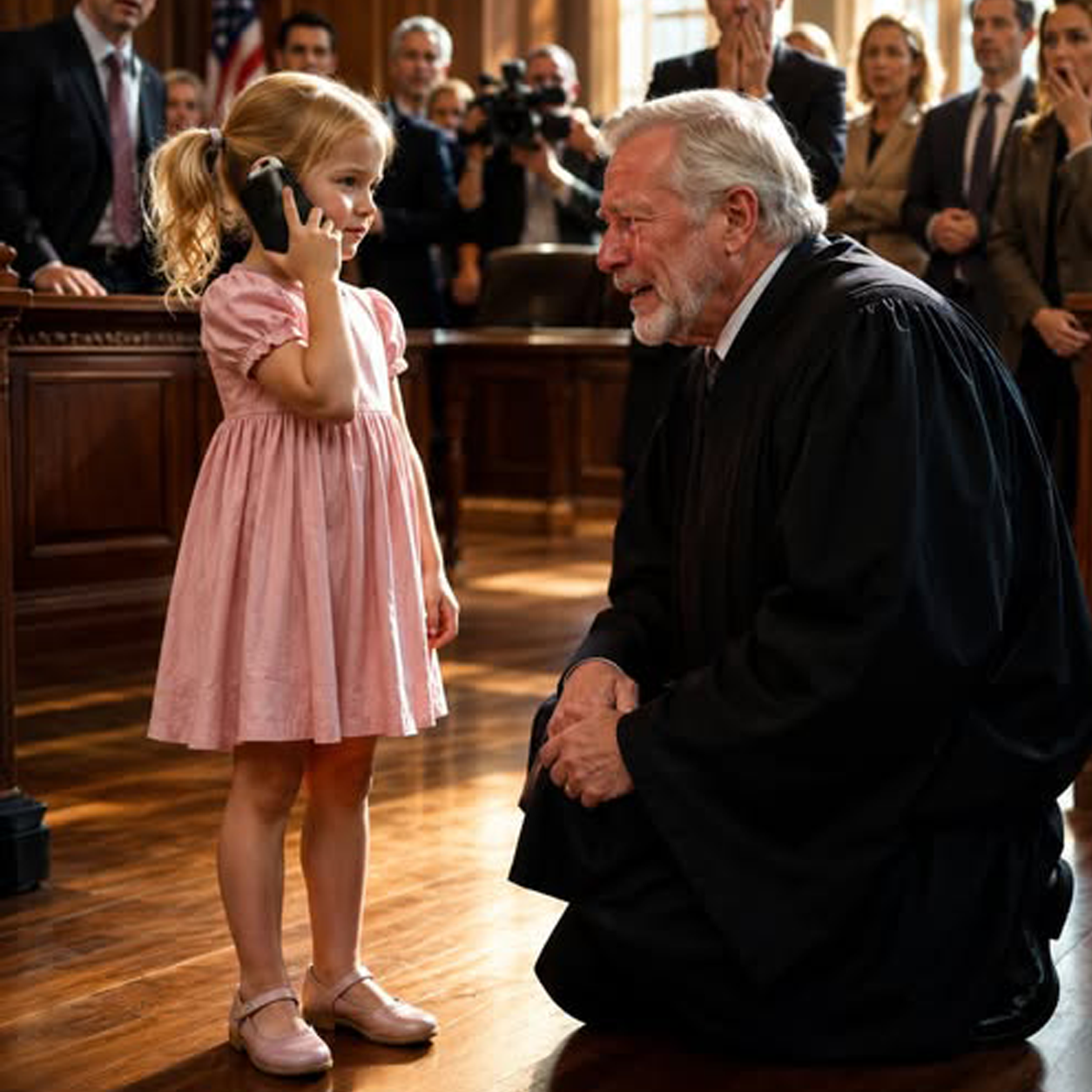
At the center of the courtroom stood a little girl in a pastel pink dress.
She could not have been more than four or five.
Blonde pigtails.
White socks.
Pink shoes with scuffed toes.
A serious little mouth.
And in both hands, held tightly against her ear, was a black smartphone she had absolutely no legal right to possess.
The phone belonged to Claude Foster, a custody attorney known across Savannah for his polished shoes, expensive suits, and ability to make even decent people feel underprepared for life. Claude was standing at counsel table with one hand hovering awkwardly near his empty coat pocket, unsure whether to object, retrieve the phone, or pretend none of this was happening.
The little girl had stolen it with the calm precision of a professional thief.
No one had seen her do it.
Not her grandmother in the gallery.
Not the attorneys.
Not Benjamin.
Not even Claude, who billed five hundred dollars an hour to notice details that harmed other people.
The child had slipped from the second row during a brief recess in a tense custody hearing, walked past the public railing as if she owned the courthouse, removed the phone from Claude’s jacket pocket, and returned to the center of the courtroom without running.
No panic.
No guilt.
No hesitation.
Just purpose.
Judge Miller had noticed her only when he heard the faint electronic beep of numbers being pressed.
He looked over the rim of his glasses and saw the tiny figure standing below his bench, dialing with the focus of someone performing emergency surgery.
“What are you doing down there, little one?” he asked.
His voice usually made grown men sit straighter.
The girl did not flinch.
“Calling.”
That was when the first amused whisper moved through the room.
Judge Miller leaned forward.
“Calling who?”
The little girl looked up at him, completely unbothered by the robe, the bench, the seal of the state, or the dozen adults staring at her.
“Whoever I want.”
That was when Henry Miller laughed.
Not a polite chuckle.
Not a restrained smile.
A real laugh.
A laugh that escaped before he could capture it and put it back behind the iron bars of his reputation.
The lawyers exchanged stunned glances. Benjamin found sudden interest in the ceiling. One reporter’s eyebrows lifted so high they nearly disappeared into her hairline.
Judge Miller wiped one eye with the side of his hand.
“All right, young lady,” he said, still smiling. “Call whoever you want.”
It was supposed to be a harmless moment.
A strange, sweet interruption in a bitter morning.
A child’s small rebellion inside a room built for adult conflict.
Then the call connected.
And the laughter began to die.
Not all at once.
Not like a light snapped off.
It faded slowly, painfully, as if the room itself sensed that innocence had stepped on something buried.
A woman’s voice came through the speaker.
Clear.
Frantic.
Too familiar.
“Mia? Mia, honey, is that you?”
Judge Henry Miller went completely still.
His hand remained half lifted in the air.
His mouth, open from laughter a second earlier, closed into a hard line.
Every person in the courtroom felt the shift.
The little girl smiled.
“Mom!”
One word.
One small, bright, ordinary word.
And suddenly everyone understood that this was no longer funny.
Henry Miller knew that voice.
He knew it better than he knew any statute, any precedent, any oath carved into the wall behind him.
It was Isabella.
His daughter.
The daughter who had not spoken to him in two years.
The daughter who had moved out of Georgia, changed her number twice, returned his letters unopened, and told him the last time they stood face-to-face that she never wanted to see him again until he understood what he had done wrong.
Now her voice filled his courtroom through a stolen phone held by a child he barely knew.
Mia.
His granddaughter.
The baby he had seen only three times in her life.
Once in the hospital.
Once during a stiff holiday visit before the rupture.
Once from across a sidewalk when Isabella spotted him, turned the stroller around, and walked away.
Now that baby stood below his bench in a pink dress, holding the phone toward him with absolute seriousness.
The courtroom turned its attention from the child to the judge.
Henry felt it.
The weight of the room.
The curiosity.
The confusion.
The public exposure of a private wound.
He could have ordered the phone taken.
He could have cleared the courtroom.
He could have hidden behind authority, as he had done so many times before.
Instead, he stared at Mia.
She had Isabella’s chin.
That stubborn little lift, like a challenge to the entire world.
She had Isabella’s eyes too.
Blue, direct, unafraid of consequence.
The kind of eyes Henry had spent thirty-one years misunderstanding.
“Mia?” Isabella’s voice trembled through the speaker. “Where are you? Who is with you?”
Mia looked around the courtroom.
“I’m in a big room.”
A few people inhaled.
“There’s a man in a black robe at the front. He was laughing.”
She paused, listening.
Then added matter-of-factly, “He stopped laughing now.”
Benjamin lowered his eyes.
The reporter in the back stopped typing.
Claude Foster’s face had gone pale.
Henry Miller gripped the edge of the bench.
His courtroom, the place where he had always been safest, suddenly felt like a room built to judge him.
Mia looked up at him again.
“Are you Grandpa Henry?”
The question struck him harder than any accusation could have.
There was a legal answer.
Yes.
The birth records said yes.
The family tree said yes.
The blood said yes.
But the truth was not so simple.
A grandfather showed up.
A grandfather knew birthdays.
A grandfather did not allow two years of silence to harden into pride.
A grandfather did not learn the shape of his granddaughter’s face in public, under courtroom lights.
Henry swallowed.
“I am.”
His voice came out rough.
Mia turned back to the phone.
“Mom, it’s him.”
Static followed.
Then a sound Henry had not heard in years.
His daughter crying.
Not loudly.
Not dramatically.
Softly.
Like she had learned to cry without expecting rescue.
Mia held the phone out toward him.
“She wants to talk to you.”
No one moved.
Then Judge Henry Miller did something no attorney in Savannah had ever seen him do.
He stepped down from the bench.
Three wooden steps.
That was all.
Three steps from authority to humanity.
Three steps from the high place where he ruled other people’s pain to the floor where his own waited for him.
The movement seemed to take forever.
His robe shifted around him. His silver hair caught the overhead light. His face looked suddenly older, not stern now, just tired. He crossed the small space between the bench and the girl in pink.
Then he knelt.
The entire courtroom watched the most feared judge in the county lower himself to eye level with a child.
Mia handed him the phone.
Her fingers were warm and sticky, probably from fruit snacks.
Henry took it with both hands.
“Isabella,” he whispered.
A breath on the other end.
Then, “Dad.”
One word.
It held two years of silence.
It held slammed doors, returned letters, unanswered calls, birthdays missed, custody battles ignored, medical appointments endured alone, and every old wound that had never healed because the man who caused it kept insisting he had acted properly.
“Isabella,” he said again.
Because for once, language failed him.
The judge who could turn a courtroom with one sentence had no sentence ready for his own child.
“What is happening?” he asked. “Why is Mia here?”
A long silence followed.
Not anger.
Not exactly.
A pause so heavy it felt like someone deciding whether truth deserved one more chance.
Then Isabella said, “Ask your ex-wife.”
Henry lifted his eyes.
In the second row of the gallery sat Elizabeth Miller.
His former wife.
Mia’s grandmother.
The woman who had once shared his home, raised his child, and finally walked away after eighteen years of trying to compete with a courthouse for her husband’s soul.
Elizabeth sat upright, hands clasped over her purse, face pale but steady.
She did not look triumphant.
She looked sad.
Determined.
And tired of waiting for Henry Miller to become brave on his own.
“You brought her here?” Henry asked.
Elizabeth did not answer.
She did not need to.
“Isabella,” he said into the phone, “what is this about?”
His daughter’s breath shook.
“The treatment.”
The word did not register at first.
“What treatment?”
Another silence.
Then Isabella said the word that emptied the room of air.
“Cancer.”
Henry’s knees nearly gave out beneath him.
“Stage two breast cancer,” she continued. “I’ve been in chemotherapy for four months.”
No one breathed.
Even the walls seemed to go still.
Henry held the phone so tightly his knuckles whitened.
Four months.
His daughter had been sick for four months.
Fighting for her life.
Losing hair.
Losing strength.
Sitting under fluorescent medical lights while poison entered her veins to save her body.
And he had known nothing.
“When were you going to tell me?” he asked.
His voice sounded strange to him.
Small.
“When you understood what mattered,” Isabella said.
That sentence landed in him like a gavel.
Because she had said it before.
Two years earlier.
In his chambers.
On a sweltering August afternoon when the air conditioning failed and the whole courthouse smelled like dust, sweat, and old paper.
Isabella had stood in front of his window with her arms crossed, exhausted and furious.
She was thirty-one then.
A pediatrician.
A mother.
A woman who had built her life by caring for children in ways Henry claimed to value in theory but rarely practiced in private.
She had come to him because her ex-husband, Robert Gaines, had been using Mia as leverage.
Keeping her past agreed visitation times.
Ignoring medical instructions.
Missing school meetings.
Letting the little girl spend nights in chaotic conditions while he complained in court filings about Isabella being “emotionally unstable.”
Robert was charming.
Educated.
Connected.
A man who knew how to stand before judges and sound reasonable while doing unreasonable things.
Henry had known him through legal circles.
Golf fundraisers.
Bar association dinners.
Shared acquaintances.
Respectable men protecting each other with the soft net of reputation.
Isabella had brought Henry documents.
Messages.
Missed handoffs.
Photos.
A daycare report.
A pediatric note.
She had not come asking him to break the law.
She had come asking him to see her.
To believe her.
To help her navigate a system he understood better than anyone.
Henry had listened like a judge.
Not a father.
He had leaned back in his chair, adjusted his glasses, and told her the matter was legally complex.
He had said he could not interfere.
He had said proper channels mattered.
He had said judicial integrity required distance.
He had said all the correct things.
Every one of them a failure.
“Are you telling me,” Isabella whispered that day, “that you are not going to help me?”
“I am telling you,” Henry said, “that you must follow the rules.”
“Mia is three years old, Dad. Three. She spent the last week in Robert’s care under conditions no child should be in, and you’re talking to me about protocol.”
His voice had hardened.
“Do not confuse my neutrality with indifference.”
She stared at him for a long time.
Then said, “Neutrality is just indifference wearing a robe when your own family is bleeding.”
That should have stopped him.
It did not.
Pride is a terrible editor.
It removes the sentence that might save you and keeps the one that makes you sound right.
So Henry told her, coldly, “You are too emotional to see this clearly.”
He had regretted it before the words finished leaving his mouth.
But regret without action is just vanity.
Isabella’s face changed.
Not anger.
Not even surprise.
Something worse.
Recognition.
She finally understood that her father would choose the bench over her every time if the bench allowed him to feel righteous.
She picked up her folder.
“You want to know what matters?” she said. “Your granddaughter matters. Your daughter matters. A child’s safety matters more than your reputation.”
Then she walked out.
That was the day the silence began.
At first, Henry told himself she would cool down.
Then weeks passed.
Then months.
Letters came back unopened.
Calls went unanswered.
Elizabeth refused to mediate.
“She told you what she needed,” Elizabeth said once. “You chose your answer.”
He buried himself in work.
Sentences.
Rulings.
Opinions.
Awards.
Professional respect.
The kind of success that claps loudly enough to hide an empty house if you keep the speeches going.
But silence has a way of sitting beside you at dinner.
Silence sat across from him on holidays.
Silence waited in the hallway when he came home from court.
Silence stood by the framed photo of Isabella at age seven, missing two front teeth, holding a school certificate she had once been desperate to show him.
He had missed that ceremony too.
Emergency hearing.
Important matter.
Proper channels.
Always proper channels.
Now, kneeling on the courtroom floor, Henry listened to Isabella breathe through a phone stolen by her child and understood that every proper channel had led him away from love.
“Mia is here because Robert filed for emergency custody,” Isabella said.
Henry turned his head slowly toward Claude Foster.
Claude looked down.
Robert’s attorney.
The man whose phone Mia had stolen.
The man who had Isabella’s private number saved in his contacts because he had been preparing filings against her while she underwent chemotherapy.
Henry’s stomach turned.
Isabella continued, “Robert is arguing that my cancer makes me an unfit mother. He says treatment makes me too weak to care for Mia. He wants full custody before my surgery.”
Henry closed his eyes.
Behind him, the courtroom remained frozen.
This was a custody hearing.
A hearing Henry had allowed onto his docket without recognizing that the child in the gallery was his own granddaughter.
Because he had not bothered to know enough.
Mia touched his sleeve.
“Grandpa?”
He opened his eyes.
Her face was serious now.
Not scared.
Watching him.
“Can you tell Mom to come home?”
That broke him.
Not cracked.
Broke.
Henry looked toward Benjamin.
“Clear the courtroom.”
The bailiff straightened.
“Your Honor?”
“Clear it. Now.”
Claude Foster opened his mouth.
“Judge Miller—”
Henry stood, and the old authority returned for one sharp second.
“Mr. Foster, you and opposing counsel will wait in separate conference rooms. This matter is suspended pending immediate review and reassignment. Say one word before I finish, and you will wish you had remained silent.”
Claude closed his mouth.
People rose slowly.
Confused.
Whispering.
Reporters tried to linger until Benjamin’s look convinced them otherwise.
Within minutes, the heavy doors clicked shut.
Only Henry, Mia, and Elizabeth remained.
The phone stayed connected.
A thin line between Savannah and a hospital room hundreds of miles away.
Henry looked at Elizabeth.
“You knew.”
“Yes.”
“And you didn’t tell me.”
“She asked me not to.”
His voice cracked.
“Why?”
Elizabeth stood from the gallery and came forward slowly.
“Because she wanted to know whether you would ever look up from your bench on your own.”
That was the second sentence that hit him like a gavel.
Henry looked down at Mia.
The little girl reached for his robe again.
“Are you sad?”
He tried to answer.
Could not.
His face collapsed before he could stop it.
He opened his arms.
Mia studied him for one careful second.
Then stepped into them.
She smelled like strawberry shampoo and crayons.
So small.
So warm.
So real.
Henry sank back to his knees and held his granddaughter for the first time since she was an infant.
Then he cried.
Not politely.
Not with dignity.
He sobbed.
Ugly, chest-deep sobs that tore through decades of discipline, arrogance, regret, and lonely dinners.
Mia did not pull away.
She patted his shoulder with one small hand, as if comforting him had been her plan all along.
On the phone, Isabella said nothing.
But Henry could hear her crying too.
For the first time in two years, the wall between them began to crack.
Not fall.
Not yet.
But crack.
That evening, Henry sat in Elizabeth’s kitchen drinking black coffee that tasted like regret.
Mia slept upstairs in the guest room with a stuffed turtle tucked under her chin.
The house was quiet except for the hum of the refrigerator and the faint creak of old wood settling in the walls.
Elizabeth sat across from him.
She had not softened with age.
Not in the way people mean when they say that.
Her hair was gray now, her face lined, but her eyes were as clear as ever.
“You knew everything,” Henry said.
“I knew enough.”
“Why bring Mia to court?”
Elizabeth looked at him for a long moment.
“Because you would not answer any door I knocked on. But you have always answered the court.”
He looked down.
That was true.
Cruel.
Accurate.
“I failed them,” he said.
“Yes.”
No comfort.
No immediate forgiveness.
Just the truth.
Henry nodded slowly.
“I failed you too.”
Elizabeth’s face changed.
Only slightly.
“Yes,” she said. “But today is not about me.”
That night, Isabella called at eleven.
They spoke for three hours.
It was not sentimental.
It was not easy.
It was the kind of conversation that scrapes old paint off the walls until everyone can see where the rot began.
This time, Henry did not defend himself.
He did not mention judicial ethics as a shield.
He did not explain his intentions.
He listened.
Isabella told him about the diagnosis.
The first lump.
The biopsy.
The call from the doctor.
The way she sat in her car afterward and screamed into both hands because Mia had been in school and she could not fall apart until pickup.
She told him about chemotherapy.
The nausea.
The exhaustion.
The hair in the shower drain.
The fear of dying before Mia was old enough to remember her mother’s voice.
She told him about Robert.
How he had learned about the cancer through insurance filings and turned it into a custody strategy.
How his attorney painted treatment as weakness.
How every medical appointment became evidence in his hands.
How she had fought him while fighting her own body.
“I needed a father,” she said.
Henry pressed the phone against his ear.
“I know.”
“No,” Isabella said. “You knew then.”
That clean pain again.
The kind that does not destroy, but demands transformation.
“You knew when I came to your office. You knew when I said Mia was not safe. You knew Robert was using the system. But it was easier to call yourself neutral than to admit helping me might cost you comfort.”
Henry closed his eyes.
“You’re right.”
The line went silent.
She had not expected that.
“I was wrong,” he said. “Not just in August. Long before that. I built a name in this city and called it a legacy. But my real legacy was supposed to be you. I missed that. I missed you.”
Isabella’s breath trembled.
“I don’t know what to do with your apology.”
“You don’t have to do anything with it tonight.”
“I’m tired, Dad.”
“I know.”
“No, you don’t.”
“You’re right,” he said. “I don’t. But I want to learn.”
Another silence.
This one was different.
Not a wall.
A bridge under construction.
Finally, Isabella asked, “How was Mia?”
Henry looked toward the staircase.
“She is brave.”
A faint laugh came through the phone.
“She is impossible.”
“That too.”
“She liked you?”
“I don’t know why.”
“She knows things,” Isabella said softly. “Children do.”
The next morning, Henry arrived at the courthouse before sunrise.
He did not go to his chambers.
He did not put on his robe.
He went to the clerk’s office and filed formal recusal paperwork from every case involving Isabella, Robert, Mia, or related custody motions.
The clerk looked shocked.
“Judge Miller, are you certain?”
“I am.”
By seven-thirty, the courthouse knew.
By eight, the attorneys knew.
By nine, half the Georgia legal community would know.
Henry did not care.
For the first time in his career, gossip felt small.
Then he went to the archives.
The basement smelled like dust, cardboard, old ink, and institutional regret. Rows of boxes stretched beneath fluorescent lights. Records from years of family court, civil disputes, probate matters, and lives reduced to numbers.
Henry requested everything connected to Robert Gaines.
Not to manipulate.
Not to interfere.
To understand what he had refused to see.
He found patterns quickly.
Late payments.
Contempt filings.
Manipulative emergency motions.
A history of using legal delay as punishment.
Witness statements dismissed as “domestic conflict.”
Custody exchanges missed and then reframed as misunderstandings.
Robert had been telling the court exactly who he was for years.
Henry had not listened because Robert dressed like respectability.
Gerald, the archivist, found him two hours later.
Gerald was seventy, thin, and quiet, the kind of man who knew where truth went when people stopped asking for it.
“You’re looking hard today, Judge.”
Henry looked up.
“I’m looking for the parts I missed.”
Gerald leaned against a stack of boxes.
“Those are usually not in the bold print.”
Henry almost smiled.
“No.”
Gerald watched him for a moment.
“My oldest daughter graduated from college while I was down here cataloging probate files. I told myself I was providing.”
Henry lowered the folder in his hands.
“She forgave you?”
“Somewhat.”
Gerald shrugged.
“Children don’t want only providers. They want witnesses. Someone to see them become who they are.”
That stayed with Henry.
Witness.
He had been a provider of rulings.
A witness to nothing.
He left the archives with copies organized properly and submitted through lawful channels to the new presiding judge’s clerk, along with a statement explaining his conflict and his prior failure to recognize it.
No pressure.
No interference.
Just truth placed where truth belonged.
By afternoon, Judge Marlene Price was assigned to the custody matter.
Strict.
Impartial.
Unmoved by reputation.
Known for reading every page.
Known for one guiding principle in family court: the child is not a trophy for adults to win.
Henry felt something close to relief.
The legal channels worked best when he got out of the way and stopped pretending his pride was principle.
The weeks that followed were not easy.
Henry flew to Isabella three times during her final cycles of chemotherapy.
The first visit was awkward enough to make both of them nearly retreat.
Isabella sat in a recliner under a beige hospital blanket, pale, scarf wrapped around her head, IV tubing attached to her arm. Henry stood near the door with flowers he had bought because he did not know what else to bring.
She looked at the flowers.
“Lilies?”
He froze.
“I’m sorry. I didn’t think.”
She sighed.
“They’re fine.”
“They’re not. I should have asked.”
That was new.
So she looked at him.
Really looked.
Mia saved them from the silence by demanding he draw a dragon.
“I don’t draw dragons.”
“Then learn.”
Henry, who had ruled on constitutional motions, estate disputes, business fraud, and custody cases with composure, spent forty minutes drawing what Mia declared “a sick lizard with wings.”
Isabella laughed.
It was small.
But real.
The second visit was better.
He brought no flowers.
He brought ginger candies, a soft blanket recommended by Elizabeth, three children’s books for Mia, and a notebook.
“What’s that?” Isabella asked.
“For me,” he said. “To write down what you need.”
She blinked.
“You’re taking notes?”
“I’ve spent decades taking notes on strangers. I can do it for my daughter.”
That almost made her cry.
Almost.
She told him she needed rides sometimes.
She needed someone to sit with Mia after school during treatment days.
She needed someone to help organize insurance documents because the paperwork made her want to scream.
She needed him not to fix everything by force.
She needed him not to make grand promises.
She needed consistency.
He wrote all of it down.
Then he did it.
Not perfectly.
But faithfully.
By the third visit, he and Isabella spoke about old things.
The camping trip when she was eleven and rained on.
The science fair where he arrived late but still remembered her volcano.
The night she got into medical school and he said he was proud, but then took a call before she finished telling him how scared she was.
“I remember that,” she said.
Henry looked down.
“I do too now.”
“That’s the worst part,” she said. “You were there sometimes, but only in pieces.”
He nodded.
“I want to learn how to be present whole.”
It was not poetry.
It was better.
It was true.
During that visit, Henry took Mia to a park near the hospital while Isabella rested.
Autumn sunlight moved through the trees.
Mia ran across the grass in a pink jacket, her energy wild and unbothered by adult tragedy. Henry sat on a bench and watched her like a man witnessing sunrise after years underground.
She returned with a smooth gray stone in her palm.
“For you,” she said.
He accepted it gravely.
“What is it?”
“A keeping stone.”
“A keeping stone?”
“Yes. You keep it in your pocket so you remember us when we are not there.”
Henry closed his hand around it.
The stone was cool.
Ordinary.
Priceless.
“I will keep it forever.”
“You better,” Mia said.
Then she ran back toward the swings.
Henry sat there, holding the stone, and understood that no plaque, award, judicial honor, or leather-bound opinion had ever meant what that small rock meant.
A child had given him something useless and made it sacred.
That was love.
The custody hearing concluded six weeks later.
Judge Price reviewed everything.
Medical evidence.
School records.
Robert’s history.
The documented neglect.
The manipulative timing of his filing.
Isabella’s treatment plan.
Her support network, now stronger because Henry and Elizabeth had both appeared in sworn statements—not to control the outcome, but to support Isabella’s stability.
Robert arrived in a navy suit with Claude Foster beside him.
He looked polished.
Concerned.
Reasonable.
Judge Price did not confuse presentation with parenting.
Primary custody remained with Isabella.
Robert received strictly supervised visitation pending compliance with counseling, parenting requirements, and review.
In her ruling, Judge Price said, “A parent’s temporary illness is not an invitation for the other parent to weaponize vulnerability. The court’s concern is not which adult appears stronger, but which adult has consistently protected the child’s welfare.”
Henry sat in the back row.
Silent.
He did not smile.
This was not victory.
It was correction.
Outside the courthouse, Isabella stood beside him with Mia between them.
“Thank you for not trying to control it,” she said.
He looked at her.
“I almost did.”
“I know.”
“I’m learning.”
“I know that too.”
Two months later, Isabella finished chemotherapy.
Her surgery was successful.
Her doctors used cautious, hopeful language.
Clear margins.
Strong response.
Excellent prognosis.
Remission.
Henry cried in the hospital hallway when he heard.
Elizabeth handed him tissues without comment.
Isabella decided to move back to Savannah after treatment.
Not because everything was fixed.
Because healing needs a village when pride stops blocking the road.
Henry retired at the end of the year.
The announcement stunned the courthouse.
At his retirement ceremony, attorneys praised his brilliance, discipline, legal mind, and twenty-three years of service. There were speeches. A plaque. A standing ovation.
Henry accepted it all politely.
Then he stepped to the microphone.
“I spent most of my career believing justice required distance,” he said.
The room quieted.
“Sometimes it does. But I mistook distance for virtue in places where love required presence. I was a good judge more often than I was a good father. That is not a legacy I am proud of.”
People shifted.
Uncomfortable.
He continued.
“The law matters. But people matter before they become cases. Families matter before they become filings. Children matter before adults turn them into arguments. I leave this bench grateful for the law, but more grateful for the little girl who reminded me to step down from it.”
Mia, seated between Isabella and Elizabeth, waved.
The room laughed softly.
Henry touched the gray stone in his pocket.
After retirement, his life became smaller in public and larger in every way that mattered.
Mornings in the garden.
Roses.
Tomatoes.
Weeds he fought with judicial intensity.
Afternoons picking Mia up from school.
Trips to the library.
Homework at the kitchen table.
Bedtime stories when Isabella had late clinic shifts.
He learned the names of Mia’s friends.
Her teacher.
Her favorite cereal.
Her fear of thunder.
Her opinion that peas were “small green lies.”
He learned to braid hair badly.
Then better.
He learned that being present was not grand.
It was repetitive.
It was showing up when nothing dramatic happened.
It was listening to a seven-minute story about a classroom hamster and treating it like testimony.
It was sitting beside Isabella during follow-up scans without offering empty certainty.
It was apologizing when he slipped into old habits.
It was letting Mia climb into his lap even when he had newspaper ink on his hands.
One Saturday morning, two years after the phone call, Mia sat at Henry’s kitchen table coloring a sea turtle.
She was seven now.
Taller.
Still serious when she wanted answers.
“Grandpa?”
“Yes?”
“Do you remember when I called Mom in the big room?”
Henry smiled.
“I remember it every day.”
“Why were you laughing?”
He set down his coffee.
“Because I thought you were funny.”
“I was serious.”
“I know that now.”
She studied him.
“Why did you stop laughing?”
Henry leaned back.
“Because I realized the person being judged in that room was me.”
Mia frowned.
“But you were the judge.”
“I thought I was.”
She considered that with the heavy seriousness of a child arranging the moral universe.
“Did I get you in trouble?”
Henry reached across the table and touched her hand.
“No. You got me home.”
Mia nodded, satisfied.
Then returned to her sea turtle.
That evening, the family gathered for dinner at Henry’s house.
Elizabeth brought pie.
Isabella brought a salad and teased him for overcooking the chicken.
Mia set the table and placed forks on the wrong side, then argued that “tables should be creative.”
Henry stood in the kitchen doorway and watched them.
Elizabeth laughing near the stove.
Isabella alive, strong, hair growing back in soft waves, eyes bright in a way he had once feared he would never see again.
Mia dancing with a spoon.
The room smelled like roasted chicken, butter, herbs, and home.
Not success.
Not prestige.
Home.
Later, after dinner, Henry and Mia sat on the porch swing.
The Savannah night spread soft around them.
Crickets sang.
The marsh air moved warm and slow.
Mia leaned against his shoulder.
“Grandpa?”
“Yes?”
“I love you.”
Henry closed his eyes.
Some verdicts take years to arrive.
This one was the only one that ever truly mattered.
“I love you too,” he said. “More than all the books in the world.”
“That’s a lot.”
“It is.”
She yawned.
He reached into his pocket and closed his hand around the small gray stone.
Still there.
Always there.
A reminder.
Not of the day he laughed.
Of the day he stopped.
The day a child in a pink dress stole a lawyer’s phone and reached through years of pride, silence, fear, and procedure to call a mother who needed help and a grandfather who needed to remember he had a heart.
People later told the story as if Mia had interrupted a hearing.
But that was not the truth.
She had interrupted a life.
A life built too high above the people it was supposed to love.
Henry Miller had spent decades believing the most important place in a courtroom was the bench.
He was wrong.
The most important place was the floor where he finally knelt.
Eye to eye with a child.
Phone in hand.
Daughter on the line.
Pride breaking.
Love waiting.
And from that lower place, he finally saw clearly.
A title cannot hold your hand.
A reputation cannot forgive you.
A courtroom cannot call you Grandpa.
In the end, the greatest judgment of Henry Miller’s life was not one he delivered from the bench.
It was the one he passed on himself.
And the sentence was simple.
Step down.
Go home.
Love them while there is still time.