During a family trip, I woke up inside a small boat, in the middle of a lake — alone with my 11-year-old daughter. No oars. No signal. My parents and sister were gone. There was a note: “You chose this.” I didn’t cry. I did this. Nine hours later, my parents and sister were calling their lawyers in a panic… During a family trip, I woke up inside a small boat in the middle of a lake alone with my 11-year-old daughter. No oars.
My parents and sister were gone. There was a note. You chose this. I didn’t cry. I did this. 9 hours later, my parents and sister were calling their lawyers in a panic.
First there was water, then nothing.
The lake lay still like glass stretched tight over silence. Smooth surface sky reflected pale and empty. Not a ripple, not a breath of wind, just the boat creaking softly beneath us like it had a life of its own.
We weren’t floating. We were suspended.
The sun slammed into my face the second I opened my eyes. Needles of light slicing through my eyelashes. My cheek burned. I blinked, sat up slowly.
My back achd. My legs were numb.
Where was I?
No, not that.
Where was everyone?
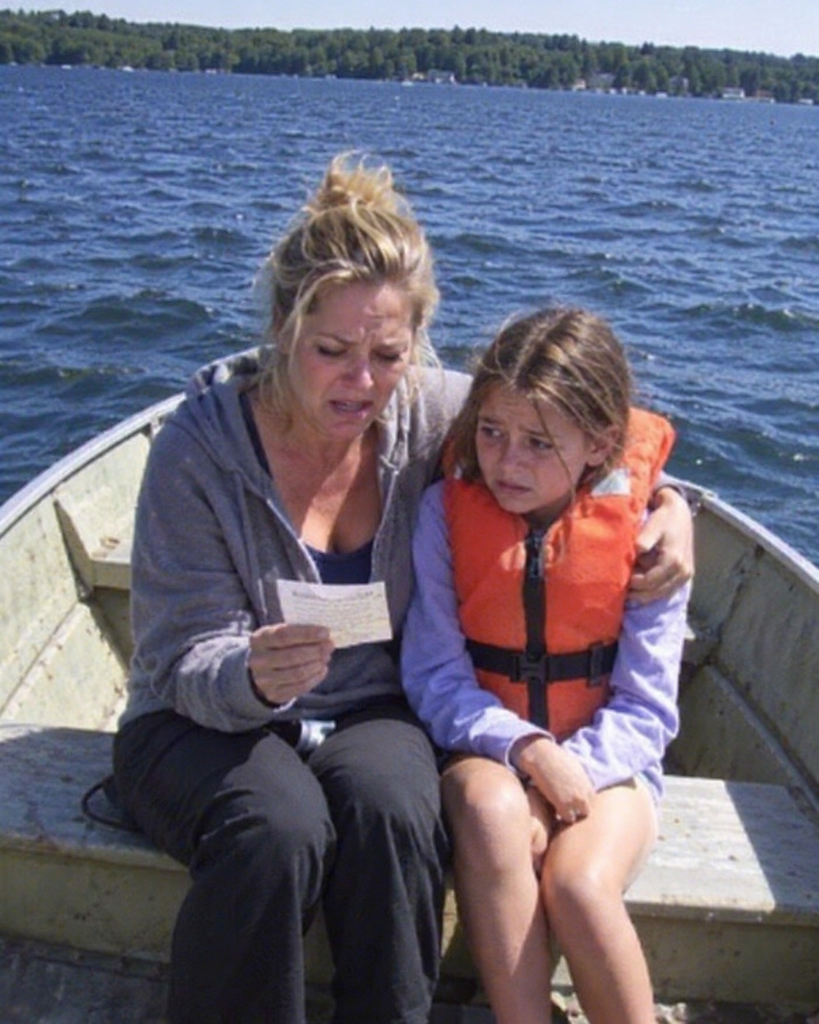
Maya was curled up on my lap, her cheek resting against my thigh. She looked peaceful, small, trusting. She was still in her life jacket.
I laid a hand on her shoulder without thinking. Like touch alone could push the nightmare away.
The shoreline was far. Or maybe it just felt closer than it really was. I could make out the shapes of trees, but no cars, no tents, no people, not even birds.
The forest didn’t whisper. The lake didn’t move.
It didn’t feel like nature. It felt like a scene wiped clean.
I turned my head and looked down into the boat, nearly empty. One backpack, a plastic water bottle, a small first aid kit, and a folded piece of paper pinned down with a smooth flat rock, crisp white, lightly creased like someone had crumpled it, then changed their mind.
I picked it up.
The paper crackled in my hand.
You chose this.
Typed black ink. No date, no signature, no emotion, but I heard her voice anyway.
Aaron, my sister.
That careful tone, that eyebrow tilt, that smile that always said, “You don’t really get it, do you?”
Maya stirred. I quickly slid the note back under the bag and pulled the zipper halfway.
My heart pounded in my temples. Sweat slid down my spine. The air thickened like right before a thunderstorm.
“Mom.”
Her voice was dry, almost.
“Where is everyone?”
I looked at her. She rubbed her eyes, sat up a little. Her gaze drifted to the shoreline.
“They left,” I said.
“Left? Where? Why? We just got here.”
She spoke like she was trying to figure out if this was a dream she couldn’t remember waking from. Her eyes moved from the water to the sky to the backpack to my hands.
“I don’t know,” I lied. “But we’re going to be okay.”
She didn’t answer.
Neither did I.
We just sat there surrounded by glassy water and nothing else.
Maya scooted closer. I wrapped my arm around her. My back burned from the sun. My shoulders were stiff. My stomach twisted.
Not from hunger, from fear.
Time passed. I don’t know how much. 5 minutes, 30, an hour.
Then Maya whispered, “Maybe it’s a game. Like in summer camp, like one of those survival quests. You follow clues. Solve the puzzle. Win a prize at the end.”
I didn’t say anything because I knew the answer.
This wasn’t a game.
This was the end of trust.
3 weeks earlier, things looked different. I was working night shifts, school runs during the day. Groceries, laundry, dishes.
Maya helped when she could, but she was still a kid, 11 years old, that in between age, not little anymore, not quite a teenager, quiet, fragile.
Sometimes I’d catch her humming while doing her homework. Other times she’d stare out the window like she’d aged 10 years in a month.
Mom called one night while I was sorting dishes.
“Caroline, we have an idea. Aaron found a place by the lake. Beautiful little house. We’re all going. Maya would love it. You know how important family is.”
I gripped the edge of the counter.
“Is this really about family or just about showing off how perfect Aaron’s life is?”
Silence.
Then that two smooth voice.
“Of course not. It’s just a weekend. You need to breathe. Maya needs a break. You don’t want her to feel isolated, do you?”
That’s how they did it.
Through guilt.
Through Maya.
Aaron, my younger sister, added me to the group chat. Everyone else was already there. My parents, her husband Dean, their daughter Samantha.
The only one missing was me until I gave in.
They sent photos. The lake, the dock, the trees.
“No reception, no emails, just you and nature,” Aaron wrote.
No reception felt like a warning, but Maya’s eyes lit up when she saw the pictures.
“Look, we can swim and boats. Do you think we’ll go fishing? Please, Mom, let’s go.”
After Michael died, Maya’s father, everything cracked.
No warning.
Just one night.
Heart failure.
I held it together in front of her. But at night, I’d hide in the bedroom. No lights, no sound, just silence and that kind of grief that never fully lands.
Maya never asked questions. She just started boiling the kettle herself, sitting beside me without a word.
She stopped laughing, started asking strange grown-up things.
“Are you always going to be alone now?”
That was when Aaron suggested the trip.
She said, “Maya needs a change of scenery. It’ll help both of you.”
And I thought, “Maybe, maybe she’s right. Maybe Mia needed something sunny, something with water, something that didn’t carry his shadow.”
We left on Friday morning, 5 hours on the road.
Maya sang, counted license plates, listened to audiobooks. I gripped the steering wheel like it was the only thing holding me together.
When we pulled up to the house, everything looked fine.
Too fine.
Aaron came out in a white t-shirt, hair perfect. Dean made jokes. Samantha was off to the side texting someone. Barely looked up.
My parents were on the porch with coffee mugs, but something felt off.
Not obvious, more like the silence that follows a fight no one mentions.
“Come in,” Aaron smiled. “It’s all ours for the weekend. You and Maya have your own room. Cozy closer to the woods.”
“The woods?” I asked.
“You like quiet, don’t you?”
I nodded.
Even though I didn’t.
Not that kind of quiet.
Now I look back and I wonder how I missed it. How I didn’t feel it. How I let them pull us in.
Maya sat next to me in the boat, knees hugged to her chest. She stared across the water, silent. I could feel her heart pounding through her back.
I reached for the note again.
Black letters.
Cold.
Final.
You chose this.
No, Aaron.
You did.
And now it’s starting to understand how we ended up alone on that lake.
You don’t need to go back 3 weeks. Just a few hours back to the morning that started almost happy.
Almost.
It was Saturday, day two at the lake.
After the heat of the day before, a storm had rolled in overnight. Thunder loud enough to make Maya crawl into my sleeping bag just like she used to during storms in Seattle.
By morning, it was quiet again.
The air thick, warm. Everything smelled like pine and damp wood.
Aaron was already on the porch lining up coffee mugs like trophies. Dean was pouring orange juice.
My mom stood behind my dad rubbing something menthol smelling into his shoulders like she was prepping him for a marathon, not breakfast.
Everything looked perfect.
Too perfect.
Too cheerful.
Too composed.
Only Samantha felt real, half slouched in a chair, tapping her phone screen with a single long fingernail.
“Boat day,” Aaron announced as if we’d been waiting all week for it. “Well hug the shoreline, then cut across the lake and head back from the west dock. Might even catch the waterfall if we’re lucky.”
“No cell phones, no emails,” Dean added. “Just nature and us.”
“And Pelican’s,” mom said, even though I hadn’t seen a single one.
I picked up a coffee mug and took a sip.
There was something odd about the taste.
Sweet, almost like honey, but not quite.
I wrinkled my nose. Told myself it was just a new brand.
Aaron stepped over and laid a hand on my shoulder.
“Don’t back out now. Mia’s already excited. Her eyes are glowing.”
I turned toward the dock.
Maya was adjusting the straps on her life jacket, tying her sneakers. She looked over, caught my gaze, and waved with both arms.
I nodded.
Something shifted inside me.
A creek I felt in my bones.
“I made tea, too,” Aaron said. “Chamomile and lavender calms the nerves. God knows you’ve been on edge.”
I didn’t argue.
Didn’t want to ruin the mood.
There were three boats, all motorized.
Aaron, Dean, and Samantha loaded into the first. My parents took the second. Maya and I got the third, smallest one.
There were ores tucked along the side just in case. Life jackets neatly folded on the bench. A fleece blanket, two bottles of water, and a thermos.
Maya climbed in first. I pushed off and followed.
The oars dipped into the water, and we glided forward.
“It’s pretty, right?” Maya asked.
“Yeah, it is.”
She leaned into me.
I opened the thermos, poured some tea.
The smell was sickly sweet.
Not like chamomile at all.
“Drink a little,” I told her. “So you don’t get queasy.”
She took a few sips, nodded.
“Mom, can I lie down for a bit?”
“Of course. Rest.”
She curled up under the blanket.
I kept rowing.
The oars made soft sounds. Aaron’s boat had already disappeared ahead. My parents were somewhere behind.
I could still hear their motor faintly, like a lawn mower in the distance.
Then my head started to spin.
My eyelids got heavy.
I set the oars down and leaned against the side of the boat.
The last thing I remember was the taste of tea and voices.
Laughter far, far away.
Then darkness.
When I opened my eyes again, sunlight was in my face.
Too bright.
The boat rocked beneath me. My mouth was dry.
I sat up fast.
Too fast.
My heart slammed into my ribs.
I looked around.
Nothing.
Just water.
Maya was still curled up at the bottom of the boat, her cheek red from the sun.
I reached over and touched her shoulder.
“Maya, wake up.”
She stirred.
Her eyes opened slowly, confused at first. Then she sat up.
“Where is everyone?”
I scanned the horizon.
No boats, no people, no sounds.
Our motor was dead.
Just a backpack, two water bottles, and a folded piece of paper pinned beneath a rock.
I picked it up, unfolded it.
You chose this.
A sentence.
A verdict.
Soft.
Final.
“Mom,” Maya whispered. “What is that?”
I didn’t answer.
I tucked the note into the backpack and zipped it shut.
Looked around again.
The shoreline was far, too far.
No buildings, no trails, just open water in every direction.
My hands trembled.
My stomach twisted.
There was a metallic taste in my mouth.
Minty.
The tea?
Of course.
“They drugged us,” I said aloud.
“What?”
“Do you remember falling asleep?”
“No, I was just tired. I thought it was from the sun, from the boat.”
I nodded.
They drugged us in the tea or the water. Made sure we were far enough out. Made sure we wouldn’t wake up until it was too late.
And then they left us because I said no.
Because I didn’t sign the paperwork.
Because I didn’t hand over the land.
Because I wasn’t useful anymore.
I looked at Maya.
Her breathing was fast, her lips pale.
“Mom, are we living here now?”
“No,” I said. “We’re getting out. I promise.”
I wrapped the blanket around her shoulders, held her close, stared up at the sky, and felt something solid lock into place inside me.
They thought they got rid of us.
They were wrong.
There had been a motor.
I remembered that clearly.
We were moving when Maya started yawning, and I’d even rode a little to keep us steady.
Now, the motor just dangled off the back, lifeless.
No key.
Cable detached.
The ores gone.
Completely vanished.
The boat drifted like someone had tossed it aside.
Their plan was perfect.
Leave us in the quiet.
No direction.
No exit.
I tried rowing with the lid of the backpack.
Then just my hands.
Pointless.
The boat spun in lazy circles but went nowhere.
The water was too still.
The current too subtle.
But the drift was real, slow, inevitable.
I watched the sun, the shadows.
We were moving, just not where we needed to go.
Maya was silent now.
No more questions, just a look.
That kind of look kids give when they already know the answer, but still hope you’ll say something different.
We shared one protein bar. I broke off the bigger half for her. Kept the corner for myself.
She chewed slowly, struggling.
Asked for water.
I gave it to her.
Didn’t drink any myself.
My throat was too tight.
When the sun climbed higher, I knew I couldn’t wait any longer.
My eyes said, “Listen to me carefully.”
She nodded.
“I’m going to swim. I have to.”
“No, Mom. No. Stay.”
“I can’t. We have no food. No way to call for help. If I don’t make it, someone will find you. But if we both stay, no one ever will. We disappear.”
“But you’ll come back.”
“I’ll do everything I can. Or I’ll send someone. I swear.”
She didn’t answer right away.
Then softly, “What if I fall asleep and wake up alone?”
“You won’t. You’ll sing to yourself like you do at home or make up stories or think about the park. Remember the park?”
She nodded again.
Her face was pale, white as paper.
I opened the backpack and took out everything that mattered.
The second bottle of water, the blanket, a life vest, one last bar.
Laid them all out in front of her.
“Don’t move. Don’t stand. Don’t shout unless someone’s close. If it gets too hot, cover yourself. If you see a helicopter, wave with anything you’ve got.”
I wanted to say you’ll be okay, but I couldn’t because I wasn’t sure I would be.
I grabbed a scrap of paper, scrolled, “My name is Caroline Harper. I’m swimming for help. My daughter Maya is in this boat. She is not alone. I’m coming back.”
I tucked the note beneath the water bottle and pressed it down.
Mia looked at me, eyes wide, not crying, but her bottom lip trembled.
If she cried, I’d break.
I took off my shoes, pulled my hair into a knot, handed her my jacket.
“Wear this so you don’t burn.”
“Mom.”
She whispered it like a secret.
“I love you.”
I nodded.
“I love you too, sweetheart.”
I hugged her tight, kissed her forehead, looked at her one last time, tried to memorize everything, every freckle, every eyelash.
Then I slipped into the water.
It was colder than it looked.
Not freezing, but cold enough to shock my body into a tight coil.
I started slow, deliberate strokes, not fast, just steady.
Don’t waste energy.
The lake smelled like algae and heat.
The air was thick pine and sunburn.
The only sound was my arms cutting through water.
I tried not to look back, tried not to check, but maybe 30 minutes in, I turned.
Maya was still there, still watching, a small shape against a sheet of glass.
I kept swimming.
Minutes stretched.
My back achd.
My arms burned.
I slowed, picked up again.
The shore was closer now, but barely, like the world itself didn’t want me to reach it.
The sun pounded the back of my neck.
I remembered everything I knew.
Use your shoulders.
Breathe every third stroke.
Keep your rhythm.
Sometimes I felt like everything was sinking.
Me, hope, everything.
But something kept whispering back.
A voice.
Not mine.
Deep.
Come.
Keep going.
Don’t stop.
I don’t know how long it took.
Time didn’t exist.
Just movement.
Just will.
Then land.
Rocks, pine trees, sand.
I made it.
I crawled out of the water like something half drowned.
My knees shook.
Fingers refused to work.
Breathing hurt.
Everything burned.
I stood there in soaked clothes, feeling like a rag rung dry.
I stepped forward.
Sand stuck to my feet.
Then I saw a trail.
Narrow but real.
I walked slow at first, then faster.
10 minutes later, I hit a clearing.
Gravel, tire tracks, dust.
I raised my arms, waved, screamed.
Nothing.
5 minutes, 10.
Then sound.
Tires.
I stumbled into the road.
A pickup truck.
Old rust red.
The driver, a man, maybe 50 in a baseball cap.
“Hey,” I shouted. “Help. My daughter. She’s in a boat. She’s alone.”
He break.
Got out.
“What happened?”
I spoke fast, jumbled.
He didn’t interrupt.
Just listened, then nodded.
Handed me a towel.
Helped me into the truck.
“We’ll call for help,” he said.
I had no phone.
He gave me his.
My hands shook.
I couldn’t type.
He dialed.
“Rangers will be there in 20. We’ll wait at the marina. I know a shortcut.”
We drove fast.
I didn’t speak.
Just stared out the window back toward the lake.
Maya.
She’s waiting.
Mia slept.
The room smelled like plastic, antiseptic, and warm cotton.
I sat beside her, eyes locked on her face.
Every breath an anchor, every exhale, proof that we were still here.
They’d transferred us to a clinic. I’d spend a night on four fluids, then under observation.
They said I was severely dehydrated, that I was lucky, that I made it.
I didn’t care.
In my head, we were still on that boat.
Maya was still out there alone waiting, even though now she was under soft blankets, safe, breathing.
The next morning, a man in uniform walked in.
Detective Blake come straight forward.
“We need to take your official statement.”
He said the situation raises serious concerns.
I told him everything from the beginning.
The invitation.
The tea with the strange taste.
The boat.
Waking up.
The note.
I handed it to him.
I’d kept it sealed in a plastic bag.
He read it carefully, then looked up.
“Any idea who might have left this?”
“Aaron. My sister.”
I’d thought about it a lot.
Too much.
I remembered her twirling a pen between her fingers in the kitchen, saying, “Just sign the trust paperwork. It makes everything easier. It all stays in the family anyway.”
I said, “No.”
Back then, I didn’t know what they were planning, but I knew something was off.
“Why would she do this?” he asked.
“Land,” I said. “A piece of property my aunt left me. My parents and sister wanted it added to the family trust. I refused, and then I found out developers were making offers. The city was planning a logistics hub. The land value jumped nine times. They found out before I did.”
He nodded.
“You believe you were drugged?”
“I know we were. We both fell asleep in the boat after a few sips of chamomile tea. We woke up drifting. No ors, no gas, no ignition key, everything disabled. I swam for, I don’t know, an hour, maybe two. Maya stayed behind alone.”
“Will you consent to a toxicology screen?”
“Yes. Whatever you need.”
That evening, he came back.
Preliminary talks results.
Both of us had traces of strong sedatives.
“This may constitute chemical sedation,” Blake said. “Given the isolation, the lack of food, no communication, and a child involved, this could qualify as attempted homicide.”
“What now?”
“We’ve sent the note for forensic testing. Also found fingerprints on the thermos lid. They match your sisters.”
My fingers went cold.
Later in the hallway, a doctor pulled me aside.
“You should know the clinic received an informal request, a psychiatric evaluation.”
“From a private lawyer?”
“From who?”
“Seattle. The paperwork lists a name. Aaron Hall.”
I didn’t react.
Just curled my hands into fists.
“What exactly did they want?”
“An assessment. Suspected emotional instability and concern regarding the safety of a minor daughter in the care of a grieving parent.”
I laughed.
Short, dry.
Of course.
That’s their next move.
A week later, we were back home.
Maya was eating again, talking a little, sleeping through the night.
Then the call came.
We were summoned to the station.
They said Aaron, Dean, and my parents had been brought in for questioning.
They arrived with lawyers.
All three claimed they had no idea how we ended up in the boat.
Aaron said she was depressed.
“After her husband died, she shut down. We thought she just left. We waited. We didn’t know what to do.”
Dean added, “Maybe she meant to hurt herself and the kid.”
But the evidence said otherwise.
The note.
Aaron’s fingerprints.
Paper chemistry matched stock from their home printer.
The thermos.
Traces of the same sedatives found in our blood.
Medical reports.
I was found mentally stable, fully competent.
Old text messages.
Me telling Aaron, I’m not signing anything until I know why you want the land.
But still, according to Detective Blake, those were all circumstantial.
Not enough for an attempted murder charge.
Then another twist.
A week later, my parents broke.
Probably the pressure.
Probably fear of real prison time.
First in a private interview with detectives.
Then under oath, my mother admitted she knew Aaron had a plan.
That she wanted to teach me a lesson, to make me understand what being alone feels like.
She said she didn’t stop her.
Said she knew the tea was drugged.
My father backed her up.
Yes, there had been conversations.
Yes, Aaron said I was being selfish.
That maybe if I got scared, I’d be more cooperative.
They insisted they never meant for anyone to die.
That the plan was to come back for us, that it got out of hand.
Of course, they said that.
But Maya and I were sedated.
Adrift.
No food.
No way to call for help.
No one searched.
No one even pretended to care.
Whether they meant to kill us or not didn’t matter anymore.
What mattered was that they made sure we wouldn’t come back.
And that was enough for the law.
My parents cut a deal.
In exchange for full testimony, they got 5 years probation.
No jail time.
But their statements changed everything.
Now there was motive, a method, a plan, and confirmation.
3 months later, the trial began.
The DA charged Aaron and Dean with conspiracy, child endangerment, reckless endangerment, and attempted serious harm.
They both plead not guilty.
Tried to blame it on me.
Caroline was unstable.
She was grieving.
She planned it herself.
But the judge saw the statements, the medical reports, the forensic analysis, the photos the rangers took of the boat.
Aaron got seven years, eligible for parole after four.
Dean got five, at least 2.5 mandatory.
Maya and I started over.
New house, small, quiet, windows facing an open field.
Every night she’d sit on the porch wrapped in a blanket reading.
She remembered everything, but she kept going.
Grew into herself.
Quiet, steady.
I moved the land into an irrevocable trust.
Maya’s name only.
No one could sell it, lease it, touch it, until she turned 25.
I pulled my funds from the family trust.
Airbnb closed.
Their cash flow dried up.
Everything they built collapsed in a day.
I didn’t scream.
I signed papers.
That night, we sat on the porch.
Maya flipped a page in her book.
“Mom,” she asked. “Did you really think we wouldn’t make it?”
I hugged her.
“I didn’t know, but I knew you wouldn’t give up.”
Sometimes revenge isn’t a scream.
It’s a form, a signature, a quiet line drawn in ink, and the silence you can finally breathe in.
Thank you for staying with us until the very end.
Do you think they deserve their sentence, or did it go too far?
Tell us in the comments.
And if this story hit something inside you, like, subscribe, and stay with us.
There’s more to come.