PART 1
“I told you she doesn’t belong here!”
Karen Whitmore’s voice cut through the quiet suburban street so sharply that three neighbors immediately stopped what they were doing.
Across the street, a woman unloading groceries froze with a carton of milk still in her hands.
Alyssa Carter wasn’t surprised.
She knew that expression.
The pursed lips.
The narrowed eyes.
The flushed cheeks.
The absolute certainty of a woman who seemed to believe every disagreement proved that someone else had violated rules she had invented moments earlier.
What Alyssa had not expected was Karen’s hand in her hair.
Alyssa had just returned from the grocery store.
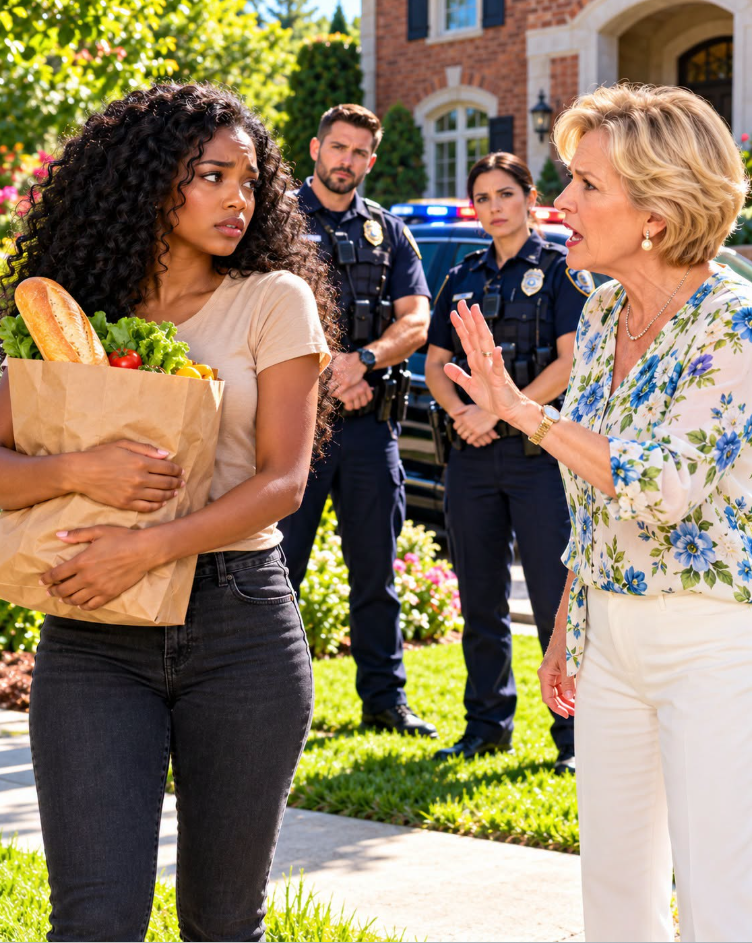
One paper bag rested against her hip. Her house keys were pinched between two fingers. Her fitted beige top was slightly wrinkled from the drive, and one of her ankle boots had picked up a streak of dirt from the curb.
She was barely ten feet from her front door when Karen appeared.
Not from her own property.
From the sidewalk.
And she wasn’t alone.
Two police officers stood beside her.
That was what made Alyssa stop.
Karen hadn’t come to complain.
She had come expecting backup.
Officer Daniel Pierce, a tall white man in his early forties, stood with his hands near his duty belt. Beside him was Officer Rachel Monroe, younger, alert, and visibly uncomfortable with the confrontation.
Karen pointed toward Alyssa before she had even reached the walkway.
“There she is.”
Alyssa looked from Karen to the officers.
“What is going on?”
Karen moved closer.
“You were told.”
Alyssa blinked.
“Told what?”
“That you cannot keep coming onto private property whenever you feel like it.”
For a second, Alyssa genuinely wondered whether she had misunderstood.
She glanced behind herself.
At the driveway.
At the mailbox.
At the wide two-story brick house she had unlocked almost every day for the past three years.
Then she looked at Karen again.
“This is my house.”
Karen gave a loud, incredulous laugh.
“No, sweetheart. This is the Carter residence.”
Alyssa stared at her.
“Yes.”
Officer Pierce finally spoke.
“Ma’am, do you have identification showing that you live here?”
The question itself wasn’t offensive.
It was everything surrounding it.
The assumption.
The certainty.
The fact that nobody had asked Karen for anything.
Alyssa slowly lifted her keys.
“I have keys.”
Karen immediately cut in.
“Anybody can have keys.”
Alyssa looked at her.
“I also have groceries.”
“That proves nothing.”
“My car is in the driveway.”
Karen scoffed.
“You could be a cleaner.”
Officer Monroe glanced toward Karen.
Alyssa caught the look.
So did Karen.
That only made Karen raise her voice.
“I called because I’ve seen her coming and going here for weeks.”
“Weeks?” Alyssa repeated.
“Yes.”
“And that made you think I was trespassing?”
“You don’t look like the people who own this place.”
The words landed heavily.
Alyssa went completely still.
Even Officer Pierce’s expression shifted.
Karen seemed either unable or unwilling to recognize the damage her words had caused.
“I mean, this neighborhood has standards. We have homeowners who travel. We have service people coming through. We have package theft. We have people pretending to belong.”
Alyssa’s jaw tightened.
Officer Monroe stepped forward.
“Mrs. Whitmore, let’s keep this factual.”
“I am being factual.”
“No,” Alyssa said quietly. “You’re being very clear.”
Karen turned sharply toward her.
“Don’t get smart with me.”
Alyssa adjusted the grocery bag against her hip.
“I’m trying to go into my house.”
Karen stepped directly in front of her.
“You’re not going anywhere until the officers verify who you are.”
Alyssa looked at Officer Pierce.
“Fine.”
She reached into her crossbody purse.
“I have my driver’s license.”
Karen suddenly grabbed her wrist.
Alyssa’s eyes widened.
“Don’t touch me.”
“Don’t reach into your bag.”
Officer Monroe immediately stepped forward.
“Mrs. Whitmore, let go of her.”
Karen released Alyssa’s wrist.
That should have been the end of it.
It wasn’t.
Alyssa took a step toward her front door.
Karen blocked her again.
Alyssa slowly exhaled.
“Move.”
“You don’t command me.”
“I’m not commanding you.”
Alyssa’s voice stayed remarkably calm.
“I am asking you to get off my walkway.”
Karen’s mouth twisted.
“Your walkway?”
“Yes.”
Karen laughed.
Then she raised her voice, apparently determined to make sure the officers heard.
“You hear this? She actually thinks she can just claim the house.”
Alyssa looked toward Officer Pierce.
“Can I please unlock my front door?”
Pierce hesitated.
Karen answered for him.
“No.”
Alyssa turned back.
“You don’t get to answer that.”
Something in Karen snapped.
Her hand shot forward and tangled into Alyssa’s long curls.
Alyssa stumbled.
The grocery bag tipped sideways.
An orange rolled across the pavement.
Officer Monroe shouted:
“Mrs. Whitmore!”
Karen yanked harder.
“I told you she doesn’t belong here!”
Pain tightened Alyssa’s face.
But she didn’t scream.
She didn’t swing.
She didn’t drop the keys.
Instead, she lifted her chin and said through clenched teeth:
“Get your hands off me.”
Karen pulled her closer.
“You better shut your mouth before I—”
Her other hand rose.
Palm open.
Ready to strike.
Officer Monroe lunged forward.
Too late.
The front door suddenly flew open.
Everyone turned.
A tall Black man stood in the doorway, wearing dark trousers and a fitted white dress shirt with the sleeves rolled to his forearms.
He had been on a conference call upstairs less than thirty seconds earlier.
His name was Marcus Carter.
He was thirty-nine.
A corporate attorney.
A husband.
And until that moment, a man who had spent nine months telling his wife that Karen Whitmore was irritating but probably harmless.
Marcus saw only one thing.
Karen’s fist tangled in Alyssa’s hair.
He went completely still.
One second.
That was all.
Then his expression changed.
He descended the steps quickly.
“Take your hands off my wife.”
Karen froze.
Her grip loosened immediately.
Marcus stepped between them and moved Alyssa behind him.
He did not shove Karen.
He did not raise his fist.
But something in his posture made her take a step backward.
“My wife,” he repeated.
Karen looked at Alyssa.
Then at the house.
Then at Marcus.
Her anger dissolved into confusion.
“What?”
Marcus kept his eyes on her.
“You heard me.”
Officer Pierce finally moved.
“Sir—”
Marcus turned toward him.
“And you two watched her put her hands on my wife?”
Officer Monroe answered immediately.
“I was moving to intervene.”
Pierce said:
“We were trying to verify residency.”
Marcus stared at him.
“Then verify it.”
He turned toward Alyssa.
“Are you okay?”
Alyssa nodded, though her breathing was uneven.
“I’m fine.”
Marcus looked at the strands of hair Karen had pulled loose.
“No, you’re not.”
Alyssa reached around him.
“Marcus.”
He turned slightly.
She held up her keys.
“I just want to go inside.”
His expression softened.
“Okay.”
Then he looked at the officers.
“You can come inside with us if you need to verify ownership.”
Karen suddenly laughed.
“You can’t be serious.”
Marcus looked at her.
“About what?”
“This is ridiculous.”
“You attacked my wife.”
“I did not attack her.”
PART 2
Three neighbors exchanged looks.
Officer Monroe said quietly:
“I witnessed physical contact.”
Karen’s face reddened.
“She was trespassing.”
Marcus pointed toward the house.
“She lives here.”
Karen shook her head.
“You don’t understand. I’ve been watching this house for months.”
Marcus’s eyebrows lifted.
“You’ve been watching my house?”
Karen hesitated.
“I’ve noticed suspicious activity.”
Alyssa finally spoke.
“Nine months, Karen.”
Karen looked at her.
“What?”
“You’ve been doing this for nine months.”
Alyssa’s voice remained calm.
“You’ve questioned me when I came home. You complained when I had packages delivered. You asked why my husband wasn’t with me. You called the homeowners association because I had friends over. You even asked a delivery driver whether I was ‘really’ the homeowner.”
Karen folded her arms.
“Because none of it looked right.”
Marcus stared at her.
“None of what?”
Karen didn’t answer.
Officer Pierce cleared his throat.
“Mrs. Carter, may I see your identification?”
Alyssa handed him her driver’s license.
Pierce looked at it.
Then at the address.
Then back at Alyssa.
He seemed uncomfortable.
“Thank you.”
Marcus turned to him.
“I can provide the deed.”
He disappeared inside for a moment.
Karen watched him go.
Then she looked at Officer Monroe.
“This is absurd.”
Officer Monroe said nothing.
Marcus returned with a folder.
He handed it to Pierce.
The officer opened it.
The deed was clear.
The property belonged to Marcus and Alyssa Carter.
Officer Pierce read the names again.
Then he looked toward Karen.
“Mrs. Whitmore, there appears to be no question that Mrs. Carter resides here.”
Karen’s face hardened.
“She could have changed her name.”
Alyssa almost laughed.
“She did.”
Karen frowned.
“What?”
Alyssa looked at her husband.
“We got married last year.”
Marcus nodded.
“That’s why she is Alyssa Carter.”
Karen opened her mouth.
Closed it.
Then opened it again.
“But—”
Officer Monroe interrupted.
“Mrs. Whitmore, you need to step back.”
Karen stared at her.
“You’re taking her side?”
“No.”
Officer Monroe’s voice was firm.
“I’m telling you what I observed.”
Karen looked around.
The neighbors were still watching.
The woman across the street had placed her groceries down.
The lawn mower remained silent.
For the first time, Karen seemed to realize that everyone had witnessed what happened.
Her confidence began to crack.
But Alyssa wasn’t interested in humiliating her.
She simply wanted the confrontation to end.
“Marcus,” she said softly.
He turned.
“Let’s go inside.”
He nodded.
Before they could move, Officer Pierce spoke.
“Mrs. Carter, I do need to ask whether you want to make a complaint.”
Alyssa paused.
She looked at Karen.
Karen looked back.
For nine months, Alyssa had swallowed every insult.
Every accusation.
Every suspicious glance.
Every unnecessary question.
She had told herself Karen was simply difficult.
She had told herself that responding would only make things worse.
But now Karen had crossed a line that could no longer be explained away as neighborhood tension.
Alyssa touched the side of her head where Karen had pulled her hair.
“Yes.”
Karen’s face changed.
“Alyssa—”
Alyssa looked directly at her.
“I want to make a complaint.”
Karen’s voice dropped.
“You’re really going to do this?”
Alyssa nodded.
“Yes.”
Officer Monroe asked for the details.
Alyssa described exactly what happened.
She did not exaggerate.
She did not add a single word.
She told them about Karen grabbing her wrist.
Blocking the walkway.
Pulling her hair.
Threatening to hit her.
The neighbors were asked whether they had seen anything.
One by one, they confirmed what they had witnessed.
The woman across the street said:
“I saw Karen grab her hair.”
The man with the lawn mower nodded.
“I saw it too.”
Another neighbor came out onto his porch.
“I heard her yelling before I looked over.”
Karen stared at them in disbelief.
“You’re all against me?”
Nobody answered.
That silence said enough.
Eventually, the officers asked Karen to explain her side.
She claimed Alyssa had been acting suspiciously.
She said she believed Alyssa was trespassing.
But when asked why she had never contacted the police before that day, Karen couldn’t give a clear answer.
When asked why she had grabbed Alyssa, she said she had been frightened.
Officer Monroe calmly replied:
“You approached her.”
Karen’s lips tightened.
“She was reaching into her purse.”
“For identification.”
“I didn’t know that.”
“You were told.”
Karen said nothing.
The report took nearly forty minutes.
By the time the officers finished, the street had grown quiet again.
Karen received instructions regarding the complaint and was told not to approach Alyssa.
She looked humiliated.
But Alyssa didn’t feel victorious.
She felt tired.
Deeply tired.
Marcus stood beside her.
When the officers finally left, he closed the front door.
For several seconds, neither of them spoke.
Then Marcus turned.
“I owe you an apology.”
Alyssa looked at him.
“For what?”
“For telling you she was harmless.”
Alyssa sighed.
“You didn’t know she’d do this.”
“I should have listened.”
“You did listen.”
“No.”
Marcus shook his head.
“I heard you. That’s different.”
Alyssa looked down.
The grocery bag was still sitting outside.
One orange had rolled all the way toward the curb.
Marcus noticed.
He opened the door again and retrieved it.
When he came back inside, Alyssa was standing in the foyer.
PART 3
He put the orange into the bag.
Then he looked at her.
“I don’t want you dealing with her anymore.”
Alyssa gave a small, exhausted smile.
“I don’t want to either.”
But the incident did not end with the police report.
The next morning, Karen’s behavior changed.
She stopped speaking to Alyssa.
She stopped waving.
She stopped appearing outside whenever Alyssa came home.
But the silence wasn’t peaceful.
It was watchful.
Alyssa noticed Karen’s curtains moving whenever she walked down the street.
Then, three days later, a letter arrived from the homeowners association.
Alyssa opened it at the kitchen counter.
Her face changed as she read.
Marcus looked up from his coffee.
“What is it?”
Alyssa handed him the letter.
It contained several complaints.
Unauthorized occupants.
Excessive visitors.
Suspicious activity.
Violation of neighborhood standards.
Marcus read it twice.
Then he looked at Alyssa.
“This is from Karen.”
“She didn’t sign it.”
“She didn’t have to.”
Marcus picked up his phone.
“I’m calling the HOA.”
Alyssa stopped him.
“Wait.”
“Why?”
“Because I don’t want this to become a war.”
Marcus sat down.
“What do you want to do?”
Alyssa thought about it.
Then she said:
“I want facts.”
Marcus nodded.
“Okay.”
They requested the HOA records.
They asked for the original complaints.
They asked for the dates.
They asked for the evidence supporting them.
And what they discovered surprised even Marcus.
Most of Karen’s complaints contained almost identical wording.
Suspicious woman.
Unknown occupants.
Unusual traffic.
Possible unauthorized residency.
But there was almost never any actual evidence.
One complaint had been filed on the exact day Alyssa had returned from visiting her mother.
Another had been filed after Alyssa hosted a birthday dinner.
A third had been filed because Alyssa had a moving company deliver furniture.
Karen had apparently been documenting Alyssa’s ordinary life and labeling it suspicious.
Then Marcus noticed something else.
One complaint had been filed the day after Alyssa’s promotion announcement.
He looked at his wife.
“Did you tell Karen about your promotion?”
“No.”
Marcus stared at the document.
“Then how did she know?”
Alyssa went quiet.
That question stayed with them.
Until another piece of information surfaced.
The HOA manager had received an email from Karen several months earlier.
In it, Karen had complained that the Carter house had been purchased by “people who don’t fit the established character of the neighborhood.”
Marcus read that sentence several times.
Alyssa sat silently beside him.
For the first time, the entire situation looked different.
This wasn’t about noise.
It wasn’t about parking.
It wasn’t about safety.
It wasn’t even about property.
Karen had decided that Alyssa did not belong.
And then she had spent months searching for reasons to justify that belief.
Marcus forwarded the documents to their attorney.
Alyssa didn’t want revenge.
She wanted boundaries.
The attorney helped them formally notify the HOA and Karen that any further harassment, surveillance, or unwanted contact would be documented.
The police report remained on file.
The neighbors who had witnessed the confrontation gave statements.
And for the first time in nine months, Alyssa stopped trying to make herself smaller to keep someone else comfortable.
Weeks passed.
Karen stayed away.
The neighborhood gradually returned to normal.
One Saturday morning, Alyssa stood outside watering the flowers along the walkway.
The same walkway Karen had once told her she didn’t belong on.
Alyssa looked toward the sidewalk.
The street was quiet.
A car passed.
A dog barked in the distance.
Then she heard footsteps.
She turned.
It was Officer Rachel Monroe.
She had come by to follow up on the report.
Alyssa smiled politely.
“Officer Monroe.”
“Mrs. Carter.”
They exchanged greetings.
Monroe looked toward the house.
“Everything been quiet?”
“Yes.”
“Good.”
There was a pause.
Then Monroe said:
“I wanted to tell you something.”
Alyssa waited.
“When this happened, you handled yourself better than most people would have.”
Alyssa gave a small smile.
“I was scared.”
“I know.”
“I just didn’t want things to get worse.”
Monroe nodded.
“That restraint mattered.”
Alyssa looked toward the front door.
“I kept thinking that if I ignored her, she’d eventually stop.”
“Sometimes people stop when you set boundaries.”
“And sometimes?”
Monroe looked at her.
“Sometimes you have to make it clear that the boundary is real.”
Alyssa nodded.
After the officer left, she stood quietly for a moment.
Then Marcus stepped onto the porch.
He held two cups of coffee.
“One for you.”
Alyssa took it.
“Thank you.”
He looked at her.
“You okay?”
She smiled.
“Yeah.”
Marcus glanced toward the sidewalk.
“You know what I keep thinking about?”
“What?”
“The moment the door opened.”
Alyssa laughed softly.
“You mean when you scared Karen half to death?”
“I wasn’t trying to scare her.”
“You absolutely scared her.”
Marcus smiled.
Then his expression became serious.
“I keep thinking that I almost didn’t hear anything.”
Alyssa looked at him.
“I was upstairs. I was on a call. If I hadn’t happened to finish when I did…”
He didn’t finish.
He didn’t need to.
Alyssa reached for his hand.
“But you did.”
Marcus squeezed her fingers.
“Yes.”
She leaned against him.
The house behind them was quiet.
Their home.
Their front door.
Their walkway.
Their lives.
Everything Karen had spent months questioning was still exactly where it had always been.
Alyssa looked down at the flowers.
Then she smiled.
“You know what?”
“What?”
“I think I’m finally going to plant roses here.”
Marcus raised an eyebrow.
“Why roses?”
“Because Karen always said they were too much work.”
Marcus laughed.
“Then we’re definitely planting roses.”
And they did.
A few months later, the roses began to bloom.
Neighbors stopped to compliment them.
Children walked past the fence on their way home from school.
The woman across the street sometimes waved.
Even the man with the lawn mower occasionally stopped to admire the garden.
Karen never spoke to Alyssa again.
Eventually, she moved away.
No dramatic confrontation followed.
No public revenge.
No humiliating speech.
Just distance.
And perhaps that was the strongest ending of all.
Because Alyssa never needed to prove that she belonged.
She had never needed permission.
She was home.
She had been home the entire time.
And the day Karen grabbed her hair outside that front door, she thought she was exposing someone who didn’t belong.
Instead, she exposed something else entirely:
how quickly assumptions can become cruelty when nobody challenges them.
And how powerful it can be when the person being targeted finally says:
Enough.
Alyssa never forgot that day.
But she also refused to let it define her.
She kept walking through that front door.
She kept planting flowers.
She kept living her life.
And every time she passed the spot where the orange had rolled across the pavement, she remembered something Marcus had told her that night.
“You never have to earn the right to stand in your own home.”
Alyssa had believed him.
This time, she believed herself too.