I can still smell that Christmas morning.
Not the cinnamon rolls my mother always burned around the edges. Not the pine candle she kept lit on the mantel because the tree was fake and she hated admitting it. Not even the coffee my father drank too strong and too black while he sat in his recliner like some retired judge waiting for everyone else to disappoint him.
No.
What I remember most is the smell of torn wrapping paper. That dusty, papery smell mixed with sugar frosting, carpet cleaner, and betrayal.
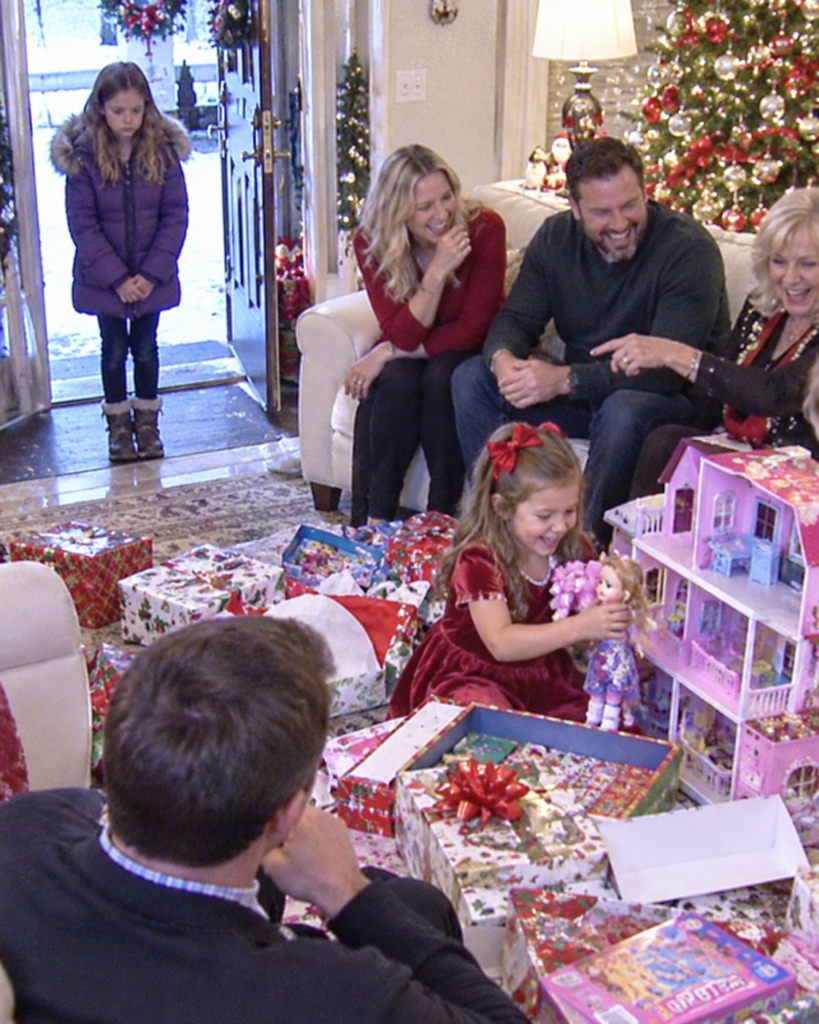
My daughter Emma stood in the doorway of my parents’ living room in her purple winter coat, one mitten hanging loose from her sleeve, her little mouth open but no sound coming out. She was seven years old—old enough to read her own name, old enough to understand fairness, old enough to know when people were laughing at her pain.
And across the room, my nephew Lucas sat in the middle of a wreckage pile of gifts.
Her gifts.
Every single box I had wrapped the night before Christmas Eve. Every tag I had written with a silver marker:
To Emma, Love Mom.
To Emma, Merry Christmas.
To Emma, because you make my whole world brighter.
All opened. All destroyed.
And my parents were laughing.
My mother had one hand pressed to her chest like Lucas was putting on a Broadway show just for her. My father leaned back in his recliner with a drink in his hand, smiling in that lazy way he had when he didn’t want to be responsible for anything happening in front of him. My brother Kyle sat on the couch with his wife Jennifer, both of them wearing matching Christmas sweaters and the kind of smug little smiles people wear when they know they got away with something.
Lucas held the dollhouse.
The dollhouse.
The one Emma had pressed both hands against the store display case to look at for nearly ten minutes. The one with voice buttons, tiny lights, a miniature kitchen, a little balcony, and furniture so detailed that she whispered, “Mommy, it looks like people could really live there.”
I had worked overtime for that dollhouse.
I had skipped buying myself new boots even though mine leaked in the rain. I had eaten leftovers for lunch for two weeks. I had stood in the toy aisle with that huge box balanced against my hip and cried a little because I knew her face would be worth every penny.
Now Lucas was smashing two tiny chairs together, one already missing a leg.
Emma took one step forward. “That’s mine,” she said.
It came out so soft that the Christmas music almost swallowed it.
Lucas looked up, cheeks sticky with cinnamon icing. “No, it’s mine.”
My mother smiled like Emma had said something adorable. “Sweetheart, Lucas opened the presents this morning. He was so excited. You can share.”
I blinked at her.
Share.
The word landed in my chest like a stone.
“Mom,” I said slowly, because part of me still believed there had to be some explanation. “Those presents had Emma’s name on them.”
My mother waved her hand.
That hand wave had been the soundtrack of my life.
When I was ten and told her Kyle had taken money from my piggy bank. Wave.
When I was sixteen and asked why Dad came to every one of Kyle’s baseball games but skipped my awards ceremony. Wave.
When I was twenty-nine and newly divorced, trying to hold myself together while she said, “Well, marriage is work, Hazel.” Wave.
And now, when my daughter stood in front of her entire family watching another child play with the Christmas I had built for her piece by piece. Wave.
“Oh, Hazel,” she said. “Don’t start. They’re just things.”
Emma looked up at me. Her eyes were wet already, but she was fighting it. My sweet girl had learned too young how to hold tears in her throat because adults around her hated being made uncomfortable.
“Mommy,” she whispered. “Those were mine?”
I wanted to kneel down and wrap myself around her like armor. Instead, I stared at my mother.
“They weren’t just things,” I said. “They were her Christmas presents.”
Kyle laughed. Actually laughed.
“Come on, Hazel. He’s four. He saw presents and got excited. What were we supposed to do, tell him no on Christmas?”
“Yes,” I said. “That is exactly what you were supposed to do.”
Jennifer lifted her eyebrows. “Wow. Okay. Maybe Emma needs to learn that family shares.”
Part 2
Jennifer’s words, “Maybe Emma needs to learn that family shares,” hung in the warm, scented air of the living room like a slap.
I looked at Jennifer. I looked at Kyle, who was smirking while taking a slow sip of his eggnog. I looked at my mother, who had already turned her attention back to Lucas, making silly faces as he ripped off the delicate balcony railing of Emma’s dollhouse with a sickening plastic crunch.
Emma didn’t cry out. She just flinched. That tiny, subtle flinch cut through me deeper than any scream could have.
I didn’t yell. I didn’t throw a scene. Instead, a icy, crystal-clear stillness settled over my bones. The thirty years of being the second-tier child, the resilient daughter who was always expected to absorb the damage so everyone else could stay comfortable—it all burned away in a single breath.
I reached down and gripped Emma’s small, mitten-covered hand.
“Emma, sweetie,” I said, my voice dangerously calm. “Go put your boots back on. We’re leaving.”
My mother stopped her exaggerated cooing and snapped her head toward me. “Hazel, don’t be ridiculous. Dinner is in two hours. Your father bought a ham.”
“Keep the ham, Mom,” I said.
“Oh, for God’s sake, Hazel!” Kyle snorted, leaning back on the plush sofa. “Don’t ruin Christmas over a plastic toy. You’re being hysterical. You always do this—make everything about you.”
I looked Kyle straight in the eyes. “He ruined her entire Christmas, Kyle. And you let him. You taught him that what belongs to her is his for the taking.”
“He’s four!” Jennifer interjected, her tone shrill and defensive. “He doesn’t understand tags!”
“He can’t read, but you can,” I said, stepping closer to the coffee table. “My father can. My mother can. Every single one of you watched him tear open boxes marked with her name, and not one of you had the spine to say, ‘No, Lucas, that belongs to Emma.’”
My father cleared his throat from his recliner, shifting his heavy frame. “Hazel, watch your tone in my house. You’re making a mountain out of a molehill. Let the kids play. She can have it when he’s done.”
When he’s done. When it was broken, scraped, and discarded. Just like every hand-me-down sweater, every broken bicycle, and every piece of praise I had ever been offered in this family.
I didn’t answer him. Instead, I walked right into the middle of the room. I bent down in front of Lucas. He looked up at me with sticky fingers, clutching the remaining miniature chairs.
I took the tiny plastic chairs gently out of his hands.
“Hey!” Lucas whined, reaching for them.
“Hazel, leave him alone!” my mother barked, standing up so fast her knees bumped the oak coffee table.
I ignored her. I gathered the main dollhouse frame, the loose pieces, the shredded cardboard box, and every single tag bearing silver ink. I picked up the half-broken pieces of Emma’s other gifts—the velvet hair bows, the storybooks with bent covers—and piled them into my arms.
“What are you doing?” Kyle demanded, rising from the couch, his face flushing red. “You’re taking toys away from a toddler? What kind of monster are you?”
“These aren’t his toys, Kyle,” I said, turning to face him. My voice was steady, vibrating with an authority I hadn’t known I possessed. “I paid for them. I earned them. And if my daughter isn’t allowed to enjoy her gifts here in peace, then none of you deserve to watch her grow up.”
My mother’s face went pale. “Hazel… you don’t mean that.”
“I’ve meant it for ten years, Mom. I just finally had the courage to say it.”
I walked past them all. I didn’t look at my father, who was suddenly sitting up straight, his lazy smile completely erased. I didn’t look at Jennifer, whose mouth was agape in shock.
I reached the front hallway where Emma was standing quietly, her coat still zipped, watching me with wide, tear-filled eyes. I packed the broken dollhouse and damaged gifts into two large black garbage bags I grabbed from the kitchen cabinet, loaded them into the trunk of my beat-up sedan, and buckled Emma into her booster seat.
As I started the engine, my mother ran out onto the porch without her coat, hugging her arms against the biting winter wind. She banged on my passenger window.
“Hazel! Stop this drama! Come back inside! You’re breaking your father’s heart!”
I rolled down the window just two inches. The cold air rushed in, mixing with the warmth of the car’s heater.
“My father’s heart was never involved, Mom,” I said softly. “And neither was yours.”
I rolled the window back up and drove away into the white, quiet morning, leaving my mother standing alone on the icy driveway.
Part 3
The drive back to my tiny two-bedroom apartment was silent. The snow had started to fall in heavy, soft flakes, blurring the windshield. In the rearview mirror, I could see Emma staring out her window, her little forehead pressed against the glass.
My heart was beating wildly against my ribs. The adrenaline was beginning to fade, leaving behind a cold, sickening hollow. I had just severed ties with my family on Christmas Day. I had no backup presents. My bank account was practically empty after buying that dollhouse and the groceries for the month.
When we parked outside our building, I helped Emma out of the car. We carried the black bags up the three flights of stairs to our apartment.
Inside, our apartment was quiet and warm. Our small, artificial tree stood in the corner—modest, decorated with handmade paper ornaments and popcorn strings we had made together. Underneath it, there was nothing.
I sat down on the living room rug, exhausted, and pulled the broken plastic dollhouse out of the bag. The balcony was snapped off. The tiny front door was hanging by a single plastic hinge. One chair was smashed beyond repair.
I felt a hot tear finally slip down my cheek.
“I’m sorry, Emma,” I whispered, wiping my eye quickly so she wouldn’t see. “I’m so, so sorry, baby. Mommy tried to make today perfect. I worked so hard…”
Suddenly, two tiny arms wrapped around my neck from behind. Emma buried her face in the crook of my shoulder. Her body shook with small, quiet sobs.
“It’s okay, Mommy,” she sniffled, her voice tiny and sweet. “I don’t care about the house.”
“You loved that house,” I murmured, turning around to hold her tight against my chest.
“I loved it because you gave it to me,” she said, looking up at me with clear, honest eyes. “I was just sad because… because Grandma and Grandpa didn’t like me.”
Her words shattered what was left of my composure. Children are far too perceptive. She hadn’t been crying over plastic; she had been crying because she felt invisible in a room full of people who were supposed to love her.
“Oh, sweetie,” I said, kissing her forehead over and over. “They don’t know how to love properly. That has nothing to do with you. You are the brightest, sweetest, most amazing thing in this world. Don’t you ever forget that.”
I pulled back and looked at the damaged dollhouse. Then, I looked at Emma.
“You know what?” I said, a sudden spark blooming in my chest. “It’s broken. But we know how to fix things, don’t we?”
Emma blinked, wiping her cheeks with the back of her sleeve. “We do?”
“We do.”
For the next four hours, Christmas turned into something entirely different.
I pulled out my craft box—superglue, acrylic paint, colored cardstock, fabric scraps from old sewing projects, and a hot glue gun. We sat together on the floor with Christmas music playing softly from my phone.
We glued the balcony back together, reinforcing it with miniature popsicle sticks painted to look like real wood. We fixed the little front door. For the broken chair, we crafted a brand-new cozy beanbag chair out of a stray red sock and cotton balls. We made tiny paintings out of cardboard to hang on the dollhouse walls, and cut out little rug circles from felt scraps.
By 4:00 PM, the dollhouse wasn’t just restored—it was unique. It didn’t look like a store-bought toy anymore; it looked like a home built with real love.
Emma spent the rest of the afternoon sitting by the window, moving the little plastic figures through their newly renovated rooms, humming happily to herself.
My phone had been buzzing nonstop on the kitchen counter since noon.
14 missed calls from my mother. 8 text messages from Kyle calling me ungrateful and selfish. 1 voicemail from my father, his voice stern, telling me I was acting like a child and demanded I bring Emma back to apologize for ruining the family gathering.
I listened to the voicemail once. Then, slowly and deliberately, I deleted it. I opened my contacts, selected their numbers, and blocked every single one of them.
No more hand waves. No more playing the quiet victim. No more letting them make my daughter feel second-best.
That evening, I baked a simple batch of chocolate chip cookies. The apartment smelled of vanilla, warm sugar, and melted chocolate. We didn’t have a grand ham or expensive champagne, but as Emma and I sat on the sofa wrapped in a fleece blanket, eating fresh cookies and watching Christmas movies, a profound sense of peace settled over me.
Emma leaned her head against my arm, her eyes heavy with sleep.
“Mommy?” she murmured softly.
“Yes, baby?”
“This was the best Christmas ever.”
I smiled, pressing my lips to the top of her hair.
“Yes, it was, my love. Yes, it was.”
For the first time in my life, I didn’t care about the expectations of the people who shared my blood. I had built a real home right here in this tiny apartment—a home built on respect, boundaries, and unconditional love. And that was the greatest gift I could have ever given us both