Then he installed cameras.
“For security.”
Then he wanted to know where I was every hour.
“For safety.”
Then he started taking my phone whenever we argued.
“So we can communicate without distractions.”
Words changed.
Behavior didn’t.
Control slowly replaced partnership.
My finances became “our finances.”
Then our finances became his finances.
My access to certain accounts disappeared.
Passwords changed.
Cards stopped working.
If I questioned him, he smiled.
“Why are you worried? I’m your husband.”
By our third anniversary, Ethan believed he controlled everything.
The house.
The company.
The money.
My movements.
My relationships.
Me.
What he never fully understood was who I had been before I became his wife.
Before Ethan.
Before Apex Development.
Before charity dinners and expensive dresses and photographs beside buildings with his name on the plaques.
I had worked as a forensic accounting investigator supporting U.S. military financial investigations.
My job wasn’t simply to read spreadsheets.
I traced hidden money.
Shell companies.
Fraudulent invoices.
Forged records.
Asset transfers.
Contracts designed to hide theft behind legitimate-looking transactions.
I learned something important during those years.
People who believe they are smarter than everyone else almost always create patterns.
They repeat themselves.
A payment goes to the same address.
A director appears in multiple companies.
An invoice number changes slightly.
A signature appears where it shouldn’t.
One irregularity can be explained.
Ten become a map.
Ethan thought I was merely “good with numbers.”
That misunderstanding helped build his empire.
When Apex Development struggled during its early years, I rebuilt the company’s financial structure.
I negotiated debt.
Reorganized ownership.
Separated liabilities.
Created holding entities.
Refinanced properties.
Found investors.
Ethan became the public face.
His picture went into magazines.
His name went onto buildings.
Mine stayed buried inside legal documents almost nobody read.
Including Ethan.
My late father had been far more careful.
Before he died, he established a family trust that provided the capital keeping Apex alive during its worst financial crisis.
The trust documents contained protections Ethan never bothered to study.
Through those provisions, I retained majority voting control.
Ethan owned the attention.
I owned the deciding vote.
He never knew.
Or perhaps, more accurately, he never thought it mattered.
Six months before that night, I started preparing to leave him.
Not impulsively.
Not emotionally.
Methodically.
I documented everything.
Threatening messages.
Recordings.
Photographs of bruises.
Dates.
Times.
Witnesses.
Medical visits.
Damaged property.
Financial transfers.
I kept copies away from our home.
I encrypted files.
I created redundant backups.
And I sent everything to the one person Ethan could never intimidate into silence.
My older brother.
Dr. Liam Bennett.
Liam was the chief physician at Riverside Hospital.
He also served as a senior military physician supporting Department of Defense medical operations.
He had seen injuries from training accidents.
Combat zones.
Domestic violence.
People who lied about how they got hurt.
People who were too terrified to tell the truth.
And people who didn’t live long enough to tell anyone anything.
Three months earlier, Liam had noticed bruising on my wrist during dinner.
I pulled my sleeve down.
Too late.
He waited until Ethan stepped outside to answer a phone call.
“What happened?”
“Nothing.”
“Don’t lie to me.”
I stared at my plate.
Liam lowered his voice.
“Did Ethan do that?”
I said nothing.
That was enough.
His face changed.
He leaned closer.
“Come home with me tonight.”
“I can’t.”
“You can.”
“I need more time.”
“For what?”
“Evidence.”
He stared at me as if I’d lost my mind.
“You already have enough.”
“Not for everything.”
“What does that mean?”
I looked toward the patio door where Ethan stood with his back to us.
“Apex.”
Liam’s expression hardened.
“You think the abuse is connected to the company?”
“I think the company is worse than the abuse.”
“Then let federal investigators handle it.”
“They need something they can use.”
“And you need to stay alive.”
I remember the fear in his eyes when he said the next sentence.
“I’m afraid you won’t survive long enough to collect it.”
I promised him I was almost finished.
That had been three months ago.
The night Ethan attacked me, he had finally realized I was doing something behind his back.
Not everything.
But enough.
I’d requested an independent audit of several Apex subsidiaries.
The request automatically generated notifications to senior executives.
Ethan saw one.
He came home shortly after ten.
He didn’t shout immediately.
That was always worse.
He walked into the kitchen carrying his phone.
“What’s this?”
I looked at the screen.
The audit authorization.
“I requested an independent review.”
“You requested it?”
“Yes.”
“Without me?”
“I don’t need your permission.”
His eyes narrowed.
“You absolutely need my permission.”
“No, Ethan.”
Silence.
Then he smiled.
“Cancel it.”
“No.”
His expression disappeared.
Just like that.
“Cancel the audit.”
“No.”
He grabbed my arm.
Hard.
“Ethan, let go.”
“Password.”
“What?”
“Your files. Give me the password.”
“I don’t know what you’re talking about.”
His grip tightened.
“You think I’m stupid?”
“I think you’re hurting me.”
“Password.”
“No.”
He slammed me against the pantry door.
The back of my head struck wood.
My vision flashed white.
I fell.
He kicked me when I tried to crawl away.
He demanded the password again.
I refused.
Every instinct screamed at me to give him anything he wanted.
But another thought was louder.
If he got those files, he would erase them.
He would know what I had discovered.
And after that, I might never get another chance.
So I curled into myself and said nothing.
The attack seemed to last forever.
Maybe it was minutes.
Maybe seconds.
Eventually, I couldn’t hear him clearly anymore.
His voice sounded distant.
Then came the whisper.
“You never learned when to keep your mouth shut.”
And darkness.
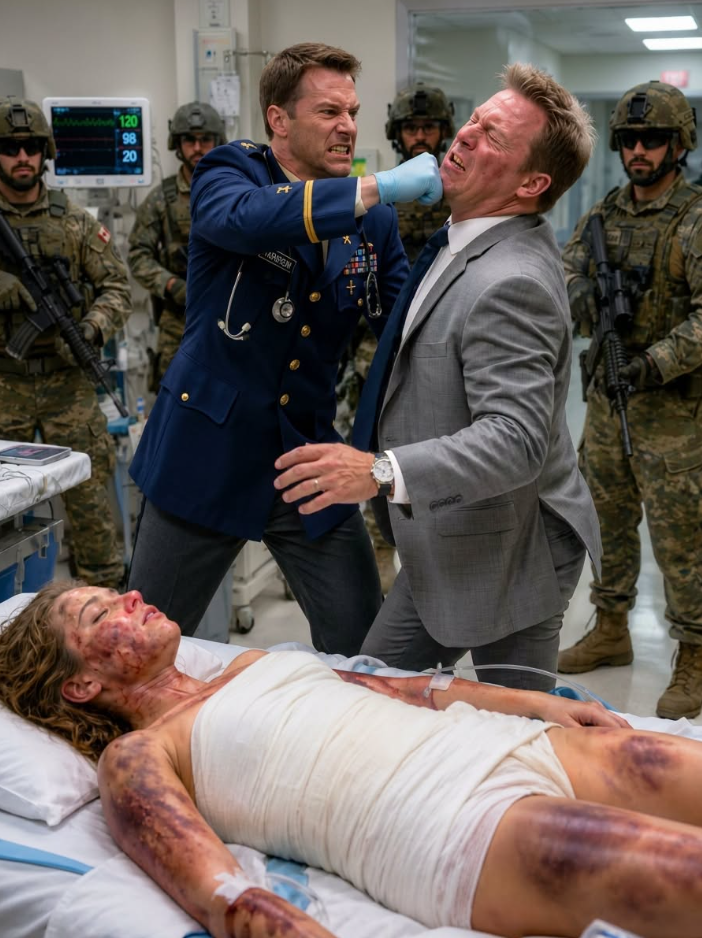
Now I lay beneath white hospital lights while that same man told strangers I had fallen in a shower.
A nurse asked him another question.
“Was she conscious after the fall?”
“Briefly.”
“Any vomiting?”
“No.”
“History of seizures?”
“No.”
“Blood thinners?”
“No.”
Ethan answered smoothly.
Prepared.
He had rehearsed this.
My eyelids felt unbearably heavy.
But I forced them open.
A doctor stepped into the room.
Navy scrubs.
Broad shoulders.
Dark hair touched with gray near the temples.
Liam.
At first he was looking down at the chart.
Then he saw my name.
His steps stopped.
His eyes lifted.
For one second, neither of us moved.
I watched recognition hit him.
Then fear.
Then something colder.
“Liam,” I whispered.
He was beside me immediately.
“Don’t move.”
His hand hovered near my face but didn’t touch me until he knew where I was injured.
“Can you hear me?”
I nodded faintly.
“Do you know where you are?”
“Riverside.”
“What day is it?”
I answered.
His jaw tightened.
He examined my pupils.
My lip.
My scalp.
My neck.
Then he pulled the blanket lower to assess my ribs.
That was when he saw the bruises.
Not one area.
Several.
Different shapes.
Different angles.
Some older.
Some new.
Finger marks around my upper arm.
Bruising near my throat.
Swelling along my side.
Liam went completely still.
Behind him, Ethan spoke.
“Doctor, as I explained, my wife had an unfortunate fall.”
Liam didn’t look at him.
He continued examining me.
Then he asked quietly, “Did you fall?”
Ethan answered for me.
“She—”
Liam turned.
“Don’t speak for my patient.”
The silence that followed felt electric.
Ethan blinked.
“I’m her husband.”
“And she is my patient.”
Then Liam looked back at me.
“Did you fall?”
My throat burned.
I looked at Ethan.
He stared at me.
No expression.
But I knew that look.
A warning.
I turned back to Liam.
“No.”
One word.
Everything changed.
Liam’s eyes closed for half a second.
When he opened them again, he looked directly at Ethan.
“She didn’t fall.”
Ethan gave a short, disbelieving laugh.
“Excuse me?”
“These injuries are inconsistent with your account.”
“You’re jumping to conclusions.”
Liam slowly straightened.
“No.”
Ethan stepped closer.
“This is a private family matter.”
Liam finally let something personal into his voice.
“No. You assaulted my sister.”
Ethan’s face drained of color.
His eyes moved between us.
“Sister?”
He genuinely hadn’t known.
Liam and I had different last names professionally. I had taken Ethan’s surname after marriage, while Liam still used Bennett.
Ethan had met Liam only twice, briefly, at large family events years earlier.
He had never bothered remembering him.
Liam crossed the room and lifted the wall phone.
“Security to trauma room four. Lock access to this unit. Contact police immediately.”
Ethan took a step backward.
“That’s completely unnecessary.”
Liam kept his eyes on him.
“It’s already done.”
“You can’t detain me.”
“No. But hospital security can control access to this clinical area while police respond.”
Ethan’s confidence cracked.
Only slightly.
But I saw it.
“You have no idea what’s going on.”
Liam’s voice became almost quiet.
“I know my sister has injuries consistent with repeated assault.”
He paused.
“And I know you attacked a forensic accounting investigator whose evidence was protected long before you ever raised your hand.”
Ethan looked at me.
The fear was unmistakable now.
“What did you do?”
I almost smiled.
But my lip hurt too much.
“Exactly what you were afraid I did.”
Security arrived before Ethan reached the door.
Two officers positioned themselves between him and the hallway.
He immediately changed tactics.
His shoulders dropped.
His voice softened.
“This is a misunderstanding. My wife is confused. She hit her head.”
Liam said nothing.
That was when Ethan made his first serious mistake.
He tried to discredit me.
“She’s been under enormous stress lately. She’s paranoid about company finances. She hasn’t been sleeping. She thinks everyone is stealing from her.”
Liam’s expression sharpened.
“Interesting.”
“What?”
“I didn’t mention company finances.”
Ethan stopped speaking.
A police officer arrived fifteen minutes later with another officer and a domestic violence investigator.
By then, Liam had already ordered imaging.
Two cracked ribs.
A concussion.
Extensive bruising.
Soft-tissue injuries.
Signs of prior trauma in different stages of healing.
Every injury was documented.
Photographed.
Measured.
Entered into my medical record.
For months, I had feared Ethan would eventually hurt me badly enough to kill me.
Instead, in his arrogance, he had delivered me into the one hospital where the chief physician was my brother and where every mark he left could become independent evidence.
The investigator asked Ethan to wait outside.
He resisted.
“My wife needs me.”
I spoke before anyone else could.
“No.”
He looked at me.
“You don’t mean that.”
“I don’t want you here.”
His face twitched.
The investigator stepped between us.
“You heard her.”
Ethan left under escort.
The door shut.
I started shaking.
Not because he was gone.
Because for the first time in years, I was in a room he could not enter simply because he wanted to.
Liam sat beside the bed.
He didn’t say I told you so.
He didn’t ask why I’d waited.
He simply held my hand.
“I’m sorry,” I whispered.
His eyes filled.
“For what?”
“For making you watch this happen.”
His grip tightened.
“You didn’t make me watch anything. He did this.”
I breathed carefully around the pain in my ribs.
“Liam.”
“What?”
“The files.”
“I have them.”
“All of them?”
“Everything you sent.”
“There’s more.”
He stared at me.
“Of course there is.”
Despite everything, I almost laughed.
“My emergency archive.”
“Where?”
“Cloud storage. Dead-man release.”
Liam frowned.
“What exactly did you build?”
“If I failed to authenticate for forty-eight hours, the archive was scheduled to release copies to you, my attorney, the independent auditor, and two federal contacts.”
He stared at me.
“You created an automatic evidence release?”
“Yes.”
“When does the timer expire?”
I looked toward the clock.
“Tomorrow morning.”
Liam exhaled slowly.
“And Ethan knows?”
“He knows something exists. He doesn’t know what.”
That was why he attacked me.
Not merely because of the audit.
Because he had searched my office and found evidence that I had been tracking Apex transactions.
What Ethan didn’t know was how far I’d gotten.
For nearly a year, money had been moving through Apex subsidiaries in amounts small enough to avoid immediate attention.
Consulting fees.
Materials reimbursements.
Development deposits.
Vendor retainers.
Individually, the transactions looked legitimate.
Together, they formed a pattern.
Millions moved through shell companies.
Several companies shared registered agents.
Some had no real employees.
One supposedly provided construction materials to three Apex projects but had never purchased inventory.
Another billed Apex for environmental consulting despite having been incorporated only nine days before receiving its first payment.
Then there were political consulting firms.
Lobbying intermediaries.
Property companies.
Foreign accounts.
I had not yet proven every purpose behind the transfers.
But I had proven enough to justify an independent audit.
And I had found one connection Ethan could never explain.
Three shell companies ultimately traced back to a holding structure controlled by him.
He hadn’t just been moving company money.
He had been hiding it from his own investors.
From lenders.
From tax authorities.
And from me.
“What else is in the archive?” Liam asked.
“Bank records. Corporate structures. Email exports. Contract comparisons. Metadata from altered invoices.”
“Anything tying Ethan directly to them?”
“Yes.”
I swallowed.
“His authorization credentials.”
Liam sat back.
That was when someone knocked.
The domestic violence investigator returned.
“Mrs. Cole, your husband is insisting he needs access to your residence to retrieve medication and personal items.”
I knew immediately what he wanted.
Not medication.
My home office.
“Liam.”
He saw my face.
“What?”
“Don’t let him go home.”
The investigator stepped closer.
“Why?”
“Because he’ll destroy evidence.”
Everything moved quickly after that.
I gave police written consent to enter the house because my name was on the property.
I identified the office.
The safe.
The computers.
The external storage cabinet.
My attorney was contacted.
A judge was reached for additional warrants once investigators learned the financial evidence might relate to crimes beyond the assault.
Ethan, meanwhile, continued pretending everything was fine.
For almost three hours.
Then his lawyer arrived.
After that, he stopped talking.
By sunrise, detectives were inside our house.
At 7:42 a.m., my emergency archive timer expired.
The files released automatically.
At 7:48, Liam received his copy.
At 7:50, my attorney confirmed receipt.
At 7:53, the independent auditor called.
At 8:06, one of my former federal contacts acknowledged the package.
Ethan could no longer erase anything.
The truth existed in too many places.
Around noon, my attorney, Rachel Meyers, entered my hospital room carrying a laptop and a folder thick enough to bend under its own weight.
“You look terrible,” she said.
“Thank you.”
“It’s good to see your sarcasm survived.”
Liam almost smiled.
Rachel placed the folder on the table.
“Do you want the good news or the very good news?”
“The good news.”
“Your father was paranoid.”
I blinked.
“That’s the good news?”
“In this case, yes.”
She opened the trust documents.
“When he structured the investment into Apex, he didn’t merely give you voting rights. He created an automatic protective provision.”
I stared at her.
“What provision?”
“If the operating executive becomes subject to certain criminal investigations involving fraud, fiduciary misconduct, or violence against a controlling beneficiary, his voting authority can be suspended pending review.”
Liam leaned forward.
“Meaning?”
Rachel looked at me.
“Meaning Ethan woke up this morning believing he controlled Apex Development.”
She turned the document toward me.
“He doesn’t.”
For years, Ethan had called Apex his company.
His empire.
His legacy.
He had told me more than once that without him, I would have nothing.
Rachel tapped the signature line.
“As majority voting controller, you can call an emergency board meeting.”
“When?”
“Already scheduled.”
“For when?”
“Forty minutes from now.”
I stared at her.
“I’m in a hospital bed.”
“Then the board meeting is happening from a hospital bed.”
Liam looked between us.
“Are you serious?”
Rachel smiled faintly.
“Extremely.”
Forty minutes later, a laptop sat on my tray table.
My ribs were wrapped.
My face was bruised.
There was an IV in my arm.
Five board members appeared on the screen.
Nobody knew what to say.
Ethan’s chair was empty.
Rachel began.
“Under the emergency provisions of the family trust and corporate voting agreement, Mrs. Cole is exercising her majority authority.”
One board member cleared his throat.
“Given Ethan’s absence—”
“His absence is not voluntary,” Rachel said.
Silence.
She summarized the investigation.
Not the assault details.
Not everything.
Only what was necessary.
Then I spoke.
My voice was weak.
But steady.
“I move to suspend Ethan Cole from all executive authority at Apex Development pending criminal and financial investigation.”
A second appeared.
Then the vote.
Ethan lost control of Apex at 2:17 that afternoon.
At 2:23, his corporate access was disabled.
At 2:31, company legal counsel received instructions to preserve all records.
At 2:40, the independent forensic team began imaging Apex servers.
By evening, investigators had found something I hadn’t.
Ethan had tried to move money the morning after attacking me.
Nearly three million dollars.
The transfer had failed because the receiving bank flagged the transaction for additional verification.
He had apparently believed I might wake up.
So while standing in a hospital hallway pretending to be a devastated husband, he had been attempting to move company assets from his phone.
That transaction became evidence too.
Two days later, I learned police had also recovered the shirt Ethan wore during the attack.
He had thrown it into a garbage bag in the garage.
There was blood on the cuff.
Mine.
His story about the shower collapsed completely.
There was no blood in our shower.
No evidence of a fall.
No broken fixtures.
No wet towels.
Nothing.
But there was blood near the pantry.
A damaged cabinet door.
A broken glass under the kitchen island.
And footage from one of Ethan’s own security cameras showing him dragging me through the hallway after I lost consciousness.
He had installed those cameras to control me.
In the end, they documented him.
The irony was almost unbearable.
Three weeks later, I sat in Liam’s guest room wearing loose clothing because my ribs were still healing.
News vans crowded outside Apex headquarters.
Ethan’s reputation had collapsed almost overnight.
But I tried not to watch coverage.
I had spent too many years living inside his version of reality.
I didn’t want to spend the rest of my life watching the world react to his downfall.
Instead, I focused on practical things.
Physical therapy.
Counseling.
Legal meetings.
Security.
Rebuilding my financial identity.
Changing passwords.
Closing shared accounts.
Filing for divorce.
Learning to sleep without listening for footsteps outside the bedroom door.
Some nights were harder than others.
Freedom did not arrive as one dramatic feeling.
It came in small moments.
Choosing what to eat without explaining myself.
Leaving my phone on the table without fearing someone would search it.
Driving somewhere without being tracked.
Saying no.
Locking a door.
Sleeping.
Weeks later, Rachel called me.
“We found the final piece.”
“What final piece?”
“The shell company you couldn’t identify.”
My stomach tightened.
For months, one company had bothered me more than all the others.
Northbridge Advisory LLC.
Apex had transferred more than nine hundred thousand dollars to Northbridge over eighteen months.
There were invoices.
Contracts.
Signatures.
Everything looked real.
Too real.
But I could never identify who actually controlled it.
“Who owns it?” I asked.
Rachel was silent.
Then she said, “Technically? A nominee.”
“And actually?”
“Ethan.”
I closed my eyes.
“I knew it.”
“That’s not the important part.”
I opened them.
“What is?”
“Investigators recovered deleted emails from the Apex server.”
My hand tightened around the phone.
“What emails?”
“Emails between Ethan and an outside attorney discussing your father’s trust.”
I stopped breathing.
“He knew?”
“Not originally.”
“When did he find out?”
“About eight months ago.”
Eight months.
I sat down.
That changed everything.
Eight months ago was when Ethan’s control had escalated dramatically.
Eight months ago was when he started restricting my access to accounts.
Eight months ago was when my phone began disappearing.
Eight months ago was when the violence became more frequent.
Rachel continued carefully.
“One email says that if the marriage ended while you retained your voting rights, Ethan could lose effective control of Apex.”
My skin went cold.
“And the others?”
“He’s asking whether there was any legal strategy to challenge your capacity to exercise those rights.”
I knew what that meant.
“He wanted to declare me incompetent.”
“That’s what it appears he was exploring.”
Suddenly, his comments in the hospital made sense.
She’s paranoid.
She’s under stress.
She hasn’t been sleeping.
She thinks everyone is stealing from her.
That wasn’t improvisation.
He had been building a story.
A wife becoming unstable.
A wife confused about finances.
A wife whose judgment couldn’t be trusted.
The abuse hadn’t only been about rage.
Some of it had been strategy.
My voice shook.
“Was he planning this?”
Rachel answered carefully.
“We can prove he was discussing ways to remove your corporate authority. Investigators will determine how far that went.”
That was enough.
For me, the emotional truth landed all at once.
Ethan had spent months convincing me I was powerless while privately discovering that I was the one person standing between him and complete control of Apex.
The cruelty had hidden fear.
His fear of me leaving.
His fear of losing money.
His fear of losing the company.
His fear that one day I would remember exactly who I had been before him.
Months later, I entered a courtroom for one of the preliminary hearings.
Ethan sat at the defense table.
For the first time since I’d known him, he looked small.
Not physically.
Something else.
The confidence was gone.
No assistants.
No executives.
No carefully staged charity photographs.
No wife beside him making him look trustworthy.
Just Ethan.
He looked at me as I walked past.
For one second, our eyes met.
I remembered the kitchen floor.
His breath against my face.
“You never learned when to keep your mouth shut.”
For years, silence had protected him.
That was what he had misunderstood.
He thought silence meant weakness.
It didn’t.
My silence had been preparation.
Every photograph.
Every bank record.
Every message.
Every transfer.
Every medical report.
Every hidden corporate connection.
I had been building a record while he was building an illusion.
And illusions collapse quickly when evidence arrives.
The criminal cases took time.
The financial investigation became larger than I expected.
Additional executives were questioned.
Investors filed claims.
Regulators reviewed Apex transactions.
Some allegations remained contested for months.
Others were supported by records nobody could reasonably explain away.
I didn’t need every question answered immediately.
For the first time in years, I had something more important than certainty.
I had control of my own life.
Nearly a year after the night Ethan attacked me, I stood inside Apex headquarters again.
The lobby had changed.
His enormous portrait was gone.
The brass wall display listing him as founder and chief executive had been removed.
Employees moved quietly around me.
Some recognized me.
Some didn’t.
That was fine.
I hadn’t come for recognition.
I entered the conference room where the board had once treated me like Ethan’s quiet wife.
Rachel sat to my right.
Independent directors filled the remaining seats.
At the center of the table was a document authorizing a complete restructuring of Apex Development.
New compliance controls.
Independent oversight.
Mandatory financial transparency.
No executive with unchecked authority.
No hidden subsidiaries.
No private arrangements buried beneath layers of paperwork.
When the final document reached me, I signed my name.
Not Ethan’s wife.
Not a silent beneficiary.
My name.
When the meeting ended, Liam was waiting downstairs.
He leaned against the lobby wall with two cups of coffee.
“You done?”
“For today.”
He handed me one.
We stepped outside.
The air was cold.
I took a slow breath.
For months after the attack, deep breaths had hurt because of my ribs.
Now they didn’t.
Liam glanced at me.
“You okay?”
I thought about the question.
There had been a time when I would automatically say yes.
Even with bruises beneath my clothes.
Even while terrified.
Even while planning escape routes in my head.
This time I answered differently.
“I’m getting there.”
He nodded.
That was enough.
Before we reached the sidewalk, my phone buzzed.
A message from Rachel.
The divorce judgment had been entered.
Final.
I stared at the word for several seconds.
Final.
No dramatic music.
No crowd.
No applause.
Just one word on a screen.
But my hands started trembling anyway.
Liam looked over.
“What happened?”
I turned the phone toward him.
He read it.
Then he smiled.
“How does it feel?”
I looked back at the glass tower behind us.
Apex Development.
The company Ethan had believed made him untouchable.
Then I remembered the hospital.
The fluorescent lights.
His calm voice.
“She slipped in the shower.”
He thought telling the story first meant he owned the truth.
He thought money could make people believe him.
He thought control was the same thing as power.
He thought fear would keep me silent forever.
He was wrong about all of it.
I slipped my phone into my pocket.
“It feels quiet,” I said.
Liam frowned slightly.
“Quiet?”
I smiled.
“Yeah.”
Because for the first time in years, quiet didn’t mean Ethan was angry.
It didn’t mean I needed to check where he was.
It didn’t mean I had to hide evidence, lower my voice, or prepare myself for what might happen next.
Quiet finally meant safety.
We started walking.
Behind us stood the empire Ethan had nearly destroyed trying to own.
Ahead of me was a life I had once been convinced I would never get back.
And I finally understood the biggest mistake Ethan had made.
It wasn’t underestimating my brother.
It wasn’t forgetting the cameras.
It wasn’t ignoring my father’s trust.
It wasn’t even assuming he could erase the financial evidence.
His biggest mistake happened much earlier.
He spent years convincing himself that because I was afraid of him, I was weak.
But fear and weakness had never been the same thing.
I had been afraid.
Terrified, sometimes.
And I had still documented every bruise.
Still traced every dollar.
Still protected every file.
Still prepared an escape.
Still said no when he demanded the password.
Still survived long enough to speak.
Ethan once leaned over my broken body and told me I had never learned when to keep my mouth shut.
He was right about one thing.
I never did.
And in the end, that was exactly what saved me.