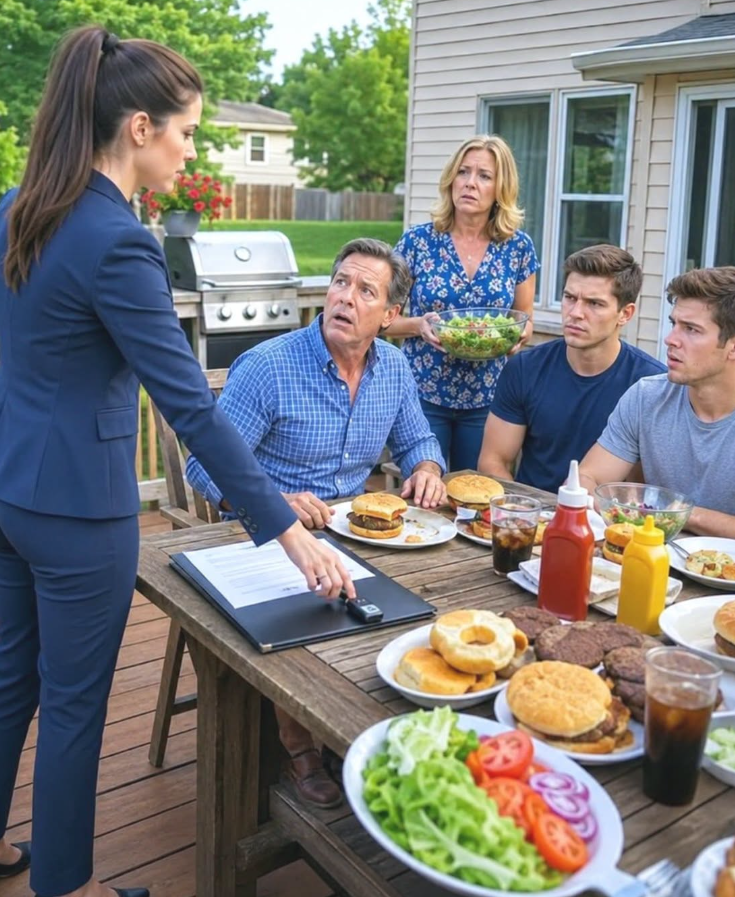
Franklin Camden slowly slid his calloused thumbs under the flap of the heavy black envelope. He was still trying to maintain his easy smirk—the practiced, masculine confidence that had commanded every room, every dinner table, and every board meeting he had ever walked into. But as his fingers pulled the thick parchment out, the smirk stiffened into something brittle. The first page bore the gilded crest of a holding company named Aegis & Frame Management LLC. Beneath it sat the official seal of the state registry and a clear, bold title: NOTICE OF CONTROLLING SHARE ACQUISITION & CORPORATE RESTRUCTURING.
“What is this nonsense?” Franklin muttered, his brow furrowing as his eyes scanned the legal header. He pulled a pair of reading glasses from his shirt pocket, unfolding them with trembling fingers. “Aegis? I don’t know any Aegis.”
“Read the second line, Dad,” Maris said evenly. She didn’t raise her voice. She didn’t need to. The quiet strength in her tone held the entire backyard hostage.
Derek leaned over his father’s shoulder, trying to look unimpressed, while Colton took another slow swig of beer, though his eyes darted nervously between his sister and the black Jaguar idling quietly near the front gate.
Franklin’s eyes dropped to line two.
The silence deepened until even the wind through the Idaho pines seemed to stop.
For thirty-five years, Franklin Camden had served as the Senior Vice President of Operations at Mountain Tech Solutions. It was his pride, his identity, the corporate hammer he had repeatedly wielded over family dinners to prove his standing in the world. He had spent the last eight months bragging to anyone who would listen about how he was spearheading the company’s grand survival strategy during the recent economic downturn, positioning himself as the indispensable savior of the firm.
He didn’t know that the venture firm he had begged for capital six months ago was a shell wholly owned by Helix Frame—the software startup Maris had pitched at Thanksgiving three years ago. The very startup Franklin had cut off mid-sentence to talk about Colton’s entry-level real estate commercial lease.
“This… this is a fake,” Franklin choked out, his face suddenly losing all its sun-bronzed color, leaving behind an ash-gray pallor. “Mountain Tech was bought out by an institutional investor out of Seattle. The board confirmed it last Tuesday!”
“Helix Frame is headquartered in Seattle, Dad,” Maris replied, her arms resting loosely at her sides. “And I am the board.”
“You?” Colton sputtered, dropping his bottle onto the grass. “You run a little app company! You do data entry!”
“I build enterprise workflow automation software,” Maris said, turning her cool, steady gaze toward Colton. “And last month, Helix Frame was valued at four hundred and twenty million dollars. When Mountain Tech was three days away from missed payroll and insolvency, your dad’s CEO came to me on his knees. I bought eighty-one percent of the debt and equity for pennies on the dollar.”
She took one deliberate step closer to the head of the table.
“For the last ninety days, Dad, every paycheck you deposited, every expense report you submitted, every memo you signed… you were working for me. I was your ultimate superior. And I let you keep working without saying a word, just so you could sit at this table today and tell me who built this family.”
Franklin stood up so fast his heavy wooden chair crashed backward into the grass. “You… you little snake! You went behind my back? You bought my company to humiliate me?!”
“I didn’t buy Mountain Tech to humiliate you, Franklin,” Maris said, using his first name for the first time in her life. The word fell like a heavy stone into the grass between them. “I bought it because it was a sound acquisition for my platform. You just happened to be on the payroll. And as of eight o’clock tomorrow morning, Mountain Tech Solutions will cease independent operations. Its assets will be folded into Helix Frame.”
“You can’t fire me!” Franklin roared, his veins bulging along his neck. “I built that operational pipeline! I spent twenty years in those offices!”
“I’m not firing you,” Maris said softly.
Franklin blinked, a fleeting spark of hope or confusion flickering across his eyes.
“I’m retiring your division,” she continued effortlessly. “Your position no longer exists. Your severance package has been calculated according to standard company policy—no bonuses, no executive payouts. Just what the law requires.”
She turned toward her mother, who was standing by the porch rail, tears streaming silently down her cheeks.
“Mom,” Maris said gently, her voice softening just a fraction. “Your car is parked around the corner. If you want to stay here in this house that he bought with money he never let you touch, you can. But if you want to leave, the keys to the Jaguar are on the table. The pink slip is in your name.”
Her mother looked at Franklin, then looked at the sleek black key sitting next to the plate of lukewarm barbecue ribs. For decades, Eleanor Camden had been the quiet shadow in the background, smoothing over Franklin’s outbursts, making excuses for his cruelty, absorbing his dismissals so her children wouldn’t have to face the full brunt of his rage.
“Eleanor, don’t you dare touch that key,” Franklin barked, turning his fury on his wife. “Get back inside!”
Eleanor looked at her husband. Then she looked at Maris. Slowly, deliberately, she walked past her two sons, reached across the wooden table, and picked up the key.
“Eleanor!” Franklin shouted.
“I’ve washed your dishes for forty years, Franklin,” Eleanor said, her voice shaking at first, then steadying into a quiet, unwavering truth. “And you never once asked me if I was tired.”
She didn’t look back as she walked down the driveway toward the gate.
Franklin stood frozen, surrounded by his silent extended family, his two sons looking small and utterly helpless beside him. He looked down at the black paper on the table, then up at Maris, his mouth opening and closing as if searching for a power he no longer possessed.
“You took everything,” he whispered.
“No,” Maris said, taking a step backward toward the exit. “You never gave me a seat at your table. So I built my own. Happy Father’s Day, Franklin.”
She turned her back on them all.
As she walked down the sunlit pavement, the roar of the Jaguar engine echoed through the quiet suburban street—not as a display of wealth or vengeance, but as the sound of absolute, unshakeable freedom.
Epilogue:
Six months later, the high-rise office on the forty-second floor of Seattle’s tech corridor smelled of fresh rain and roasted espresso.
Maris stood by the floor-to-ceiling glass, watching the ferries trace pale lines across the gray surface of Puget Sound. Her desk was immaculate—a stark contrast to the cluttered, secondhand kitchen table where Helix Frame had been born.
A quiet chime signaled an incoming call on her personal line. She didn’t check the screen; she already knew the caller ID. Her father’s phone number had tried reaching her twenty-seven times over the last six months. Colton and Derek’s numbers had logged even more, usually followed by urgent, demanding text messages that slowly transformed over time into desperate, pleading voicemails.
“Maris, please… the bank is foreclosing on the Boise property.” “Maris, Derek got laid off. Can you just put in a word for him at your logistics partner?” “Maris, your father isn’t doing well. He just wants to talk.”
She had deleted every single one without listening past the first five seconds. Silence had been their currency for thirty years; she was simply returning it with interest.
A soft knock sounded on the frosted glass door.
“Come in,” Maris said.
Eleanor walked in, wearing a tailored cream knit sweater, her shoulders back, her posture effortless. She looked younger—lighter, as if a decades-long weight had been lifted from her lungs. She set a small paper bag from a local bakery onto the edge of the desk.
“You’re working late again,” Eleanor noted, sitting down in one of the leather armchairs facing the harbor.
“Just wrapping up the Q3 forecasts,” Maris replied, leaning back against her desk. “How was the ceramics studio today?”
“Wonderful,” Eleanor smiled, a genuine, quiet warmth filling her eyes. “I signed the lease on the small storefront in Capitol Hill. The landlord was surprised when I paid the first six months upfront in cash.” She paused, looking down at her hands—hands that were no longer red from endless household chores, but neat, manicured, and strong. “It feels surreal, Maris. For forty years, I asked permission for a twenty-dollar grocery overage. Now I own my time.”
“You earned your time, Mom.”
They sat in comfortable silence for a moment. No performance, no quiet barbs masked as concern, no competition for space.
“I saw Franklin’s lawyer’s latest letter,” Eleanor said gently, referencing the final divorce settlement papers that had arrived earlier that week. “He had to sell the house in Idaho. Moving into a two-bedroom rental near the interstate. Colton and Derek are living with him now.”
Maris nodded slowly. She felt no surge of triumph, no lingering bitter spark of spite. Hearing about his decline felt as distant as reading about an unfamiliar company’s liquidation in a financial journal.
“Do you ever think about going back?” Eleanor asked quietly. “Not to him. But to… any of it?”
“No,” Maris said softly. “Revenge would mean I built all of this just for him. I didn’t. I built it for me.”
She walked over to her desk, picked up a small, framed photo, and set it near the window. It wasn’t a picture of her modern corporate headquarters, nor was it a shot of her graduation. It was a simple, faded photograph of a ten-year-old girl sitting alone at a quiet desk, pencil in hand, drawing stars in the late-night light.
Maris turned back to her mother, offering a calm, unshakeable smile.
“I spent my whole life waiting for someone to build a chair for me at his table,” Maris said, looking out over the endless horizon of the city below. “Turns out, the sky has a much better view.”