“Are you sure?”
“Yes.”
“And Miss Victoria?”
“I’ll handle Victoria.”
Her expression tightened.
“I’m sorry.”
“For telling me?”
“For what you had to hear.”
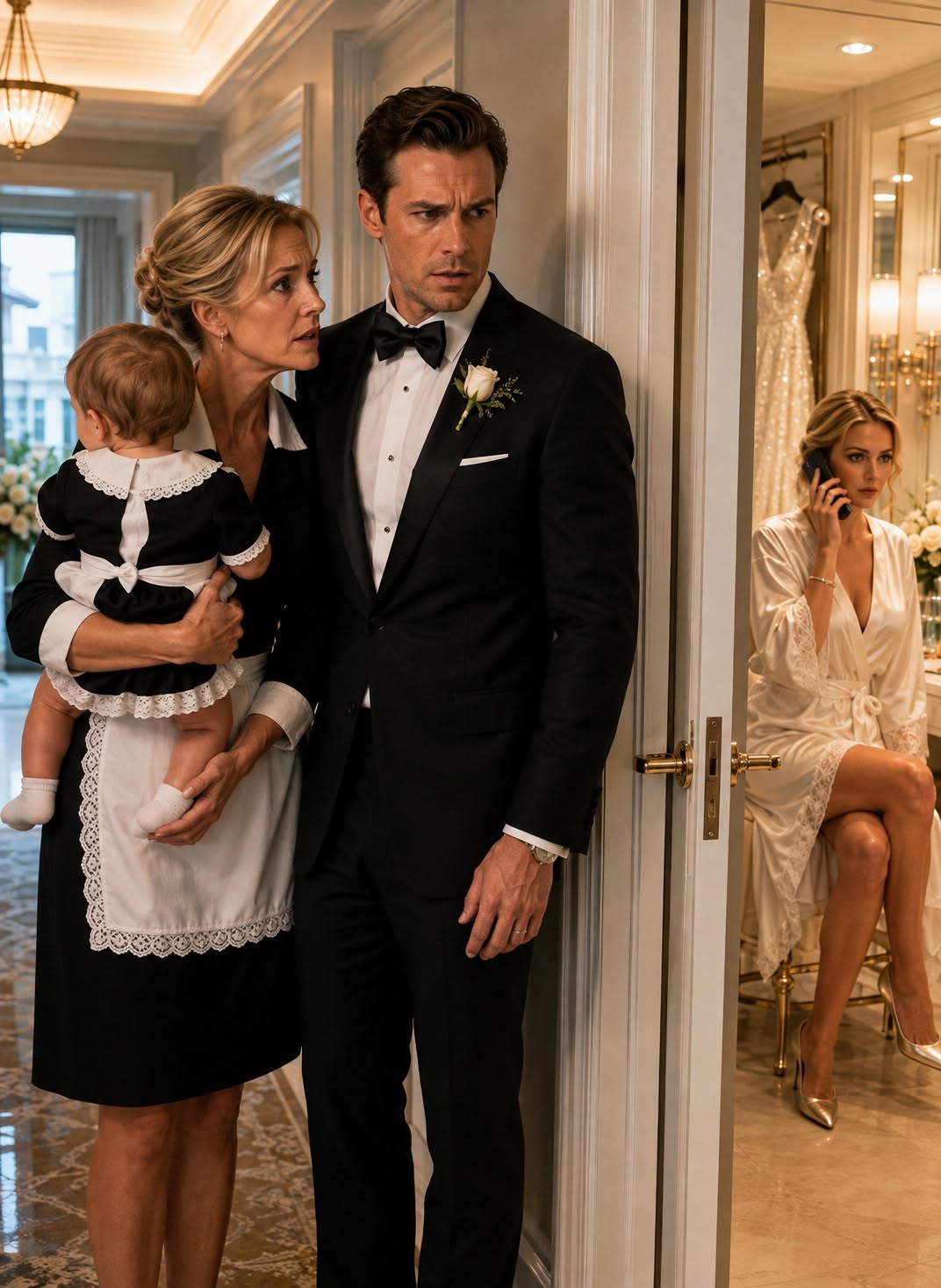
I looked toward the barely open dressing-room door.
“So am I.”
Teresa started away.
Then she stopped.
“Mr. Vance.”
I turned.
“She wasn’t alone earlier.”
A strange stillness settled over me.
“What do you mean?”
“Not in the room. I mean… there was someone else involved in all this before today.”
I stared at her.
Teresa glanced down the corridor.
“I’ll explain when Leo is settled.”
Then she disappeared toward the private elevator.
I stood there alone.
From downstairs came the faint swell of strings.
The hotel ballroom occupied the entire ground floor of an old lakeside estate I had restored five years earlier. Victoria had fallen in love with it the first time I brought her there.
She called it romantic.
Timeless.
Perfect.
Now the carved ceilings, the rose arrangements, the champagne towers, and the hundred and eighty people waiting below felt like scenery from a play in which I had suddenly discovered I was the only actor who had not been given the script.
My phone vibrated.
David Mercer.
My attorney.
I answered immediately.
“Tell me.”
“The license hasn’t been submitted.”
“Good.”
“I’ve instructed the coordinator that there’s a legal delay. Nothing gets filed unless you personally authorize it.”
“Thank you.”
There was a pause.
“Julian, what happened?”
“I heard something.”
“What kind of something?”
“Enough.”
David knew me well enough not to press.
We had been friends since graduate school. He had represented Sterling Developments from the year it was a two-person office above a tire shop.
His voice changed.
“Do you want me there?”
“You’re already downstairs.”
“I mean with you.”
I looked toward Victoria’s room.
“Yes.”
“I’m coming up.”
Five minutes later, David stepped out of the elevator.
He had removed his boutonniere.
That small detail nearly undid me.
This had become real enough that he no longer considered himself a wedding guest.
“What do the guests know?” I asked.
“Only that there’s been a delay.”
“My mother?”
“She thinks you’re dealing with a business emergency.”
“That won’t last.”
“No.”
I gave a humorless laugh.
“Nothing lasts long around my mother.”
David studied me.
“You look remarkably calm.”
“I’m not.”
“I know.”
We walked toward an empty sitting room near the end of the hall.
He closed the door behind us.
“Start from the beginning.”
So I did.
I told him everything.
Victoria’s voice through the door.
The comment about marital property.
The company.
My guilt.
Leo.
Especially Leo.
David listened without interrupting.
When I finished, he sat back.
“There are a few things you need to know before you decide what to do.”
“What things?”
“First, Victoria’s understanding of marital property is simplistic.”
“That isn’t exactly comforting.”
“It should be slightly comforting.”
“I’ll take slightly.”
“Your premarital assets don’t automatically become hers because of a marriage license. Sterling is separately structured. Your estate is held partly through trusts. There are protections.”
I stared at him.
“Then why was she so confident?”
“That is the more interesting question.”
I leaned forward.
“You think someone advised her.”
“I think it’s possible.”
David paused.
“Second, the prenuptial agreement she signed yesterday is enforceable as drafted.”
I frowned.
“She signed it?”
“Yes.”
“You’re sure?”
“I witnessed it.”
That didn’t fit.
Victoria had complained about the prenup for weeks.
Not openly.
She had simply delayed.
Asked questions.
Requested amendments.
Said she wanted independent counsel.
All reasonable things.
Then yesterday afternoon, she had finally signed.
“Why would she sign an agreement limiting what she could claim if she was planning to marry me for money?”
David’s expression sharpened.
“Exactly.”
I stood and walked toward the window.
Below us, the lawn sloped toward the lake.
Guests wandered between white chairs, unaware that there would soon be nothing to wait for.
“What aren’t we seeing?”
“I don’t know yet.”
My phone buzzed again.
My mother.
I stared at her name.
David said, “You should answer.”
“I’m thirty-nine years old.”
“And still afraid of disappointing your mother.”
“Correct.”
He almost smiled.
I answered.
“Mom.”
“Julian.”
Her voice held the specific calm that meant she was anything but calm.
“What’s wrong?”
“Nothing dangerous.”
“That was not my question.”
I closed my eyes.
“I’m not getting married today.”
Silence.
Then, very quietly, “All right.”
I had expected questions.
Instead she said, “Where’s Leo?”
“With Teresa.”
“Good.”
“And Mom?”
“Yes?”
“I need you.”
“I’m coming upstairs.”
The line went dead.
David looked amused.
“Efficient.”
“You have no idea.”
My mother arrived three minutes later.
Margaret Vance was sixty-seven, small, elegant, and incapable of pretending something was acceptable when she believed otherwise.
She entered the room, closed the door, and looked at me.
“Tell me.”
I did.
Her face changed only once.
When I repeated what Victoria had said about Leo.
My mother looked toward the door.
“Where is she?”
“Mom.”
“I only asked.”
“You asked in the tone you used when a contractor put plastic shutters on the north wing.”
“He deserved that tone.”
David intervened gently.
“Margaret, Julian doesn’t want a confrontation.”
She turned to him.
“Did I say I intended one?”
“No.”
“Good.”
Then she came to me.
Not to the businessman everyone downstairs knew.
Not to the groom.
To her son.
She put both hands around mine.
“What do you want to do?”
That question loosened something in my chest.
Not What are you going to do to her?
Not How could she do this to us?
What did I want to do?
“I want everyone to go home without turning this into entertainment.”
My mother nodded immediately.
“Then we tell them there has been a private family matter and the ceremony will not proceed.”
“No details.”
“No details.”
“No blaming Victoria.”
My mother’s eyebrows rose.
“I didn’t say I approved of her.”
“I know.”
“But I agree.”
David stood.
“I can coordinate with the hotel.”
My mother shook her head.
“No.”
We both looked at her.
“I will.”
“Mom—”
“These people are family, friends, employees, investors. If a lawyer dismisses them, they’ll think something catastrophic happened.”
“And if you do it?”
“They’ll know something personal happened and that they should stop asking.”
She was right.
Of course she was.
She squeezed my hand.
“Stay upstairs.”
Then she left.
David looked at the closed door.
“I have never been more grateful she likes me.”
Victoria came looking for me twenty minutes later.
She found me alone in the small conservatory beside the bridal suite.
David had deliberately stepped away.
I had asked him to.
Some conversations required witnesses.
Others required courage.
Victoria entered wearing the gown.
For a moment, despite everything, I forgot to breathe.
She was beautiful.
Ivory silk.
Her dark hair pinned loosely at the back.
My grandmother’s pearl earrings, which I had given her as her “something old.”
That was what grief did.
It allowed beauty to survive betrayal.
“Julian?”
She smiled uncertainly.
“What is going on? They’re telling everyone the ceremony is postponed.”
“Canceled.”
Her smile vanished.
“What?”
“The wedding is canceled.”
She stared at me.
Then laughed once.
Not because anything was funny.
Because she thought I had to be joking.
“What are you talking about?”
“I heard your phone call.”
Every trace of color left her face.
Neither of us moved.
Finally she whispered, “How much?”
“Enough.”
Her eyes closed.
I had imagined this moment differently.
I thought she would deny it.
Become angry.
Accuse me of listening.
Instead, she sat down.
The dress spread around her like a pale circle on the floor.
“Who were you talking to?” I asked.
She opened her eyes.
“Does it matter?”
“Yes.”
She looked away.
“Evan.”
The name meant nothing to me at first.
Then it did.
Evan Cross.
Victoria’s former business partner.
A man she had described as controlling, reckless, and impossible to work with.
I had met him once at a charity dinner.
He had been charming.
Almost aggressively so.
“Why is Evan calling you on our wedding day?”
She stared at her hands.
“Because he knows things.”
“What things?”
“About me.”
“That is not an answer.”
“I know.”
I waited.
For years, I had been good at filling silence.
Negotiators learned quickly that silence made people uncomfortable enough to reveal more than they intended.
But this was not a negotiation.
It was the end of something I had believed in.
So I said the only thing that mattered.
“Tell me the truth.”
Victoria looked at me.
“I did want your money.”
The honesty hurt more than denial would have.
She continued before I could respond.
“At first.”
I shook my head.
“Victoria.”
“I’m not trying to make it sound better.”
“Then don’t.”
She nodded.
“When I met you, I knew exactly who you were.”
“Of course you did.”
“No. I mean before we were introduced.”
I stared at her.
“I researched you.”
A hollow feeling opened in my stomach.
“For what purpose?”
“My company was failing.”
“What company?”
“My consulting business with Evan.”
“You told me you sold your half.”
“I did. Eventually.”
“When we met?”
“No.”
I stood.
She continued quickly.
“We had debts. Serious ones. Evan found out you were considering purchasing the Mercer Street portfolio. One of our clients owned part of it. He thought if I got close to you, we could steer the deal.”
I could barely believe what I was hearing.
“You met me because of a real estate transaction?”
“Yes.”
I laughed quietly.
“Sixteen months.”
“I know.”
“You moved into my house.”
“I know.”
“You held my son.”
Her eyes filled.
“I know.”
“That was part of some plan?”
“No.”
“Why should I believe that?”
“You shouldn’t.”
The answer stopped me.
Victoria wiped at one eye carefully.
“You shouldn’t believe anything today just because I say it.”
For the first time, she sounded like the woman I thought I knew.
Which only made things worse.
“What happened to the deal?”
“You didn’t buy the portfolio.”
“No.”
“You said the numbers were wrong.”
“They were.”
“I knew then Evan’s plan was finished.”
“Yet you stayed.”
“Yes.”
“Why?”
She looked at me.
“I fell in love with the life.”
Not me.
The life.
I turned toward the windows.
“And eventually with you,” she added.
I closed my eyes.
“Do not.”
“It’s true.”
“You said ninety minutes ago that you don’t love me.”
“I said I don’t love you the way Evan thinks.”
“What does that even mean?”
Her shoulders dropped.
“He thinks I’m naive. He thinks I became sentimental.”
“You called me useful.”
“I was trying to keep him calm.”
“You called Leo a complication.”
That was the sentence I could not move past.
Victoria lowered her head.
When she spoke again, her voice trembled.
“I know.”
“You talked about sending him away.”
“I said terrible things.”
“You described a plan.”
“No.”
I looked at her.
“No?”
“No.”
“Then why say it?”
“Because Evan hates children.”
That answer was so strange I almost laughed.
“What?”
“He thinks your attachment to Leo makes you unpredictable. Every time we discussed money, he said you would never prioritize anything over your son.”
“That sounds accurate.”
“It is.”
“And somehow your solution was to agree with him?”
“I needed him to believe I was still following the plan.”
“What plan?”
She said nothing.
“Victoria.”
“He lent me money.”
“How much?”
“Two hundred and seventy thousand dollars.”
My anger shifted.
Not disappeared.
Shifted.
“For the consulting business?”
“Mostly.”
“Does he have a lien?”
“No.”
“A contract?”
“Yes.”
“What kind?”
She hesitated.
“He receives a percentage of my future earnings for five years.”
“That sounds predatory.”
“It is.”
“And the wedding?”
“He believed if I married you, I could repay him.”
I stared at her.
“Did you?”
“At first, yes.”
The room went very quiet.
“Then I signed the prenup.”
I frowned.
“What does that have to do with anything?”
“Everything.”
She looked up.
“Evan told me not to sign it.”
I remembered David’s question.
Why would Victoria sign an agreement limiting what she could gain?
“I signed because I had decided I wasn’t taking anything from you.”
I said nothing.
“He was furious,” she continued. “He started calling last night. Then again this morning.”
“So the conversation I heard…”
“Was me trying to convince him I still had a plan.”
“By discussing my son like he was luggage?”
Her face crumpled.
“Yes.”
I looked away.
There are explanations that clarify.
They do not excuse.
This was one.
“Why not tell me?”
“Because then I had to tell you how we met.”
“Yes.”
“And I thought I would lose you.”
“You did.”
She nodded.
Tears slipped down her cheeks.
“I know.”
For several minutes, neither of us spoke.
Finally I asked, “Did you ever intend to send Leo away?”
“No.”
“Did you ever resent him?”
Victoria’s answer took longer.
“Sometimes.”
That surprised me more than a denial would have.
She looked ashamed.
“Not because he’s a baby. Because you love him without fear.”
I stared at her.
She continued.
“You don’t analyze it. You don’t wonder whether he’ll leave. You don’t wonder whether you’ve earned it. You just love him.”
“That’s my son.”
“I know.”
“And you were jealous of that?”
“Sometimes.”
She pressed her fingertips to her eyes.
“I hated myself for it.”
The answer was messy.
Human.
Painful.
But believable.
“What was your plan after today?” I asked.
“I didn’t know.”
“That isn’t good enough.”
“No.”
Her voice was barely audible.
“I kept thinking I would tell you tomorrow.”
I laughed sadly.
“Tomorrow.”
“I know how that sounds.”
“Do you?”
“Yes.”
She stood.
“I’m going to leave.”
I looked at the dress.
“Where?”
“My sister’s.”
“I’ll have a car take you.”
“You don’t have to.”
“I know.”
She looked at me for a long moment.
Then removed my grandmother’s pearl earrings.
She placed them on the table.
“I’m sorry.”
I did not say I forgave her.
I did not say I hated her.
I simply nodded.
She walked toward the door.
Then stopped.
“There is something else you need to know.”
My exhaustion turned instantly to alertness.
“What?”
“It’s about Teresa.”
I stared at her.
Victoria swallowed.
“She didn’t overhear me by accident.”
A chill moved through me.
“What are you saying?”
“Teresa has known about Evan for months.”
I found Teresa in the library suite with Leo asleep in the crib.
She was sitting beside the window.
The moment she saw my face, she knew.
“Victoria told you.”
“She said you knew Evan.”
Teresa nodded.
“How?”
She looked toward Leo.
Then back at me.
“Because Evan is my brother.”
For a few seconds, I thought I had heard incorrectly.
“Your brother?”
“Yes.”
“You’ve worked in my house for ten months.”
“I know.”
“Did he send you?”
Teresa’s eyes filled.
“At first.”
The answer hit with a terrible familiarity.
Another person.
Another beginning built on a lie.
I sat opposite her.
“Tell me everything.”
She folded her hands tightly.
“Evan knew Victoria was seeing you. He wanted someone close enough to know whether the relationship was serious.”
“And you volunteered?”
“No.”
“Then why come?”
“My brother had helped me when my marriage ended. I owed him money. I was trying to start over.”
“You could have said no.”
“I should have.”
“What did you tell him?”
“At first? Your schedule. Whether Victoria stayed overnight. Whether she had access to the house.”
My jaw tightened.
Teresa continued quickly.
“Never anything about Sterling. Never financial documents. Never security information.”
“What about Leo?”
Her expression changed.
“No.”
“Did you report on my son?”
“Never.”
I believed that.
I hated that I believed it.
Because belief had become dangerous.
“When did you stop?”
“The second month.”
“Why?”
She looked at the crib.
“Leo.”
My eyes narrowed.
“I don’t understand.”
“You were trying so hard.”
I said nothing.
“You’d come home exhausted, loosen your tie with one hand, and pick him up with the other.”
She smiled sadly.
“You thought nobody noticed how scared you were.”
“Scared of what?”
“Doing it wrong.”
The words struck somewhere deep.
Leo’s mother, Elena, had died three weeks after giving birth from complications nobody expected.
One day I had been a husband and new father.
Then suddenly I was only one of those things.
I had hired Teresa because I did not know how to attend board meetings and keep a newborn alive.
I had hated myself for needing help.
“You weren’t spying on a billionaire,” Teresa said quietly. “You were helping raise a baby who had already lost one parent.”
Her voice trembled.
“I couldn’t keep doing what Evan asked.”
“Did you tell him?”
“Yes.”
“What happened?”
“He was angry.”
“Did he threaten you?”
“No.”
She shook her head.
“He just said I had become soft.”
“Then why stay?”
Teresa looked toward Leo again.
“Because I loved my job.”
That was not quite the answer.
I waited.
She sighed.
“And because I loved him.”
My gaze followed hers to my sleeping son.
“He laughs when I sing badly,” she said. “He throws peas at me. He hates socks. He gets angry when bananas break in half.”
Despite myself, I smiled.
“He really does.”
“I wasn’t staying for Evan anymore.”
Tears slipped down her face.
“I was staying because this became my real life.”
I rubbed both hands over my face.
“Why tell me today?”
“Because I heard Victoria this morning.”
“You said you already knew about Evan.”
“I knew she owed him money. I knew how they met you. I didn’t know what she was saying about Leo.”
Teresa’s voice broke slightly.
“When I heard his name, I stopped caring what happened to me.”
I looked at her.
“You thought I’d fire you.”
“I assumed you would.”
I had no answer.
She stood.
“I packed my things.”
“What?”
“They’re in the staff apartment.”
“Teresa—”
“You have every reason not to trust me.”
“That doesn’t mean—”
“It does.”
She wiped her cheeks.
“You shouldn’t have to wonder whether the person holding your child is telling someone else about your life.”
The truth of that hurt.
“I never endangered Leo,” she said.
“I know.”
“I would never.”
“I know.”
“But trust isn’t only about danger.”
No.
It wasn’t.
She reached into her handbag and handed me a small envelope.
Inside was a folded sheet of paper.
A handwritten timeline.
Dates.
Phone calls.
Messages from Evan.
Everything she had ever told him.
Beside each entry, Teresa had written whether the information had been true.
Most of it was mundane.
Victoria stayed until midnight.
Julian left for Chicago.
Wedding planning meeting Thursday.
Then the reports stopped.
Eight months earlier.
At the bottom was one final note.
Evan called again after I stopped responding. He said Victoria had changed the plan.
I looked up.
“What does this mean?”
“That is what I wanted to explain before.”
Teresa sat back down.
“Victoria didn’t just sign the prenup yesterday.”
“I know.”
“No.”
She shook her head.
“She asked David for it three months ago.”
I frowned.
“That can’t be right.”
“I heard her on the phone.”
“With David?”
“Yes.”
“She specifically told him she wanted an agreement that guaranteed Leo’s inheritance stayed protected.”
I stared at her.
“That isn’t what she told me.”
“I don’t think she wanted you to know.”
“Why?”
“I don’t know.”
Teresa looked toward the door Victoria had walked through less than an hour earlier.
“But I think somewhere along the way, the woman who came into your life for the wrong reason started trying to leave it better than she found it.”
I looked down at the timeline in my hands.
Three months.
Victoria had been changing something for three months.
And suddenly, canceling the wedding no longer felt like the end of the story.
It felt like the first honest thing that had happened inside it.
PART 3
By five o’clock, the ballroom was empty.
One hundred and eighty guests had gone home carrying unanswered questions.
The flowers remained.
So did the cake.
A six-tiered construction of white sugar flowers Victoria had spent weeks choosing stood untouched beneath the chandeliers.
Someone had covered it in clear plastic.
There was something almost absurd about that.
As though the cake deserved preservation even if the wedding did not.
I stood alone at the entrance to the ballroom until my mother found me.
“Leo is asleep upstairs.”
“With Teresa?”
My mother watched my face carefully.
“Yes.”
I nodded.
She knew there was more.
“Do you want to tell me?”
“Not yet.”
“All right.”
That was one of the things I had inherited from my father and she had not.
The instinct to press.
My mother had always understood that sometimes love meant staying nearby without demanding immediate access.
She joined me.
For a while, we looked at the empty room.
“I’m sorry,” she said.
“I’m angry.”
“I know.”
“I’m embarrassed.”
“You shouldn’t be.”
“I had a hundred and eighty people waiting downstairs while my fiancée—”
“Julian.”
I stopped.
“Do not confuse being deceived with being foolish.”
I almost smiled.
“David would object to that statement on technical grounds.”
“David charges by the hour.”
“He’s my friend.”
“He can be both.”
That made me laugh.
My mother rested her hand against my arm.
“Are you going home tonight?”
“I think so.”
“I can stay with Leo.”
“No.”
“You need rest.”
“I need my son.”
She nodded immediately.
“Then take your son home.”
I looked at her.
“Was I wrong to bring Victoria into his life?”
My mother’s expression softened.
“No.”
“How can you say that?”
“Because wanting a family is not a mistake.”
“I missed things.”
“Of course you did.”
“I should have known.”
“No one knows everything about another person.”
Her gaze moved toward the abandoned chairs.
“You loved someone while grieving someone else. That made you hopeful, not stupid.”
I swallowed.
My mother rarely mentioned Elena directly.
Even after nearly a year, her name could still alter the temperature of a room.
“You liked Victoria,” I said.
“I did.”
“Do you still?”
She considered the question.
“In some ways.”
That surprised me.
“After today?”
“People are not single events.”
I looked at her.
“She lied to you. That matters. She spoke carelessly about Leo. That matters very much.”
My mother paused.
“But I watched her sit on the nursery floor for forty minutes last month because he refused to nap unless someone held the wooden rabbit beside his crib.”
I remembered.
Victoria had missed dinner reservations that night.
She never complained.
My mother continued.
“I watched her learn which spoon he liked. I watched her convince you to leave work early for his first swimming lesson.”
“That doesn’t erase anything.”
“No.”
She squeezed my arm.
“But perhaps it tells you there is more to understand.”
I thought of Teresa’s timeline.
Victoria asking for protections three months before the wedding.
Leo’s inheritance.
The prenup.
Nothing fit neatly.
And I was beginning to understand that neatness was not the same as truth.
I went home with Leo shortly after sunset.
Teresa came too.
I had not decided what to do about her employment.
I told her that directly.
She accepted it without argument.
For now, she would stay through the weekend.
After that, we would talk.
The house felt enormous when we entered.
Victoria’s coat was hanging in the front closet.
A pair of her shoes sat beside the bench.
A half-read novel lay open on the kitchen island.
Her life was everywhere.
That was the strange thing about endings.
They happened instantly.
Objects did not receive the message.
Leo woke while I was carrying him upstairs.
He blinked at me, confused, then smiled.
“Da.”
My entire chest tightened.
He had only started saying it clearly two weeks earlier.
I sat in the rocking chair.
“Yeah, buddy.”
He grabbed my tie.
I had forgotten I was still wearing it.
I loosened the knot.
Leo laughed.
“You find this entire day amusing, don’t you?”
He slapped my chin.
I kissed his forehead.
For the first time since that morning, my breathing slowed.
Whatever else was uncertain, this was not.
I was his father.
He needed dinner.
A clean diaper.
His bedtime story.
Tomorrow morning, he would wake up around six fifteen and demand breakfast with the urgency of a man who had been fasting for months.
Children reduced life to its most useful truths.
Teresa appeared in the doorway.
“Do you want me to make his bottle?”
I looked at her.
Normally the answer would have been automatic.
“Yes.”
Tonight it wasn’t.
“Tell me something first.”
She stepped inside.
“Anything.”
“Did Victoria ever ask you to keep Leo away from her?”
Teresa frowned.
“No.”
“To change his schedule around her?”
“No.”
“To make sure he was asleep when she came home?”
“Never.”
I studied her.
“Did she ever complain about how much time I spent with him?”
Teresa’s answer took longer.
“Once.”
My stomach tightened.
“When?”
“About four months ago.”
“What did she say?”
“She said you had canceled dinner again.”
“I remember.”
“He had an ear infection.”
“Yes.”
“She was frustrated.”
“That sounds more like the woman I heard this morning.”
Teresa shook her head.
“Not exactly.”
“What happened?”
“I told her you weren’t leaving Leo sick with a nanny to attend a restaurant.”
“And?”
“She got quiet.”
Teresa smiled faintly.
“Then she asked me what medicine he needed.”
I said nothing.
“She went to the pharmacy herself.”
I remembered that too.
I had assumed Teresa asked her.
“Anything else?”
“Yes.”
Teresa hesitated.
“She cried in the kitchen afterward.”
That surprised me.
“Why?”
“She said she was afraid she wasn’t made for family life.”
I looked down at Leo.
“She told you that?”
“Yes.”
“What did you say?”
“That nobody is born knowing how to belong to a family.”
Teresa’s expression softened.
“I told her families teach you.”
Something about that sentence stayed with me.
Families teach you.
Perhaps Victoria had spent her life learning the wrong lessons.
Perhaps I had too.
David came over at nine.
He carried three folders and a box of takeout.
“You didn’t eat.”
“I had half a wedding cake available.”
“You would have eaten none of it.”
“Correct.”
We sat in the study.
Teresa had put Leo to sleep upstairs.
For the moment, I allowed that.
Trust did not have to be restored all at once to remain possible.
David opened the first folder.
“I reviewed the prenup history.”
“And?”
“Teresa was right.”
I leaned back.
“Victoria contacted you three months ago.”
“Yes.”
“Why didn’t you tell me?”
“Attorney-client privilege.”
I stared at him.
“She was your client?”
“Independent counsel drafted her portions. But she asked me procedural questions because the agreement involved your trusts.”
“What did she want?”
David flipped to a page.
“She wanted stronger protections around Leo’s inheritance.”
“Why?”
“Her exact words were: ‘I don’t want Julian ever wondering whether marrying me could change what belongs to his son.’”
I looked at him.
David continued.
“She also asked for a clause waiving any claim to Sterling Developments.”
My confusion deepened.
“She waived the company?”
“Yes.”
“Entirely?”
“Yes.”
“Then what was she talking about today?”
“I don’t know.”
“She said after the license was filed, marital property law would kick in.”
David frowned.
“That statement was legally inaccurate.”
“She knew it was inaccurate.”
“Almost certainly.”
“So she was lying to Evan.”
“It appears so.”
I stood.
Anger was easier when everything lined up.
The problem now was that nothing did.
“She still met me because of money.”
“Yes.”
“She still lied for sixteen months.”
“Yes.”
“She still said those things about Leo.”
“Yes.”
David closed the folder.
“But you are not required to choose between ‘Victoria is innocent’ and ‘Victoria is irredeemable.’”
I looked at him.
“Those are not the only two options.”
I knew that.
I disliked it.
Because certainty had felt better.
“What else?”
David opened another folder.
“This is more complicated.”
“When lawyers say that, my bank account suffers.”
“Not this time.”
He slid several documents toward me.
They were corporate filings.
Victoria’s former consulting company.
Cross & Bell Advisory.
Her name.
Evan’s name.
Loans.
Guarantees.
Then a settlement.
“What am I looking at?”
“Victoria did sell her ownership stake last year.”
“She told me that.”
“She left out why.”
I waited.
“Evan had been using company credit to finance personal investments.”
I frowned.
“Was Victoria involved?”
“No indication she knew initially.”
“What happened?”
“When she discovered it, she confronted him.”
“And?”
“He threatened to sue her for breach of partnership obligations if she walked away.”
“Could he?”
“Not successfully, in my opinion. But litigation would have been expensive.”
“So she borrowed money from him?”
“Technically, he reclassified part of the company debt as a personal obligation in exchange for releasing her from the partnership.”
I stared at him.
“He made her take debt she didn’t create.”
“Part of it.”
“Why would she agree?”
“To get out.”
My anger toward Evan sharpened.
Then David added, “Don’t simplify him either.”
I gave him an irritated look.
“You and my mother have apparently formed a committee.”
“I’m serious.”
“Fine.”
“Evan also invested his own savings into the company. When it failed, he lost almost everything.”
“That doesn’t justify what he did.”
“No.”
“But?”
“But people who feel ruined sometimes decide everyone else owes them for surviving.”
I thought about that.
“Does he still have legal rights to her income?”
“Under the agreement, yes.”
“So if she married me…”
“Her personal income might increase. Gifts could become complicated depending on how structured. But he had no automatic claim to your assets.”
“Did Victoria know that?”
“Yes.”
I sat down slowly.
“So she wasn’t planning to steal my company.”
“Not based on the paperwork.”
“She was pretending she was.”
“To Evan.”
“Why?”
“That is something only she can answer.”
Victoria did not answer my calls that night.
I called twice.
Then stopped.
At eleven thirty, I received a message.
I’m sorry. I don’t think talking tonight will help either of us.
Reasonable.
Infuriating.
At six sixteen the next morning, Leo woke up.
At six twenty, he threw oatmeal onto the floor.
At six twenty-two, he attempted to feed oatmeal to the dog we did not own.
It was the most normal morning of my life.
Teresa entered the kitchen carrying coffee.
“I can take over.”
“No.”
She stopped.
“I didn’t mean—”
“I know.”
I wiped oatmeal from Leo’s chin.
“I want to do this.”
She smiled.
“Okay.”
We were quiet for a moment.
Then I asked, “Why didn’t you tell me about Evan earlier?”
Teresa looked down.
“Shame.”
“You could have protected yourself by telling me.”
“Yes.”
“But you didn’t.”
“I thought you would see every kind thing I had ever done for Leo as part of the lie.”
That answer hit me harder than I expected.
“Was it?”
“No.”
“I know.”
Her eyes lifted.
I did know.
That was the difficulty.
A lie at the beginning did not automatically make everything afterward false.
Neither did later sincerity erase the lie.
Two truths could exist together.
I was learning to live there.
“I’m not firing you today,” I said.
Teresa blinked.
“That is not the same as saying everything is fine.”
“I understand.”
“We need boundaries.”
“Yes.”
“No contact with Evan regarding this family.”
“Yes.”
“If he contacts you, you tell me.”
“I will.”
“And I need time.”
Her eyes filled.
“You have it.”
Leo chose that moment to fling his spoon.
It landed beside Teresa’s shoe.
She looked down.
Then at him.
“Was that necessary?”
Leo laughed.
Teresa laughed too.
And against my will, so did I.
Victoria called shortly after noon.
“Can we meet?”
“Yes.”
“Somewhere neutral?”
“Your choice.”
She chose a public garden beside the old city museum.
When I arrived, she was sitting on a bench beneath a maple tree.
No makeup.
No silk dress.
No pearls.
Just jeans, a gray sweater, and the woman I thought I had loved.
Or did love.
I was no longer certain how past tense worked with betrayal.
I sat beside her.
For a while, neither of us spoke.
Finally Victoria said, “Did David explain the prenup?”
“Yes.”
“I should have told you.”
“Yes.”
“I thought if I quietly removed every financial reason you might someday doubt me, then eventually the way we met wouldn’t matter.”
“It mattered.”
“I know.”
“You cannot build trust retroactively.”
“No.”
She looked toward the fountain.
“I kept thinking there would be a perfect moment to confess.”
“There isn’t.”
“I know that now.”
I studied her face.
“Why did you say those things yesterday?”
“To Evan?”
“Yes.”
She exhaled.
“Because I was trying to get him to sign a release.”
“A release from what?”
“My debt agreement.”
I frowned.
“He offered?”
“Not exactly.”
“Then explain.”
Victoria pulled a folded envelope from her bag.
“He wants something from Sterling.”
My body stiffened.
“What?”
“Not money.”
“What?”
“A consulting contract.”
I stared at her.
“He wanted me to persuade you to hire his new firm on the Harbor Point redevelopment.”
“Absolutely not.”
“I know.”
“He’s underqualified.”
“I know.”
“And you told him—”
“That if he released me from the debt, I would try.”
My voice hardened.
“Victoria.”
“I wasn’t going to.”
“Then why offer?”
“Because I wanted the written release first.”
“That’s dishonest.”
“Yes.”
Her voice remained steady.
“I was trying to escape a lie by telling another lie.”
There it was.
The real pattern.
Not greed.
Fear.
Avoidance.
Cowardice wearing sophistication.
I knew something about that.
After Elena died, I had buried myself in Sterling because spreadsheets did not grieve.
I had convinced myself I was working for Leo.
Sometimes I had simply been hiding from an empty bedroom.
People could turn escape into virtue if they explained it carefully enough.
“What happened yesterday morning?” I asked.
“Evan realized I had signed the prenup.”
“How?”
“I told him.”
“Why?”
“Because I wanted him to understand there was no fortune waiting for me.”
“And he became angry.”
“Yes.”
“He thought you had gone soft.”
She gave a sad smile.
“Those were his exact words.”
“What did he ask about Leo?”
Victoria’s eyes filled.
“He said you would never put me first while Leo was in the house.”
I waited.
“I told him I would handle it.”
Her voice faltered.
“I said those awful things because I knew he would believe them.”
“Why would he?”
“Because…”
She stopped.
“Because what?”
“Because they sounded like our mother.”
I stared at her.
“Your mother?”
Victoria looked down at her hands.
“She sent us to boarding school when I was eight and Evan was eleven.”
I had known she attended boarding school.
I had never known why.
“She remarried,” Victoria continued. “Her new husband didn’t want children around full time.”
The pieces shifted.
Not into innocence.
Into context.
“So when you talked about Leo…”
“I repeated the worst thing anyone had ever done to me.”
Her voice broke.
“I knew exactly which words would convince Evan.”
I looked away.
“And afterward?”
“I hated myself.”
“Did you ever imagine actually doing it?”
“No.”
“Not even once?”
She took time before answering.
“I imagined what it would be like if it were only you and me.”
That honesty hurt.
She continued.
“But imagining an easier life is not the same as wanting to harm the life you have.”
I said nothing.
“Then Leo started reaching for me when I walked into rooms.”
Her lips trembled.
“And I realized I was becoming someone’s family.”
The fountain splashed softly in front of us.
Victoria wiped her eyes.
“I didn’t know what to do with that.”
“So you kept lying.”
“Yes.”
I leaned forward, elbows on my knees.
“Why did you want the inheritance clause?”
She looked at me.
“Because your fear has always been that you’ll fail him.”
My throat tightened.
“You talk in your sleep sometimes.”
I stared at her.
“You say Elena’s name.”
The world slowed.
Victoria continued gently.
“You apologize.”
I could not speak.
“I realized I wasn’t marrying only you,” she said. “I was entering a family shaped by someone who died before I arrived.”
She touched her chest.
“I could never replace her. I didn’t want to.”
My eyes burned.
“I wanted Leo to have everything she would have wanted him to have.”
For several minutes, I looked at the fountain because looking at Victoria was too difficult.
Then I asked, “Why didn’t you tell me any of this before the wedding?”
“Because I wanted to become worthy of the truth before admitting how badly I started.”
I finally looked at her.
“That is not how worthiness works.”
“I know.”
We sat in silence.
Then she handed me the envelope.
“What is this?”
“The release.”
I opened it.
A signed document.
Evan Cross.
Debt canceled.
No claim on future earnings.
I stared at her.
“How did you get this?”
“I gave him my remaining savings.”
“How much?”
“Almost everything.”
“Victoria.”
“It was my debt.”
“Some of it wasn’t.”
“I know.”
She looked strangely peaceful.
“But I wanted him out of my life.”
“Why didn’t you ask me for help?”
“Because then I would be using your money to solve the very problem I came into your life hoping your money would solve.”
I had no answer to that.
“Evan signed this yesterday afternoon,” she said.
“After the wedding was canceled?”
“Yes.”
“Why?”
“Because once he knew I wasn’t becoming your wife, he realized there was nothing else to gain by keeping me tied to him.”
I looked at the signature.
The story should have ended there.
It almost did.
Then I noticed an attachment.
A one-page letter.
Not legal language.
Personal.
I unfolded it.
The first line read:
Victoria, you were right about one thing. I spent years blaming you for getting out when I couldn’t.
I read the rest slowly.
Evan apologized.
Not beautifully.
Not completely.
But sincerely enough to be recognizable.
He admitted he had pressured her.
Admitted resentment.
Admitted he had mistaken survival for betrayal.
At the bottom was one final sentence.
Tell Julian the truth about the portfolio, because I never did.
I looked at Victoria.
“What does that mean?”
She went pale.
“I don’t know.”
“Victoria.”
“I swear.”
I reread the line.
The Mercer Street portfolio.
The deal through which Victoria had first entered my life.
The one I had rejected because the numbers were wrong.
“What truth?”
Victoria stared at the letter.
Then whispered, “Julian… maybe Evan wasn’t the person who chose you.”
My stomach tightened.
“What?”
She looked at me.
“Maybe someone else gave him your name.”
PART 4 — Conclusion
Three days after the wedding that never happened, I sat across from Evan Cross in David’s conference room.
He looked different from the man I remembered at the charity dinner.
Less polished.
Tired around the eyes.
He wore no tie.
Victoria was not there.
That had been her choice.
“This is between you and him,” she told me.
I respected that.
David sat beside me.
Not because I needed protection.
Because I wanted a witness.
Some truths were easier to hold when another person heard them too.
Evan looked at me.
“I owe you an apology.”
I did not respond.
He nodded.
“Fair.”
“What happened with the Mercer Street portfolio?”
Straight to it.
Business had taught me that complicated people sometimes respected direct questions more than emotional ones.
Evan leaned back.
“It was never really about Mercer Street.”
“What was it about?”
“You.”
I stared at him.
He continued.
“Your company had become difficult to reach.”
“That was intentional.”
“I know.”
Sterling had grown enough that every developer, broker, and consultant in the region wanted access.
I had learned to protect my calendar.
“So who wanted access?”
“A man named Martin Hale.”
The name meant nothing.
David wrote it down.
“Who is he?” I asked.
“A private investor.”
“Why did he want me?”
Evan looked uncomfortable.
“He said he represented a group interested in acquiring minority positions in midsize development companies.”
“We’re not midsize.”
“You were closer then.”
I folded my arms.
“And?”
“He wanted information.”
“What kind?”
“Whether you were underleveraged. Whether you planned to sell. Whether the company was dependent on you personally.”
“So corporate intelligence.”
“More or less.”
“Why use Victoria?”
“He didn’t.”
I frowned.
“I did.”
Evan rubbed his palms together.
“Hale paid my company to analyze the Mercer portfolio because Sterling was rumored to be interested. He wanted to know how you evaluated risk.”
“That still doesn’t explain Victoria.”
“I told her if she could meet you socially, maybe we could learn what Sterling intended to bid.”
David’s expression hardened.
“You encouraged her to develop a personal relationship with my client for commercial intelligence?”
Evan looked ashamed.
“Yes.”
“And Hale knew?”
“No.”
I studied him.
“Why should I believe that?”
“You don’t have to.”
He reached into his briefcase.
“But you should read this.”
He placed a folder on the table.
Inside were emails.
Invoices.
The original engagement letter from Hale.
Nothing mentioning Victoria.
Nothing suggesting seduction or marriage or personal access.
Just business.
Uncomfortable business.
But business.
“Hale wanted market information,” Evan said. “I decided proximity to you would make me look useful.”
“You used your sister.”
“Yes.”
He did not defend it.
“Why?”
Evan looked toward the window.
“Because I was panicking.”
The answer sounded familiar.
“I had put everything into the company. My house. Savings. Retirement.”
He swallowed.
“When we started losing clients, I couldn’t accept that I had failed.”
I thought of Victoria.
Of my own grief.
Of all the terrible decisions people made to avoid standing still long enough to admit they were afraid.
“I convinced myself it was temporary,” Evan continued. “One good contract. One deal. Then I’d fix everything.”
David glanced at me.
We had both heard versions of that sentence from failing developers dozens of times.
“What happened after Victoria met me?” I asked.
“She told me you wouldn’t discuss work.”
“She was right.”
“She said you talked about your son.”
At that time, Leo had not yet been born.
Elena had been eight months pregnant.
A memory surfaced.
A museum fundraiser.
Victoria standing beside a sculpture.
Me telling her I was terrified of becoming a father.
Had that been the first night?
I had almost forgotten.
“You knew about Elena,” I said.
Evan nodded.
“And she still approached me.”
“Yes.”
The anger returned.
Steady.
Not explosive.
“You sent a woman to cultivate a married man.”
“No.”
He shook his head.
“That wasn’t the plan.”
I stared at him.
“Victoria was supposed to introduce herself and talk business. That’s all.”
“But she didn’t.”
“No.”
“What happened?”
“She liked you.”
I almost laughed.
“Apparently not enough to leave.”
Evan looked at me.
“She tried.”
I frowned.
“When?”
“Two weeks after Elena died.”
The room went completely still.
David stopped writing.
I looked at Evan.
“What?”
“She called me.”
His voice softened.
“She said whatever stupid plan I had was over.”
I could barely breathe.
“She said you had just lost your wife and had a newborn son, and the last thing you needed was someone around you with an ulterior motive.”
I stared at the table.
“When did she come back?”
“Months later.”
“Why?”
“She said you called her.”
I remembered.
Of course I did.
Victoria had sent flowers after Elena’s funeral.
Nothing extravagant.
White lilies with a card.
You don’t have to answer. I’m thinking of you and your little boy.
Three months later, I found the card in a drawer.
One night after Leo had cried for nearly two hours and I had forgotten how to be a person outside of grief, I called her.
We spoke until midnight.
I had believed that was where our relationship began.
Perhaps, emotionally, it was.
“She didn’t tell you about me,” Evan said.
“No.”
“She should have.”
“Yes.”
He looked down.
“But I want you to understand something. I kept trying to pull her back into the original plan. She kept refusing.”
“Until she owed you money.”
His face tightened.
“Yes.”
“You used the debt.”
“Yes.”
“Why?”
“Because I was angry.”
At least he did not pretend otherwise.
“She got out,” Evan said. “She found you. She had this beautiful life starting, while I was still carrying the business failure.”
“So you thought she owed you.”
“Yes.”
He gave a bitter little smile.
“It sounds ugly when you say it plainly.”
“Most bad choices do.”
Evan nodded.
For several seconds, no one spoke.
Then I asked, “Why release her?”
“Because Teresa called me.”
My attention sharpened.
“When?”
“After the wedding.”
“What did she say?”
He smiled sadly.
“She told me I had spent years being furious that everyone moved forward without me.”
Teresa.
His sister.
The woman who had entered my house for the wrong reason and stayed because she learned to love my son.
“She said if I cared about either of them at all, I had to stop making them pay for the fact that my life had not become what I expected.”
I looked at David.
He said nothing.
Evan continued.
“She was right.”
“Did you know she told me everything?”
“Yes.”
“Are you angry?”
“I was.”
“And now?”
“Now I’m mostly embarrassed.”
He stood.
“I’m not asking you to forgive me.”
“Good.”
He nodded.
Then paused.
“For what it’s worth, Victoria changed.”
I said nothing.
“She changed before she had anything to gain by changing.”
That mattered.
Not enough to erase the past.
Enough to consider.
After Evan left, David closed the conference-room door.
“Well?”
“I hate complicated people.”
David smiled.
“You are one.”
“That explains it.”
He gathered the papers.
“What are you going to do about Victoria?”
“I don’t know.”
“That is probably the first intelligent answer you’ve given all week.”
“Thank you.”
“My invoice will reflect the compliment.”
I did not see Victoria for ten days.
We spoke twice.
Short conversations.
Practical ones.
She arranged to collect more of her belongings.
I returned the money she had contributed toward renovations on the house.
She refused at first.
I insisted.
Not because I wanted to wipe her fingerprints from my life.
Because financial clarity mattered now.
Teresa stayed.
Not exactly as before.
We rewrote her employment agreement.
Added privacy provisions.
Clear boundaries.
No personal requests involving my business.
No contact with Evan about my household.
Most important, we began rebuilding trust through ordinary days.
She did not demand forgiveness.
I did not pretend suspicion vanished.
But Leo did what babies do.
He continued growing while the adults around him tried to become better people.
At twelve months, he learned to stand without holding furniture.
He would rise carefully, spread both hands for balance, and stare at us as though he had personally defeated gravity.
The first time he did it, Teresa cheered so loudly he dropped immediately onto his diapered bottom.
Then he laughed.
I laughed too.
That night, after Leo was asleep, Teresa found me in the kitchen.
“Do you regret keeping me?”
I considered the question.
“No.”
Her eyes softened.
“But I don’t regret being angry either.”
“I wouldn’t ask you to.”
That was how trust returned.
Not through forgetting.
Through allowing two things to be true.
I had been deceived.
And Teresa had become family to my son.
Both mattered.
My mother was less patient regarding Victoria.
Not cruel.
Simply practical.
“You either need to speak with her honestly or let her go honestly,” she told me one Sunday.
“I am speaking with her.”
“Four-minute telephone calls about furniture are not emotional bravery.”
“Did David hire you?”
“No. He could not afford me.”
I sighed.
My mother poured tea.
“What are you afraid of?”
“That I still love her.”
“That is not a fear.”
“It is when loving someone makes you stupid.”
She gave me a long look.
“No, Julian.”
“What?”
“Refusing to love anyone because one person died and another disappointed you would be stupid.”
I stared at her.
She rarely spoke that directly about Elena.
My mother set down the teapot.
“You lost your wife.”
“I know.”
“You did not betray her by surviving.”
My throat tightened.
“I never said I thought that.”
“You didn’t have to.”
She reached across the table.
“For eleven months you have been trying to be enough mother and father for Leo because some part of you believes needing anyone else means failing Elena.”
I looked away.
“She trusted you to raise him,” my mother said. “That does not mean she expected you to do it alone.”
The room blurred slightly.
I had spent months telling myself my fear was about Victoria.
Some of it was.
But beneath that was an older fear.
If I built another family, did that mean the first one mattered less?
If another woman loved Leo, did that take something from his mother?
If I was happy again, had grief been temporary?
My mother squeezed my hand.
“Love does not replace people.”
I closed my eyes.
“No.”
“It makes room.”
That sentence followed me home.
I called Victoria that evening.
“Can you come over?”
She was quiet.
“When?”
“Tomorrow.”
“All right.”
She arrived at six.
Leo was in the living room surrounded by wooden blocks.
Teresa was upstairs.
Victoria stopped when she saw him.
For a second, her face changed completely.
She crouched several feet away.
“Hi, Leo.”
He stared at her.
Eleven days was a long time when you were one.
Then he smiled.
“Tor.”
Victoria pressed a hand over her mouth.
That had been his name for her.
Not Victoria.
Tor.
She did not approach him.
She waited.
Leo picked up a block, toddled two unsteady steps, and held it out.
Victoria accepted it.
“Thank you.”
Her voice cracked.
I looked away.
Not because the moment proved anything.
Because it proved something.
There was a difference.
We sat in the kitchen while Leo played nearby.
“I spoke with Evan,” I said.
Victoria nodded.
“I assumed.”
“He told me what happened after Elena died.”
She looked down.
“You tried to leave.”
“Yes.”
“Why didn’t you tell me later?”
“Because every month that passed made it harder.”
“That is becoming a theme.”
A faint smile appeared.
“I know.”
I leaned back.
“I don’t know if I can trust you.”
“I know.”
“I love you.”
Her eyes lifted.
I had not planned to say it.
But once spoken, the truth felt less dangerous.
Victoria’s eyes filled.
“Julian…”
“Let me finish.”
She nodded.
“I love you, and I am angry with you.”
“Yes.”
“I believe some of what we had was real.”
“It was.”
“I also believe you let me build a future without knowing how its foundation started.”
She lowered her head.
“Yes.”
“I cannot marry you.”
“I know.”
“Not now.”
Victoria looked up.
I saw hope arrive.
I almost wished I hadn’t added those words.
But they were true too.
“Not now,” I repeated. “Maybe not ever.”
She nodded slowly.
“What are you asking?”
“Nothing.”
She frowned.
“For the first time, I’m not asking for a plan.”
I looked toward Leo.
“I spent my whole life making plans.”
Sterling had taught me to think in phases.
Acquisition.
Permits.
Financing.
Construction.
Exit.
Love did not work that way.
Neither did grief.
Neither did forgiveness.
“I want to know who you are when there is nothing to gain.”
Victoria absorbed that.
“And if I’m willing?”
“Then maybe we start with coffee.”
She smiled through tears.
“Coffee.”
“No wedding venue.”
“Understood.”
“No engagement ring.”
“I sold mine.”
I stared at her.
“What?”
She winced.
“To finish paying Evan.”
Despite everything, I laughed.
“You sold the engagement ring?”
“You said financial clarity.”
“That was not what I meant.”
“I know that now.”
We both laughed.
It felt strange.
And good.
Not a reset.
A first honest conversation.
The next six months were intentionally ordinary.
Victoria rented an apartment downtown.
She found a position at a nonprofit housing organization.
The salary was a fraction of what she had once earned in consulting.
She loved the work.
We had dinner occasionally.
Then weekly.
She never stayed overnight at first.
Not because I imposed that rule.
Because she did.
“I want Leo to have consistency,” she said.
That mattered more to me than any speech.
She attended therapy.
So did I.
Separately.
Eventually together.
Not couples therapy, exactly.
Trust work.
The therapist once asked Victoria, “Why do you think you kept lying after you no longer wanted the original outcome?”
Victoria answered without hesitation.
“Because if Julian knew who I had been, I thought he would never believe who I had become.”
The therapist looked at me.
“And what do you think?”
I considered it.
“I think people change.”
Victoria’s eyes filled.
I continued.
“I also think changed people have to tell the truth about who they were.”
She nodded.
“That seems fair.”
It was.
Teresa remained Leo’s nanny.
Eventually, she became director of household operations for my family office.
Not because I forgot how she entered my life.
Because after earning back my trust, she proved extraordinarily good at managing the small world around us.
She also repaired her relationship with Evan.
Slowly.
With boundaries.
He started working for a mid-sized accounting firm.
No shortcuts.
No grand ventures.
For the first time in years, Teresa told me, he seemed relieved to have a job where nobody expected him to be impressive.
David found that hilarious.
“Half the world would be healthier if they stopped trying to be impressive.”
“You are a lawyer.”
“Exactly.”
Leo turned eighteen months old on a cold March morning.
We held a small birthday lunch at home.
My mother came.
David came.
Teresa came with her daughter, Sofia.
Victoria came carrying no expensive gift.
Just a picture book about buildings.
Inside the cover she had written:
For Leo. May you always know that homes are built from people before they are built from walls.
I read it twice.
Then handed it back to her.
“You made my mother cry.”
“I saw.”
“She’ll deny it.”
“I know.”
Leo dragged Victoria toward his toy blocks.
“Tor.”
She followed immediately.
Watching them, I felt something settle inside me.
Not certainty.
Peace.
There was a difference.
Later, after everyone left, Victoria stood by the door.
“Thank you for today.”
“You’re part of his life.”
She looked at me carefully.
“I don’t take that lightly.”
“I know.”
That was new.
Once, I would have said I hope so.
Now I said I know.
Trust had returned quietly enough that I almost missed it.
I reached into the hall drawer.
Victoria raised an eyebrow.
“What?”
I pulled out a small velvet box.
She froze.
“Julian.”
“It is not what you think.”
“That sentence has never improved a velvet box.”
I laughed.
Inside was no ring.
It was a key.
She stared at it.
“To the house?”
“Yes.”
Her eyes widened.
“Are you asking me to move in?”
“No.”
“Oh.”
The disappointment on her face made me smile.
“I’m asking you to stop waiting on the porch when you arrive before me.”
She stared.
“That’s it?”
“That’s it.”
She picked up the key.
“This is suspiciously symbolic.”
“I own a real estate company. Keys are what I have.”
Victoria closed her fingers around it.
“Thank you.”
Then she looked at me.
“I’m not ready to move in either.”
“I know.”
“But someday…”
“Maybe.”
She smiled.
“Maybe is enough.”
For now, it was.
A year later, we did marry.
Not at the lakeside estate.
Not in front of one hundred and eighty guests.
There were nineteen people in my mother’s garden.
Teresa stood beside Leo.
David was my witness.
Victoria wore a simple cream dress.
No orchestra.
No champagne tower.
No corporate guests.
Before the ceremony, Victoria asked to speak with me privately.
I found her beneath the old magnolia tree.
“You can still change your mind,” she said.
I smiled.
“So can you.”
“I’m serious.”
“So am I.”
She held out a folder.
I stared at it.
“What is this?”
“The updated prenup.”
“I already signed it.”
“There’s an amendment.”
“Victoria.”
“Please read it.”
I opened the folder.
One new clause.
If our marriage ended, neither of us would claim assets the other brought into it.
Simple.
Mutual.
Balanced.
Then there was a second page.
Not legal.
A letter.
Julian, the first time I came into your life, I had a hidden reason.
I never want that again.
So here is the only reason I am standing in this garden today: because I love the man you are when no one is watching. I love the father you are to Leo. I love that you still check door locks twice and pretend you don’t. I love that you make terrible pancakes. I love that you grieve Elena without making that grief a wall between us.
I cannot promise never to make mistakes.
I can promise you will not have to discover them through a half-open door.
I finished reading.
Then folded the letter carefully.
Victoria watched me.
“Well?”
“You insulted my pancakes.”
“They’re objectively terrible.”
“I’m reconsidering the entire ceremony.”
She laughed.
I kissed her forehead.
Then said, “Let’s go get married.”
This time, neither of us was pretending.
Leo walked between us during the ceremony.
He was almost three.
He carried one ring in a small wooden box and became distracted halfway down the path by a butterfly.
Nobody stopped him.
Nobody hurried him.
We waited.
Victoria laughed.
My mother wiped her eyes.
Teresa whispered something encouraging.
Eventually Leo remembered us.
He came running.
“Daddy!”
I crouched.
“There you are.”
He handed me the box.
Then turned to Victoria.
“For Mama Tor.”
The garden went silent.
Victoria’s face crumpled.
She knelt.
“You don’t have to call me that.”
Leo frowned, as though adults were exhausting.
“Mama Tor.”
She hugged him gently.
I looked toward the empty chair in the first row.
On it rested a small framed photograph of Elena.
Victoria had placed it there herself.
Not as competition.
Not as sadness.
As family.
My mother was right.
Love did not replace people.
It made room.
When I stood again, Victoria took my hand.
The same hand I had once curled into a fist outside her dressing room.
The same hand that had called an attorney to stop a marriage.
The same hand now holding hers because, after everything, I had chosen this.
Not blindly.
Not because the past no longer mattered.
Because it did.
The truth mattered.
The work mattered.
The boundaries mattered.
Forgiveness mattered.
And so did change.
I looked at the people gathered around us.
My son.
My mother.
Teresa.
David.
The woman I loved.
I had once believed a second chance meant getting back the family life grief had taken from me.
I had been wrong.
A second chance was not a replacement.
It was the courage to build something new without pretending the old life had never existed.
Sterling Developments had taught me that foundations mattered.
Leo taught me something more important.
A home was not safe because nothing difficult had ever happened there.
A home became safe when the people inside it were willing to tell the truth, repair what they could, and keep choosing one another with open eyes.
The officiant smiled.
“Julian?”
I realized everyone was waiting.
Victoria raised an eyebrow.
“Having second thoughts?”
I looked at her.
Then at Leo.
Then at the empty chair holding Elena’s photograph.
“No.”
For once, the answer came without fear.
“No second thoughts.”
And this time, when I said yes, I knew exactly what I was choosing.
-END OF PART 4 – PLEASE LIKE AND SHARE THIS POST ON FACEBOOK TO MOTIVATE US TO SHARE EVEN MORE STORIES.