My mother waited until every guest had a full plate before she destroyed me.
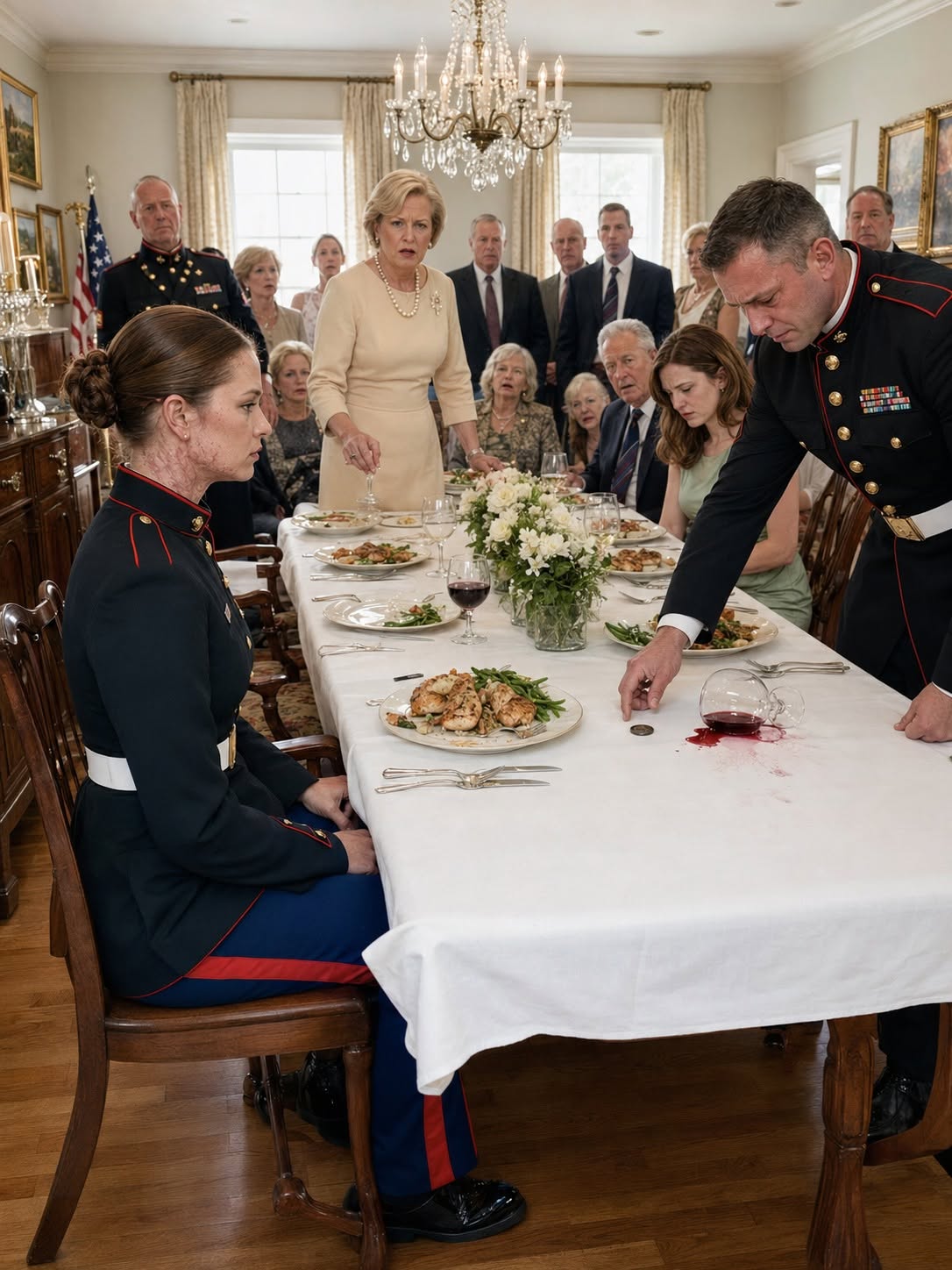
The dining room glowed beneath two chandeliers, the kind of warm light that made silverware shine and ordinary wine look expensive. Nearly fifty people filled Vivian Rowe’s house that night—neighbors, church friends, charity-board women, retired officers, local business owners, and smiling strangers who knew how to judge a room without ever moving their lips.
I had made the mistake of believing I could survive one dinner.
Just one.
My younger sister, Lila, sat across from me in a pale green dress with her hands folded tightly in her lap.
She looked thinner than the last time I had seen her.
Not elegant.
Not healthy.
Hollow.
Her collarbones rose beneath the fabric like coat hooks. The skin beneath her eyes had gone gray. Every few minutes, she glanced toward the bread basket, then toward our mother, then lowered her eyes again.
Vivian Rowe stood at the head of the table wearing pearls.
She held her wineglass the way a judge might hold a sentence.
Then she looked at my plate.
Two pieces of grilled chicken.
A spoonful of potatoes.
Salad.
Nothing extraordinary.
Nothing deserving a public execution.
But Mom smiled.
That little smile had raised me.
It meant she had located the softest part of someone and was preparing to press.
“Eat less,” she said.
Someone near the buffet laughed.
My mother’s smile widened.
“You look like a bloated, ugly grunt.”
The room dimmed around the edges.
She continued.
“No different from those trashy women hanging around supply depots. Look at you. You’re a stain on this family.”
Her gaze moved toward Lila.
“Why can’t you be more like your sister? Slim. Graceful. Refined.”
Then she reached forward and shoved my plate.
Porcelain scraped violently across oak.
The plate struck the centerpiece, tipped a wineglass, and sent sauce across the white tablecloth.
The entire room went silent.
Forks stopped.
Conversations died.
And fifty pairs of eyes moved over me.
Over the shoulders my mother had always said were too broad.
Over the burn scars climbing above the collar of my Marine dress uniform.
Over the thickened skin tracing my jaw where surgeons had reconstructed tissue fire had destroyed.
Over the body that had changed after seven operations, months of medication, and a recovery that had taught me more about pain than any battlefield ever had.
My mother looked almost satisfied.
I stayed still.
Under the table, my hands curled into fists.
I pressed my lips together hard enough to taste blood where my teeth cut the inside of my mouth.
Because if I opened it, I would either scream or cry.
And Vivian Rowe had taken enough from me without getting that too.
Lila stared at the ruined tablecloth.
Her face was completely white.
Mom’s friends did not look horrified.
That would have been easier to forgive.
They looked entertained in that restrained, respectable way people do when cruelty is disguised as family concern.
Then the front door slammed open.
The sound cracked through the house.
Everyone turned.
Heavy footsteps crossed the foyer.
A man appeared in the dining-room doorway wearing Marine dress blues.
He was tall, broad through the chest, with graying hair cut close at the sides and ribbons covering enough of his uniform to make several retired officers in the room straighten instinctively.
Gunnery Sergeant Marcus Hale.
I hadn’t seen him in almost three years.
For a moment, neither of us moved.
Then his eyes found me.
They traveled over my face.
My uniform.
The spilled food.
My mother’s hand still resting near my empty place setting.
Something changed in his expression.
“Major Rowe?”
My mother blinked.
I stood automatically.
“Gunny.”
Marcus crossed the room.
He had been invited to the dinner by Colonel Whitaker, one of my mother’s charity-board contacts. Vivian had spent weeks advertising that the evening would benefit a local veterans rehabilitation program. She liked causes that photographed well.
Apparently, nobody had told her who the keynote guest’s former commanding officer was.
Me.
Marcus stopped beside my chair.
His eyes moved to the blood at the corner of my mouth.
“What happened?”
“I bit my cheek.”
He looked at Mom.
Then at the plate halfway down the table.
My mother lifted her chin.
“This is a family matter, Sergeant.”
Marcus’s jaw tightened.
“Gunnery Sergeant.”
Vivian gave a dismissive wave.
“Whatever.”
Three retired Marines at the far end of the table visibly flinched.
I whispered, “Marcus, don’t.”
He looked at me.
For an instant, I saw Afghanistan again.
Dust.
Smoke.
His helmet cracked above one eyebrow.
Blood running down his neck while he screamed that two men were still behind the barrier.
Marcus reached into his uniform pocket.
He removed a small round object.
Blackened metal.
Bent along one edge.
Then he slammed it onto the table.
The sound rang through the room.
My breath stopped.
I knew that coin.
I had not seen it in nine years.
It was a Marine Corps challenge coin, once gold-colored, with the emblem of our logistics battalion stamped into one side.
Now most of it was scorched black.
A crack ran through the eagle’s wing.
My mother stared at it.
“What is that?”
Marcus didn’t look at her.
He looked at me.
His eyes filled.
I whispered, “You kept it?”
“For nine years.”
“Why?”
His mouth trembled.
Then he turned toward my mother.
“You think she looks like this because she ate too much?”
Vivian’s face hardened.
“I don’t know who you think you are—”
“She took the blast.”
His voice broke.
Nobody moved.
Marcus pressed both palms against the table as if he needed the wood beneath him.
“She took the blast so six of us could get behind the barrier.”
Silence.
He looked around the room.
“Six Marines walked home because she didn’t.”
My mother stared at me.
Lila’s hand rose slowly to her mouth.
Marcus picked up the blackened coin.
“This was in Major Rowe’s breast pocket when the medics cut her uniform off.”
I closed my eyes.
The memory came anyway.
Helmand Province.
Nine years earlier.
I had been Captain Evelyn Rowe then, commanding a logistics company supporting units moving equipment between small forward positions.
The mission that morning was supposed to be routine.
Routine is a dangerous word in war.
We were moving through a checkpoint when I saw a white truck change direction.
Too fast.
Wrong lane.
The sentry shouted.
Somebody fired.
The truck kept coming.
There were seven of us exposed near a concrete barrier.
I remember seeing Marcus.
Corporal Tate.
Lance Corporal Nguyen.
Three others.
And nineteen-year-old Private Isaiah Cole, frozen in the open because fear had turned his legs to stone.
I remember yelling.
“MOVE!”
People later told me I pushed Cole first.
I don’t remember that.
I remember grabbing somebody’s body armor.
I remember shoving another Marine so hard he fell behind the wall.
I remember Marcus screaming my name.
Then white.
Not light.
White.
A brightness so total it erased the world.
The truck detonated before I reached the barrier.
Concrete protected most of my Marines.
I was still outside it.
The blast threw me nearly twenty feet.
Fragments tore through my left side.
Heat burned my neck, shoulder, jaw, and part of my back.
My lungs filled with dust.
For thirty-six hours, my parents were told there was a possibility I would not survive.
For three days, Lila slept in a hospital waiting room.
Vivian came once.
Forty minutes.
The first thing she asked the surgeon was whether the scars on my face would be permanent.
Not whether I would walk.
Not whether I could breathe normally again.
Whether people would be able to see what happened.
I spent seven weeks at a military hospital before I could stand without assistance.
Then months learning how to use my left arm properly again.
Steroids and nerve medications changed my body.
Scar contractures changed how I moved.
Reconstructive procedures changed my face.
Pain changed everything else.
Marcus had visited whenever he could.
So had the other five.
One afternoon, he placed that damaged challenge coin on my bedside table.
“We found it near your gear.”
I had pushed it back toward him.
“Keep it.”
“Ma’am—”
“Keep it until all six of you stop blaming yourselves.”
Apparently, Marcus had taken me literally.
Back in my mother’s dining room, he held it between his fingers.
“Major Rowe spent eleven months in treatment after that blast.”
Mom finally found her voice.
“Evelyn never told us all those details.”
I stared at her.
I actually laughed.
It hurt my split lip.
“I did.”
Her eyes moved toward me.
“What?”
“I told you.”
“No, you said there had been an explosion.”
“I sent the after-action summary Dad requested.”
My father had died four years earlier. Unlike Mom, he had at least tried during my recovery, although trying usually meant standing awkwardly beside a hospital bed and asking whether I needed anything from the vending machine.
Vivian frowned.
“You never said you deliberately put yourself in front of it.”
Marcus looked stunned.
“She didn’t put herself in front of a bomb for fun.”
“That isn’t what I meant.”
“She saw six Marines exposed and moved them.”
Vivian’s cheeks reddened.
“I don’t appreciate being spoken to this way in my own home.”
Marcus straightened.
“And I didn’t appreciate watching the woman who saved my life get called ugly because of what saving it did to her.”
Nobody laughed now.
Not one person.
A retired Navy captain sitting near the end of the table slowly set down his fork.
A woman from Mom’s church began studying her lap.
Colonel Whitaker looked furious.
Not at Marcus.
At Vivian.
My mother noticed.
That mattered to her.
Reputation had always mattered more than truth.
She softened her expression.
“This has been misunderstood. I was encouraging Evelyn to take better care of herself.”
Marcus let out one short, disbelieving breath.
Then Lila spoke.
“No, you weren’t.”
Everyone looked at her.
My mother turned sharply.
“Excuse me?”
Lila’s fingers were shaking.
She placed them flat on the table.
“You weren’t helping her.”
“Lila, stay out of this.”
“No.”
I had never heard my sister say that word to our mother.
Neither had Vivian.
Mom’s face changed.
“Don’t embarrass yourself.”
Lila laughed.
It sounded broken.
“That’s all you ever say.”
She pushed her chair back.
Her green dress hung loosely around her.
“I’m not graceful.”
My mother’s voice dropped.
“Sit down.”
“I’m sick.”
The room went still again.
I stared at my sister.
She looked at me for the first time all evening.
Tears filled her eyes.
“I’ve been throwing up.”
My stomach dropped.
“What?”
“Lila,” Mom warned.
“For almost two years.”
I walked around the table.
“How often?”
She began crying.
“I don’t know anymore.”
My mother stood.
“This is inappropriate.”
I turned on her.
“You knew?”
Vivian’s silence answered before her mouth did.
“Mom?”
“She has always been dramatic about food.”
Lila made a choking sound.
“You weigh me every Sunday.”
The room seemed to tilt.
“What?” I asked.
Lila wiped her face.
“She keeps a scale in her bathroom. If I gain more than three pounds, she says I’m losing discipline.”
I looked at my mother.
Vivian crossed her arms.
“She models occasionally. Appearance matters.”
“She’s twenty-eight.”
“And?”
“And she looks ill.”
“She looks beautiful.”
Lila flinched.
That was when I understood.
My mother had spent my entire life using Lila’s body as a weapon against mine.
Slim.
Graceful.
Perfect.
I had assumed Lila enjoyed it.
I had resented her for years.
But perfection had simply been a different cage.
Mine required hiding.
Hers required shrinking.
I reached for her hand.
Her fingers felt cold.
“How long have you wanted to tell me?”
She looked at the floor.
“A long time.”
“Why didn’t you?”
“Because you already had enough.”
That nearly broke me.
I pulled her into my arms.
She was so light.
Too light.
For the first time, I felt the bones beneath her shoulders instead of seeing them.
Behind us, Mom said, “This is ridiculous. She needs discipline, not attention.”
Marcus looked at her with an expression colder than anger.
But I no longer needed him to speak for me.
I turned.
“You don’t get to talk about her body anymore.”
Vivian’s eyebrows rose.
“Excuse me?”
“You heard me.”
“This is my daughter.”
“So am I.”
She froze.
I continued.
“And look what you did with that privilege.”
Her lips parted.
For thirty-six years, I had been trained to stop when my mother looked offended.
That night, I didn’t.
“You spent my childhood teaching me that being loved required being attractive enough not to embarrass you.”
Her face whitened.
“You told me not to smile with my whole mouth because it pulled my scars.”
People shifted uncomfortably.
“You made me wear turtlenecks in July after my surgeries.”
“Evelyn—”
“You asked a plastic surgeon if he could make my face normal before you asked whether the nerve damage would improve.”
Her eyes flickered.
“I was worried about your future.”
“No. You were worried about photographs.”
I pointed toward Lila.
“And while you were telling me I was too big, you were teaching her there was no such thing as thin enough.”
Lila began sobbing.
Vivian looked around the room.
I knew that look.
She was searching for allies.
For years, someone always rescued her.
A friend.
My father.
An aunt.
Someone willing to say she meant well.
No one did.
Colonel Whitaker stood.
“Vivian, I think this dinner is over.”
She stared at him.
“This is my house.”
“Yes.”
His voice remained calm.
“And those are your daughters.”
That hurt her more than shouting would have.
Guests began leaving.
Quietly.
Coats were collected.
Chairs scraped.
Nobody lingered for dessert.
The same people who had watched my humiliation with polite curiosity now avoided my mother’s eyes.
I should have enjoyed that.
Instead, I felt tired.
Marcus walked over and placed the blackened coin in my palm.
“No.”
I tried to hand it back.
“You were supposed to keep it.”
“I did.”
“Until when?”
His eyes filled again.
“Until I stopped blaming myself.”
I looked at him.
“And?”
He smiled.
“Eight years ago.”
“Then why keep carrying it?”
“So I’d remember what courage looks like when I start confusing it with medals.”
My throat tightened.
He closed my fingers around the coin.
“Time for you to have it back, ma’am.”
I hugged him.
Military people are sometimes terrible at hugging.
Marcus was no exception.
He thumped my back once and nearly knocked the air from me.
“Still strong,” he muttered.
I laughed.
For the first time that night, it didn’t hurt.
Lila came home with me.
There was no grand discussion.
No family vote.
She packed a bag.
Mom stood in the upstairs hallway watching.
“You’re really leaving because she put ideas in your head?”
Lila stopped on the stairs.
For years, my sister had mastered the art of becoming smaller when Vivian entered a room.
That night, she stood straight.
“No, Mom.”
Her voice shook.
“I’m leaving because I finally realized the voice in my head sounds exactly like you.”
Vivian looked as if Lila had slapped her.
We left together.
At my apartment, Lila stood in front of the refrigerator for almost a full minute.
“What?”
She wiped her nose.
“You have cheese.”
I frowned.
“Yes.”
“Regular cheese.”
I understood.
Mom had kept low-fat everything.
Measured portions.
A drawer full of diet products.
Lila started crying again.
I held her.
The next morning, we called an eating-disorder treatment center.
I had commanded Marines under fire.
I had sat through casualty notifications.
I had signed paperwork that could change careers.
But helping my sister make that call was one of the hardest things I had ever done because part of her still believed getting well meant becoming unacceptable.
Recovery was not beautiful.
That is something inspirational stories often leave out.
There were appointments.
Arguments.
Relapses.
Anger.
Days when Lila accused me of watching what she ate even when I wasn’t.
Days when she called Mom and came back shaking.
Days when I wanted to fix everything and had to learn that loving someone does not make you qualified to become their therapist.
She moved into an outpatient recovery apartment after three months.
She found a counselor she trusted.
She stopped weighing herself.
Eventually.
I stopped commenting on food entirely unless she asked.
Mom called constantly at first.
She blamed me.
Then Marcus.
Then the military.
Then Lila’s therapist.
Anyone except herself.
One voicemail lasted seven minutes.
“You’ve always resented your sister because she was prettier than you.”
I deleted it halfway through.
Two weeks later, Vivian appeared at my apartment.
I almost didn’t open the door.
She looked smaller without pearls.
That sounds cruel.
It isn’t.
My mother used beauty like armor.
Without makeup, jewelry, and an audience, she looked like a tired sixty-three-year-old woman who had lost control of both daughters.
“Can I come in?”
“No.”
Her face hardened automatically.
Then softened again.
“Please.”
I stepped into the hallway and closed the door behind me.
“What do you want?”
“To see Lila.”
“She isn’t here.”
“I know.”
That surprised me.
Vivian twisted a tissue in her hands.
“I spoke to her therapist.”
My body tensed.
“She gave permission?”
“Yes.”
“Why?”
Mom looked down.
“Because Lila told her she wants a relationship with me someday.”
Someday.
Not now.
That distinction mattered.
Vivian took a breath.
“The therapist asked me when I first started criticizing Lila’s weight.”
I waited.
“I said I didn’t criticize it.”
I almost laughed.
“She asked again.”
“And?”
Mom stared at the carpet.
“I remembered something.”
For the first time, her voice lacked performance.
“My mother used to weigh me.”
I said nothing.
“Every Friday morning before school.”
She gave a strange laugh.
“If I gained weight, she made me skip dessert all weekend.”
I had heard almost nothing about my grandmother’s parenting.
Vivian rarely discussed childhood.
“I swore I would never be like her.”
There are moments when generational cruelty reveals itself not as an excuse, but as an inheritance someone never bothered to refuse.
“You became her anyway,” I said.
Mom cried.
I did not comfort her.
Not because I wanted her to suffer.
Because she needed to remain inside what she had finally admitted.
After a minute, she looked at my face.
Really looked.
Her eyes moved along the burn scars.
I hated how quickly I became twenty-seven again, lying beneath hospital lights while she asked doctors about cosmetic procedures.
“I’m sorry,” she whispered.
“For tonight?”
“For a lot of things.”
“That’s vague.”
She nodded.
Then tried again.
“I am sorry I called you ugly.”
My jaw tightened.
“I’m sorry I treated your injuries like something you did to me.”
Better.
“I’m sorry I compared you to Lila.”
Better.
“And I’m sorry I taught both of you that your bodies determined whether I was proud of you.”
There it was.
Specific enough to hurt.
Specific enough to matter.
I looked away.
“I don’t forgive you yet.”
She nodded.
“I know.”
That was new too.
Vivian Rowe had never accepted a consequence without negotiating.
I eventually let her attend one of my therapy sessions with me.
Then another.
Lila did the same months later.
Our family did not magically become healthy.
Mom still slipped.
Once, at lunch, she looked at the dessert menu and started to say, “Do we really need—”
Both Lila and I stared at her.
She stopped.
Closed her eyes.
Then said, “I’m sorry. Order whatever you want.”
Lila ordered cheesecake.
I ordered pie.
Mom ordered coffee.
Halfway through dessert, she stole a bite of mine.
That was probably the most normal moment the three of us had ever shared.
A year after the dinner, Marcus invited me to a reunion with the six Marines from the blast.
All six came.
Isaiah Cole, the nineteen-year-old private who had frozen at the checkpoint, was twenty-nine now.
Married.
Two daughters.
He hugged me so tightly my scars pulled.
“Easy,” I said.
He laughed.
“Sorry, ma’am.”
“Still apologizing after ten years?”
“Probably forever.”
We sat outside a restaurant in San Antonio telling stories that grew less accurate and funnier with every retelling.
At some point, Isaiah asked about the coin.
I took it from my pocket.
Marcus stared.
“You carry it now?”
“Sometimes.”
Isaiah smiled.
“Good.”
I ran my thumb across the scorched edge.
For years, I had thought the blast divided my life into two versions.
Before, when I still looked like the daughter Vivian wanted.
After, when I became the body she found embarrassing.
I had been wrong.
The explosion did not ruin my body.
It revealed the people around it.
It showed me who would sit beside my hospital bed.
Who would come back.
Who would remember.
Who would see scars and think survival instead of ugliness.
My mother looked at my face and saw damage.
Marcus looked at the same face and remembered six people getting home.
Lila looked at my body and eventually learned that taking up space did not make someone unworthy of love.
And eventually, I learned it too.
I still have scars.
Some mornings they ache before rain.
My left shoulder never recovered its full range of motion.
Medication and age changed my body again.
I am not thin.
I am not delicate.
I do not photograph the way my mother once wished I would.
I am also no longer interested in apologizing for any of that.
The blackened coin sits on my desk now in a small wooden stand.
One side is almost impossible to read.
The metal is warped.
The eagle is damaged.
The edge is burned.
Vivian saw it there during a visit two years after the dinner.
She touched it with one finger.
“That’s the one?”
“Yes.”
“The one he brought?”
“Yes.”
She looked at my cheek.
Then at the coin.
“I used to think damaged things needed to be hidden.”
I didn’t answer.
She gave me a sad smile.
“I was wrong.”
I looked at the burned metal.
“No, Mom.”
Then I looked at her.
“Some damaged things need to be remembered.”
The coin stayed exactly where it was.
So did my scars.
And for the first time in my life, neither one needed an apology.
THE END