My Husband Handed Me $200 After I Gave Birth and Said Our $3 Million Home Was Sold Then My Father’s Attorney Walked In With the Buyer’s Lawyer
Daniel dropped the envelope on the coffee table.
“There,” he said. “Use it to rent a room somewhere.”
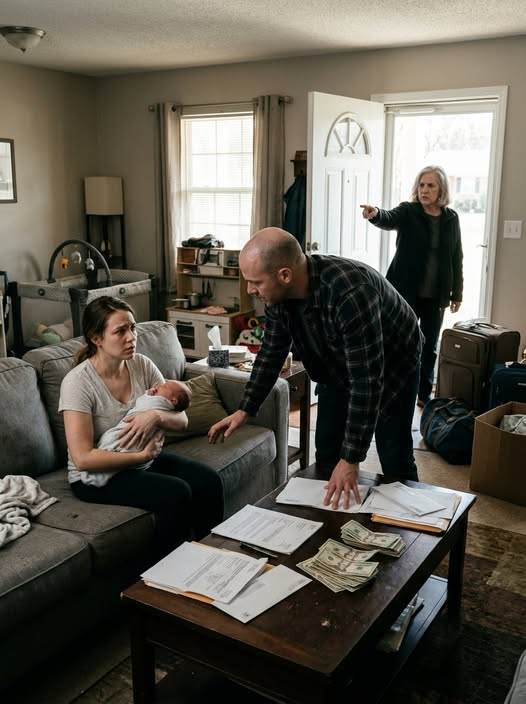
I was sitting on the couch in the living room of the house my father left me. Four days after giving birth. My body still ached in places I didn’t know could ache. My daughter was asleep in her car seat at my feet, wrapped in the pink hospital blanket.
I picked up the envelope and opened it.
Two hundred dollars. Ten twenty-dollar bills.
My mother-in-law, Patricia, was standing behind my husband with her arms folded.
“There’s a neighborhood out past the interstate,” she said. “Rooms are cheap there. You’ll manage.”
I looked at my husband.
“You want me to leave tonight? With a four-day-old baby?”
Daniel crossed his arms.
“The house has been sold, Claire. We sold it. While you were in the hospital.”
“You keep saying that.”
“Because it’s true.”
Patricia smiled. For the first time since I walked through the door, she looked satisfied.
“You should be grateful Daniel’s giving you anything at all,” she said.
I looked down at those ten twenty-dollar bills in my hand.
And then I started laughing.
Not polite laughter. Not the kind you do to make people comfortable. The absurdity of it caught in my chest, and I laughed until I had to brace one hand on the coffee table.
They stared at me like I’d lost my mind.
“What’s so funny?” Daniel demanded.
I looked at the money. Then back up at him.
“Because the house you just sold,” I said, “had already—”
I stopped.
I left it right there.
Patricia’s face tightened. Daniel looked confused.
And then, for the first time in months, I saw something on my husband’s face I’d never seen there before.
Fear.
My name is Claire Bennett. I’m thirty-six years old.
And that was the moment I realized my husband still had absolutely no idea what he’d done.
Three months earlier, I still believed my marriage could be saved.
Daniel and I had been married for seven years. We lived in a beautiful two-story brick colonial on a quiet street in Dunwoody, just outside Atlanta. The kind of neighborhood where people know which house has the best Christmas lights. Where kids ride their bikes until somebody calls them in for supper. Where neighbors wave from their driveways without even stopping the lawn mower.
The house was worth about three million dollars.
But it never started out as Daniel’s house.
My father bought it in 1998, before the neighborhood took off. He was a heart surgeon at Emory. He raised me in that house by himself after my mother died when I was eight.
He passed away four years ago. Pancreatic cancer. He left the house to me. In my name alone.
Over the next few years, I renovated it. I paid for the new kitchen and the new roof and the new windows out of my own savings and my salary as a hospital pharmacist. And slowly, it turned into the home Daniel and I shared.
Daniel always called it “our house.”
I never corrected him.
I thought that’s what marriage was supposed to feel like. Two people sharing a life without keeping score over every word.
My father left me something else, too.
A letter. Handwritten. In a sealed envelope that his attorney handed me after the funeral.
I kept it in a wooden box on the top shelf of my closet. Under photographs I still couldn’t look at without crying.
One line in that letter, I read over and over.
Whatever happens, sweetheart, never let anybody convince you that what I left you is something you owe them.
I didn’t understand what he meant until I was married.
Daniel was a good husband in the beginning. At least, that’s how I remember him.
He worked hard. He sold commercial insurance. He made me laugh. The day we bought our first car together, a used Honda Pilot, we sat in it in the dealership parking lot for an hour talking about all the road trips we were going to take.
We wanted kids. We wanted a quiet life.
But somewhere around year five, something changed.
Daniel got interested in money. Not the electric bill. Not the grocery budget.
My money.
He started asking how much I had in savings. Whether my father left me any investments. How much the house had gone up in value.
I didn’t think much of it at first.
Then his mother started asking too.
Patricia was always polite to me in public. But she had a way of making an insult sound like advice.
One Sunday afternoon, Daniel was out mowing the front yard. Patricia was sitting across from me at my kitchen table, slowly stirring her coffee.
“You know, Claire,” she said, “a house like this can cause problems between spouses.”
I smiled politely.
“What kind of problems?”
She shrugged.
“Ownership problems. Inheritance problems. Things people don’t think about until it’s too late.”
“We seem to be doing fine.”
She lowered her voice.
“Do you?”
“What does that mean?”
She folded her hands on the table.
“Daniel works hard. He contributes. But the biggest asset in this marriage came from your family. That can make a man feel like a guest in his own home.”
I looked out the kitchen window. Daniel was guiding the mower along the edge of the driveway.
Until that moment, I’d believed we were building a life together.
Patricia was describing a competition I didn’t even know I was supposed to lose.
After that, I started paying attention.
Daniel started coming home late. He took phone calls out in the garage. He started keeping financial papers in his car instead of our home office.
Then came the questions about the deed.
One night at dinner, he asked casually, “Do you know if your name is the only one on the title?”
I put down my fork.
“Yes.”
“Are you sure?”
“Yes, Daniel. I’m sure.”
He laughed awkwardly.
“I’m just asking.”
“Why?”
“Because we’re married.”
That answer stuck with me for weeks.
Marriage was never supposed to mean one person could quietly take control of something that belonged to the other.
A few days later, I was seven months pregnant. I came downstairs at ten o’clock at night for a glass of water.
The light was on in my father’s old study.
Daniel was standing next to the filing cabinet. The one where I keep all my father’s estate papers.
The drawer with the property records was open.
He spun around so fast he almost knocked over the lamp.
“What are you doing?” I asked.
“Nothing.”
“You’re going through Dad’s property documents.”
“I’m looking for an insurance form.”
“You could’ve asked me.”
“I didn’t think it mattered.”
He shut the drawer.
That night, we had the worst fight of our marriage.
He said I was treating him like a stranger. I told him he was acting like the house belonged to him.
He slammed his hand down on the kitchen counter.
“I live here!”
“So do I.”
“You’re my wife!”
“And you’re my husband,” I said. “Neither one of those things changes the deed.”
He stared at me.
He didn’t look hurt. He didn’t look left out.
He looked angry that I’d said it out loud.
The next morning, I called Margaret Hayes.
Margaret was my father’s attorney for twenty-two years. She handled his estate. She’s sixty-four, sharp as a tack, and she never tells you what you want to hear unless it happens to be true.
I sat across from her desk in her office in Buckhead. I put my father’s property documents in front of her.
She read them carefully. All of them.
Then she took off her reading glasses.
“Claire, this house is legally yours. Daniel lives there. That gives him no authority whatsoever to sell it. None.”
“I know.”
“No,” she said gently. “I don’t think you understand how important that is. Not yet.”
I felt relieved.
But Margaret wasn’t done.
“There’s another question,” she said. “What do you want to do?”
“What do you mean?”
“You can stay. You can sell. You can move somewhere new. But make the decision based on the life you want. Not on what Daniel or his mother might try to do.”
I thought about the last few months.
The fights. The phone calls in the garage. The questions about the deed. The way Patricia looked around my living room like she was already deciding which furniture to keep.
I put both my hands on my belly. The baby kicked.
“I want a fresh start,” I said.
Margaret nodded.
“That can be arranged.”
She listed the house quietly. No yard sign. No open houses. A private listing through a real estate agent she trusted.
Two weeks later, a couple from Charlotte made an offer. A pediatrician and his wife with three kids. They’d been looking for a house in that school district for over a year. They fell in love with the backyard and the big oak tree.
They paid full price. Two million, nine hundred and sixty thousand dollars.
The closing happened through a licensed title company in Sandy Springs. Every document reviewed. Every signature verified. The deed was recorded with the Fulton County Clerk the next morning.
The buyers agreed to let me stay in the house for sixty days after closing. To give me time to have the baby and move.
The money went into accounts in my name alone.
Two weeks before my due date, the house stopped belonging to me.
And I didn’t tell Daniel.
Not yet.
I want to be honest about why I didn’t tell him.
Part of it was that I was scared of how he’d react. Eight months pregnant. Alone with him and his mother.
But part of it was something harder to admit.
I wanted to know if I was wrong about him.
I wanted to know whether he’d stop short of the thing I could hardly stand to imagine.
I found out three days after the closing.
I was coming in from the backyard through the laundry room. The door to the garage was cracked open.
Daniel was in there with his mother.
“We can get it done quickly,” Daniel said.
“How much?” Patricia asked.
“Not enough at the price we talked about.”
“Then lower the price.”
I froze.
They were talking about my house.
The house I had already sold.
Patricia laughed. A small, satisfied little laugh.
“She’ll be too busy with the baby to even notice.”
“And once it’s gone,” Daniel said, “she won’t have anywhere to go.”
I stood behind that door with my hand over my mouth.
My hands were shaking.
This wasn’t a misunderstanding about marriage. This wasn’t about feelings.
They were planning to use the most vulnerable days of my entire life to make decisions for me.
They thought a newborn would make me powerless.
I walked back to the kitchen without opening that door.
That evening, Margaret called.
“Claire. Something’s come up. Someone has contacted a title company in Marietta claiming to have authority to sell your former property.”
My heart stumbled.
“Daniel?”
“I don’t know yet. I’ll find out.”
I closed my eyes.
“Then let him try to explain that.”
“Are you sure you don’t want to confront him?” Margaret asked.
“Yes,” I said. “I’m done arguing with people who treat every boundary like the start of a negotiation. Let the paperwork speak.”
Nine days later, I went into labor.
It was a Tuesday morning in October. Five a.m.
Daniel drove me to Northside Hospital. Patricia was already sitting in the passenger seat of his car when I came outside with my hospital bag. I had to sit in the back.
As we pulled out of the driveway, I turned around and looked at the house through the rear window.
The big oak tree. The front porch. My father’s study window.
I knew they’d been planning something.
I didn’t know they’d move forward while I was lying in a hospital bed.
Our daughter was born at 2:47 that afternoon. Seven pounds, two ounces. A full head of dark hair.
We named her Lily. After my mother.
I still remember the smell of the antiseptic. The soft, warm weight of her on my chest. I’d barely slept in thirty hours. My whole body was shaking. And every part of me was focused on keeping that tiny person warm and safe.
Daniel held Lily for less than five minutes.
Then he handed her back to me.
“I have to go handle something at the house,” he said.
At the time, I thought he meant diapers. Or the car seat. Or some paperwork.
Even then, after everything, some small part of me wanted an ordinary explanation.
I was wrong.
The next morning, while Lily slept beside me in her little plastic hospital bassinet, my phone rang.
Margaret.
“Claire. I need to tell you something. The title company in Marietta has confirmed it. Daniel and his mother signed a purchase agreement yesterday. For your former property.”
I closed my eyes.
“Did they actually sell it?”
“No. It can’t close. The house was transferred to your buyers sixteen days ago. It’s recorded with the county.”
I let out a long breath.
“So they failed.”
“They attempted to sell a property they did not own,” Margaret said carefully. “Claire, that’s very different from simply failing to sell a house.”
I looked down at my daughter.
“How much?”
“What?”
“How much did they agree to sell it for?”
Margaret was quiet for a second.
“Eight hundred and fifty thousand dollars.”
I stared at the wall of that hospital room.
My father’s house. Worth three million dollars.
Daniel had agreed to give it away for less than a third of its value. Just to get it done fast. Before I got home.
“The buyer is an investor,” Margaret said. “He put fifty thousand dollars into escrow. He thought he’d found the deal of a lifetime. The title company called him this morning to tell him the seller doesn’t own the house.”
I thought about that man. Sitting in some office. Finding out his bargain was a lie.
I felt sorry for him.
He didn’t create this mess.
Daniel and Patricia did.
That evening, Daniel called my cell phone.
I watched his name light up the screen. I let it ring.
A minute later, he called again. Then again.
Finally, he left a voicemail.
“Claire. Call me. We need to talk.”
No apology. No question about the baby. No how are you feeling.
Just an instruction.
I deleted it.
He came back to the hospital the next morning to take us home. Patricia came too.
He didn’t say anything about the house in the hospital. Not one word. He signed my discharge papers. He carried the car seat. He loaded the flowers from my coworkers into the trunk.
He was waiting until he had me home.
The drive back to Dunwoody was silent. Lily slept in her car seat. I watched the familiar streets go by. The Kroger. The library. The elementary school where I used to walk with my father.
For years, that house had meant safety to me.
Now it meant a lesson I wished I’d never needed.
When we pulled into the driveway, Patricia went inside first.
By the time I got through the front door, slowly, carefully, my body still aching, she was standing in the foyer with her arms crossed.
“Finally,” she said.
I looked at her.
“I just gave birth, Patricia.”
She didn’t respond to that. She glanced down at the car seat.
“She’s beautiful.”
There was something cold about the way she said it. I wanted to hear warmth. Instead I heard the same flat certainty she used for everything in our lives.
She pointed at the living room.
“Sit down. We need to talk.”
I sat down on the couch. Daniel stood by the fireplace. He looked uncomfortable.
Patricia set a single sheet of paper on the coffee table in front of me.
“You need to sign this.”
“What is it?”
“An acknowledgment. That you understand the house has been sold.”
I almost smiled.
“You want me to sign that?”
“Yes.”
“Why?”
“So there’s no confusion later,” Patricia said.
I picked up the paper.
It wasn’t from a title company. It wasn’t a closing document. It wasn’t anything a lawyer had ever seen.
It was a statement typed up on Daniel’s home printer. With two blank lines at the bottom. One for my signature. One for a date.
I, Claire Bennett, acknowledge that the property has been sold by Daniel Bennett and that I have no further claim to it.
I set it back down on the table.
“I’m not signing this.”
Daniel’s jaw tightened.
“Why not?”
“Because I don’t agree with it.”
Patricia shook her head.
“You don’t have a choice, Claire.”
That sentence hung in the air.
You don’t have a choice.
I’d heard versions of it my whole marriage. Every time Patricia wanted Daniel to make a decision. Every time Daniel wanted me to accept something. Every time either one of them mistook pushing for permission.
I looked at both of them.
“I always have a choice.”
Patricia laughed.
“You have nowhere to go.”
I didn’t say anything.
That’s when Daniel walked into the kitchen. He came back holding a small white envelope.
And he dropped it on the coffee table.
“There.”
And that was the two hundred dollars.
And that was when I laughed.
And that was when I started to say it, and stopped.
Because the house you just sold had already—
“Had already what?” Daniel said. He stepped toward me. “Finish the sentence, Claire.”
I shook my head.
“You’ll find out soon enough.”
“Claire. What did you do?”
I looked down at Lily, asleep in her car seat. Then back up at my husband.
“I protected myself,” I said.
Patricia snatched the typed statement off the coffee table.
“What does that mean? What does that mean?”
And right then, there was a knock at the front door.
Daniel turned toward it. Patricia frowned.
I stayed sitting on the couch.
“It’s open,” I called.
The door swung open. Margaret Hayes walked in. In her navy suit, carrying her leather briefcase.
And behind her was a tall man in a gray suit I’d never seen before.
“Good afternoon,” Margaret said pleasantly. “I hope we’re not interrupting.”
Daniel stared at her.
“What are you doing here?”
“I was Claire’s father’s attorney. I’m Claire’s attorney.” Margaret nodded toward the man beside her. “And this is Thomas Reed. He represents the family who purchased this house.”
Daniel’s face went completely blank.
“Purchased?”
Thomas Reed stepped forward. He was polite. Calm. Very serious.
“Mr. Bennett. My clients, Dr. and Mrs. Alvarez, closed on this property sixteen days ago. On October fourth. The deed was recorded with Fulton County on October fifth. My clients graciously allowed Mrs. Bennett to remain in the home for sixty days after closing. Because she was expecting.”
He opened a folder. He laid it out on the coffee table, right on top of the two hundred dollars.
A copy of the recorded deed. The settlement statement. The wire confirmation.
“Yesterday,” Thomas Reed said, “my office was contacted by a title company in Marietta. They informed us that you, Mr. Bennett, and your mother signed a purchase agreement to sell my clients’ home. To a third party. For eight hundred and fifty thousand dollars.”
The room went completely silent.
Patricia picked up the deed. Her eyes moved down the page.
Then she looked at me.
“You sold the house?”
“Yes.”
“Two weeks ago?”
“Sixteen days ago,” I said.
Her mouth opened. Nothing came out.
Daniel grabbed the papers out of his mother’s hands.
“You sold my house without telling me?”
“I sold my house,” I said. “Without telling you. Yes.”
“You’re my wife!”
“And you’re my husband,” I said quietly. “And you tried to sell it too. Without telling me. While I was in the hospital giving birth to your daughter.”
Daniel looked at his mother.
“We thought—” Patricia started.
Thomas Reed held up his hand. Very gently.
“Ma’am. I understand you may say you believed you had the authority. But the documents establish ownership. And they establish it very clearly. Your purchase agreement with the third party will have to be addressed separately.”
He paused.
“The buyer in Marietta has retained counsel. He placed fifty thousand dollars in escrow based on representations you and your son made in writing. That he was the owner. That he had the right to sell.”
Daniel sat down hard in the armchair.
For the first time, he looked truly frightened.
“How much trouble am I in?”
Margaret didn’t answer right away.
“That depends on the facts, Daniel,” she finally said. “What you signed. What you said. What the buyer believed. I’m not your lawyer. You need to get your own. Today.”
Patricia turned to me. Her face was white.
“You’re his wife! You’re supposed to protect him!”
I looked down at my daughter.
“I spent seven years protecting him, Patricia.”
Then I looked her straight in the eye.
“But protecting somebody doesn’t mean hiding the consequences of their own choices.”
Daniel put his face in his hands.
The man who walked into my living room an hour earlier thinking he could decide my future was sitting there staring at proof that he couldn’t.
He’d wanted me frightened. Desperate. Standing on the curb with a newborn and two hundred dollars.
Instead, he was sitting in a house that hadn’t belonged to either one of us for sixteen days.
Patricia’s eyes filled with tears.
“You could have told us sooner,” she whispered.
“I could have.”
“Why didn’t you?”
I looked at Daniel.
“Because I wanted to know what you’d do,” I said. “When you thought I had nothing left.”
He lowered his eyes to the floor.
“And now I know,” I said.
There was no shouting. No celebration. No big announcement that I’d won.
Just silence.
They’d finally stopped arguing with the truth.
Margaret and Thomas Reed left a little while later.
Patricia left right after them. She didn’t say goodbye.
Daniel stayed in the armchair for a long time after the front door closed. Staring at that recorded deed.
“How long were you planning this?” he finally asked.
“I wasn’t planning anything, Daniel. I just sold my house. After you started going through my father’s files in the middle of the night.”
He didn’t say anything.
That night, I slept in the nursery with Lily. In the rocking chair. With the door locked.
The next morning, I heard his phone buzzing on the kitchen counter while he was in the shower. Over and over.
I looked at the screen.
Three missed calls. From a law office in Marietta. The attorney for the buyer he’d tried to sell my house to.
I looked at that screen for a long moment.
Then I walked away.
That wasn’t a problem I could fix for him anymore.
By breakfast, Daniel was pacing around the kitchen.
“I need to talk to you.”
I was sitting at the table feeding Lily a bottle.
“About what?”
“The house.”
“There’s no house for us to negotiate about, Daniel.”
He blew out a hard breath.
“The buyer wants his money back. His lawyer’s talking about suing me. And maybe the district attorney.”
“That sounds reasonable,” I said. “You took his money.”
“I didn’t take it. It’s in escrow.”
“You told him you owned a house you didn’t own. So he’d give you his money.”
Daniel rubbed his forehead.
“I didn’t know the house was already sold.”
“That part’s true,” I said.
“But I didn’t know you were going to sell it!”
Something tightened in my chest.
“You’re still talking about my decision like it was the betrayal, Daniel.”
“I was trying to protect our family.”
“No,” I said quietly. “You were trying to take control of something that belonged to me.”
“My mother said—”
“That’s part of the problem,” I said.
He stopped.
“For seven years, every time something went wrong, you let your mother tell you what to think. What to do. What I should have to accept. And when she decided my father’s house was something you deserved, you listened.”
“You make it sound like I was stealing from you.”
I didn’t raise my voice.
“You were trying to take something that wasn’t yours. Maybe you called it marriage. Maybe you called it fair. But you were making decisions about my property behind my back.”
“I thought it was ours.”
“You never once asked me,” I said.
That stopped him cold.
Because he knew I was right.
A few days later, after the escrow money had been returned to the buyer in Marietta, Daniel asked me to sit down with him at the kitchen table.
“Claire. There’s something I have to tell you.”
I waited.
“I have debts.”
I’d already suspected.
“How much?”
He hesitated.
“More than you know.”
“How much, Daniel?”
He told me.
Two hundred and thirty-eight thousand dollars.
Credit cards. A personal loan. A line of credit against his retirement account. Two years of sports betting on his phone that started small and kept getting bigger.
I sat there in shock.
And suddenly, everything made sense.
The late-night phone calls in the garage. The questions about the deed. Patricia’s pressure. The rush. Being willing to sell a three-million-dollar house for eight hundred and fifty thousand. Just to get it done fast.
“You were going to use the money to pay your debts.”
He nodded.
“Some of it.”
“And my father’s house was the easiest way to get it.”
He didn’t answer.
That was answer enough.
A few months earlier, I’d have screamed. I’d have demanded explanations until sunrise. I’d have believed that if I just found the right question, his answer would make the hurt smaller.
But I looked down at Lily in my arms.
And I knew I didn’t want her childhood to be measured against the worst thing her father ever did.
I wanted her to grow up knowing that love doesn’t mean giving up your boundaries. That forgiving somebody doesn’t mean pretending. That being family doesn’t give anybody permission to take what belongs to you.
So I told Daniel the truth.
“I’m not going to use what you did to keep you from your daughter. I promise you that.”
He looked up. His eyes were wet.
“But things are going to change,” I said. “You’re going to get a financial counselor. You’re going to show me every account. You’re going to go to Gamblers Anonymous. You’re going to see a therapist. And you’re going to stop letting your mother make decisions inside our marriage.”
“Okay.”
“And you’re going to understand that trust doesn’t come back because you said you’re sorry once.”
“I understand.”
“No,” I said gently. “I don’t think you do yet. Trust isn’t something you ask for after you break it. It’s something you rebuild. One day at a time.”
That week, I moved out.
I’d already found a smaller house. In Decatur. A little three-bedroom bungalow with a front porch swing and a crepe myrtle in the yard. I bought it with cash from the sale.
It wasn’t worth three million dollars.
It didn’t need to be.
It was bright and peaceful. Morning light came across the kitchen floor. The rooms held only what we needed.
And nobody in that house thought they had a right to control me.
Daniel got an apartment in Sandy Springs.
The buyer in Marietta got his fifty thousand dollars back. His lawyer sent a long letter. Daniel’s new lawyer worked out a settlement. Daniel paid the man’s legal fees and an extra fifteen thousand dollars for his trouble. Out of his retirement account.
The district attorney’s office opened a file. Daniel’s lawyer met with them twice. In the end, they decided not to file charges. The deal never closed. Nobody lost money. And Daniel cooperated with everything.
But it was close.
His lawyer told him later that if the sale had gone through, if that buyer had wired eight hundred and fifty thousand dollars for a house that wasn’t Daniel’s, he’d be in prison.
Two weeks after I moved to Decatur, Patricia showed up on my front porch.
She looked different. All that confidence was gone. She was holding a small Target bag.
“I brought some things for the baby.”
I thanked her. But I didn’t invite her in right away.
She looked at me.
“I owe you an apology, Claire.”
I waited.
“I thought I was protecting my son.”
“You were protecting what you thought he deserved,” I said.
She nodded slowly.
“I suppose that’s true.”
She wiped her eyes.
“I convinced him the house should belong to both of you. And then I convinced him you’d eventually just give in. Because women do. Because I always did.”
I didn’t say anything.
“I was wrong,” Patricia said.
It was the first thing she’d said to me in a very long time that didn’t put part of the blame on me.
I stepped aside.
“You can come in.”
She came in very quietly.
And for the first time, Patricia held her granddaughter without giving me a single instruction. She didn’t criticize the nursery. She didn’t say anything about the size of the house.
She just looked down at Lily.
“She has your eyes,” she whispered.
“She does.”
“I know I can’t undo what I did.”
“No. You can’t.”
“But I’m sorry. I’m so sorry.”
I believed she meant it. In that moment.
I didn’t suddenly feel close to her. I didn’t forget the envelope. Or the typed statement on the coffee table. Or her laughing in the garage. She’ll be too busy with the baby to notice.
But I accepted the apology.
Those are two different things.
Over the next six months, Daniel started doing what he should’ve done from the very beginning.
He took responsibility.
He went to a Gamblers Anonymous meeting at a church in Roswell every Tuesday night. He hasn’t placed a bet since.
He met with a credit counselor and set up a repayment plan. He closed his secret accounts. He sent me his bank statements every month without being asked.
And he came to see Lily. Every Wednesday evening. Every Saturday afternoon.
At first, those visits were awkward. He’d sit on the floor next to her crib and just watch her sleep. Sometimes he’d talk to her. Sometimes he’d just sit there for an hour. Learning how to be present without asking anything from either of us.
One afternoon, I found him on the living room rug holding Lily while she played with his watch.
He looked up at me.
“She gets bigger every week.”
“She does.”
He smiled. Then he got serious.
“I missed so much before she was even born,” he said. “Those last months. When I should’ve been getting ready to be a dad. I was planning how to take your house instead.”
“Yes,” I said. “You were.”
“I can’t change that.”
“No.”
“But I can change what happens next.”
There was no request for forgiveness attached to it. He wasn’t asking me for anything.
He was just saying what he’d done. And what was his to fix.
And the hardest thing of all, he learned to tell his mother no.
One evening, I was at his apartment dropping off Lily’s diaper bag. Patricia called.
I couldn’t hear everything she said. But I heard enough.
“You need to think about yourself, Daniel. You need to protect what’s yours.”
Daniel was quiet for a long time.
Then he said, “I am, Mom.”
She kept talking. His face got tight.
And then he said something that made me look up from across the room.
“No, Mom. Claire and I are going to make our own decisions. Without you.”
There was a long silence on the line.
Then he hung up.
He looked over at me.
“I should’ve said that seven years ago.”
I didn’t disagree.
A few weeks later, Patricia asked if she could talk to me. Just the two of us.
We met at a coffee shop in Decatur Square. We sat on a bench outside with paper cups while cars rolled slowly through the parking lot.
She looked older than I remembered.
“I’ve been thinking about everything,” she said.
“So have I.”
“I told myself I was protecting Daniel.”
“I know.”
Then she said something I didn’t expect.
“I was jealous of you, Claire.”
“Jealous? Of me? Why?”
“Your father trusted you. He left you something valuable. You had a real career. You built a life for yourself. And Daniel always felt like he was standing in somebody else’s shadow. In somebody else’s house.”
She took a breath.
“I thought if he controlled the house, he’d finally feel important.”
I listened.
“That was never your burden to fix,” Patricia said.
“No. It wasn’t.”
“I know that now. I’m sorry, Claire. I really am.”
This time, the anger didn’t come first.
I just felt tired. Not the exhaustion of a new baby. The weariness of carrying the same hurt into every room I walked into.
“I forgive you,” I said.
Her eyes filled with tears.
“But forgiveness doesn’t mean I forget, Patricia. And it doesn’t mean you get to make decisions about my marriage ever again.”
She nodded.
“I won’t.”
Not every relationship has to go back to what it was. Sometimes peace starts with accepting what happened. And being very clear about what can happen next.
Daniel and I started counseling together. Every other Thursday. With a marriage therapist in Brookhaven named Dr. Lena Ortiz.
There were hard conversations. There were nights I cried the whole drive home. There were moments when Daniel wanted me to move faster than I could.
But eventually, he stopped asking me, “When are you going to trust me again?”
And he started asking, “What can I do today?”
That question mattered.
Because it put the work where it belonged.
On Lily’s first birthday, Daniel asked me to meet him for dinner.
A small Italian restaurant in Virginia-Highland. It reminded me of the place where we’d celebrated our first anniversary. Close tables. Warm bread. A waiter who let us take our time with the menu.
Daniel was nervous. He kept turning his water glass around and around.
“I’ve been thinking about something,” he said.
I smiled a little.
“That sounds dangerous.”
He laughed softly.
“I deserve that.”
Then he reached into the inside pocket of his jacket and took out an envelope.
My chest went tight.
For one second, I saw the other envelope. The white one on the coffee table. The ten twenty-dollar bills. Patricia’s satisfied face.
But this envelope didn’t have money in it.
It had a letter. Three pages. In Daniel’s handwriting.
He didn’t ask me to come back. He didn’t ask me to forget.
He wrote that he was sorry for believing marriage gave him ownership of my life. Sorry for letting his mother’s opinions become his excuses. Sorry for the way he treated me in the days after I gave birth.
And sorry for making our daughter’s very first days on earth about money and control.
At the bottom of the last page, he’d written one line.
I know I can’t buy back your trust. I can only spend the rest of my life earning it.
I folded the letter carefully. I put it in my purse.
“Thank you,” I said.
He looked at me.
“Is that all?”
“For tonight,” I said.
He nodded. And he smiled.
“I’ll take it.”
We didn’t move back in together that night.
We didn’t suddenly become a perfect family.
Real life doesn’t work like that.
But over the next year, we started rebuilding. Slowly. With boundaries we should have had from the very beginning.
Separate finances. Complete honesty. A mother who could be his mother without being the third person in our marriage.
And a wife who’d stopped confusing keeping the peace with giving up her voice.
Daniel moved back in on a Saturday in June. Two years after Lily was born.
Into the little bungalow in Decatur. My house. My name on the deed.
He knows that. He’s never once asked about it.
The first night he was back, he was sitting on the porch swing holding Lily, who was trying to say the word “bird” and coming out with “bur.”
“Claire,” he said. “Do you still have it? The two hundred dollars?”
I laughed.
“Of course I still have it.”
“Why?”
I thought about how to answer.
“Because I want to remember the day I understood that somebody else’s cruelty can’t decide my future,” I said. “And that walking away from something valuable isn’t always losing. And that I don’t have to turn bitter to prove somebody wronged me.”
He looked down at our daughter in his lap.
“I’m going to have to explain that envelope to her someday, aren’t I?”
“We are,” I said. “Together.”
He nodded slowly.
“Okay,” he said. “Together.”
The two hundred dollars is still in my nightstand drawer. In the same white envelope. Folded around my father’s letter.
I’ve never spent a cent of it.
My daughter is older now. She’s in preschool. She doesn’t know the whole story yet.
One day, when she’s ready, I’ll tell her. About the house. About the envelope. About how her father made a terrible choice, and how fixing it took a lot more than just saying sorry.
But I won’t teach her to hate him.
I’ll teach her something she can actually use.
Love needs trust. Family needs boundaries. Money can be replaced, and houses can be sold. But no relationship is worth disappearing inside.
Some mistakes can be repaired. But repair takes action. And patience. And the willingness to accept that the person you hurt gets to decide what happens next.
And most of all, I’ll tell her the thing my father wrote to me.
Never let anybody convince you that what you’ve been given is something you owe them.
And never let somebody else’s estimate of your worth become your own.
The day Daniel handed me two hundred dollars, he thought he was telling me what my future was worth.
He was wrong.
He was never in charge of my future.
I was.
I still am.
You can lose a house and still have a home.
My father knew that.
It just took me a three-million-dollar house and a white envelope to learn it.