PART 3 — THE LETTER HE NEVER READ—AND THE FAMILY HE WOULD HAVE TO EARN
“I saw you on television,” Alex choked out. “Elena, I need to know.” For several seconds, Elena said nothing.
People moved around them on Boylston Street, carrying coffee cups, checking phones, hurrying toward the subway. A delivery truck rumbled through the intersection. Somewhere behind Alex, a car horn sounded.
Yet he heard only the small click of Elena adjusting the strap of her handbag on her shoulder.
She looked almost exactly as she had on television, except the camera had not captured the faint tiredness beneath her eyes or the careful way she held herself now.
Not frightened.
Not angry.
Prepared.
“You need to know what?” she asked.
Alex swallowed.
He had rehearsed a dozen versions of the question during the three hours he had waited outside.
None of them seemed adequate anymore.
“The children.”
Elena’s expression barely changed.
“Are they mine?”
Her eyes met his.
“Yes.”
One word.
Alex felt the sidewalk tilt beneath him.
He looked away instinctively, toward the windows of a bookstore across the street, because looking directly at Elena suddenly felt impossible.
“All four?”
A strange question. A ridiculous question.
But Elena understood.
“All four.”
Alex pressed a hand against his mouth.
He had imagined the answer during the drive from his penthouse. He had told himself the resemblance might be coincidence. He had told himself the dates might not mean what they seemed to mean.
Now every possibility disappeared except the one standing directly in front of him.
“I have four children.”
Elena’s voice became quieter.
“I have four children.”
The correction landed gently, which somehow made it hurt more.
Alex nodded.
“You’re right.”
She studied him.
For nearly six years, Alex had imagined Elena’s life only in occasional fragments. A Christmas morning when her favorite carol played in a restaurant. Her birthday appearing on his calendar before he finally removed the reminder. A photograph of Barcelona that made him remember the honeymoon they had once planned but never taken.
He had assumed she had moved on.
He had never once imagined four children calling her Mommy.
“Why didn’t you tell me?”
The moment the words left him, he regretted them.
Elena’s face changed.
Not dramatically.
A tiny tightening around her mouth.
“I wondered how long it would take you to ask that.”
“I didn’t mean—”
“Yes, you did.”
“Elena, I—”
“You’ve known for approximately four hours, Alex. I’ve known for almost six years. So perhaps don’t begin by asking me to explain myself.”
There was no sharpness in her voice. That was what stopped him from defending himself.
Alex lowered his gaze.
“You’re right.”
Again.
Two words he had rarely been willing to say when they were married.
Elena glanced toward the building behind her.
“I have to pick them up in twenty minutes.”
“Can I see them?”
“No.”
The answer came without hesitation.
Alex flinched.
Elena noticed.
Her expression softened, though her decision did not.
“They’re five,” she said. “They had a television appearance this morning, which was already more excitement than they usually have before lunch. They don’t need a man they’ve never met arriving this afternoon and announcing that he’s their father.”
“I wouldn’t do that.”
“I don’t know what you would do.”
The sentence was quiet.
And completely fair.
Alex shoved his hands into his coat pockets.
“What do they know about me?”
“That their father and I separated before they were born.”
“Do they know my name?”
“Yes.”
“Do they know I’m alive?”
Elena gave him an incredulous look.
“Of course they know you’re alive.”
Alex shut his eyes briefly.
“I deserved that.”
“Probably.”
A faint trace of the Elena he remembered appeared in her voice.
For one irrational second, he nearly smiled.
He didn’t.
“Can we talk?”
“Not now.”
“When?”
Elena considered him.
“Tomorrow. Ten o’clock.”
“Where?”
“There is a café on Marlborough Street called Alder House. Upstairs seating. It’s quiet.”
“I’ll be there.”
“I know you will.”
She started walking.
Alex turned after her.
“Elena.”
She stopped.
“I really didn’t know.”
For the first time, something uncertain crossed her face.
“I know,” she said.
Then she walked away.
Alex stood motionless.
That answer bothered him more than anything else.
She knew he hadn’t known.
Which meant there was something else he did not understand.
Alex called his old law office from the car.
For twelve years, Vance, Halloran & Pierce had occupied six floors of a granite building near Post Office Square. Alex had left three years earlier to start a smaller corporate advisory practice, but many of the people who had worked with him remained.
His former assistant, Margaret Bell, answered.
“Alex?”
“Margaret.”
“Well, this is unexpected.”
“I need a favor.”
There was a pause.
Margaret had always possessed an extraordinary ability to detect trouble from the first three words of a conversation.
“What kind of favor?”
“Do you still have my archived personal correspondence?”
“Some of it. Why?”
“Elena may have sent something to the office around six years ago.”
This time the silence lasted longer.
“Rivas?”
“Yes.”
“Oh.”
Alex gripped the phone.
“What does that mean?”
“Nothing. Give me a moment.”
He heard typing.
“Approximately when?”
“Between October and February. The year of the divorce.”
More typing.
Then Margaret said, “We digitized most of that material during the renovation, but sealed personal mail wasn’t opened or scanned.”
“Could there be something physically there?”
“There could.”
“Please look.”
“I’ll call records.”
“Margaret, please do it now.”
She recognized something in his voice.
“All right.”
Alex parked beneath his building but remained in the driver’s seat.
Four children.
Five years and two months old.
He whispered it aloud as though repetition might make reality understandable.
Four.
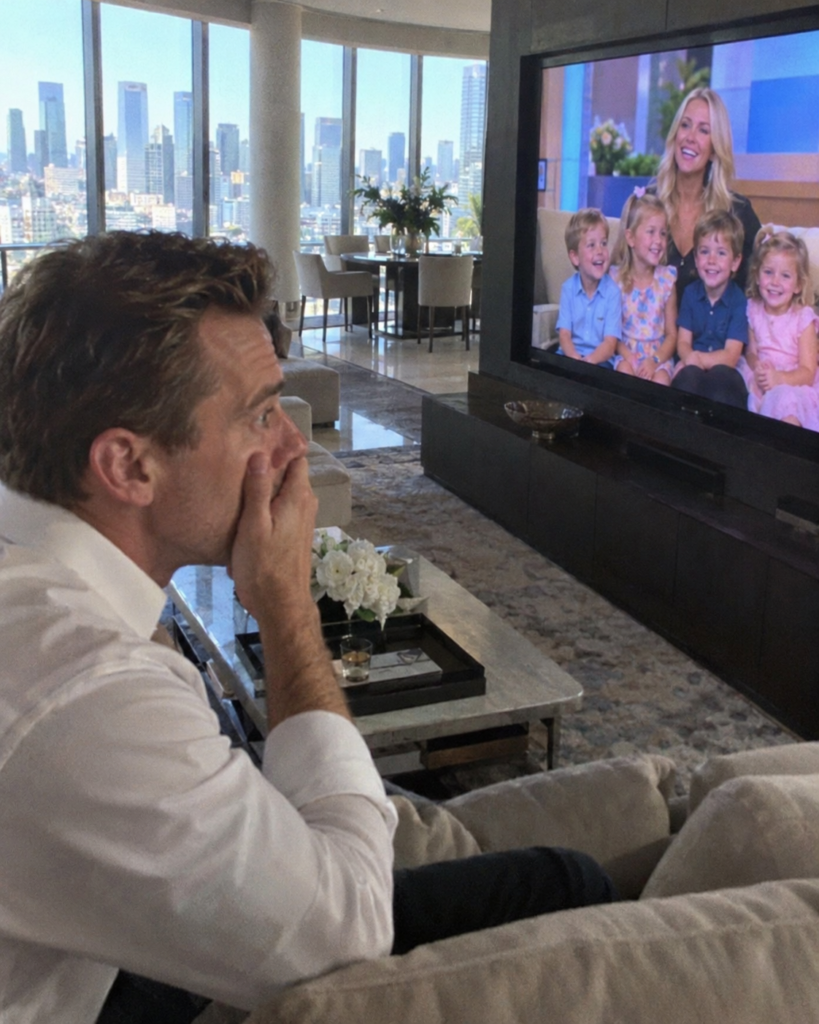
He opened his phone and searched for the morning interview.
There they were.
The children sat around Elena while the presenter showed them wooden blocks from one of the Little Nests classrooms.
The taller boy was Mateo. Alex learned that because Elena said his name when he tried building a tower taller than himself.
The other boy was Daniel, quieter and intensely focused on arranging blocks by size.
The girls were Sofia and Lucia.
Sofia talked with her hands.
Lucia watched everything before speaking.
Alex replayed the segment three times.
Mateo had his dimple.
Lucia had his eyes.
Daniel frowned exactly the way Alex’s grandfather had frowned while reading financial reports.
Sofia laughed like Elena.
He was watching pieces of himself living lives he had never known existed.
His phone rang.
Margaret.
“We found something.”
Alex straightened.
“What?”
“An envelope.”
His throat went dry.
“From Elena?”
“It has no return address, but her name is written inside the intake notation. It was delivered by hand.”
“When?”
“January eighteenth.”
Alex quickly calculated.
Elena would have been approximately four months pregnant.
“Was it opened?”
“No.”
“Why wasn’t it sent to me?”
“That part is complicated.”
“I’m coming.”
“Alex—”
“I’ll be there in fifteen minutes.”
Margaret met him in a conference room.
She had silver hair now, though she wore the same black rectangular glasses he remembered.
On the polished table sat a thick cream-colored envelope.
Alex’s name was written across the front in Elena’s handwriting.
ALEXANDER VANCE
PERSONAL AND CONFIDENTIAL
His knees weakened.
He sat.
Margaret remained standing.
“Where was this?”
“In a sealed transfer box from your old office.”
“Why?”
“During the divorce, anything marked personal was separated from client correspondence. Then you took the London assignment. When you returned, you transferred departments. That box followed you twice and eventually went into storage.”
“You’re telling me this sat downstairs for six years?”
“Essentially.”
Alex stared at it.
“I had standing instructions to forward personal mail.”
“Yes.”
“Then why wasn’t this forwarded?”
Margaret hesitated.
“Because you changed those instructions before London.”
Alex looked up.
“I did?”
“You were receiving quite a lot of personal correspondence connected to the divorce. You told reception that anything not urgent should be held until you returned.”
A memory surfaced.
Alex standing beside Margaret’s desk, irritated by another letter from the mediator.
Put everything personal in a box. I don’t want to see any of it until this deal closes.
He remembered saying it.
The realization made his stomach turn.
“Did Elena call?”
Margaret nodded slowly.
“Twice.”
Alex stared at her.
“What did you tell her?”
“That you were abroad and weren’t accepting personal calls.”
He covered his face.
Neither woman had hidden his children from him.
He had constructed a wall and then forgotten he had built it.
Margaret moved toward the door.
“I’ll give you privacy.”
“Did my mother know about this?”
Margaret paused.
“Your mother called the office regularly while you were abroad. But I don’t remember discussing this particular envelope with her.”
Alex nodded.
“Thank you.”
Margaret closed the door.
For nearly a minute, Alex simply stared.
Then he opened the envelope.
Inside was a photograph.
An ultrasound.
Four tiny shapes were marked with neat letters.
A.
B.
C.
D.
Alex stopped breathing normally.
Behind it was a folded letter.
January 16
Alex,
I have tried to decide whether writing this is the right thing to do.
I don’t know anymore.
There is something you need to know, not because I expect it to repair our marriage and not because I’m asking you to return.
I’m pregnant.
There are four babies.
Alex’s hand began shaking.
He lowered the page.
For a few seconds he could not continue.
When he finally did, Elena’s voice seemed to rise from the paper.
I found out three days before you left.
I almost told you that evening. The test was in my purse when you came home with your suitcase.
I didn’t show you because I needed to know something first.
I needed to know whether I mattered when there was no guarantee I could give you what you wanted.
You answered that question.
I have been angry with myself for not telling you immediately, and I have been angry with you for making me feel that pregnancy was the only fact that might have made me worth choosing.
But the children should not inherit the consequences of decisions we made while frightened and hurt.
I don’t know what role you will want.
I don’t even know what role I am ready to offer.
But you have a right to know they exist, and someday they will have a right to know you.
My doctor says they appear healthy.
I have enclosed the most recent scan.
Elena
Alex stared at the last word until it blurred.
There were additional papers.
A note from her obstetrician.
A laboratory summary.
Then something from their old fertility clinic.
He recognized the letterhead immediately.
Massachusetts Center for Reproductive Medicine.
His first instinct was to put it aside.
Instead he read.
The document was a copy of a consultation summary sent to both spouses several weeks before their separation.
Alex remembered that appointment differently.
He remembered the doctor discussing Elena’s diminished ovarian reserve.
He remembered words like reduced likelihood and uncertain response.
He remembered leaving the building convinced that Elena was the reason they might never have children.
But the written summary contained paragraphs he had apparently forgotten.
Mrs. Vance demonstrates reduced ovarian reserve; however, spontaneous conception remains possible.
And beneath that:
Mr. Vance’s initial semen analysis demonstrates reduced progressive motility. Repeat evaluation is recommended before any conclusion regarding primary contributing factor.
Alex read the sentence again.
Then again.
He sank backward.
There had never been a diagnosis that Elena could not become a mother.
There had never even been a diagnosis that she alone was responsible for their difficulty conceiving.
He had turned incomplete information into certainty because certainty had been easier than fear.
A final handwritten note from Elena was attached.
You left before we received the repeat testing appointment. I included this because I don’t want you spending your life believing something that was never actually true.
Alex rested his forehead against his hand.
Nearly six years ago, Elena had tried to tell him everything.
Not only about the babies.
About the story he had told himself.
His phone buzzed.
His mother.
He almost ignored it.
Instead he answered.
“Alex? Your assistant said you called the Beacon Hill house asking whether we still had any old correspondence from Elena.”
Alex looked at the ultrasound photograph.
“Mom.”
“What is this about?”
He said nothing for several seconds.
Then he asked quietly, “Do you remember telling me I wasn’t going to ruin my life for Elena?”
Beatrice became silent.
“Alex—”
“Do you remember?”
“Yes.”
He closed his eyes.
On the table in front of him were four tiny shadows from nearly six years earlier.
“They’re my children.”
“What?”
“Elena has four children.”
His mother did not respond.
“They’re five years old,” Alex continued. “And they’re mine.”
He heard Beatrice inhale sharply.
“Oh, Alex.”
He expected anger from himself.
Instead there was only exhaustion.
“Did you know?”
“No.”
The answer came quickly but not defensively.
“I swear to you, I didn’t.”
“She called while I was in London.”
“I knew she called the office once. I assumed it concerned the divorce.”
“You never spoke to her?”
“Not after you left.”
Alex believed her.
That surprised him.
Perhaps because there was no hesitation in her voice.
Perhaps because the envelope on the table had already provided a simpler and far more uncomfortable explanation.
No conspiracy.
No hidden scheme.
No one had stolen six years from him.
He had made decisions.
Elena had made decisions.
A misfiled envelope had compounded them.
And life had moved forward while both of them assumed the other had chosen silence.
Beatrice spoke carefully.
“What happens now?”
Alex looked at the four letters printed on the ultrasound image.
A.
B.
C.
D.
“I don’t know.”
“Do you want me to come over?”
“No.”
“Alex—”
“I need to think.”
He hung up.
At ten the next morning, Elena was already at Alder House.
Alex found her upstairs beside a window overlooking brick townhouses dusted with the first light snow of December.
The envelope sat on the table between them.
Elena saw it immediately.
For the first time since he had reappeared, her composure broke.
Her lips parted.
“You found it.”
Alex sat across from her.
“You knew it might still exist?”
“I knew I delivered it.”
“Why didn’t you tell me yesterday?”
“Because I wanted to know what you would do before I supplied an explanation for everything.”
The answer felt familiar.
It was almost exactly what she had done six years ago with the pregnancy test.
Alex absorbed that.
Then he slid the letter toward her.
“I should have received it.”
“Yes.”
“I should have taken your calls.”
“Yes.”
“I should have listened to our doctor instead of hearing only the parts that confirmed what I was afraid of.”
Elena looked down.
“I wasn’t completely fair either.”
He frowned.
“You tried to tell me.”
“Four months later.”
“You were pregnant with four babies and going through a divorce.”
“That doesn’t erase my choices.”
Alex watched her carefully.
“I don’t want you taking responsibility to make this easier for me.”
“I’m not.”
She folded her hands around her coffee cup.
“I was hurt, Alex. Deeply hurt. And a part of me wanted you to understand what you had chosen without knowing I was pregnant. For a while, withholding that information felt like the only decision in my life that still belonged entirely to me.”
Alex nodded slowly.
“I understand.”
“No. You understand intellectually. That’s different.”
“Then maybe someday I’ll understand better.”
Something shifted in her expression.
Not forgiveness.
But perhaps surprise.
He took a breath.
“I want to know them.”
Elena’s fingers tightened around the cup.
“I expected that.”
“I don’t mean today. I don’t mean I walk into their lives and they call me Dad tomorrow. I mean… if you’ll allow it, I want to know who they are.”
“They’re not an opportunity to correct your regrets.”
“I know.”
“They’re people.”
“I know.”
“They have routines. Friends. A school. Favorite foods. Things they’re afraid of and things they’re proud of. They aren’t empty spaces waiting for you.”
“I know.”
Elena finally looked directly at him.
“What are you asking me for?”
Alex thought about it.
Six years earlier he would have come with a proposal.
A schedule.
A lawyer.
Terms.
He would have converted uncertainty into something measurable.
Now he said the only truthful thing he had.
“A chance to begin wherever you think beginning is safe for them.”
Elena studied him for a long time.
Then she reached into her bag.
She placed four pieces of folded construction paper on the table.
Alex blinked.
“What are those?”
“They watched the interview replay yesterday.”
His heart began pounding.
“And?”
“They asked why I looked strange after we got home.”
Alex almost smiled.
“That sounds like children.”
“It is.”
“I told them someone from a long time ago had seen the program and contacted me.”
“What did they say?”
“Mateo wanted to know whether you were famous.”
Despite himself, Alex laughed.
Elena’s mouth curved slightly.
“Daniel asked why someone from a long time ago didn’t have my phone number. Lucia wanted to know whether you liked pancakes. Sofia wanted to draw you a picture.”
Alex stared at the folded pages.
“All four drew something?”
“Yes.”
“Can I open them?”
Elena nodded.
He unfolded Sofia’s first.
Five brightly colored figures stood beneath an enormous purple sun. Above them she had written in careful uneven letters:
MOMMY + US
At the edge of the page was a sixth figure.
The figure had no face yet.
Only a question mark.
Alex stared at it.
Then he opened Mateo’s.
A dinosaur.
Daniel had drawn an elaborate building with six windows.
Lucia had drawn a stack of pancakes.
At the bottom, in Elena’s handwriting, were the children’s answers to a question she had apparently asked each of them.
WHAT WOULD YOU LIKE TO KNOW ABOUT ALEX?
Mateo: Does he know how to throw a baseball?
Daniel: What does he do at his work?
Sofia: Does he have a dog?
Lucia: Does he put blueberries in pancakes?
Alex laughed once.
Then tears filled his eyes.
He wiped them away before they could fall onto the drawings.
Elena looked out the window, giving him privacy.
“When can I answer them?” he asked.
She turned back.
“Write it down.”
“A letter?”
“Four letters.”
Alex nodded.
“Okay.”
“And Alex?”
“Yes?”
“If you begin this, don’t disappear when it becomes inconvenient.”
He met her eyes.
“I won’t.”
“You can’t promise them perfection.”
“No.”
“You can’t promise me perfection either.”
“I know.”
She waited.
Alex folded Lucia’s pancake drawing carefully.
“But I can promise that the next decision I make won’t be based on fear of the life I might miss.”
Elena said nothing.
He looked at the empty-faced figure in Sofia’s drawing.
“For once,” he said, “I’d like to learn how to live the life that’s actually here.”
Elena’s eyes softened.
Then she reached into her bag again.
“There is one more thing.”
She slid a small business card across the table.
A family medical clinic.
Alex looked at her.
“What’s this?”
“If you’re serious about becoming part of their lives, I want certainty on paper. For everyone.”
“A paternity test.”
“Yes.”
“I’ll do it today.”
Elena nodded.
But she did not take the card back.
Alex turned it over.
On the reverse, Elena had written four dates.
Four birth times.
5:41 a.m. — Mateo
5:44 a.m. — Sofia
5:48 a.m. — Daniel
5:52 a.m. — Lucia
Alex ran his thumb over the handwriting.
Four children had entered the world in eleven minutes.
And somewhere else in Boston, their father had been living an ordinary January morning without knowing his entire life had just changed.
This time, he would not look away.
PART 3 — THE FATHER THEY MET SLOWLY
The test results arrived nine days later.
Alex opened the secure email at his kitchen counter at 6:17 in the morning.
He had already known what it would say.
That did not make reading the words any easier.
Probability of paternity: greater than 99.99%.
He printed the report.
Then he stood beside the printer holding five pages that officially confirmed what four children’s faces had already told him.
He was their father.
But fatherhood, Alex was beginning to understand, could be a biological fact long before it became a relationship.
At 6:32, he texted Elena.
The results came.
Three dots appeared almost immediately.
I received them too.
He typed several responses and deleted each one.
Finally:
Thank you for allowing the test.
Her reply arrived a minute later.
Thank you for not treating it as an insult.
Alex stared at that sentence.
Six years earlier, he probably would have.
For the next three weeks, Alex communicated with his children through envelopes.
He purchased four identical sets of stationery because he feared giving one child something better than another.
Then he realized the absurdity of trying to make four separate people identical.
Mateo received a card with a baseball on it.
Daniel received one covered in tiny architectural sketches.
Sofia’s had dogs.
Lucia’s had pancakes.
He answered every question seriously.
To Mateo:
Yes, I can throw a baseball, although I haven’t done it in a long time. You may have to teach me again.
To Daniel:
I help companies make decisions. Some days that means reading contracts. Some days it means listening to people argue politely for three hours.
Elena later told him Daniel found that answer fascinating.
To Sofia:
I do not have a dog. I had a golden retriever named Arthur when I was ten. He ate one of my school shoes.
Sofia sent a reply declaring Arthur “A VERY GOOD DOG.”
And to Lucia:
Blueberries absolutely belong in pancakes. Chocolate chips can also be considered, depending on circumstances.
Lucia responded with a drawing of a judge banging a gavel beneath the words:
BLUEBERRIES WIN.
Alex placed every picture on his refrigerator.
His refrigerator had never held anything except filtered water, prepared meals, and an expensive bottle of champagne he had forgotten why he bought.
Within a month it looked like the refrigerator of an entirely different man.
Perhaps it was.
The first meeting took place on a Saturday morning at one of the Little Nests centers in Cambridge.
Elena chose the location because the children knew it well.
Alex arrived twenty minutes early.
He brought nothing.
He had spent two days considering gifts before Elena gently suggested that his presence was enough.
At exactly ten, he heard children’s voices in the hallway.
His entire body went rigid.
Elena entered first.
Then four small people came in behind her.
Seeing them through a television screen had not prepared him.
Mateo walked closest to Elena, carrying a red baseball cap.
Sofia held a stuffed dog.
Daniel had a notebook tucked beneath his arm.
Lucia was eating half a blueberry muffin.
They stopped together.
Alex stood.
No one spoke.
Then Lucia looked at his empty hands.
“Did you bring pancakes?”
Elena closed her eyes.
“Lucia.”
“What?”
Alex laughed.
“No. That was a serious mistake.”
Lucia nodded solemnly.
“Yes.”
Mateo whispered something to Sofia.
Alex couldn’t hear it.
Sofia elbowed him.
Then Daniel stepped forward.
“You’re taller than the picture.”
“What picture?”
“Mommy’s wedding picture.”
Alex looked at Elena.
She shrugged.
“They’ve seen albums.”
Daniel considered him.
“You had more hair.”
Alex touched his head.
“I still have hair.”
“Not the same amount.”
Elena turned away to hide a smile.
And somehow, with that, the tension broke.
For forty-five minutes, they played.
No one called him Dad.
No one hugged him.
No one asked where he had been.
Mateo threw a foam ball across the classroom and seemed impressed when Alex caught it.
Sofia introduced him to every stuffed animal in the reading corner.
Daniel showed him how the classroom’s magnetic building tiles could support a bridge.
Lucia demanded confirmation that blueberry pancakes remained his official position.
When the meeting ended, Alex wanted desperately to ask for another hour.
He didn’t.
Elena had told him forty-five minutes.
So when she said, “Time to go,” Alex stood.
“I had a very nice morning.”
Sofia looked at him.
“Are you coming next Saturday?”
Alex looked at Elena before answering.
She gave one small nod.
“If you’d like me to.”
Mateo shrugged with exaggerated casualness.
“You can.”
Alex drove home smiling and crying at the same time.
Weeks became months.
The meetings expanded naturally.
Forty-five minutes became two hours.
Two hours became Saturday afternoons.
Elena remained nearby in the beginning, sometimes answering emails at a classroom table while Alex played with the children.
Gradually, she started leaving for short periods.
The first time she walked to a nearby pharmacy for twenty minutes, Alex understood the significance.
It was not a grand declaration of trust.
It was better.
It was practical trust.
Trust measured in ordinary minutes.
He learned that Mateo hated bananas but would eat three apples if allowed.
Daniel disliked loud hand dryers in public restrooms.
Sofia loved animals so much that every injured pigeon became an emergency requiring investigation.
Lucia asked questions continuously until the exact moment she fell asleep.
He learned not to arrive with extravagant surprises.
Not to promise outings before checking with Elena.
Not to use money as a substitute for familiarity.
And most importantly, he learned that being their father did not mean becoming the center of their lives.
He was joining something that had already been built.
Elena had built it.
There were babysitters, preschool teachers, neighbors, Little Nests employees, friends.
There was Mrs. Alvarez from the apartment downstairs, who had helped Elena during the babies’ first winter.
There was Priya Shah, Little Nests’ operations director, who had once spent an entire night assembling four cribs because Elena had been too pregnant to bend comfortably.
There was Elena’s cousin Rosa, who flew from Chicago twice during the first year when Elena was exhausted.
Alex listened to these stories with gratitude and embarrassment.
Other people had occupied spaces he should have filled.
But none of them treated him as an enemy.
Mrs. Alvarez shook his hand and said, “The children have more people loving them now. That’s useful.”
Alex never forgot it.
Beatrice Vance met her grandchildren in March.
That meeting was more complicated.
At first, Elena refused.
“I don’t want history arriving all at once,” she said.
Alex did not argue.
He told his mother she would have to wait.
To his surprise, Beatrice did not protest either.
Instead, she began sending Alex questions.
What books do they like?
Do any of them have allergies?
Would it be appropriate if I knitted something?
Alex barely recognized the cautious woman asking permission.
Eventually Elena agreed to a one-hour visit at a public garden.
Beatrice arrived carrying four small paper bags.
Nothing expensive.
Inside each was a book.
She knelt awkwardly when the children approached.
“You’re Alex’s mother?” Sofia asked.
“I am.”
“So you’re our grandmother?”
Beatrice looked at Elena.
Then at Alex.
Then back at Sofia.
“If you’re comfortable calling me that.”
Sofia considered the matter for approximately three seconds.
“Grandmother sounds fancy.”
Beatrice smiled.
“My friends call me Bea.”
Sofia looked horrified.
“You can’t call your grandmother Bea.”
Mateo interrupted.
“We could call her Grandma Bea.”
And just like that, a title was decided.
Later, while the children chased pigeons with Elena nearby, Beatrice sat beside Alex on a bench.
“They’re extraordinary.”
“They’re children, Mom.”
She looked at him.
“That wasn’t meant as pressure.”
“I know.”
Beatrice folded her gloves in her lap.
“I’ve been thinking about the things I said to you.”
Alex remained silent.
“I spoke about family as if it were an achievement,” she continued. “An heir. A legacy. I made it sound like you were responsible for continuing something instead of building something.”
“You didn’t make me leave Elena.”
“No.”
She did not allow him to excuse her.
“But I made it easier for you to believe leaving was reasonable.”
Alex watched Lucia crouch beside a flower bed while Elena reminded her not to pick the tulips.
“I wanted to believe somebody else pushed me into it.”
“I know.”
“But I chose.”
“Yes.”
Beatrice reached for his hand.
It was something she rarely did.
“I wish I’d taught you that loving someone and being afraid with them can exist at the same time.”
Alex looked at her.
“So do I.”
The hardest conversation happened in May.
Not with Elena.
With Mateo.
They were eating grilled cheese sandwiches at Elena’s house after a rainy afternoon when Mateo suddenly asked, “Where were you when we were babies?”
Alex stopped chewing.
Elena, standing by the sink, became still.
The other children continued eating.
Alex put down his sandwich.
“I lived in Boston.”
Mateo frowned.
“But we lived in Boston.”
“Yes.”
“Then why didn’t you come?”
Alex had known the question would arrive.
He had prepared explanations.
None felt right now.
He glanced at Elena.
She did not rescue him.
She shouldn’t.
Alex turned back to Mateo.
“I didn’t know you were born.”
“Mommy didn’t tell you?”
“She tried.”
Elena looked at him then.
Alex continued carefully.
“She sent me a letter, but because of some choices I had made, I didn’t get it.”
“What choices?”
“I was angry and sad about some grown-up things, and instead of handling them very well, I tried not to think about them.”
Daniel had stopped eating now.
Sofia too.
Lucia was listening while peeling the crust from her sandwich.
Mateo asked, “Were you mad at us?”
“No.”
The answer came immediately.
“I didn’t know about you. I have never been angry at you.”
“Were you mad at Mommy?”
Alex breathed slowly.
“Your mother and I were both sad about things we didn’t know how to solve.”
Elena leaned against the counter.
Mateo thought about it.
“Are you going away again?”
Alex’s heart tightened.
He resisted the temptation to make a dramatic promise.
“I don’t plan to.”
“But what if you’re sad?”
“Then I’ll tell people I’m sad instead of disappearing.”
Mateo nodded.
This seemed to satisfy him.
Five minutes later he was arguing with Daniel about who had more tomato soup.
Children, Alex realized, did not always need speeches.
They needed truthful answers small enough to carry.
By summer, Elena allowed Alex to have the children at his penthouse for Saturday afternoons.
His home changed rapidly.
A basket of toys appeared beside a designer bookshelf.
Four plastic cups occupied a cabinet previously dedicated to wine glasses.
Sofia insisted the gray sofa needed pillows “that don’t look like rain.”
Alex bought yellow ones.
Mateo kept a baseball glove by the door.
Daniel constructed an elaborate cardboard city in Alex’s guest room.
Lucia discovered that the penthouse kitchen had a griddle.
Saturday pancakes became mandatory.
One afternoon, Elena arrived early to collect them and stopped in the doorway.
The kitchen was chaos.
Flour covered the counter.
Mateo wore pancake batter on one sleeve.
Sofia was cutting strawberries.
Daniel was calculating how many pancakes remained.
Lucia stood on a stool supervising Alex.
“You’re burning that one,” she warned.
“I am not.”
“You are.”
Smoke rose.
Lucia pointed triumphantly.
“You burned it.”
Elena laughed.
Alex looked up.
For a second they simply stared at each other.
Something about her laughter transported him backward.
Not to the final year of their marriage.
Earlier.
To Sunday mornings when they had lived in a smaller apartment and made breakfast barefoot while music played.
Elena seemed to feel it too.
Her smile faded.
Alex turned back to the stove.
He did not pursue the moment.
That mattered.
Little Nests continued expanding.
Elena was preparing to open a seventh Massachusetts location, and Alex occasionally offered business advice when she asked.
Only when she asked.
One night, after the children had fallen asleep, they sat on her back porch reviewing a lease agreement.
“You can negotiate this clause,” Alex said.
“I thought so.”
“You don’t need me.”
Elena glanced sideways.
“That sounded almost disappointed.”
“No.”
He smiled.
“Maybe impressed.”
“I built seven childcare centers without you.”
“I noticed.”
“I learned contracts.”
“You learned them well.”
She closed the folder.
The summer air smelled faintly of rain.
“Why did you really leave the old firm?” she asked.
Alex leaned back.
“You know why.”
“I know the official reason.”
He considered whether to answer.
“Because I realized I’d built my entire life according to what looked impressive from the outside.”
“That’s unusually philosophical for a corporate lawyer.”
“I charge by the hour for philosophy.”
She smiled.
Then silence settled between them.
Not uncomfortable.
Almost familiar.
“Elena.”
“Hmm?”
“I owe you an apology that isn’t connected to the children.”
She became still.
Alex chose his words carefully.
“When we were trying to have a baby, I started treating you like you were responsible for solving my fear.”
She looked down at her hands.
“I was afraid too.”
“I know. I just didn’t make room for your fear.”
He continued.
“When the doctor talked about your test results, I heard a verdict. I didn’t hear the uncertainty. And I definitely didn’t hear the part about my own results.”
“You were overwhelmed.”
“That isn’t an excuse.”
“No.”
“I made you feel defective.”
Elena’s eyes glistened.
She blinked rapidly.
“You did.”
Alex nodded.
“I am deeply sorry.”
For several seconds, neither spoke.
Then Elena said, “Thank you.”
He did not ask whether she forgave him.
He was learning that apologies were not invoices requiring payment.
In August, nearly nine months after Alex saw the television interview, something unexpected arrived at his office.
A package from Elena.
Inside was a wooden frame.
Four photographs filled it.
Mateo pitching a baseball.
Daniel standing beside a block tower.
Sofia holding a sleepy golden retriever belonging to one of Elena’s friends.
Lucia flipping a pancake.
Across the bottom, in four different colors of crayon, were the words:
FOR ALEX’S OFFICE.
He smiled for the rest of the day.
Then he noticed a folded sheet behind the frame.
He removed it carefully.
It was not from the children.
It was from Elena.
Alex,
There is something I haven’t told you.
I kept thinking it didn’t matter anymore.
Now I think it does.
The first year after the children were born, I almost contacted you again.
Not once.
Several times.
I even drove to your office.
Alex stopped reading.
His pulse quickened.
He continued.
I saw you outside with your mother. I heard part of your conversation before you saw me.
You were talking about moving on.
I misunderstood what you meant.
I thought you were saying you had moved on from me, from everything connected to our marriage, and that contacting you would only reopen something you had deliberately closed.
Years later, I discovered you had actually been discussing leaving the firm.
I have carried that misunderstanding with me ever since.
But there is more.
When I returned home that afternoon, I wrote you another letter.
I never sent it.
I still have it.
I think you should read it now.
Alex lowered the page.
Outside his office, phones rang and people moved through the corridor.
He stared at Elena’s final sentence.
For nearly a year, he had believed the envelope at the old law firm contained the last lost piece of their history.
Apparently, it did not.
There was another letter.
One Elena had chosen not to send.
And tomorrow evening, she wanted to give it to him.
PART 4 — THE LIFE THAT WAS STILL HERE
Elena gave Alex the second letter on a Sunday evening.
The children had spent the afternoon with Beatrice at the Museum of Science, their first outing with their grandmother without Elena or Alex present.
Six months earlier, neither parent would have considered it.
Now Grandma Bea had four booster seats in her car, emergency snacks in her handbag, and a handwritten list of everyone’s preferences taped beside her refrigerator.
People could change, Elena had begun to believe.
But change was different from forgetting.
That distinction mattered.
She and Alex sat at her kitchen table while late-August sunlight warmed the wooden floor.
Between them lay an envelope that had never been mailed.
Alex did not reach for it immediately.
“What will I find in there?”
“The person I was five years ago.”
“Is she angry?”
“Very.”
Alex nodded.
“She had a right to be.”
“She was also exhausted.”
“She had that right too.”
Elena pushed the envelope toward him.
“I don’t need you to apologize for every sentence.”
“I’ll try.”
“You’re smiling.”
“A little.”
“Why?”
“Because six years ago you would have warned me that I was about to read something painful, and six years ago I would have immediately explained why your interpretation was wrong.”
Elena laughed softly.
“That is unfortunately accurate.”
Alex opened the envelope.
The letter was dated eleven months after the children were born.
Alex,
I saw you today.
I don’t think you saw me.
The babies were with Rosa, and I had driven downtown because I had finally convinced myself I should speak to you.
I was tired of wondering whether I had made the right decision.
I was tired of being angry.
Mostly, I was tired.
Then I heard you tell your mother you had decided there was no going backward and that you were ready to move on.
So I went home.
Alex stopped.
“I remember that conversation.”
Elena nodded.
“I know that now.”
“I was talking about Halloran’s partnership offer.”
“Yes.”
Alex returned to the letter.
The children are eleven months old.
Mateo laughs whenever someone sneezes.
Sofia hates socks.
Daniel watches ceiling fans as if they’re explaining the universe.
Lucia refuses to sleep unless I sing the same song four times.
There are moments when I want you here so badly that I become angry all over again.
Then I remember the last night of our marriage, and I think perhaps being alone is easier than waiting for someone to choose us.
Alex swallowed.
The next paragraph was shorter.
Maybe someday I’ll send this.
Maybe someday you’ll know them.
Right now I don’t know whether I am protecting them, protecting myself, or simply afraid.
Elena
Alex folded the paper.
Neither spoke.
Finally he asked, “Why give it to me now?”
“Because I don’t want the story to become simpler than it was.”
He looked at her.
“For a while, I let myself believe you were the person who left and I was the person who stayed. It was useful. It allowed me to keep going.”
“You did stay.”
“Yes. But I also made choices after you left. Some of them came from fear.”
Alex looked down at the letter.
“We wasted a lot of time.”
Elena’s expression became thoughtful.
“Yes.”
He expected that answer to hurt.
Instead she continued.
“But I don’t want to waste more time being angry about wasted time.”
Alex raised his eyes.
Something passed silently between them.
Not a promise.
Not yet.
But perhaps permission to imagine that their lives did not have to be defined forever by their worst decisions.
The next year became a collection of ordinary milestones.
Alex attended his first school concert.
Daniel stood in the back row wearing a paper moon costume and forgot one line of a song.
Alex applauded as if Daniel had performed at Carnegie Hall.
He took Mateo to his first Red Sox game.
They left in the seventh inning because Mateo was tired and wanted ice cream.
Six years earlier, Alex would have considered leaving a game early a waste of expensive tickets.
Now he remembered almost none of the baseball.
He remembered Mateo falling asleep against his shoulder on the train home.
Sofia convinced him to volunteer at an animal shelter once a month.
The first time she saw him cleaning kennels in an old sweatshirt, she announced, “You look normal.”
Alex decided to accept it as praise.
Lucia continued making pancakes.
Her technique improved faster than his.
She also discovered a passion for reading and began calling him whenever she finished a book.
Sometimes the phone rang during meetings.
Whenever possible, Alex answered.
“I finished another one,” she would say.
“What happens?”
“I can’t tell you. You have to read it.”
His office bookshelf gradually filled with children’s novels.
Elena watched these changes cautiously.
She noticed the important things.
Alex did not appear only for celebrations.
He came when Mateo had an ordinary Tuesday baseball practice.
He attended parent conferences when invited.
He remembered which child needed which permission form.
He stayed home with Daniel when Daniel caught a harmless winter cold and Elena had an unavoidable licensing inspection.
He learned how to braid Sofia’s hair badly enough that she eventually taught him herself.
He showed up.
Again and again.
Reliability was less dramatic than apology.
It was also far more persuasive.
Their relationship changed almost accidentally.
One evening, Alex came to Elena’s house to return the children’s backpacks.
They stood in the doorway talking for twenty minutes.
Then forty.
Eventually Elena said, “Would you like tea?”
Alex stepped inside.
They sat in the kitchen until midnight discussing everything except the children.
Books.
Work.
Travel.
The restaurants they missed.
The strange fact that both of them now preferred quiet weekends to elaborate social events.
When Alex left, he paused on the porch.
“That felt dangerously like a date.”
Elena folded her arms.
“It wasn’t.”
“I know.”
“Good.”
He walked toward his car.
“Alex?”
He turned.
She smiled.
“It wasn’t unpleasant either.”
He drove home with that sentence glowing inside him.
Three months later, Elena asked him to dinner.
No children.
No lease agreements.
No schedules.
Alex stared at the text for so long that one of his colleagues asked whether something was wrong.
Dinner?
Just us?
Elena replied:
Unless you’d prefer to bring Daniel’s science project.
Alex typed:
I think the volcano needs a night off.
They went to a small Italian restaurant in the South End.
The first twenty minutes were awkward.
Then Elena mentioned the disastrous dinner party they had hosted during their second year of marriage when Alex accidentally served a frozen pie because he had misunderstood the cooking instructions.
“You told everyone it was semifreddo,” she said.
“It sounded sophisticated.”
“It was frozen apple pie.”
“No one complained.”
“One guest nearly broke a tooth.”
By dessert, both were laughing.
Outside the restaurant, they stood beneath a streetlamp while early spring rain fell lightly.
Alex did not try to kiss her.
Elena noticed.
“Thank you,” she said.
“For dinner?”
“For not assuming.”
Alex put his hands in his coat pockets.
“I assumed too much the first time we were married.”
The words hung between them.
The first time.
Elena heard it.
Alex heard it too.
Neither corrected him.
Their second beginning was slower than their first.
There were dinners.
Walks.
Occasional weekends when Beatrice watched the children.
There were also difficult conversations.
Elena admitted that she sometimes expected Alex to leave whenever they disagreed.
Alex admitted he sometimes felt he had to agree with everything because disagreement might convince her he had not changed.
They learned that neither instinct was healthy.
One evening, after arguing over whether the children were ready for a longer vacation with Alex, Elena said, “You know we can disagree without this becoming 2020 again.”
Alex sat quietly.
“I know logically.”
“So do I.”
That made them both laugh.
Eventually they planned the vacation together.
Three days in Cape Cod.
Elena came too.
No dramatic reconciliation happened beneath a sunset.
No life-changing speech was delivered beside the ocean.
Instead, Alex burned hamburgers while the children collected shells, Elena teased him about his cooking, and Beatrice called twice because she had forgotten they had gone away and arrived at Elena’s empty house carrying cookies.
It felt uncomplicated.
That was what made it precious.
Little Nests opened its tenth location the following autumn.
The company held a small celebration rather than an extravagant launch.
Elena insisted the children cut the ribbon.
Mateo held one side of the enormous ceremonial scissors.
Sofia held the other.
Daniel worried they would cut crookedly.
Lucia simply grabbed the handles and helped.
Alex stood in the crowd.
He had invested nothing in the company.
That was deliberate.
Elena’s achievement belonged to Elena.
After the ribbon fell, applause filled the room.
A reporter from a Boston business magazine approached Alex.
“Mr. Vance, how involved were you in the company’s expansion?”
Alex glanced toward Elena.
“Almost not at all.”
The reporter looked surprised.
“But you advise businesses.”
“I do.”
“So you didn’t advise Little Nests?”
“Sometimes Elena asks my opinion.”
He smiled.
“But she built this before I returned to her life. She deserves the credit.”
Across the room, Elena heard him.
Their eyes met.
Alex did not know it then, but that simple answer mattered to her almost as much as every apology he had made.
He had once valued being necessary.
Now he knew how to admire someone without needing ownership of what they had accomplished.
Beatrice changed too.
Not instantly.
There were moments when old habits surfaced.
At the children’s seventh birthday dinner, she began saying something about Mateo eventually carrying on the Vance name.
Then she stopped herself.
Mateo looked confused.
“What name?”
“Never mind,” Beatrice said.
Sofia pointed her fork at her grandmother.
“You were doing the legacy thing again.”
Everyone froze.
Alex nearly choked on water.
Beatrice stared at her granddaughter.
Then she sighed.
“Yes.”
Elena covered her mouth.
Sofia nodded seriously.
“Mommy says people can learn.”
“They can.”
“Okay.”
Conversation resumed.
Later Beatrice whispered to Elena, “Your daughter terrifies me.”
Elena smiled.
“She likes you.”
“That’s worse.”
Their relationship never became sentimental.
It became genuine.
Beatrice apologized once, clearly, for the way she had treated Elena during the marriage.
Elena accepted the apology without pretending the past had vanished.
Then they both moved forward.
It was enough.
Two years after the television interview that changed everything, Alex took Elena back to Alder House.
The same upstairs café.
The same window.
Elena recognized the table immediately.
“You planned this.”
“Yes.”
“That’s suspicious.”
“Probably.”
She sat.
Alex ordered coffee.
Then, instead of producing a ring, he placed something else on the table.
A folded piece of construction paper.
Elena opened it.
It was Sofia’s old drawing.
MOMMY + US.
The sixth figure still stood at the edge.
But someone had added a face.
Sofia had drawn it several months earlier.
Alex.
Beneath the picture, four children had signed their names.
Elena looked up.
“What are you doing?”
Alex took a breath.
“I’m not going to ask you to erase what happened.”
Her eyes began to shine.
“Good.”
“I’m not going to promise I’ll never disappoint you.”
“Also good.”
“And I’m definitely not promising I’ll learn to cook.”
“That might ruin the moment.”
He smiled.
Then became serious.
“I loved you badly once.”
Elena looked down.
Alex continued.
“I thought loving someone meant knowing exactly what the future was supposed to look like. When that future became uncertain, I became afraid and treated uncertainty like failure.”
He reached across the table.
“This time, I don’t need certainty.”
Elena looked at his hand.
Then placed hers in it.
Alex smiled.
“I have a question.”
“Apparently.”
He reached into his coat.
Now he brought out a small ring box.
Elena laughed through sudden tears.
“You rehearsed this.”
“For months.”
“That’s very you.”
“I know.”
He opened the box.
The ring was simple.
Nothing like the elaborate diamond he had chosen the first time.
“Elena Rivas, would you like to build whatever comes next with me?”
She stared at him.
“You’re not asking whether I’ll marry you?”
“I am.”
“That was an extremely corporate way of phrasing it.”
“I was nervous.”
She laughed again.
Then her expression softened.
“Yes.”
Alex blinked.
“Yes?”
“Yes.”
He stood too quickly and bumped the table.
Coffee spilled.
Elena grabbed napkins.
“You’ve ruined the moment.”
“I absolutely have.”
She was still laughing when he slipped the ring onto her finger.
They married the following June.
Small ceremony.
Backyard.
Forty guests.
The children participated in everything.
Daniel carried the rings because everyone agreed he was statistically least likely to lose them.
Sofia walked Elena down the aisle.
Mateo stood beside Alex.
Lucia insisted on giving a speech.
Her speech lasted forty-seven seconds.
“Alex used to not know us,” she announced.
Several guests glanced nervously at one another.
Lucia continued.
“Then he knew us. Then Mommy liked him again. Then they took forever to get married.”
Everyone laughed.
Lucia looked pleased.
“And he still burns pancakes sometimes. But not every time.”
She raised her lemonade.
“So that’s good.”
It was, Alex thought, the most accurate summary of his life anyone had ever delivered.
On the morning after the wedding, the six of them sat around the kitchen table.
No photographers.
No flowers.
No music.
Mateo wanted cereal.
Daniel was reading.
Sofia was trying to convince Elena they needed a dog.
Lucia was supervising pancakes.
Alex flipped one.
It landed perfectly.
Lucia inspected it.
“Acceptable.”
“Acceptable?”
“Don’t get proud.”
Elena laughed.
Alex looked around the table.
For years, he had imagined fatherhood as a destination.
A legacy.
Proof that his life had turned out correctly.
Now he understood that family was nothing like that.
It was a thousand ordinary decisions.
Listening when leaving would be easier.
Showing up when no one applauded.
Allowing people to remain themselves instead of forcing them into the roles you had imagined.
Forgiving without pretending.
Remembering without living backward.
Choosing again.
And again.
And again.
Mateo reached across the table.
“Dad, syrup.”
Alex froze.
The word had appeared before, occasionally and shyly.
But this morning Mateo said it without thinking.
Dad.
As ordinary as asking for syrup.
Alex passed the bottle.
“Here.”
Mateo poured far too much.
Elena caught Alex’s eye.
She knew.
His throat tightened.
Under the table, she reached for his hand.
Nothing needed to be said.
Six years earlier, Alex had walked away from Elena because he was terrified that one uncertain future would ruin his life.
He had spent years believing the great tragedy was the family he had almost missed.
But sitting there now, Alex finally understood something gentler.
His life had not been restored.
It had not returned to what it was supposed to have been.
There was no way to recover the first words he had not heard, the sleepless nights he had not shared, or the birthdays whose candles he had not helped light.
Those moments belonged to the past.
And the people at this table did not need him to rewrite it.
They needed him here.
Now.
Elena squeezed his fingers.
“You’re staring.”
“I know.”
“At what?”
Alex looked at Mateo arguing with Daniel, Sofia negotiating for a golden retriever, and Lucia guarding the last pancake.
Then he looked at the woman beside him.
“At the life that’s actually here.”
Elena smiled.
Outside, a warm June morning spread across Boston.
Inside, someone spilled syrup.
Someone laughed.
Someone asked for another pancake.
And Alex, finally understanding how much meaning could fit inside an ordinary morning, reached for the batter and began again.