The video began with Paul entering my garage alone.
He was no longer carrying the beer he had been holding in the yard.
He walked directly to the sports rack beside my tool cabinets and removed the aluminum baseball bat Noah used during summer league.
Then he stood behind the half-open door and waited.
No one in the garage spoke as the timestamp advanced.
Twenty-three seconds later, Noah came inside carrying his electric skateboard.
Paul stepped between him and the exit.
“Your father needs to learn who runs this family,” his recorded voice said.
Noah stopped.
Even on the small phone screen, I could see the confusion on his face.
“Uncle Paul, I just need my charger.”
Paul tapped the end of the bat against the concrete.
“You embarrassed my son out there.”
“Jake took my board.
I only asked for it back.”
“Then apologize.”
Noah shifted the skateboard under one arm and glanced toward the door.
“I don’t want trouble.”
“That isn’t an apology.”
My son backed away, both hands visible.
Paul moved forward and blocked him again.
Then he swung.
The recording caught the sound before the image fully registered—a metallic crack followed by Noah’s scream.
The bat struck across his hip and lower back.
Noah dropped immediately, the skateboard sliding across the floor beneath the workbench.
Paul stood over him.
“Maybe now you’ll learn respect.”
Maria made a broken sound beside me.
Lily covered her ears, but she could not look away.
My mother reached for my phone.
“Turn that off.”
Maria stepped between us.
“Do not touch it.”
My father’s face had changed.
The confidence was gone, replaced by the frantic calculation of a man watching his preferred version of reality collapse.
“Delete it,” he ordered.
“William, delete it before the police get here.”
I stared at him.
“Why?”
“Because your brother made a mistake.
One mistake should not destroy his life.”
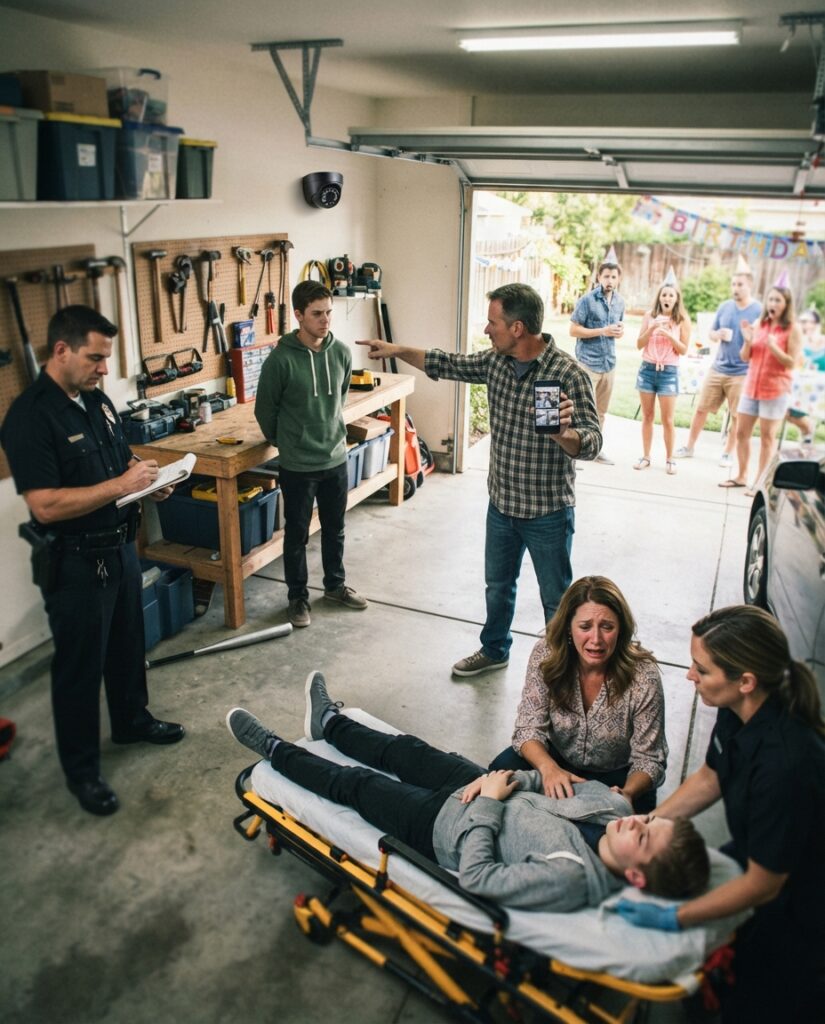
Behind us, Noah was being secured to the stretcher.
A paramedic cut through the leg of his jeans while another monitored his breathing.
My son’s eyes found mine, and the fear in them made my father’s words feel obscene.
“He could have killed him,” Maria said.
“But he didn’t,” my mother replied quickly.
“We can handle this privately.”
The video continued.
After Noah fell, Paul lifted the bat again.
That was the moment Lily appeared in the doorway and screamed.
On the recording, Paul looked toward her, lowered the bat, and stepped away from Noah.
He did not kneel.
He did not call for help.
He only stared at Lily and said, “You didn’t see anything.”
My daughter began to shake.
Paul moved toward the back exit of the garage, but sirens were already filling the street.
Two police officers entered through the open door.
One went immediately to the paramedics.
The other, a woman with a calm voice and watchful eyes, looked from Paul’s bruised face to my bleeding knuckles and then to the bat on the floor.
My father started talking before anyone asked him a question.
“It was an accident.
The boys were arguing, and William attacked his brother.”
The officer raised one hand.
“Nobody speak over anyone else.”
My father ignored her.
“There are witnesses.
Everyone saw William hit Paul.”
“And there is video,” Maria said.
PART 3
The female officer stepped forward, her eyes fixed on Maria.
“What kind of video?” she asked.
“Security footage,” Maria replied, holding out my phone. “It shows everything. Not just the argument—it shows him waiting behind the door with the bat.”
My mother lunged forward, her voice rising in panic. “She’s lying! They’re trying to ruin his life over a family misunderstanding. We are his parents, we know what really—”
“Ma’am, step back,” the officer warned, resting her hand on her utility belt. She turned to me. “I need to see that footage.”
I unlocked the screen and pressed play.
The garage fell dead silent except for the low hum of the paramedics’ equipment in the background. On the tiny screen, Paul’s face appeared in high-definition clarity. The audio filled the space—the chilling sound of the metal bat hitting flesh, Noah’s desperate cry, and Paul’s final, venomous words: “Maybe now he’ll learn respect.”
When the video ended, the officer looked up. Her expression had hardened into something cold and absolute. She looked past me to Paul, who was standing stiffly against the wall, trying to project an air of arrogant indifference that no longer worked.
“Officer, the boy provoked him,” my father stammered, his authority finally cracking under the weight of undeniable proof. “It was mutual combat—”
“Mister,” the officer interrupted, her voice sharp as glass. “I just watched a grown man ambush a child from behind a door. That isn’t combat. That’s a felony assault.”
She motioned to her partner. “Place Paul Turner under arrest.”
For the first time, color drained completely from Paul’s face. As the cuffs clicked around his wrists, he stared at me with pure, unadulterated hatred.
“You’re destroying this family over a brat,” Paul spat as they pulled him toward the exit. “You’re a traitor, William. Dad! Are you just going to let them do this?”
My father didn’t answer. He couldn’t. He stood frozen, staring at the floor where Noah’s blood had soaked into the concrete, realizing for the first time that his lifelong hierarchy of protection had just shattered.
PART 4
The hospital waiting room smelled of industrial cleaner and stale coffee.
Hours had passed since the ambulance rushed Noah away. The doctors confirmed our worst fears: severe pelvic fractures, internal bleeding, and a long road of physical therapy ahead. He was currently in surgery, his future hanging in the balance while the people who had enabled his attacker sat across from me in plastic chairs.
My parents had followed us to the hospital, not out of concern for Noah, but out of a desperate bid for control.
“You need to drop the charges,” my mother whispered fiercely, leaning across the gap between our seats. Her eyes were red, but they held no tears—only anger. “Your brother is facing prison time. Do you have any idea what this will do to our reputation in the community? What it will do to your father’s heart?”
I didn’t look up from my phone, where I was coordinating with my construction crew to reschedule my projects for the week.
“My son is on an operating table,” I said quietly. “His pelvis is crushed because your golden boy wanted to prove a point.”
“He made a mistake!” my father snapped, slamming his palm against the armrest. “We all make mistakes! When you were twenty, you wrecked your mother’s car and we didn’t call the police! We covered for you! This is how a family survives—by protecting each other when things get dark!”
I finally raised my head. The cold fury I felt burned hotter than any anger I had ever known.
“I wrecked a car, Dad,” I said, my voice dangerously low. “I didn’t hunt down a fourteen-year-old child with a baseball bat and shatter his bones while he was unarmed and defenseless. There is a vast difference between a mistake and a monster. And you spent forty years turning Paul into the latter.”
Maria walked out of the surgical consultation hallway, her eyes shining with unshed tears. She looked exhausted, but as she stopped beside my chair, her posture was unyielding.
“The surgeon said the procedure went as well as could be expected,” Maria announced, her voice cutting through the tense air. She turned her gaze directly to my parents. “And the police have already taken our formal statements, along with the unedited security footage and statements from three neighbors. Paul isn’t coming home tonight, and he won’t be coming home for a very long time.”
My mother covered her face with her hands, finally breaking down—not in sorrow for her grandson, but in grief for the illusion she had maintained for decades.
“You’re dead to us,” my father whispered, standing up with trembling legs. He looked at me with a mixture of disgust and defeat. “Both of you. If you walk down this path, you have no family left.”
“Good,” I replied. “Because the family I thought I had died in that garage tonight.”
PART 5
Six months later, the garage looked entirely different.
The bloodstains on the concrete had long since been scrubbed away, replaced by fresh gray epoxy flooring. The tool cabinets were reorganized, and the sports rack where the aluminum bat once hung had been removed entirely. In its place stood a brand-new workbench, built specifically for Noah.
The legal battle had been swift and brutal. Armed with the unedited footage and multiple eyewitness accounts, the district attorney rejected every plea for a reduced sentence. Paul was convicted of aggravated assault with a deadly weapon and sentenced to eight years in state prison. My parents refused to speak to us throughout the trial, eventually packing up their house and moving across the state, living out their remaining years in bitter isolation, mourning the son who threw his life away while refusing to acknowledge the wreckage he left behind.
Jake, Paul’s son, had been taken in by an aunt who finally saw the toxicity of our extended family. He had called Noah once, awkwardly apologizing for his behavior that day, and while Noah didn’t offer instant forgiveness, he accepted the apology with the quiet grace of someone who had learned survival too early.
On a crisp Saturday afternoon, sunlight poured through the open garage doors.
Noah sat on a stool near the workbench, his physical therapy nearing its final stages. A slight limp remained, but he was walking on his own strength. He was carefully soldering wires onto a new component for his electric skateboard, his tongue slightly caught between his teeth in concentration.
Maria walked in carrying a tray of iced tea, setting it down gently on the edge of the desk. She smiled, brushing a lock of hair from Noah’s forehead.
“How’s the wiring looking, engineer?” she asked.
“Almost done,” Noah said, looking up with a bright, genuine smile that reached his eyes. “This one’s got a better motor. No one’s going to mess with it this time.”
Lily walked in behind her, dropping her backpack onto the floor and immediately stealing a sip of tea. “Can I take it for a test run down the driveway when you’re done?”
“Only if you wear a helmet,” Noah joked, elbowing his sister playfully.
I stood leaning against the doorframe, watching them laugh and argue in the warm afternoon light. The heavy shadow that had hung over our lives for decades was finally gone. The secrets were cleared out, the enablers were out of our space, and the house was truly safe.
For the first time in my life, the quiet in our home wasn’t forged from fear or forced silence.
It was the sound of peace.