PART 1
After 32 years together, I believed I’d seen every side of my husband, including the helpless version of him that appeared whenever he was in pain. But after an accident, Conor suddenly stopped allowing me to help. The more protective he became over one seemingly ordinary injury, the more convinced I grew that something else had happened.
“Don’t touch the cast.”
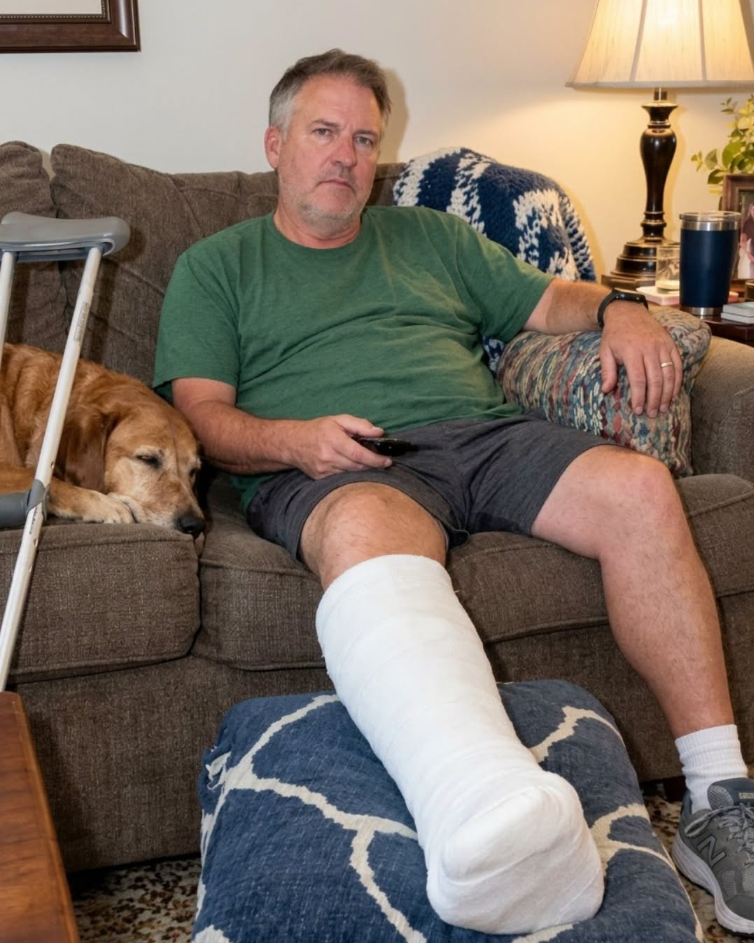
He was sitting on the bathroom floor beside the bathtub, with one crutch beneath the sink and the other lying across the doorway. The upper edge of his cast had cracked during his fall, and the padding had shifted out of place.
“I can handle it.”
“You just lost a fight with a bathtub.”
“Cynthia.”
The way he said my name made me stop.
It wasn’t irritation. It was fear.
Conor reached for a towel, but he wasn’t quick enough.
The loose padding had slipped far enough to expose a long, pink scar extending above the edge of his cast.
The wound was healing.
And it had absolutely nothing to do with the fractured ankle he’d supposedly suffered two weeks earlier.
I stared at him.
“Conor… what the hell is that?”
His fingers tightened around the towel.
All at once, the strange behavior he’d displayed over the past two weeks began to make sense.
Or at least, I thought it did.
After 32 years of marriage, you learn certain things about a person.
I knew Conor snored more loudly when he slept on his back.
I knew he’d claim he wasn’t hungry before stealing half my fries. And I knew my husband had absolutely no dignity whenever he was sick.
A cold meant soup, tea, extra blankets, and hourly updates about his sinuses.
So when his coworker, Nathan, brought him home one afternoon with his right leg in a cast, I expected six weeks of dealing with a helpless husband.
Nathan had worked alongside Conor for years. I’d met him often enough to know that he was quieter than my husband and twice as patient.
That afternoon, patience was clearly going to be necessary.
Nathan had one arm wrapped around Conor’s waist when I opened the front door.
“What happened?”
“Wet floor,” Nathan replied.
Conor lowered himself onto the couch with a groan.
“Fractured ankle. The doctor said six weeks. This is going to be miserable.”
Six weeks.
I’d deserve a medal by Friday.
I placed pillows beneath his leg and brought him a glass of water.
“Anything else, Your Majesty?”
“Tea would be nice, Cyn.”
I gave him a long look.
“You offered.”
“I absolutely did not mean it.”
He grinned.
That was my Conor.
I made the tea anyway.
When I returned, I noticed that the padding near the top of his cast looked folded. I reached toward it.
Conor immediately pulled his leg away.
“I’ve got it.”
I laughed.
“Since when?”
“I don’t want you bumping it.”
“Conor, you once asked me to check your temperature four times in one evening.”
“It was a bad fever.”
Then he moved his leg even farther away from me.
The following morning, I offered to wrap his cast before he showered.
“No. I’ll do it.”
“You plan to balance on one foot while wrapping your own leg?”
“I can manage, Cynthia. Please, stop hovering.”
He carried the plastic upstairs.
A minute later, I heard the bathroom door lock.
Conor had never locked that door before.
Three days later, I asked when his follow-up appointment was scheduled.
“Next week.”
“What day?”
“I wrote it down.”
“Where? I’ll come with you.”
He turned his attention away from the television.
“I’ve got it, Cynthia.”
There it was again.
Not annoyance.
Guarding something.
“You’ve become strangely independent since breaking your ankle.”
“What’s that supposed to mean?”
“It means you’ve spent 32 years asking me where we keep the aspirin.”
“That’s an exaggeration.”
“It’s in the same cabinet it was in when we moved here.”
He nearly smiled again, but the expression quickly vanished.
As the next week passed, the little things became increasingly difficult to ignore.
He showered whenever I was downstairs.
He kept his injured leg on the far side of the bed.
Whenever I walked into the room while he was adjusting his cast, his hands would immediately stop moving.
Then Nathan called.
Conor’s phone was lying on the kitchen counter while he sat in the living room.
I answered it.
“Hey, Nathan.”
“Oh. Hey, Cynthia.”
“Want Conor?” “Oh. Hey, Cynthia.”
“I was just calling to see how he’s doing after everything.”
My fingers tightened around the phone.
“After breaking his ankle, that’s what you mean, right?”
There was a pause.
“Yeah. That’s what I meant.”
I glanced through the doorway.
Conor was pretending to read.
“He’s fine.”
“Good. Tell him I called.”
After ending the call, Conor looked over at me.
“Nathan?”
“Yes.”
“What did he want?”
“To see how you’re doing after everything.”
His eyes widened.
“What?”
“His words.”
Conor shrugged.
“He meant the accident at work, Cyn.”
I walked away before he could notice that I didn’t believe him.
That evening, I made up my mind.
I wasn’t going to check his phone or rummage through drawers.
After dinner, I would ask my husband one question.
What are you hiding from me?
But I never got the opportunity.
A crash came from upstairs.
Then I found him beside the bathtub.
And saw the scar.
Conor pulled the towel over his leg.
“What happened?” I asked.
“Nothing.”
“Nothing doesn’t leave a scar like that.”
“It’s handled.”
“What’s handled?”
He glanced toward the doorway.
“Conor.”
“I had something removed.”
My stomach clenched.
“What? What did you have removed?”
“A spot.”
“What kind of spot, Conor?”
He remained silent.
I lowered myself beside him. “Conor, look at me.”
He met my eyes.
“Tell me the truth.”
His shoulders slumped.
“Skin cancer.”
For a moment, the only sound I could hear was the bathroom fan.
Then the questions flooded out.
“When did they find it? What did they remove? Are you okay? When do you go back?”
“Stop. Cynthia, just stop.”
I fell silent.
Conor rubbed his forehead.
“This is why I didn’t tell you.”
“Because I ask questions?”
“Because you turn fear into a plan before anyone’s allowed to feel it.”
His words hurt because they weren’t entirely wrong.
But neither was what he’d done.
“How long have you known?”
He turned his face away.
“Conor.”
“A couple of months.”
I stared at him in disbelief.
“Months?”
“I was going to tell you when I knew more.”
“And until then, you decided I wasn’t part of it.”
His expression tightened.
I thought back to Nathan’s unusual pause during the phone call.
“Did Nathan know?”
Conor took too long to respond.
That was all the answer I needed.
We dealt with the damaged cast first. I called for medical advice while Conor sat beside me, and we arranged to have it examined and replaced.
Afterward, I took my phone downstairs.
Nathan answered on the second ring.
“Cynthia?”
“Did you know about the cancer?”
Silence.
“Yes.”
“How long?”
“Since after the biopsy.”
I sat down.
“Before the ankle?”
“Yes.”
“Did you take him to an appointment?”
“Once. After they removed it. He couldn’t drive.”
This wasn’t just one panicked lie anymore. Conor had created an entire system to keep me on the outside.
“Did you tell him to tell me?”
“Did you take him to an appointment?”
“More than once.”
Nathan let out a breath.
“He was scared, Cynthia.”
“I know. I believe that. But I’m still his wife.”
“I know.”
I let his words settle between us.
“Thank you for answering me.”
After hanging up, I didn’t pace around the room or start trying to fix everything.
PART 2
Instead, I called our daughter, Tilly.
She answered in a cheerful voice.
“Your father had skin cancer, Tilly.”
“You knew.”
“How long have you known about this?”
“I drove him to a follow-up a few weeks ago.”
I closed my eyes.
“Why didn’t you tell me?”
“Dad asked me not to.”
“And you agreed?”
“I thought I was helping him. It was a huge scare, Mom. He’s fine now, but at the time we didn’t know that.”
“By helping him hide it from me?”
Her voice grew sharper.
“Maybe ask why he thought he had to.”
That left me breathless.
Then she continued, “Mom, you don’t let people be scared. You fix everything before they can even say what they’re afraid of.”
I tightened my grip on the phone.
“So that makes this okay?”
“No. It doesn’t.” “Mom, you don’t let people be scared.”
Her voice grew gentler.
“But if you want the truth, that’s part of it too.”
For the first time that evening, I had no immediate answer.
“So that’s what you think of me?”
Tilly remained silent for a moment.
“I think you show your love by taking care of things. Sometimes you do it so quickly that nobody gets a chance to express what they’re feeling first.”
“But he still should’ve told you,” she added. “I told him that.”
“Did he listen?”
“Not then.”
After we ended the call, I could no longer convince myself that Conor was entirely wrong and I was entirely right.
That evening, Conor’s sister, Amanda, dropped by with brownies.
“I figured neither of you needed another casserole,” she said.
Amanda was two years older than Conor and straightforward enough to make him uncomfortable.
“How’s the ankle?”
“Still attached,” Conor called back.
She took a seat opposite him.
Then Amanda glanced at his leg.
“At least this time you’re following instructions.”
Conor’s expression shifted.
“What does that mean?” I asked.
Amanda looked at him.
He replied, “Nothing.”
She frowned. “Conor. Have you still not said anything to Cynthia?”
“Amanda, what are you talking about?”
She placed her cup of tea on the table.
“I told him after the biopsy that keeping you out of this was a mistake.”
“After the biopsy?”
Conor interrupted. “You didn’t need to say that.”
“Apparently I did.”
I turned toward him.
“She knew about the biopsy? You told your sister and our daughter but conveniently kept me out of it?”
“Cynthia…”
“Who knew first?”
“Why does that matter now?”
“Because I’m trying to understand when you stopped seeing me as the person you could tell.”
Amanda began to rise from her chair.
“Please stay,” I said. “You didn’t create this.”
“Nathan knew. Amanda knew. Tilly drove you to an appointment. I’m your wife, and I knew nothing.”
Conor’s shoulders slumped.
“I told Nathan first.”
“Why him?”
“He noticed I kept leaving work.”
Amanda shook her head.
“You called me after the biopsy because you were scared. And you asked me not to tell Cynthia,” she added. “I told you that wasn’t protection.”
“Tilly came later?”
Conor nodded. “I needed a ride.”
At last, I understood the timeline.
The next morning, Conor sat at the kitchen table and sighed.
I recognized that sigh. It meant he wanted coffee.
I continued eating.
“What do you need?”
“Coffee.”
“Then ask me.”
He blinked. “I thought I just did.”
“You sighed and expected me to make it. That’s not the same thing.”
He studied me for a moment.
“Would you get me some coffee, Cynthia?”
“Yes.”
A few days later, Conor hobbled into the kitchen on his crutches.
“I have another appointment on Thursday. Will you come?”
Every instinct in me urged me to start making arrangements.
Instead, I asked, “Do you want your wife there, or someone to take notes?”
“My wife.”
So I went with him.
During the appointment, questions crowded into my mind before Conor had even finished asking his first one.
I stopped myself.
He glanced at me. “You had something to ask.”
“I do. But you go first.”
He asked what he needed to know, and I listened.
When he finished, he turned toward me.
“Anything?”
“One thing.”
I asked my question and let it rest there.
The doctor explained that the affected area had been treated, but Conor would still need regular skin examinations and follow-up appointments.
Relief came quietly: there was no new crisis, only the truth I should have been allowed to face alongside him.
In the car, Conor said, “Thank you.”
“For coming?”
“For not taking over.”
I let his words sting.
That night, he finally explained why he’d kept everything from me.
“When your mother was sick, I found you sitting on this kitchen floor.”
I remembered before he could finish speaking.
I’d been looking after my mother, working, barely sleeping, keeping track of appointments and medications. Then I forgot to return a library book.
That small mistake had been what finally broke me.
“I remember.”
“When they said cancer, that’s what I saw.”
“Me on the floor?”
He nodded.
“You were exhausted. You were grieving. I couldn’t get that picture out of my head. I thought I was protecting you.”
“I believe you. That doesn’t make what you did okay.”
He lowered his gaze.
“You took one of the worst moments of my life and decided it was the only version of me you could trust.”
“Nathan didn’t ask 20 questions,” he said. “He just sat there. I needed that, Cyn.”
“You should’ve told me.”
“I didn’t know how.”
“Then you should’ve been bad at it.”
He looked up.
“Bad at what?”
“Being scared with me. Saying the wrong thing. Letting me be scared too.”
A few days later, Tilly came over.
I glanced at Conor.
“We’re not skipping what happened here.”
Tilly froze.
Conor nodded.
“Tilly, I shouldn’t have asked you to keep that from your mother.”
“I thought I was helping you, Dad.”
“You were. But I put you in the middle.”
She turned toward me.
“I’m sorry, Mom.”
“I understand why.”
Then I looked at both of them.
“But neither of you gets to decide what I can handle for me.”
After Tilly left, Conor asked, “What do you want from me now?”
“I want a husband. Not a protector who shuts me out.”
He nodded.
“And if I make it hard for you to be scared around me, tell me. I’ll work on that.”
I took his hand.
“But don’t lie to me and call it love.”
Several weeks later, the cast finally came off.
Conor sat beside me.
“I’m worried about the next follow-up.”
The familiar questions immediately surfaced in my mind.
I let them pass.
“Do you want help, or do you want company?”
“Company.”
He reached toward my hand, then stopped halfway, as though he wasn’t sure he was allowed to anymore. I closed the distance between us and took his hand.
His fingers wrapped around mine, not tightly, but enough to show me that he was frightened and trying anyway.
So I stayed.
After a minute, he looked down at his leg.
“You can touch it now, you know.”
“I know.”
I rested my hand over the spot where the scar disappeared beneath his jeans.
I was still angry about what he’d taken from me.
I was still grateful he was okay.
Both things could be true.
He didn’t pull away.
This time, I wasn’t reaching for him because Conor needed me to fix something.
He had asked for company.
And I finally understood the difference.