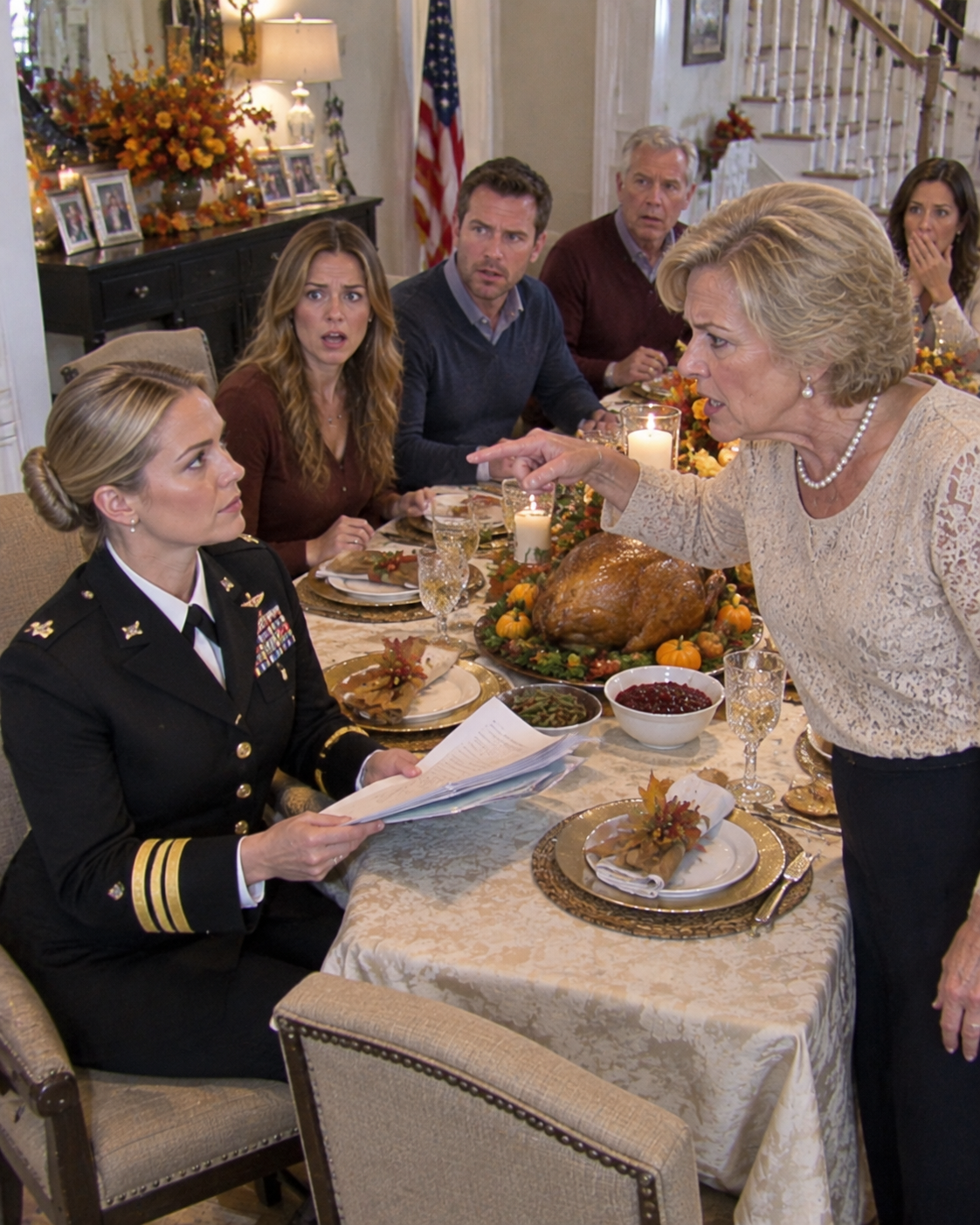
“Then your golden child can pay the house payment,” I said after my mother sneered at my Navy uniform and told me I could never compare to my sister. I watched my father freeze as I revealed the truth I had hidden for three years: I was the one secretly covering their mortgage while they praised Celeste as the family’s savior. The turkey went cold, the room fell silent, and my mother’s perfect smile disappeared. They thought they had a daughter they could shame and use forever. They never realized the money holding their world together was about to vanish. The turkey was still steaming in the center of the table when my mother decided to carve into me instead.
Thanksgiving at the Holt house had always looked beautiful from the outside. Tall windows glowing against a dark Seattle afternoon. Crystal glasses lined up like soldiers.
White candles burning beside gold-rimmed plates. My mother, Lillian Holt, floating around the dining room in a cream silk blouse, pretending we were the kind of family people envied.
Maybe some people did.
They saw the gated driveway, the polished floors, the grand piano nobody played, and my father’s framed business awards hanging in the hallway. They saw my older sister, Celeste, in a fitted navy dress, laughing softly beside her fiancé while my parents watched her like she had descended from heaven with a law degree and perfect teeth.
Then there was me.
I sat near the end of the table in my simple Navy uniform because I had driven straight from Naval Base Kitsap after duty. My hair was pinned tight. My hands were scrubbed clean, but the skin around my knuckles was still rough from years of work nobody in that dining room wanted to imagine.
The smell of roasted turkey and sage stuffing should have felt like home.
Instead, it felt like a trap.
Celeste had spent most of dinner telling everyone about a merger her firm had handled. My mother sighed at all the right places. My father lifted his wineglass and said, “That’s my girl,” like he only had one daughter.
I kept eating quietly.
I had learned a long time ago that silence cost less than hope.
Then my mother looked down the table at me. Her eyes moved over my uniform with the same expression she used when she spotted a water stain on the ceiling.
“You know,” she said, her voice sharp enough to make the forks pause, “you are not half the woman your sister is, Maren.”
The dining room went still.
Not politely quiet. Dead quiet.
The kind of quiet that rushes into your ears until you can hear the candle flames trembling.
Celeste lowered her eyes, but I saw the tiny curve at the corner of her mouth. My father stared into his wine, already choosing cowardice. My aunt pressed her napkin to her lips like she was trying to hide her excitement.
For thirty-two years, I had swallowed moments like that. I had turned them into stomachaches, migraines, sleepless nights in narrow ship bunks while the Pacific slammed against steel below me.
Not that night.
I set my fork down.
The sound of metal touching porcelain cracked through the room.
I straightened my spine, looked my mother directly in the eye, and let out one small, humorless laugh.
“Then your golden girl can start paying the house payment.”
My father froze with his glass halfway to his mouth.
His face changed so fast I almost missed it. Confusion first. Then alarm. Then something worse.
Fear.
“What house payment?” he asked.
My mother’s lips parted.
I turned my gaze toward him. “The one I’ve been covering for three years.”
Aunt Rebecca whispered, “What?”
Celeste’s smile disappeared.
My father looked from me to my mother, then back again. “Maren, what are you talking about?”
The candles burned. The turkey cooled. Outside, wind pressed cold rain against the windows.
My mother’s fingers tightened around her napkin until the linen twisted in her hand.
And for the first time in my life, I watched the people who had made me feel invisible realize I had been the wall holding their entire house upright.
I left before anyone found their voice.
My chair scraped back so loudly one of the wineglasses rattled. My mother whispered my name like a warning, but I was already moving.
I grabbed my coat from the hallway closet, walked past the framed photographs of Celeste shaking hands with judges and CEOs, and opened the front door.
Cold rain slapped my face.
I did not look back.
The driveway lights glowed on wet stone as I crossed to my SUV. Behind me, through the dining room windows, I saw bodies moving, hands raised, mouths open.
My father was standing now. My mother had both palms pressed to the table. Celeste was no longer pretending to be bored.
Good.
I started the engine and drove away from the house I had kept alive.
For the first few miles, I gripped the steering wheel so hard my wrists hurt. Seattle blurred around me in streaks of red taillights and silver rain. The wipers dragged across the glass with a tired, angry rhythm.
That house had always known how to swallow me whole.
When I was a kid, Celeste’s spelling bee ribbons went on the refrigerator. My science fair certificate went inside a drawer. When she got into law school, my parents threw a party with catered salmon and champagne.
When I commissioned as a Navy officer, my mother mailed me a card with no handwritten message inside.
Not even “proud of you.”
Just her name signed at the bottom in blue ink.
She hated my uniform. Not openly at first. She was too polished for that. She preferred little cuts.
At Christmas, when neighbors asked where I was stationed, she would smile thinly and say, “Maren works for the government.”
Works for the government.
As if I stamped forms in a basement.
As if I had not spent years walking steel passageways, coordinating fuel transfers, tracking ammunition inventories, and making sure ships had what they needed before they sailed into the Pacific.
One December, I came home early from leave and found my promotion photograph turned facedown behind a porcelain vase in the living room.
Celeste’s magazine profile was centered on the mantel.
My uniformed photograph was hidden like a stain.
I stood there with snow melting off my boots onto my mother’s expensive rug, holding that frame in my hands. The woman in the photograph looked younger than I remembered feeling. Shoulders square. Eyes clear. Proud, even.
I put it back exactly where I found it.
Facedown.
Because back then, some sick part of me still believed if I didn’t make trouble, one day they would choose me too.
They never did.
The worst day came after a nine-month deployment. I came home thinner, darker from sun and salt, my hands cracked from work and cold.
My mother looked at my calluses and sighed.
Then she took Celeste’s soft manicured hand in hers and said, “Some women are built for rooms where real decisions are made. Some are built for labor.”
Celeste never looked up from her phone.
My father sat in his leather chair, rolling bourbon around in his glass.
Nobody corrected her.
That was the Holt family rule: if Lillian hurt Maren, everyone pretended it was just weather.
Rain thickened on the windshield as I drove back toward base. I could still hear my mother’s voice from dinner.
“You are not half the woman your sister is.”
Maybe she was right.
Celeste had taken their praise and done nothing with it.
I had taken their contempt and used it to survive storms.
By the time I reached Naval Base Kitsap, my phone had already lit up seventeen times.
Twelve missed calls from my mother.
Three from my father.
Two from Celeste.
Not one of them had called to ask if I had made it through the rain safely.
They wanted to know about the mortgage.
I parked outside my quarters, shut off the engine, and watched the screen glow in the darkness.
For three years, I had made sure their payments arrived before the first of every month. I had covered the mortgage when my father’s business began collapsing. I had paid the overdue property taxes when he claimed the bank had made a mistake. I had even covered the insurance premiums when my mother insisted that their financial problems were temporary.
Every payment had come from an account they knew nothing about.
At first, I had done it because I couldn’t bear the thought of my parents losing the house where I had grown up.
Then I kept doing it because I believed that one day, when the crisis passed, they would finally see me differently.
I was thirty-two years old, a commissioned Navy officer, and I had been paying for the approval of people who had never intended to give it to me.
That realization hurt more than anything my mother had said at Thanksgiving.
My phone rang again.
MOM.
I answered.
“Maren!” Her voice exploded through the speaker. “What exactly did you tell your father?”
“The truth.”
“Don’t you dare take that tone with me.”
I closed my eyes.
There it was. Not an apology. Not embarrassment. Not even a question about how I was feeling.
An order.
“You embarrassed this family in front of everyone,” she continued. “Your aunt is asking questions. Celeste’s fiancé thinks something is seriously wrong with us. Do you have any idea what you’ve done?”
“I told them I’ve been paying your mortgage.”
“You didn’t have to announce it like that!”
“You didn’t have to insult me like that.”
Silence.
For one brief second, I thought she might finally understand.
Then she said, “Well, if you had been more involved in this family, perhaps you wouldn’t have been so desperate for attention.”
I laughed once, quietly.
“Goodbye, Mom.”
“Maren, don’t you hang up on me!”
I ended the call.
My hands were shaking, but for the first time in years, I wasn’t shaking because I was afraid of disappointing her.
I was shaking because I had finally stopped.
At 11:43 p.m., a text arrived from my father.
Your mother is upset. Come home tomorrow so we can discuss this privately. Don’t make any decisions until we’ve talked.
I stared at those words for a long time.
Then I opened my banking application.
The mortgage transfer was scheduled for the following Monday.
I canceled it.
I also canceled the automatic payments I had been making toward their property taxes and homeowners insurance.
I did not touch their accounts. I did not move their money. I simply stopped sending them mine.
Before closing the application, I downloaded three years of statements and saved them in a folder.
I named it something simple.
HOLT FAMILY PAYMENTS.
Then I went to bed.
For the first time in three years, I slept without worrying about whether my parents would be able to afford their next payment.
I wish I could say that was the end of it.
It wasn’t even the beginning.
The next morning, Celeste appeared at my apartment wearing sunglasses, a designer coat, and the expression of someone who had been personally inconvenienced by a minor natural disaster.
She hadn’t called ahead.
She simply stood outside my door and knocked until I opened it.
“Can I come in?”
“No.”
She blinked.
I had never refused her anything before.
“Maren, don’t be childish.”
“I’m not. I’m tired.”
She pushed her sunglasses onto her head and lowered her voice.
“Look, I understand that Mom was out of line last night. But you didn’t need to make everything about money.”
I leaned against the doorframe.
“Interesting. You drove all the way here to tell me not to make everything about money, and you haven’t asked one question about why I’ve been paying the mortgage.”
Her jaw tightened.
“Because I don’t understand why you would do that without telling anyone.”
“Because Dad called me three years ago and said the bank was threatening foreclosure.”
Her expression shifted.
“He told me his business was struggling. He said they had missed several payments. He said Mom was having panic attacks because she thought they’d lose the house.”
I remembered that phone call vividly.
My father had sounded broken. He had never sounded that way with me before.
He told me he was ashamed to ask Celeste for help because she was planning her wedding and had a demanding career.
He told me I was the only person he could trust.
So I transferred the money.
One payment became six. Six became twelve. Eventually, I arranged to cover the monthly mortgage through a separate account, believing that once his business recovered, he would take responsibility again.
It never happened.
“Did Dad tell you he was struggling?” I asked.
Celeste looked away.
“Of course.”
“Did he tell you he asked me to help?”
“No.”
“Did he tell you I’ve paid more than a hundred thousand dollars toward this house?”
Her face drained of color.
I went inside, retrieved a printed statement, and handed it to her.
She stared at the total.
“That’s impossible.”
“It’s math, Celeste.”
She flipped through the pages.
Mortgage payments. Property taxes. Insurance premiums. Several emergency transfers when my father claimed his business account had been frozen.
The number at the bottom was $118,640.
For several seconds, neither of us spoke.
Then she whispered, “Why didn’t you tell us?”
I looked at my sister.
“Tell you what? That I was useful?”
She flinched.
I continued before she could answer.
“When I was promoted, Mom hid my photograph. When I came home from deployment, she told me I was built for labor. When you got engaged, they spent thousands of dollars celebrating you. When I needed someone to tell me they were proud of me, I got a blank card.”
My voice broke on the last sentence.
I hated that it did.
“I didn’t tell you about the money because I wasn’t trying to buy your love. I thought I was helping our parents survive a difficult time. I thought that was what family did.”
Celeste lowered the statement.
For the first time in my life, my sister looked genuinely ashamed.
“I didn’t know,” she said.
“You didn’t ask.”
She stood there, holding the pages like they weighed more than paper.
Then she said something that made my stomach tighten.
“Mom told me you were jealous of me.”
I didn’t respond.
“She said you resented my career because you never had the patience for the kind of work I do. She said your military career was your way of escaping this family.”
I looked at her for a long moment.
“Maybe I did escape, Celeste. But I was still the one keeping your parents’ house from falling apart.”
She swallowed.
“I need to talk to Dad.”
“That’s between you and him.”
She left without another word.
I watched her walk down the corridor, her expensive shoes clicking against the floor.
For years, I had imagined what it would feel like to finally make my sister understand.
I thought I would feel victorious.
Instead, I felt exhausted.
Because the truth was that Celeste hadn’t created every wound in our family.
She had simply benefited from them.
And I had spent too many years blaming myself for not being the daughter they preferred.
On Monday morning, my father called from a number I didn’t recognize.
I almost ignored it.
Something made me answer.
“Maren, we have a serious problem.”
I sat at my kitchen table, staring at the coffee I hadn’t touched.
“Good morning to you too, Dad.”
“The mortgage payment didn’t go through.”
“I know.”
“Why?”
“Because I canceled it.”
He exhaled sharply.
“You cannot just do that.”
“I can stop making payments from my own account.”
“Your mother and I are going to be penalized.”
“Then you should contact your lender.”
His voice hardened.
“After everything we’ve done for you, this is how you repay us?”
I felt something inside me go completely still.
“Everything you’ve done for me?”
“Don’t twist my words.”
“I’m not twisting anything. I’m asking you to tell me what you’ve done for me that makes me responsible for your mortgage.”
He didn’t answer.
Instead, he said, “You have no idea how much pressure your mother is under.”
I almost smiled.
For three years, I had worked long hours, accepted difficult assignments, and sent money home while living below my means. I had postponed replacing my aging car. I had turned down vacations with friends. I had watched my savings shrink because I believed my parents needed me.
Apparently, none of that counted as pressure.
“Here’s what I can do,” I said. “I can send you copies of every payment I’ve made. You can take them to a financial adviser and work out what you can afford. But I will not be making any more payments.”
“You would let us lose our home?”
“I don’t want you to lose your home.”
“Then pay the mortgage!”
“No.”
The word surprised us both.
My father went quiet.
I continued.
“I’ll help you find a legitimate financial adviser. I’ll help you understand your options. If there are ways to restructure the debt, you can explore them. But I will not keep funding a lifestyle you refuse to adjust while you and Mom treat me like a family embarrassment.”
He made a sound of disgust.
“You’re being selfish.”
“No, Dad. I’m finally being responsible for myself.”
I hung up.
That afternoon, I received an email from a mortgage servicing company.
It wasn’t a foreclosure notice. It was a reminder that the scheduled payment had not been received and that the account was past due.
I forwarded it to my father with one sentence.
Please contact your lender directly.
Then I returned to work.
I had a readiness inspection coming up, a team depending on me, and responsibilities that did not disappear just because my family had decided I was no longer convenient.
For once, I gave my attention to the people who respected the work I did.
And slowly, I began to breathe again.
Three weeks later, I received an invitation to Celeste’s engagement celebration.
It was scheduled for a Saturday evening at a private event venue overlooking Elliott Bay.
The invitation was formal, embossed, and expensive.
At the bottom, in my mother’s handwriting, were six words.
Please come. We need to talk.
I nearly threw it away.
But I decided to attend.
Not because I expected an apology.
I wanted to see whether anything had changed.
The venue was crowded when I arrived. Lawyers, business associates, distant relatives, and family friends filled the room. Through the windows, Seattle’s waterfront shimmered beneath a gray winter sky.
Celeste stood near the center in a champagne-colored dress.
My mother was beside her, smiling as if Thanksgiving had never happened.
My father looked older than I remembered.
When they saw me, my mother hurried over.
“Maren. You came.”
“You invited me.”
She touched my arm, a gesture that might once have softened me.
“We should talk before dinner.”
“About what?”
Her smile tightened.
“Not here.”
I looked around the room.
“Then perhaps you shouldn’t have invited me to a public event.”
She pulled me toward a quiet corridor.
My father followed.
For a moment, the three of us stood beside a framed photograph of the Seattle skyline.
My mother folded her hands.
“Your father and I have been under tremendous stress.”
“I understand.”
“We’ve spoken to the bank,” my father said. “There may be options, but they need documentation of our income and expenses.”
“That’s good.”
He hesitated.
“We were hoping you might help us make the payments again for a few months while we sort everything out.”
There it was.
Not We’re sorry.
Not We were wrong.
Just another request.
“I won’t be making the payments,” I said.
My mother’s eyes flashed.
“Even after we’ve invited you here and tried to make peace?”
“Inviting me to a party isn’t making peace.”
She looked around to make sure nobody was listening.
“You’ve always had a cruel streak, Maren. You hide behind that uniform and pretend you’re stronger than everyone else.”
My father closed his eyes.
I watched him.
“Are you going to let her speak to me like that again?”
He opened his eyes but said nothing.
I nodded slowly.
“All right.”
I turned to leave.
My mother grabbed my wrist.
“Don’t you dare walk away from me.”
I looked down at her hand.
Then I looked at her.
“Let go.”
Something in my voice made her release me.
I stepped back.
“You’ve spent my entire life telling me that Celeste is the daughter you can be proud of. You have every right to love her. You have every right to celebrate her achievements. But you don’t have the right to humiliate me and then expect me to finance your life.”
My father looked toward the ballroom.
“Maren, please. Not here.”
“Then you should have thought about that before asking me to keep paying for a house while refusing to acknowledge what I’ve done.”
My mother whispered, “You’re destroying this family.”
“No, Mom. I’m refusing to destroy myself to keep it looking perfect.”
I walked back into the ballroom.
I expected people to stare.
Some did.
But nobody stopped me.
As I reached the entrance, I heard my name.
“Maren, wait!”
Celeste hurried toward me, holding the hem of her dress above the floor.
“What’s going on?”
I looked at her.
“Ask Mom and Dad.”
“I did. They said you’re refusing to help them.”
“I’m refusing to pay their mortgage. There’s a difference.”
She glanced over her shoulder at our parents.
Then she looked back at me.
“I’ve been thinking about what you told me.”
I waited.
“About the money. About everything.”
Her eyes were shining.
“I should have noticed how they treated you. I should have said something years ago.”
It was the closest thing to an apology I had ever received from her.
I wanted to embrace her.
I wanted to tell her it was all right.
But it wasn’t.
“I’m glad you’re thinking about it,” I said. “But understanding something and changing it are two different things.”
She nodded, wiping beneath one eye.
“Will you stay?”
I looked toward the ballroom, where our mother was already smiling for a photograph.
“No. Not tonight.”
Celeste didn’t try to stop me.
For the first time, she let me leave without making me feel guilty for it.
That small change mattered more than she probably realized.
The real confrontation came two months later.
It began with an email from my father asking me to meet him at a coffee shop near his office.
His business had been downsized. He had sold one of his cars, and my parents were considering selling the house rather than taking on more debt.
He looked exhausted when I arrived.
For a long time, he stirred his coffee without drinking it.
Then he said, “Your mother and I may have to move.”
I nodded.
“I’m sorry it’s come to that.”
He looked up sharply, as if he had expected me to offer money.
“That’s all you have to say?”
“What would you like me to say?”
“That you’ll help us.”
“I already offered to help you find financial advice. I can still do that.”
He stared at me.
“You have the money. I know you do. You’re a Navy officer. You have a steady salary. You don’t have children. What exactly are you saving it for?”
The question landed like a slap.
Not because it was cruel.
Because it revealed how little he knew about me.
I had saved for a home of my own. For retirement. For the possibility that one day I might want a family. For emergencies. For the future I had spent years putting on hold while I rescued his.
I looked at him across the table.
“My life, Dad.”
He said nothing.
“I was saving for my life.”
His shoulders sagged.
After a moment, he pulled an envelope from his coat.
Inside was a handwritten list of the mortgage payments I had made, copied from the statements I had sent him.
At the bottom, he had written the total.
$118,640.
“I added it up,” he said.
I watched his fingers tighten around the edge of the table.
“I didn’t realize it was that much.”
“You never asked.”
“I know.”
For the first time, he didn’t defend himself.
He didn’t blame my mother.
He didn’t tell me I was being selfish.
He simply looked down at the envelope.
“Your mother always said you could take care of yourself. She said you didn’t need the kind of attention Celeste needed.”
I felt a familiar ache in my chest.
“And you believed her.”
“Yes.”
He swallowed.
“I thought you were strong enough not to be hurt by it.”
I stared at him.
“Being strong doesn’t mean it doesn’t hurt.”
His eyes filled.
“I know that now.”
I wanted to believe him.
Part of me still wanted the father I had spent thirty-two years trying to earn.
But I had learned that tears could be sincere without changing the past, and apologies could be meaningful without obligating anyone to forgive immediately.
“I don’t expect you to pay me back tomorrow,” I said. “I don’t even expect you to repay every dollar. But I need you to understand something.”
He nodded.
“I am not your emergency fund. I’m your daughter.”
His face crumpled.
“I’m sorry, Maren.”
Two words.
I had imagined hearing them for years.
They did not erase the blank birthday cards, the hidden photograph, the dismissive comments, or the years of financial sacrifice.
But they were the first honest words he had offered me in a very long time.
I reached across the table and placed my hand over his.
“I hope you mean that.”
“I do.”
“Then start showing me.”
We sat there for another hour, discussing practical options. I gave him the contact information for a reputable financial counselor and helped him organize the paperwork he needed.
I did not promise to pay the mortgage.
I did not rescue him from the consequences of his choices.
But I helped him find a way forward.
That was the difference between helping someone and sacrificing yourself for them.
By early spring, my parents had made their decision.
They sold the house.
It wasn’t a dramatic foreclosure. No sheriff arrived at the door. No neighbors gathered to watch furniture being carried into the street.
They listed the property, reduced the price, and eventually found a buyer.
After the mortgage and other outstanding obligations were settled, they moved into a smaller home outside Seattle.
My mother described it as a temporary arrangement.
My father called it a necessary adjustment.
Neither called it a consequence.
But I knew what it meant.
For the first time in years, they were living within the limits of their own finances.
Celeste helped them organize the move. She also began contributing toward their expenses, something she had never done before.
She called me one evening after everything had settled.
“I used to think being the favorite meant I was winning,” she said.
I was sitting on my apartment balcony, watching the last light fade over the water.
“What do you think now?”
“That I was being protected from things I should have had to face.”
I didn’t answer immediately.
She continued.
“I let them treat you like you were less important because it made my life easier. I knew Mom could be cruel, but I pretended it wasn’t my problem.”
Her voice trembled.
“I’m sorry, Maren.”
I closed my eyes.
This time, the apology felt different.
Not because it could undo anything, but because she wasn’t asking me for money, forgiveness, or a favor.
She was simply acknowledging the truth.
“Thank you for saying that,” I replied.
“Do you think we can ever be close?”
I looked out at the water.
“Maybe. But it has to be different.”
“It will be.”
“I hope so.”
We talked for another twenty minutes about ordinary things. Her wedding plans. My upcoming assignment. A restaurant she wanted to try.
It wasn’t a perfect reconciliation.
It was a beginning.
And for now, that was enough.
Six months after Thanksgiving, I received orders that would take me to a new assignment.
The news should have been the highlight of my year.
Instead of immediately calling my parents, I sat alone in my apartment and let myself feel proud.
I had earned the opportunity through years of hard work, long nights, and responsibilities that rarely made it into family conversations.
Nobody had handed it to me.
Nobody had paid for it.
Nobody had to approve of it.
I called my father that evening.
He congratulated me.
Then, after a pause, he said, “Your mother would like to take you to dinner before you leave.”
I considered declining.
But I agreed to meet them at a small restaurant near the waterfront.
When I arrived, my mother stood to greet me.
She looked older. Her hair was shorter, and the expensive silk blouse had been replaced by a simple blue sweater.
For a moment, I saw the woman who had once held my hand when I was little.
Then the memory faded, and I saw the woman who had spent years making me feel like a disappointment.
We sat down.
My father asked about my new assignment. He listened when I explained what it involved, even when he didn’t understand every detail.
Then my mother placed her napkin beside her plate.
“I owe you an apology,” she said.
I looked at her.
She took a shaky breath.
“I was wrong about your career. I was wrong to compare you to Celeste. And I was wrong to accept your money while treating you as though you had nothing to offer this family.”
I didn’t speak.
“I told myself you were independent. I thought you didn’t need praise or affection. The truth is, I took your strength for granted because it made my life easier.”
Her eyes filled.
“I am sorry, Maren.”
The restaurant noise seemed to fade around us.
For years, I had imagined this moment. I had pictured myself crying, embracing her, and telling her that everything was forgiven.
Instead, I felt calm.
“I appreciate the apology,” I said.
She nodded quickly, as if she was afraid I would take it back.
“But I need you to understand something,” I continued. “I can love you without paying your bills. I can be your daughter without accepting every insult. And I can forgive you without pretending none of it happened.”
My mother lowered her eyes.
“Yes,” she whispered.
“I don’t want a relationship where I’m valued only when I’m useful.”
“You won’t have to do that anymore.”
I studied her face.
“I hope you’re right.”
My father reached for his water glass.
“I should have stood up for you,” he said. “Every time she said something cruel, I told myself it wasn’t my place to interfere. I thought staying quiet kept the peace.”
He shook his head.
“It didn’t keep the peace. It just left you alone.”
I felt tears gather in my eyes.
That was the truth I had needed him to understand.
The hurt had never come only from my mother’s words.
It had come from the silence of everyone who watched her say them.
“I can’t promise everything will go back to the way it was,” I told them.
My mother reached across the table, then stopped before touching my hand.
“I understand.”
I looked at her fingers resting on the white tablecloth.
After a moment, I placed my hand beside hers.
Not on top of it.
Beside it.
It was a small gesture, but it was honest.
We had a long way to go.
At least, for the first time, we were no longer pretending otherwise.
On the morning I left for my new assignment, I stood in front of my apartment mirror wearing my Navy uniform.
The same uniform my mother had once inspected with contempt.
The same uniform she had called a symbol of everything she believed I was not.
I straightened my collar and examined my reflection.
I looked tired.
I looked older.
But I also looked like someone who finally understood her own worth.
My phone buzzed.
A message from Celeste appeared on the screen.
I’m proud of you, little sister. Not because of your rank or your career. Because you finally stopped letting people convince you that you were worth less than them.
I read it twice.
Then I saved it.
A second message arrived from my father.
Safe travels, Maren. Your mother and I love you. We’re learning how to show it.
I didn’t know whether they would succeed.
I didn’t know whether my mother would slip back into old habits or whether my father would find his courage only when it was convenient.
I couldn’t control any of that.
What I could control was the life waiting for me beyond the front door.
I picked up my bag, locked my apartment, and walked into the morning.
The air was cold. The sky over Washington was pale and clear.
For years, I had believed that being a good daughter meant enduring whatever my family demanded of me.
I thought love meant paying the bills, swallowing the insults, and waiting patiently for someone to notice how much I had sacrificed.
I was wrong.
Love should never require you to disappear.
And family should never make you prove your worth by how much of yourself you’re willing to lose.
My parents had once believed their home stood because of their success, their reputation, and the golden daughter they proudly displayed to the world.
They had been wrong.
Their house had stood because the daughter they dismissed had quietly held it together.
But when I finally let go, I discovered something far more important than the money I had saved or the mortgage I had paid.
I discovered that I could survive their disappointment.
I could survive their anger.
I could even survive the possibility that they might never become the parents I had always wanted.
And I could do all of it without surrendering another piece of myself.
That Thanksgiving, my mother had looked across a beautiful table and told me I would never measure up to my sister.
She had been so certain that she understood my worth.
She had never understood that the daughter she considered weak had been carrying a burden she couldn’t even see.
I didn’t need to humiliate her in return.
I didn’t need to destroy the family reputation she had spent years protecting.
I simply stopped paying for a place where I had never been allowed to belong.
And in the silence that followed, I finally heard my own voice.
It was enough.
For the first time in my life, I was no longer trying to become the daughter my mother wanted.
I was becoming the woman I had always been.
THE END