Eight years after my husband abandoned me while I was pregnant, he invited me to his family’s Christmas celebration, expecting to see the lonely woman he had left behind. Instead, I stepped out of a military helicopter in my Navy command uniform, accompanied by four children he had spent years denying.His relatives stared in disbelief. His beautiful fiancée stood beside him, an engagement ring on her finger.
Daniel Reynolds turned completely pale.
But the children were only the first surprise awaiting him that Christmas.
And they were carrying documents that could destroy his decorated military career.
My name is Kesha Reynolds.
Nine years earlier, I had been a twenty-six-year-old military officer who believed I had married the man of my dreams.
Daniel was ambitious, handsome, respected, and a member of a powerful military family.
His father, General Victor Reynolds, had spent decades establishing a reputation that opened doors across the country.
His mother, Margaret, lived in a massive Colorado estate filled with portraits, medals, and reminders of the family’s distinguished legacy.
I came from a far more modest background.
My father had been a state trooper. I earned my education through scholarships and worked hard for every promotion.
At first, Daniel admired my independence.
But after our marriage, that admiration slowly turned into resentment.
He wanted a wife who would support his career without questioning his choices.
By the time I discovered I was pregnant, our marriage was already crumbling.
Daniel had been offered an opportunity for an important military assignment.
He believed having a family would get in the way of his ambitions.
The evening I told him about the pregnancy, he looked at me as if I had handed him an unsolvable problem.
“Are you certain?” he asked.
“Yes, Daniel.”
He shook his head.
“This timing is unbelievable.”
A few weeks later, an ultrasound revealed something extraordinary.
I was carrying quadruplets.
Four babies.
I was frightened, overwhelmed, and desperately needed my husband’s support.
Instead, Daniel accused me of exaggerating the pregnancy to stop him from leaving.
“You’ll say anything to keep me here,” he told me.
I showed him the medical records.
He refused to even look at them.
Not long afterward, he filed for divorce.
Outside the courthouse, I pleaded with him to reconsider.
“We’re having four children, Daniel.”
He stared at me coldly.
“Stop trying to manipulate me.”
Then he walked away.
Over the following months, I wrote letters to him and his family.
I enclosed medical records, ultrasound pictures, and updates from my doctors.
Most of the envelopes came back unopened.
The others vanished without explanation.
When the babies arrived prematurely, I endured the most terrifying weeks of my life.
Four tiny infants lay in hospital incubators as doctors closely monitored their fragile conditions.
I named them Noah, Ethan, Sophia, and Olivia.
Every day, I moved from one bed to another, praying they would become strong enough to come home.
Daniel never came to see them.
His family never called.
Eventually, I stopped waiting.
With support from fellow officers, nurses, neighbors, and friends, I raised my children while rebuilding my career.
There were sleepless nights, exhausting medical appointments, missed hours of rest, and moments when I questioned whether I could handle everything.
But my children grew.
Noah became adventurous and outspoken.
Ethan developed a love for facts, schedules, and asking questions.
Sophia discovered an extraordinary passion for books.
Olivia adored animals, drawing, and finding ways to make everyone laugh.
They filled our home with noise, disagreements, affection, and happiness.
Meanwhile, I continued serving.
The years passed.
I earned promotions and eventually advanced to a senior command position.
My children knew they had a father.
They also understood that he had chosen not to be part of their lives.
I never told them they were unwanted.
I explained the truth in terms they could understand as they grew older.
Their father had made choices that hurt us, but those choices did not define their worth.
Then, shortly before Christmas, an invitation arrived.
Daniel was celebrating his engagement at the Reynolds estate.
Somehow, the invitation had found its way to my old email address.
I immediately recognized his familiar arrogance.
Apparently, he assumed I was still alone and struggling.
What he didn’t realize was that my career, my family, and my entire life had changed dramatically.
I decided it was time for my children to meet the relatives who had never known they existed.
And when official travel arrangements brought us to Colorado by helicopter, I chose not to conceal our arrival.
On Christmas Eve, the aircraft landed near the Reynolds estate.
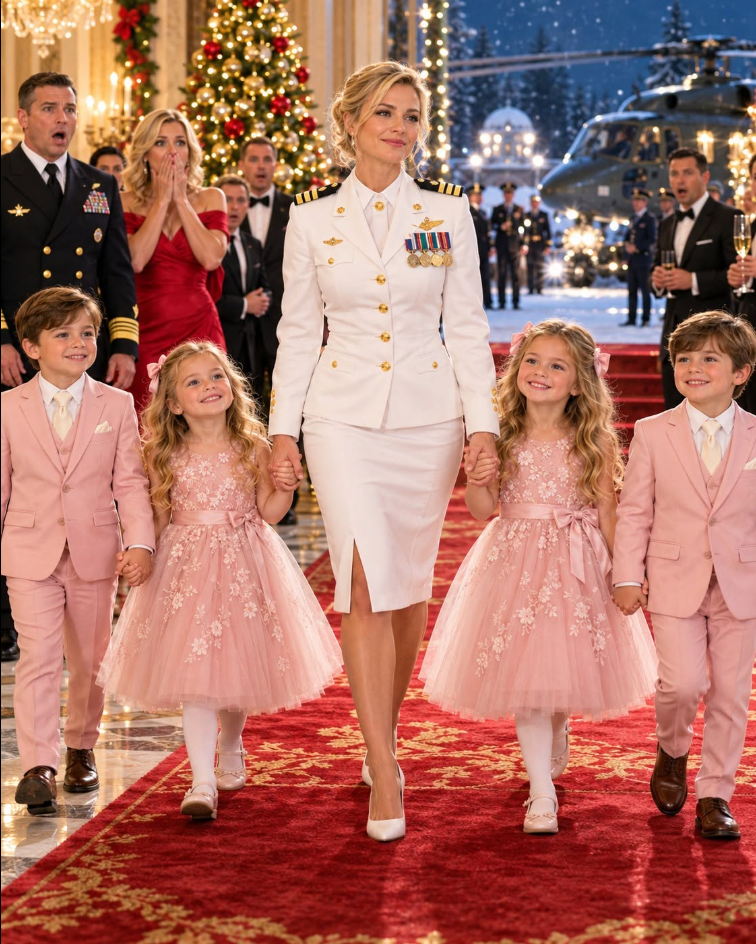
I stepped onto the snow-covered ground wearing my white Navy dress uniform.
My four children followed behind me, dressed in matching pale pink formal outfits.
Together, we entered through the mansion’s enormous front doors.
The Christmas celebration came to an abrupt halt.
Daniel stood beside his fiancée near the staircase.
He stared at me, then shifted his gaze to the children.
Four young faces bore unmistakable traces of the Reynolds family.
His mother raised a hand to cover her mouth.
“Oh, my goodness.”
Daniel struggled to find his words.
“Kesha? What is this?”
Before I could respond, Noah asked the question that changed everything.
“Are you the daddy who said we weren’t real?”
Daniel stumbled backward.
His fiancée turned to face him.
“Daniel, what does he mean?”
He looked at me desperately.
“I didn’t know.”
I opened my briefcase.
“You chose not to find out.”
I laid years of hospital records, birth certificates, DNA reports, and returned letters across the table.
His mother examined them with trembling hands.
Every document revealed the same truth.
I had repeatedly tried to contact Daniel.
He had refused to listen.
His fiancée slowly slipped off her engagement ring.
“You told me you had no children.”
Daniel attempted to explain himself.
But before he could finish, two investigators entered the hall.
One of them introduced herself as Special Investigator Marlowe.
“Colonel Reynolds, we need to discuss financial irregularities involving the Lone Star Veterans Relief Foundation.”
The room fell silent once more.
The investigators explained that government grants intended to support veterans had allegedly been diverted into private accounts and businesses linked to Daniel.
One suspicious account had been opened using his personal identification.
Several transactions were connected to his former aide, Patrick Sloane.
Daniel insisted that the entire situation was a misunderstanding.
Then he turned toward me.
“You arranged this!”
I shook my head.
“No, Daniel. Your choices brought you here.”
The investigators presented documentation confirming that an inquiry was underway.
They also cautioned him against tampering with evidence or contacting certain people connected to the investigation.
His relatives watched in utter disbelief.
For years, Daniel had been their decorated hero.
Now, they were beginning to discover just how much he had hidden from them.
His mother finally rose to her feet.
“Daniel Arthur Reynolds, enough.”
He stared at her.
She raised the returned letters.
“You allowed me to believe Kesha had disappeared. You let me spend eight years without knowing my grandchildren existed.”
Daniel dropped his gaze.
“Mother, it’s complicated.”
“No,” she replied. “You made it complicated because the truth was inconvenient.”
Then Noah walked up to her.
“Are you our grandma?”
Tears streamed down Margaret’s cheeks.
“If you’ll let me be.”
Olivia stepped forward and introduced herself.
Sophia followed, then Ethan.
Noah studied Margaret with a serious expression.
“Do you have Christmas cookies?”
A nervous laugh escaped her.
“An entire kitchen full.”
“Then I think we’ll get along.”
For the first time that evening, the room was filled with something other than anger.
Daniel watched from several feet away.
He tried to speak to the children.
“I’m your father.”
Ethan regarded him thoughtfully.
“Then why weren’t you there?”
Daniel had nothing to say.
I moved between them.
“Being their biological father doesn’t give you permission to demand a relationship overnight.”
His expression hardened with anger.
But I had spent eight years raising and protecting my children without him.
I wasn’t going to stop now.
Eventually, Daniel walked out of the mansion.
He disappeared into the falling snow without looking back.
That hurt more than I had expected.
Not because I wanted him to return.
But because four children had just stood before him, and he had chosen to walk away once again.
Later that evening, Margaret asked if we could stay.
The roads were icy, and the children were exhausted.
I reluctantly agreed.
Before bedtime, she showed them the enormous Christmas village, the library, and the kitchen filled with gingerbread decorations.
Watching her laugh with them was unexpectedly painful.
She had missed almost nine years of their lives.
And she genuinely seemed heartbroken by that loss.
After the children fell asleep, Margaret found me in the library.
“Why did you come tonight?” she asked.
“Because they’re old enough to deserve answers.”
She paused.
“And the investigators?”
“I gave a statement months ago about Daniel’s finances during our marriage. I didn’t know they would appear tonight.”
I explained that Daniel had controlled our accounts and frequently asked me to sign documents I didn’t fully understand.
Margaret looked horrified.
“I never knew.”
I held her gaze.
“You never asked.”
She accepted my words without arguing.
Then she opened a drawer and handed me a small brass key.
“The west wing has private bedrooms. You and the children can stay as long as necessary.”
I accepted the key for one night.
What none of us realized was that the Reynolds family had been hiding more than one secret.
The investigation that followed uncovered documents Daniel had signed during our divorce.
He had officially declared that he had no dependents and no knowledge of any legitimate pregnancy.
Other documents instructed staff to reject any correspondence from me.
But something even more disturbing came to light.
Several letters addressed directly to Margaret had also been intercepted.
One bore a signature belonging to General Victor Reynolds.
Daniel’s father.
The respected general had died six years earlier.
For years, the family had celebrated his memory as a symbol of integrity.
Now, the records suggested he had deliberately prevented his wife from discovering that she had grandchildren.
Margaret stared at his signature.
“Victor knew?”
The investigator nodded.
“Records indicate that several letters were intercepted through the estate office.”
Margaret looked devastated.
“My husband decided I wasn’t allowed to know my grandchildren existed?”
Daniel immediately seized on the discovery.
“If my father intercepted everything, then none of this was my fault.”
I turned toward him.
“Your father concealed information from your mother. You rejected information yourself.”
Daniel objected.
“He influenced every major decision I made.”
“I know,” I replied. “But you still made those decisions.”
Margaret stepped forward.
“Your father taught you terrible lessons, Daniel. But you’re responsible for following them.”
For once, Daniel remained silent.
The children had already endured more than enough family conflict.
I decided it was time to return home.
Margaret pleaded for another opportunity to see them.
I promised we could arrange visits once everyone had time to recover.
Before we left, Olivia wrapped her arms around her grandmother.
“Can we come back?”
Margaret hugged her tightly.
“I hope you will, sweetheart.”
Noah approached Daniel.
He studied his father with a seriousness far beyond his years.
“You should’ve asked Mommy what happened.”
Daniel crouched down.
“Yes,” he whispered. “I should have.”
Then Noah added,
“And you shouldn’t call someone crazy just because they’re sad.”
Daniel covered his mouth.
I took my children’s hands and headed toward the helicopter.
Behind us, the Reynolds family stood on the mansion steps.
For the first time, they understood the price of their silence.
The weeks after Christmas changed everything.
PART 2
Daniel’s military career came under formal review.
Questions concerning financial accounts, official declarations, and his treatment of family obligations were examined.
The family name that had once shielded him could no longer make the evidence disappear.
At first, the children weren’t sure what to call her.
Ethan suggested using her full name.
Olivia simply called her Grandma.
Noah referred to her as the Cookie Lady.
Margaret accepted every name without complaint.
She sent books, science kits, art supplies, and carefully selected gifts.
More importantly, she remembered what the children told her.
She learned about their interests.
She attended their school events.
She listened instead of making promises she couldn’t keep.
Gradually, she became part of their lives.
Daniel’s situation was different.
Before he could build any meaningful relationship with the children, he had to cooperate with the investigation, begin counseling, establish financial support, and write honest letters.
His first attempts were disappointing.
One letter blamed circumstances.
Another suggested that adult relationships were complicated.
A third insisted he had been misinformed.
The children’s psychologist rejected them.
An apology that places responsibility on everyone except the person apologizing isn’t much of an apology.
Eventually, Daniel began writing differently.
He acknowledged his selfishness.
He admitted that he had prioritized his career.
He accepted that the children owed him nothing.
Under professional supervision, the children eventually agreed to meet him.
The first visit was uncomfortable.
The second went more smoothly.
Daniel arrived without his uniform or expensive gifts.
He wore ordinary clothes and answered their questions.
Noah asked, “Did you love Mommy?”
Daniel paused.
“Yes. But I didn’t treat her the way someone should treat a person they love.”
Sophia looked directly at him.
“Are you still selfish?”
“Sometimes,” he admitted. “I’m trying to change.”
Ethan wanted proof that Daniel was attending counseling.
Daniel showed him his appointment records.
Ethan examined them carefully.
“That’s a reasonable beginning.”
Olivia presented him with a drawing of a horse with wings.
Daniel smiled.
“It’s beautiful.”
She nodded.
“But it’s not my favorite one.”
He accepted that too.
Afterward, Daniel told me he intended to resign his commission rather than continue struggling to protect his reputation.
“I’ve spent too long protecting my image,” he said.
I studied him carefully.
For the first time, he sounded less like a man defending himself and more like someone beginning to understand responsibility.
But understanding could never give him back the years he had missed.
Meanwhile, something unexpected happened in my own life.
I met Aaron Bell, a pediatric trauma surgeon, at a professional fundraiser.
Aaron was composed, patient, and comfortable around children.
He never treated me as someone who needed rescuing.
He respected the life I had already built.
When I introduced him to my children, they immediately began putting him to the test.
Ethan questioned him about his medical qualifications.
Sophia wanted to talk about books.
Olivia asked whether surgeons could repair broken dolls.
Noah asked the question that mattered most.
“Are you going to disappear?”
Aaron set his fork down.
“I don’t expect you to trust promises,” he replied. “I’ll show up when I say I will. You can decide what that means.”
Noah made a chart.
Every time Aaron kept his word, he earned another mark.
Weeks became months.
The marks kept accumulating.
Aaron attended school events, helped with science projects, prepared breakfast, listened to the children’s stories, and stayed when life became difficult.
He never insisted they call him Dad.
He never tried to compete with Daniel.
He simply became someone they could count on.
For the first time in years, I allowed myself to imagine a future that included romantic love.
A year after that unforgettable Christmas, we returned to Margaret’s estate.
The mansion looked different.
General Victor Reynolds’s enormous portrait had been removed from the staircase.
In its place hung a photograph of Margaret sitting beneath a tree with my four children.
Everyone in the picture was laughing.
Margaret smiled as she noticed me studying it.
“This house needed pictures of people who are still making memories,” she explained.
I could hardly find the words to respond.
Daniel was there too.
He had continued counseling and accepted the boundaries surrounding his relationship with the children.
That afternoon, they played outside in the snow.
Noah threw a snowball that hit Daniel squarely in the chest.
Daniel dramatically fell backward.
“I’ve been defeated,” he announced.
Noah approached him.
“You’re supposed to surrender.”
Daniel raised both hands.
“I surrender.”
Noah threw another snowball.
“That one’s for the birthdays you missed.”
Daniel accepted it without protest.
I watched from the porch beside Aaron.
For the first time, seeing Daniel with the children didn’t fill me entirely with anger.
But our fragile peace was interrupted by another revelation.
My colleague Lena contacted me with urgent information.
A former aide to General Victor Reynolds had agreed to testify.
His name was Thomas Greer.
He had served the general for more than twenty years.
And he knew precisely what had happened to my letters.
Thomas was elderly and seriously ill when investigators recorded his statement.
He admitted that Victor had ordered him to intercept correspondence concerning my pregnancy.
The general feared that a public scandal would damage Daniel’s military advancement.
He wanted the pregnancy dismissed as an attempt to interfere with his son’s career.
But then Thomas revealed something that shattered the last explanation Daniel had given me.
Daniel had eventually learned the truth.
He hadn’t merely suspected it.
He had known.
Thomas explained that after the babies were born, a hospital packet arrived containing photographs and medical information.
While on leave, Daniel had visited his father’s office.
The general showed him the documents.
Daniel had seen photographs of all four newborns.
He had read the reports describing their premature births.
He knew his children were alive.
And still, he returned to his military assignment.
According to Thomas, Daniel had said that if he visited them, he might never be able to leave again.
So he chose not to visit.
When the recording ended, I couldn’t speak.
For years, I had believed Daniel’s greatest failure was refusing to discover the truth.
Now I knew he had discovered it.
And rejected his children anyway.
My phone rang.
Daniel.
I answered.
Neither of us spoke for several seconds.
Finally, I said,
“You saw their pictures.”
His voice broke.
“Yes.”
“All four?”
“Yes.”
“You knew they were in the hospital?”
“Yes.”
I closed my eyes.
“You knew I was terrified I might lose them?”
He began to cry.
“I was afraid of destroying my career.”
I gripped the phone tightly.
“You were afraid of losing your career while I was afraid of losing our children.”
He had no answer.
“You didn’t abandon children you thought might exist,” I continued. “You abandoned children you knew were real.”
“I know,” he whispered.
“You knew then, Daniel. That’s what makes this worse.”
I ended the call.
That night, Aaron sat beside me while I cried.
He didn’t offer empty reassurance.
He didn’t tell me to forgive Daniel.
He simply stayed.
Three days later, with guidance from the children’s therapist, I explained the new information to them.
I didn’t share every painful detail.
But I refused to lie.
Noah understood first.
“He saw us when we were babies?”
“Yes.”
“And still didn’t come?”
I nodded.
Olivia began to cry.
Sophia stared at the floor.
Ethan asked whether Daniel had acknowledged this in his apology letters.
“No,” I replied.
“Then his apologies weren’t complete.”
He was right.
The children decided they weren’t ready for any more visits.
I respected their wishes.
Daniel accepted their decision without arguing.
He continued meeting his financial obligations and attending counseling.
Later, he sent me a brief letter admitting that he had known about the children and chosen to walk away. He promised he would not ask to see them again until they were ready.
I filed the letter with the other records.
Then I stepped outside.
My children were riding their bicycles along the driveway.
Noah sped ahead.
Ethan reminded him to follow the safety rules.
Sophia attempted to read while riding until I told her to stop.
Olivia had decorated her handlebars with colorful ribbons.
As I watched them, I finally understood something important.
Daniel’s choices had influenced parts of our lives.
But they had not ruined them.
PART 3
My children were happy, curious, loved, and growing.
Their world was far bigger than the man who had once denied their existence.
She brought a small wooden box.
Each one bore the name of one of my children.
I recognized them immediately.
For years, I had believed those precious mementos from the children’s earliest days were gone forever.
Margaret placed the box on our kitchen table.
“I thought they belonged with you.”
Olivia picked up her bracelet and examined it.
“Were we really that tiny?”
I smiled through my tears.
“Even smaller than you can imagine.”
Ethan carefully studied the printed information.
Sophia touched her bracelet and smiled.
Noah carried his over to the mantelpiece and placed it beside our family photograph.
Then he turned to us.
“Now nobody can ever pretend we weren’t here.”
Nobody said a word.
There was nothing more to add.
Over the next several years, our lives settled into a new rhythm.
Margaret became a loving and devoted grandmother.
Daniel continued working on himself while accepting that rebuilding trust would take time.
His relationship with the children remained limited and guided by their comfort.
Aaron became an increasingly important part of our family.
He helped Ethan with experiments, listened to Sophia’s stories, encouraged Olivia’s artwork, and supported Noah’s endless fascination with helicopters.
Most importantly, he continued showing up.
Noah’s chart eventually filled several pages.
Aaron never missed a mark.
Three years after the Christmas when everything changed, we returned to the Reynolds mansion for another holiday celebration.
This time, the house was filled with warmth instead of tension.
Photographs of the children decorated the walls.
Margaret had arranged a family dinner.
Daniel was there too, with everyone’s agreement.
There were clear boundaries.
No forced affection.
No uncomfortable private conversations.
No pretending the past had never happened.
Daniel respected them.
The children greeted him politely.
Olivia gave him a drawing.
Ethan asked about his continued counseling.
Sophia talked about a book she had been reading.
Noah invited everyone outside for a snowball fight.
Later, I stood on the porch watching Aaron play with the children.
Daniel approached but maintained a respectful distance.
“They look happy,” he said.
“They are.”
“You gave them a wonderful life.”
I looked toward Aaron, who was pretending to lose a snowball battle against four determined children.
“I made sure they had room to be happy,” I replied.
Daniel nodded.
He told me he had accepted a position helping veterans and their families in Montana.
It was meaningful work.
I wished him well.
Then Noah shouted from the snowy lawn.
“Mommy! Aaron needs backup!”
I walked down the porch steps.
Aaron approached me, laughing, with snow caught in his hair.
I took his hand.
“Yes,” I said.
He blinked in surprise.
“I haven’t asked you anything.”
I smiled.
“You’ve been carrying an engagement ring for weeks.”
Behind us, Sophia gasped.
Ethan announced that he had already suspected something.
Olivia began jumping excitedly.
Noah looked serious.
“This changes the chart.”
Aaron laughed.
Then he lowered himself onto one knee in the snow.
He opened a small ring box.
“Kesha,” he said, “you’ve built a beautiful family through courage and love. I don’t want to replace anything you’ve created. I want to be part of it, if you’ll let me. I want to keep showing up for you and the children for the rest of my life.”
Tears filled my eyes.
I looked at my children.
Noah crossed his arms.
“He never missed a box.”
Ethan nodded.
“The evidence supports saying yes.”
Sophia wiped her cheeks.
Olivia shouted,
“Mommy, say yes!”
I laughed.
“Yes!”
Aaron stood and embraced me.
The children crowded around us, cheering as snow drifted gently over the lawn.
Margaret watched from the porch, crying happy tears.
Daniel stood beside her.
For once, he didn’t interrupt, complain, or attempt to make the moment about himself.
He simply watched the family he had once rejected celebrate a happiness that had grown without him.
Later that evening, I walked alone through the mansion’s grand hall.
Christmas lights reflected across the polished floor.
The enormous tree sparkled beside the staircase.
On the mantel stood a glass case containing four tiny hospital bracelets.
Beneath them was a simple inscription.
THEY WERE ALWAYS HERE.
I rested my fingers against the glass.
Years earlier, Daniel had walked away from a pregnant woman and convinced himself that ignoring the truth would make it disappear.
He believed money, power, and a respected family name could shield him from the consequences of his decisions.
When he invited me to that Christmas celebration, he expected to see a woman who had never recovered from losing him.
Instead, I arrived with four extraordinary children and a life I had built through determination, sacrifice, and love.
His family’s secrets eventually came to light.
His carefully maintained reputation collapsed.
But the most important outcome wasn’t his humiliation.
It was the future my children gained.
They found a grandmother who was willing to learn how to love them.
They discovered that their father’s absence had never reflected their worth.
They learned that adults could acknowledge their mistakes without demanding immediate forgiveness.
And eventually, they welcomed a man who understood that love was demonstrated through consistent actions rather than impressive promises.
Behind me, Aaron entered the hall.
“Ready to go upstairs?” he asked.
I turned toward him.
His hand was extended.
There was still a faint trace of blue nail polish on one finger from Olivia’s latest artistic experiment.
I smiled and took his hand.
For the first time, I no longer thought of myself primarily as the woman Daniel had abandoned.
I wasn’t defined by his rejection.
I wasn’t merely the officer who had returned with evidence.
I was Kesha.
A mother.
A woman who had rebuilt her life.
And someone who had finally learned that being loved should never require begging another person to stay.
Upstairs, my four children were sleeping peacefully beneath a roof that had once denied their existence.
Now their photographs filled its walls.
Their laughter had transformed its rooms.
And their names had finally become part of its history.
Because family isn’t proven by a surname, a title, or a place in someone’s will.
It’s proven by the people who choose to be there, especially when staying isn’t easy.