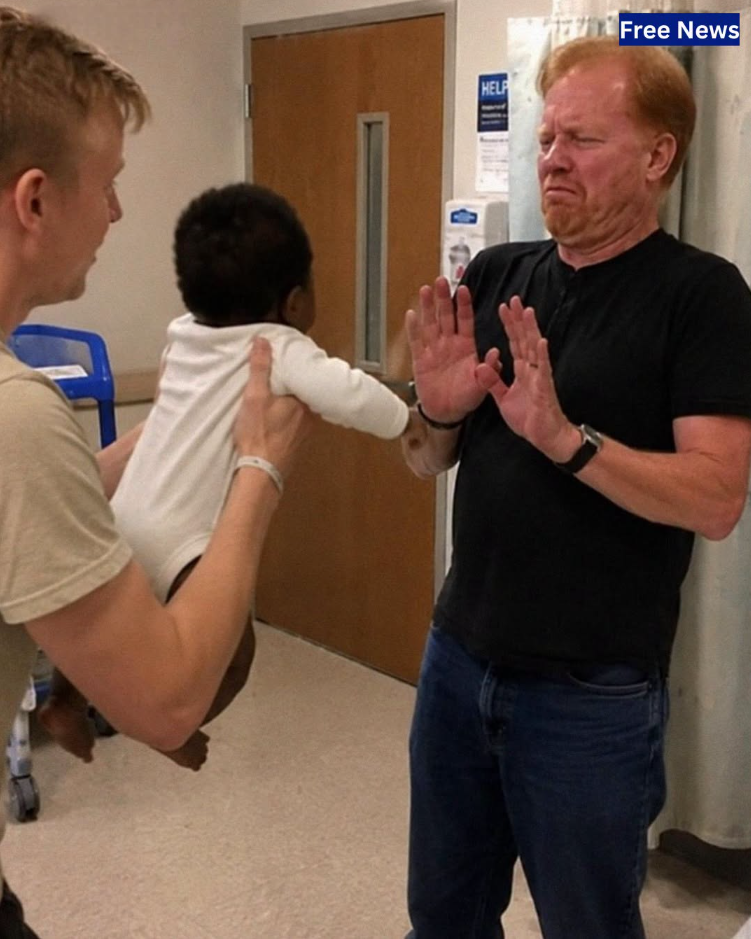
My father-in-law refused to hold my newborn daughter because she wasn’t the grandson he’d been waiting for.
He had spent months talking about the boy he was convinced would eventually carry on the family name. So when my daughter, Nora, was born, he looked into her bassinet, barely acknowledged her, and told us, “Maybe next time.”
I thought I understood what was wrong with him.
Then, five months later, he refused to hold her again at her baptism and made a comment about waiting for his “real” grandchild.
That was the moment something inside me changed.
But what happened afterward changed the way I understood George completely.
Because when I opened an old family album, I found something hidden among photographs from decades earlier. It revealed that the very family name George was so obsessed with preserving had once been given to him by a man who wasn’t his biological father.
And suddenly, his entire obsession with bloodlines, sons, and “carrying on the family name” looked very different.
It all started in the hospital.
“Well. Maybe next time.”
Those were the first words my father-in-law said after meeting my newborn daughter.
George had walked into my hospital room, glanced into Nora’s bassinet, and looked at her for perhaps two seconds before saying it.
My husband, Daniel, stared at him.
“Dad, do you want to hold her?”
George lowered himself into a chair in the corner of the room.
“I’ll do it later.”
A few minutes passed.
Daniel tried again.
“Come on. She’s your granddaughter.”
George barely glanced toward the bassinet.
“Later.”
Later never came.
He stayed in the hospital room for nearly an hour. He drank the coffee Daniel brought him, asked me how I was recovering, complained about the hospital parking, and talked about almost everything except the baby sleeping only six feet away.
When he finally stood to leave, he leaned over and kissed Daniel on the cheek.
He never went near Nora.
That was when I realized his “maybe next time” hadn’t been a badly timed joke.
He had meant it.
For most of my pregnancy, George had talked constantly about having a grandson.
He talked about taking him fishing.
Teaching him baseball.
Showing him how to work with tools.
But more than anything, he talked about one thing.
“Carrying on the family name.”
We had repeatedly told him that we weren’t going to find out the baby’s sex before the birth.
Apparently, George had interpreted that as permission to assume.
And when Nora arrived instead, he treated her as though she had somehow been the wrong answer.
Unfortunately, the hospital wasn’t the end of it.
Over the next five months, George continued keeping his distance from Nora.
At family gatherings, he would happily pick up my sister-in-law’s three-year-old son, Ethan. He’d bounce him on his knee, make him laugh, and tell anyone who would listen that Ethan was “carrying on the family name.”
Meanwhile, Nora could be sitting five feet away, and George would act as though she wasn’t there.
Eventually, Daniel confronted him.
“She’s your granddaughter too.”
“I know that.”
“Then act like it.”
George simply shrugged.
“I’m just saying, a grandson is different.”
I hated that sentence.
Still, I kept telling myself that eventually he would look at Nora and see what she actually was: a beautiful little baby who had done absolutely nothing wrong.
I hoped that once she got older, something would change.
Then came her baptism.
After the ceremony, both sides of our family gathered in the church hall for lunch, photographs, and conversation.
Everyone took turns holding Nora.
Everyone except George.
When the photographer asked the grandparents to join us for a picture, my mother-in-law, Helen, immediately stood beside me.
George remained seated.
“Come on,” Helen told him. “Hold your granddaughter for one picture.”
George folded his arms.
“I’ll wait for the real one.”
Half the room heard him.
Daniel’s face immediately turned red.
“George,” Helen whispered.
I looked down at Nora.
She was asleep peacefully against my chest, completely unaware that her grandfather had just announced in front of everyone that she didn’t count.
Something inside me went cold.
I turned toward the photographer.
“Take it without him.”
George looked up.
“What?”
“You heard me.”
“Christina, don’t be ridiculous.”
“You said you’re waiting for your real grandchild. I’m respecting your decision.”
Nobody spoke.
George let out a short laugh, but there was absolutely no humor in it.
“You’re going to exclude me from a family photograph over a joke?”
“Jokes are supposed to be funny.”
I moved beside Helen.
The photographer hesitated, clearly unsure whether to proceed.
“Go ahead,” I said.
The camera flashed.
George wasn’t in the picture.
And for the first time since Nora had been born, I saw something on his face that I hadn’t seen before.
Being excluded from her life suddenly bothered him.
Three days later, Helen called me.
“George’s upset.”
I almost laughed.
“About what?”
“The baptism pictures.”
“He chose not to be in them.”
“I know. It’s not just that.”
She hesitated.
“He wanted to know why Nora wasn’t photographed wearing the christening gown.”
I frowned.
There was an old cream-colored christening gown that George kept carefully stored in a cedar box. I’d seen photographs of Daniel wearing it as a baby.
George always called it “the family gown.”
“I didn’t know he expected us to use it.”
“He assumed Daniel would.”
That made me angry all over again.
“He won’t hold Nora because she’s a girl, but he’s upset because she didn’t wear his family gown?”
Helen was quiet for a moment.
Then she said something that caught me completely off guard.
“It’s not his family gown.”
I stopped.
“What?”
“It was mine.”
That evening, Helen came over carrying the cedar box.
Daniel opened it on our dining room table.
Inside was the christening gown, carefully wrapped in tissue paper. Beneath it was an old leather photo album.
“My grandmother made it,” Helen explained. “My mother wore it. Then I did. George started calling it the family gown after Daniel was born.”
At first, it seemed strange but hardly earth-shattering.
Then I opened the album.
There were baptism photographs dating back decades.
Pictures of babies.
Children.
Parents.
Grandparents.
Generation after generation.
Near the back, I found a photograph of George as a young boy.
He looked about seven years old, standing stiffly beside a woman I didn’t recognize.
Underneath the photograph, someone had written his full name and age.
I read it twice.
Then a third time.
Something was wrong.
His first name was George.
But the surname wasn’t the one Daniel used.
“Daniel?”
He leaned over my shoulder.
His expression changed immediately.
“Mom?”
Helen looked at the photograph.
For several seconds, she didn’t say anything.
Then she slowly sat down.
“That was your father’s name when he was born.”
I looked at her.
“What do you mean?”
Daniel pulled the album closer.
“I knew Grandpa adopted Dad. I didn’t know Dad changed his surname.”
Helen nodded.
“Your father’s biological father left when he was four. His mother eventually married Thomas. When Thomas adopted George at twelve, George took his surname.”
Daniel stared down at the photograph.
“So that’s why I’ve never seen this one.”
“Your father hated photographs from before the adoption,” Helen explained. “He didn’t like being reminded that there was a time when he didn’t carry the family name.”
I thought about every speech George had ever made about the importance of family.
Every comment about needing another boy.
Every time he’d referred to Ethan as the one who would carry on the family name.
Suddenly, George’s obsession looked completely different.
I’d always assumed he was simply obsessed with bloodlines and sons.
Now I wondered if the truth was almost the opposite.
Maybe George cared so desperately about the family name because, at one point in his life, he had been terrified that he didn’t belong to it.
For the first time, I almost understood him.
Almost.
Maybe whenever George talked about “the family men,” he wasn’t really bragging about blood.
Maybe some part of him was still that twelve-year-old boy, clinging to the name that had finally told him he belonged somewhere.
It didn’t excuse what he’d done to Nora.
But for a moment, I thought I understood where it came from.
Then Helen reached for the album.
A folded piece of paper slipped out from behind one of the photographs.
She froze.
“What is that?” Daniel asked.
Helen carefully picked it up and unfolded it.
It was a handwritten letter, folded twice and yellowed with age.
Helen recognized the handwriting immediately.
“Thomas wrote this.”
Daniel read it silently first.
Then he handed it to me.
The letter wasn’t long.
Thomas had written it shortly before the adoption became official.
But two sentences stopped me cold.
“George was my son long before a judge gave him my name. The paper only made official what our family already knew.”
I looked at Helen.
“He wrote this about Dad?”
She nodded.
“Thomas adored him.”
She gave a sad smile.
“George kept that letter for years. After Thomas died, he put it inside this album with the old family photographs. I don’t think he’s opened it since.”
I stared at the letter.
George hadn’t grown up learning that blood was what made a family.
He had been living proof that it wasn’t.
The name he was now so desperate for a grandson to preserve had originally been given to him by a man who looked at a child who wasn’t biologically his and chose him anyway.
Thomas hadn’t needed George to share his blood before calling him his son.
He simply loved him.
And somehow, George had taken that gift and turned it into a test that Nora could never pass.
I folded the letter carefully.
Daniel looked at me.
“What are you planning?”
“Nothing cruel.”
I placed the letter back inside the album.
“But your father is going to explain something to me.”
The opportunity came the following Sunday.
Helen invited everyone over for lunch.
George barely spoke to me throughout the meal.
But after dessert, he finally brought up the baptism photographs.
“I hope you’re happy with yourself.”
Daniel immediately put down his coffee.
“Dad.”
“No. Apparently I don’t count as family anymore.”
I looked directly at George.
“You said Nora didn’t.”
“I never said that.”
“You called someone who doesn’t exist your real grandchild while Nora was in my arms.”
George sighed.
“We’ve been through this.”
“Then explain it again.”
He glanced around the table.
“A grandson carries on the family name.”
I reached beside my chair and lifted the old photo album onto the table.
George’s expression changed instantly.
His eyes went straight to the album before returning to me.
“Where did you get that?”
“Helen brought it over.”
I opened the album to the photograph of George as a child.
Nobody spoke.
My sister-in-law leaned forward.
“Whose name is that?”
George looked at Helen.
“You told them?”
Helen answered quietly.
“They’re your children.”
George’s jaw tightened.
I kept my voice calm.
“You said Nora matters less because she probably won’t carry the family name.”
“I didn’t say she matters less.”
“You refused to hold her.”
“That’s not the same thing.”
“Then answer one question.”
I tapped the photograph.
“Did you carry this family’s name when you were born?”
His face reddened.
“That’s different.”
“How?”
“My father gave me that name.”
I held his gaze.
“Exactly.”
George stopped speaking.
I opened the album and carefully removed Thomas’s letter.
George went completely still.
He recognized the folded paper before I even opened it.
“Where did you find that?”
“Inside the album.”
He reached for it, then stopped himself.
I placed it in front of him.
George stared at his father’s handwriting.
His thumb moved slowly across Thomas’s signature, almost unconsciously.
Whatever anger he’d brought to the table seemed to disappear.
Nobody interrupted him.
Finally, I asked the question that mattered.
“Was Thomas your real father?”
George looked up sharply.
“Of course he was.”
“But you didn’t share his blood.”
George’s chair scraped against the floor.
“Don’t compare this to that.”
“Why not?”
“Because he was my father.”
“That’s what I’m asking you, George. What made him your father?”
“He raised me.”
I said nothing.
George swallowed.
“He chose me.”
There it was.
The answer we’d been circling around all afternoon.
“So Thomas didn’t become your real father because you had his blood.”
George said nothing.
“He became your real father because he chose to love you like his son.”
I thought about the baptism.
“Then what exactly did you mean when you said you were waiting for your ‘real’ grandchild?”
George opened his mouth.
Nothing came out.
He looked down at the letter.
Then at Nora.
For the first time, he didn’t try to defend the word.
I let the silence hang in the room.
Then I asked quietly:
“Why didn’t you choose to be Nora’s grandfather?”
George didn’t answer.
Daniel looked away.
Helen’s eyes filled with tears.
George stared at the photograph of himself at seven years old.
I continued.
“Your father looked at a boy who didn’t have his blood or his name and decided he was his son. You spent your whole life honoring him for that.”
George rubbed his thumb over the edge of the letter.
“And then my daughter was born with your blood, with your son’s blood, and you decided she wasn’t enough because she’s a girl.”
“I never said she wasn’t enough.”
“You didn’t have to.”
His face crumpled slightly.
Then he finally said the words I had been waiting months to hear.
“I was wrong.”
It was the first time he’d admitted it.
Nobody rushed to make the moment easier for him.
Nobody rescued him from the silence.
Then Nora started fussing in Daniel’s arms.
George looked at her.
Really looked at her.
He stood.
“Can I?”
He held out his hands.
Everyone at the table went still.
Five months earlier, I would have given almost anything to see that.
But I shook my head.
“No.”
George looked stunned.
“I thought this was what you wanted.”
“I wanted you to want her.”
“I do.”
“Today you do.”
He slowly lowered his hands.
I softened my voice, but I didn’t change my answer.
“You don’t get to reject her for five months, understand why it was wrong for five minutes, and then expect me to pretend none of it happened.”
George looked wounded.
Good.
Not because I wanted revenge.
But because Nora had no voice in that room.
I did.
“What am I supposed to do?” he asked.
“Be her grandfather.”
“I just tried.”
“No.”
I nodded toward Nora.
“You tried to hold her.”
Then I looked him directly in the eyes.
“Learn the difference.”
George sat back down.
For once, he didn’t argue.
The following week, he called Daniel and asked what size diapers Nora wore.
Then he brought a box over.
He didn’t ask to hold her.
The week after that, he stopped by carrying a children’s book.
“This was Daniel’s favorite,” he told me.
He sat at the opposite end of the couch and read it aloud while Nora kicked her little feet.
Then he left.
At Helen’s birthday dinner, Ethan ran straight toward George.
George scooped him up the way he always had.
A few minutes later, someone laughed and said, “There’s the little heir.”
I saw George’s expression change.
Five months earlier, he would have been the one making that comment.
This time, he shook his head.
“He’s Ethan,” George said.
Then he looked toward Nora.
“And she’s Nora.”
He paused.
“That’s enough.”
Nobody made anything of it.
I did.
Later that evening, George crouched beside Nora.
“Hello, Nora.”
Just that.
For once, he didn’t need her to represent anything.
She didn’t have to carry a name.
She didn’t have to prove anything.
She was simply his granddaughter.
Over the next month, George kept showing up.
Not dramatically.
Not with grand speeches.
He simply kept appearing.
One afternoon, while George was visiting, I returned from the kitchen and found him sitting on our living room rug, making ridiculous faces at Nora.
She laughed so hard she hiccupped.
George laughed too.
Then Nora reached out and wrapped her tiny hand around one of his fingers.
George went completely still.
He didn’t reach for her.
Instead, he looked at me.
And suddenly, I remembered the hospital room.
“Maybe next time.”
I remembered him refusing Daniel twice.
I remembered the baptism.
“I’ll wait for the real one.”
And I remembered the letter written decades earlier by a man who had understood family far better than George had.
George looked down at Nora.
“I’m sorry,” he said.
This time, he wasn’t talking to me.
I watched him for another second.
Then I asked:
“Do you want to hold her?”
His eyes lifted toward mine.
“Only if you’re ready.”
I picked Nora up and placed her carefully in his arms.
George held her as though she’d been handed to him as something fragile and precious, and as though he finally understood how close he’d come to losing the chance entirely.
Nora grabbed the front of his shirt.
Daniel quietly pulled out his phone.
The camera clicked.
George looked up.
“Send me that one.”
I did.
He never asked us to recreate the baptism picture.
I’m glad.
That empty space beside Helen belongs in Nora’s story too.
It reminds me that love isn’t proven by the title someone claims when a camera comes out.
It’s proven by whether someone shows up when nobody owes them forgiveness.
For months, I thought George needed to learn that a girl could carry a family’s legacy.
He didn’t.
He needed to remember how he’d entered that family himself.
His father hadn’t waited for a child with the right blood.
He hadn’t waited for a boy born with the right name.
He hadn’t demanded proof that George belonged.
He simply looked at a little boy and chose him.
He gave George his name because he already considered him his son.
Nora should never have needed to earn the same choice.
George had spent years believing that blood made him Nora’s grandfather.
It didn’t.
Love did.