I arrived home late that Tuesday, tired enough that I barely remembered turning into our driveway. The storm had followed me across Tampa, Florida, leaving the pavement shiny and black beneath the streetlights. For three years, that small rental had been our safe place. It was not fancy, but it was ours. Mason had a shelf for his plastic dinosaurs, a blue cup he refused to replace, and a night-light shaped like a moon. I had built every routine around one promise: Mason would never be afraid of the place where he slept. After everything I had survived before him, that promise mattered more than rent, furniture, or pride. That night, the living room smelled like stale popcorn and rainwater from the storm outside. The cartoons were still playing too loudly, bright colors flashing across Mason’s face while the old sofa fabric scratched against his legs. He was sitting perfectly still, like someone had placed him there and told him not to move. But my seven-year-old son was not watching television. He was staring through it. When I dropped my bag, my keys cracked against the tile. Mason flinched so hard his shoulders lifted toward his ears. That one movement told me more than any explanation could have. His arms were bruised. His cheek was swollen. Near his shoulder, beneath the twisted collar of his pajamas, were marks that looked too much like fingers for my mind to excuse them. “My dear, what happened to you?” I asked. I kept my voice soft, because panic from a parent can feel like another danger to a child who has already been hurt. Mason looked toward the hallway first. Then the kitchen. Then the dark sliding glass door, where our reflections looked like strangers standing in the room with us.
“Mommy,” he whispered, “I can’t tell you here.”
That sentence changed the temperature in the house. It was not only fear of pain. It was fear of being heard. It meant the danger, in his mind, still belonged to the walls around us.
I wanted to search every room. I wanted to shout. I wanted to call names into the hallway and make someone answer. Instead, I pulled his blue hoodie from the chair and wrapped it around him.
Children do not need their mothers to explode in front of them. They need their mothers to become steady enough to get them out.
At 9:47 p.m., I backed out of the driveway with both hands locked around the steering wheel. Mason sat in the back seat, small under the hoodie, breathing in short uneven pulls whenever a streetlamp passed over his face.
Tampa General Hospital was less than twenty minutes away, but the drive felt longer than any road I had ever taken. Rain clicked against the windshield. The wipers dragged back and forth like a metronome counting down something I did not understand yet.
The emergency room doors slid open with a cold hiss. The air smelled like disinfectant, burnt coffee, and wet clothes. A nurse at intake looked up, saw Mason, and stopped typing immediately.
Her eyes went from his cheek to his arms to the finger-shaped bruises near his shoulder. She did not ask us to sit in the waiting area. She did not tell me to fill everything out first.
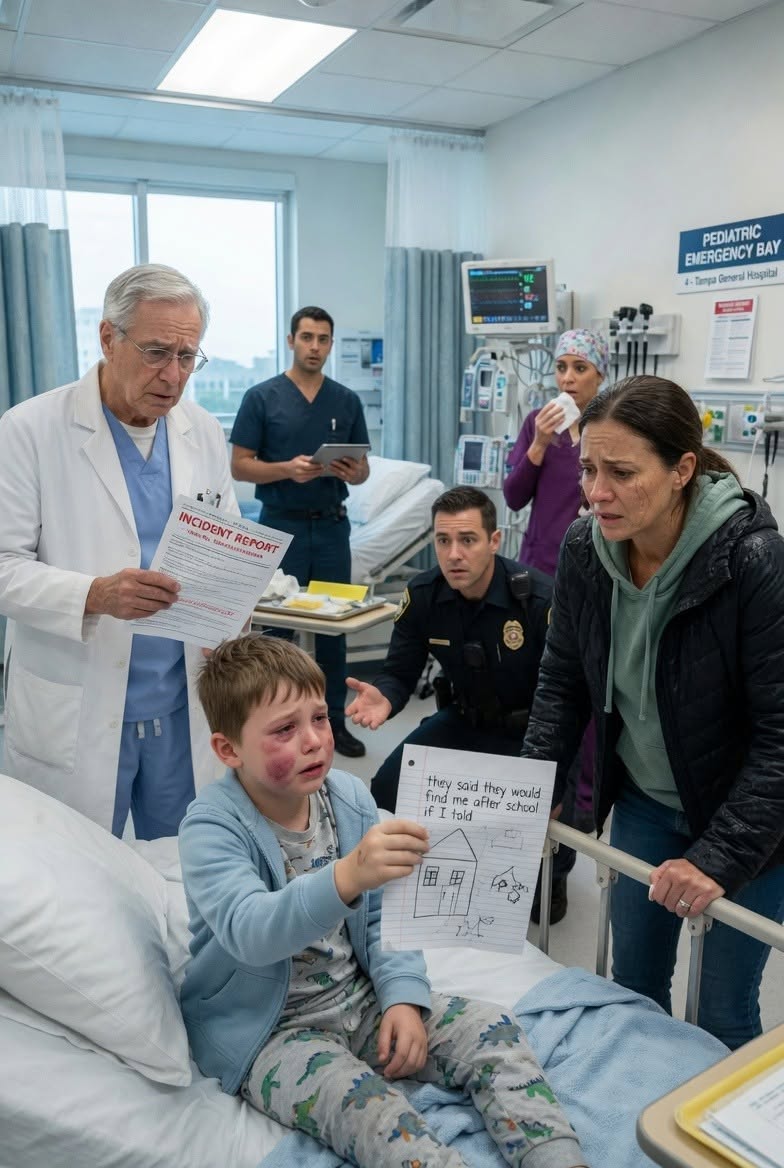
They admitted him immediately. A hospital intake form was clipped to a board, and a nurse wrote 10:06 p.m. across the top. Another nurse began documenting his visible injuries for the chart.
There were photographs. There was an injury map. There was my name, Mason’s age, the date, the time, and the location. Later, people would ask why I remembered those details so clearly.Proof has its own language. Timestamps. Forms. Photographs. People only call it drama when there is no paper trail.
Dr. Harlan came in a few minutes later. He was an elderly man with silver hair and tired, kind eyes. Instead of standing over Mason, he knelt beside the bed.
That mattered. Mason noticed. His fingers loosened slightly from the blanket.
“Mason,” Dr. Harlan said softly, “you are not in trouble. Your mom brought you somewhere safe. Can you tell me what happened?”
Mason looked at me first. I nodded, even though I felt like my throat had closed around glass. Then he leaned toward Dr. Harlan’s ear and whispered.
I could not hear the words over the monitor beside us, but I saw what they did to the doctor. His face changed instantly. The color drained from his skin, and his hand went still on the bed rail.
Behind him, a nurse froze with gauze between her fingers. A tech stopped at the curtain with a tablet in his hand. Even a woman in the next bay lowered her phone into her lap.
Nobody moved.
Dr. Harlan stood slowly. He looked at Mason, then at me, with a kind of professional horror that was worse than panic. It was the look of someone who knew exactly what had to happen next.
“Ma’am,” he said quietly, “I think you should sit down.”
I did not sit. My knees wanted to give, but I stayed standing beside Mason’s bed with one hand on his sneaker. I had promised him I would be right there, and I would not make that promise smaller because I was terrified.
For one ugly heartbeat, I imagined finding whoever had done this and making them feel one second of what Mason had felt. Then I swallowed the thought because rage without a record can become its own disaster.
I reached for my phone and called 911.
The dispatcher asked for my location. I gave her Tampa General Hospital, emergency department, pediatric bay four. I gave Mason’s age. I gave my name. My voice shook, but the information came out clean.
Dr. Harlan handed the injury chart to a nurse. She wrote suspected physical abuse in black ink. The words looked too plain for what they meant.
Then Mason grabbed my sleeve with both hands. “Mommy,” he whispered, tears spilling down his face, “please don’t let him come back here.”Before I could ask who, the automatic doors at the end of the ER hall opened again. A Tampa police officer stepped inside. Dr. Harlan walked straight toward him with Mason’s chart in his hand.
The officer did not rush. That was somehow worse. He moved slowly, reading Dr. Harlan’s face before he looked at me, and the whole pediatric bay seemed to shrink around Mason’s bed.
Dr. Harlan kept his voice low, but I heard enough. “The child disclosed an assailant,” he said. “We have visible injuries, photographs, and a completed injury map. He is afraid the person may return.”
The officer’s expression changed when he looked at Mason. He crouched beside the bed, keeping his hands visible and his voice gentle.
“Buddy,” he said, “you only have to tell me what you feel safe telling me.”
That was when Mason reached into the pocket of his blue hoodie. I had not known he was holding anything. His fingers shook as he pulled out a folded piece of paper.
It was torn from his school notebook, wrinkled from his fist, with three words written in blue crayon so hard the paper had almost ripped. Dr. Harlan read it first, and his mouth tightened.
The nurse behind him covered her lips with one hand and turned toward the wall. She had seen injuries all night, but this was different. This was a child trying to leave evidence in the only way he knew how.
The officer unfolded the page completely. Then he looked at me and asked, very quietly, “Ma’am… who has a key to your house?”
My stomach dropped.
Only a few people had keys. I had one. Mason’s emergency key was hidden in a lockbox outside. And one spare key had been given to someone I trusted because, months earlier, I had needed help with school pickup during a double shift.
That trust signal, the spare key, had once felt like responsibility. I had given it so Mason would never be stranded. I had given it because I believed access to my home meant protection, not danger.
Mason pulled the blanket to his chin and whispered the name.
The room did not erupt. There was no movie-style gasp, no dramatic shouting. The officer wrote it down. Dr. Harlan watched Mason’s face. I stood there feeling the world rearrange itself around one impossible sentence.
The person Mason named was someone who knew our routine. Someone who knew when I worked late. Someone who knew which door stuck, where the spare towels were, and how to make a child believe silence would keep things from getting worse.
The officer asked whether that person still had access. I said yes. My voice sounded far away from me, like it belonged to someone standing at the end of a tunnel.
Within minutes, the process became methodical. The officer requested a formal report. Dr. Harlan updated the injury chart. The nurse added the crayon note to a clear evidence sleeve without smoothing it flat, preserving the folds exactly as Mason had held them.
The note, the photographs, the 10:06 p.m. intake form, the injury map, and the 911 call log all became part of the record. It was no longer only my terror. It was documented.
Mason was examined again. They checked his ribs, his shoulder, his cheek, and the tenderness along his arms. He answered in whispers, but he answered. Each time he looked at me, I told him he was doing nothing wrong.
Later that night, I learned how small children survive unbearable things. They leave crumbs of truth where adults might finally see them. A bruise. A flinch. A crayon note folded into a hoodie pocket.
The police arranged for an officer to go to the house. I was told not to return alone. A hospital social worker came in with a calm voice and a folder of forms that made everything feel both official and unreal.
Mason fell asleep for a few minutes with one hand still gripping my sleeve. His eyelashes were wet. The hoodie zipper sat crooked under his chin.
I sat beside him and stared at the evidence sleeve on the counter. Three words in blue crayon had done what my questions could not. They had opened the door he was too frightened to open himself.
By sunrise, temporary safety steps were in motion. Locks would be changed. Reports would be filed. Interviews would happen with people trained to speak to children without forcing them to relive everything at once.
None of it felt like justice yet. It felt like scaffolding around a collapse. But scaffolding matters when the building is still standing because someone small inside it needs protection.
In the days that followed, Mason stayed close to me. He jumped at sudden noises. He asked twice whether hospital doors locked. He wanted the blue hoodie washed, then cried because it no longer smelled the same.
Healing did not arrive like a speech. It came in tiny proofs. He ate half a pancake. He slept through one storm. He told Dr. Harlan’s name to a counselor because he remembered the doctor kneeling instead of towering over him.
The legal process moved carefully. The paper trail mattered. The timestamps mattered. The photographs mattered. The note mattered. Each piece carried a part of the truth that Mason should never have had to carry alone.
I used to think safety was a feeling. A warm lamp. A locked door. A familiar couch. But that Tuesday taught me safety is also a system: records, witnesses, changed locks, trained adults, and a mother willing to believe the first whisper.
For three years, I had built our home around one promise: Mason would never be afraid of the place where he slept. That promise had been broken by someone who had access to our door, but it was not destroyed.
It became sharper.
Now, when Mason asks whether he is safe, I do not answer with comfort alone. I show him the new lock. I show him my phone nearby. I tell him the truth in words a child can hold.
“You told me,” I say. “I believed you. And I will always come.”
That is the part I wish every child knew before fear teaches them otherwise. A whisper is enough. A folded note is enough. A flinch is enough for someone who is truly paying attention.
PART 3
For the next several mornings, I woke before Mason did.
Not because I was rested.
Because I was listening.
Every sound in the house had become a question.
The refrigerator clicking on.
A car slowing outside.
A branch scraping against the bedroom window.
The soft mechanical sound of the new deadbolt turning when I checked it for the third time before sunrise.
I had never understood how quickly a home could stop feeling like a home.
The furniture was the same.
The walls were the same.
Mason’s dinosaur shelf was still crooked.
His blue cup was still beside the kitchen sink.
But now every room seemed to remember something I wished I could forget.
And the worst part was that Mason could feel it too.
One morning, he came downstairs wearing the same blue hoodie.
I had bought him three new ones.
He refused every one.
He stood at the bottom of the stairs and looked toward the front door.
“Mommy?”
I turned around.
“Yeah, baby?”
“Is the new lock strong?”
My heart tightened.
“Very strong.”
“Stronger than the old one?”
“Yes.”
He nodded.
Then he asked the question I had been dreading.
“Can he still come in?”
I crouched until we were eye to eye.
“No.”
Mason stared at me.
I could see him deciding whether he believed me.
Children don’t always need a complicated explanation.
Sometimes they need an answer that is simple enough to hold onto.
“No,” I repeated. “He cannot come in.”
Mason looked at the lock.
Then at me.
Then back at the lock.
“Okay.”
He walked into the kitchen.
I stayed where I was.
Because I knew something he didn’t.
The new lock could keep someone outside.
But it couldn’t erase what had already happened.
That would take much longer.
The investigation moved quietly at first.
There were interviews.
Reports.
Phone calls.
Questions I had answered so many times that eventually my own voice started sounding unfamiliar to me.
What time had I left for work?
Who had access to the house?
When had Mason first behaved differently?
Had he ever mentioned being afraid of anyone?
Had I noticed changes in his sleep?
His eating?
His behavior?
His schoolwork?
Every question felt like someone turning over pieces of my life and asking me to explain why I hadn’t noticed the broken pieces sooner.
I kept thinking about that.
Why didn’t I know?
Why didn’t I see it?
Why didn’t I recognize the signs?
Then one afternoon, Mason’s counselor said something that stopped me.
“You’re asking the wrong question.”
I looked at her.
She folded her hands on the desk.
“The question isn’t why you didn’t know. The question is what you did when you knew.”
I couldn’t answer.
She continued.
“You believed him.”
Three words.
They sounded simple.
But they followed me home.
You believed him.
That night, after Mason fell asleep, I stood in the hallway outside his room.
His door was slightly open.
The moon-shaped night-light cast a pale circle across the carpet.
He was sleeping on his side, one hand tucked beneath his cheek.
For the first time in days, his face looked peaceful.
I wanted to freeze that moment.
I wanted to protect it.
But then my phone vibrated.
One message.
Unknown number.
I almost ignored it.
Then I saw the words.
You don’t know the whole story.
I stared at the screen.
My first thought was that it was a mistake.
My second thought was that someone wanted to scare me.
My third thought was Mason.
I took a screenshot.
I didn’t respond.
I called the officer assigned to the case.
He answered after several rings.
I gave him the number.
There was silence.
Then he said something that made the room suddenly feel colder.
“Don’t delete anything.”
“I won’t.”
“And don’t reply.”
“I won’t.”
He paused.
“There’s something else.”
“What?”
“We found something at your house.”
My hand tightened around the phone.
“What?”
“We didn’t want to tell you until it was documented.”
My heart started beating harder.
“What did you find?”
Another pause.
“A second key.”
I looked toward the front door.
“I only had one spare.”
“That’s what we thought.”
“Where was it?”
“In a place you probably wouldn’t have checked.”
“Where?”
“In Mason’s room.”
I stopped breathing for a second.
“Where in his room?”
“Inside the dinosaur shelf.”
I looked down the hallway.
Mason was still asleep.
“How did it get there?”
“We don’t know yet.”
The officer’s voice became more serious.
“And that’s why I need you to listen carefully.”
I sat down.
“What?”
“Your house may not have been accessed the way you originally thought.”
The next morning, I moved Mason to my sister’s apartment.
I didn’t explain everything.
I simply told him we were having a sleepover.
He smiled for the first time in days.
That smile almost broke me.
While he packed his dinosaurs, I stood in the doorway and watched him.
He picked up one dinosaur.
Put it down.
Picked up another.
Then he suddenly froze.
“Mommy?”
“Yeah?”
“Can I tell you something?”
I immediately put down the bag.
“Of course.”
He looked toward the hallway.
That old instinct.
That old glance.
My stomach turned.
“You remember the night at home?”
“Yes.”
“Before you came home…”
He stopped.
I waited.
“Someone was in my room.”
My hands went cold.
“Who?”
“I don’t know.”
“You didn’t see them?”
He shook his head.
“I heard the door.”
“What door?”
“My closet.”
I looked at the closet behind him.
“Your closet door?”
He nodded.
“What happened?”
“I was hiding.”
“Why?”
“Because I heard someone whispering.”
My throat tightened.
“What did they say?”
Mason looked down at the dinosaur in his hands.
“I couldn’t understand everything.”
“Anything you remember?”
He thought for a moment.
Then he whispered:
“They said your name.”
I felt the room tilt.
“My name?”
Mason nodded.
“And they said…”
He stopped.
“What did they say?”
His eyes filled with tears.
“They said, ‘She doesn’t know yet.’”
That afternoon, the officer returned to the house.
I went with him.
The place felt unfamiliar.
He wore gloves.
I watched as he examined the hallway, the doors, the windows, the locks.
Then he went into Mason’s room.
He stood beside the dinosaur shelf.
“Which one does he move most often?”
I pointed.
“The green one.”
He carefully lifted it.
Nothing.
Then the blue one.
Nothing.
Then a small plastic dinosaur with a broken tail.
He turned it over.
There was a tiny strip of tape underneath.
My stomach dropped.
He removed it carefully.
Behind the shelf was a narrow gap.
Not large enough for a person.
But large enough for something else.
He reached inside.
Pulled out a folded envelope.
My name was written on the front.
Not printed.
Written.
By hand.
I recognized the handwriting immediately.
I had seen it before.
Many times.
On school pickup forms.
On notes left on my kitchen counter.
On birthday cards.
On messages reminding me about Mason’s schedule.
My hands began shaking.
“No,” I whispered.
The officer looked at me.
“You recognize it?”
I nodded.
“Yes.”
“Whose?”
I couldn’t say the name.
Because saying it would make everything real.
The person I had trusted.
The person who had possessed a key.
The person Mason had named.
The person I had once thanked for helping with my son.
The person who had looked me in the eye and said everything was fine.
The officer opened the envelope.
Inside was a photograph.
I stared at it.
It showed Mason sitting on our living room floor.
He was smiling.
But I had never seen the photograph before.
The date printed in the corner was from three weeks before the night I found him bruised.
On the back were four words.
She still trusts me.
I couldn’t move.
The officer immediately photographed the envelope and the photograph.
Then he looked at me.
“Do you know when this was taken?”
I shook my head.
“No.”
“Look carefully.”
I did.
The photograph showed the living room.
The old sofa.
The television.
The yellow lamp.
And something else.
A reflection in the sliding glass door.
Someone was standing behind Mason.
The face was mostly hidden.
But I knew the jacket.
I knew the posture.
I knew the person.
I covered my mouth.
“Oh my God.”
The officer didn’t ask me to say the name.
He already knew.
That should have been the end of my questions.
Instead, it created hundreds more.
Why had the photograph been hidden?
Why had someone taken it?
Why had it been placed inside Mason’s room?
And most importantly—
Why had that person written that I still trusted them?
The investigation changed immediately.
Phone records were reviewed.
Messages were examined.
Access logs were requested.
School pickup records were checked.
Neighbors were interviewed.
And then something unexpected happened.
A neighbor across the street came forward.
She had been reluctant before.
She said she didn’t want to get involved.
But after seeing the photograph, she contacted the police.
She told them something she had never told me.
On several evenings when I worked late, she had seen a familiar car parked near my house.
Not in the driveway.
Across the street.
Lights off.
Engine running.
She had assumed someone was waiting for me.
She had never imagined they were waiting for Mason.
Then she remembered something else.
The night before I found him injured, she had seen the same car.
At 8:53 p.m.
The exact time my work records showed I was still away.
She gave investigators the license plate.
That plate became another piece of the paper trail.
Another timestamp.
Another thread.
And suddenly the story was no longer only about what had happened inside my house.
It was about what had been happening outside it.
For how long?
Nobody knew.
Mason eventually started talking more.
Not all at once.
Never in a straight line.
A sentence here.
A memory there.
One night while brushing his teeth, he said something so casually that I almost missed its importance.
“He told me not to tell you.”
I stopped brushing.
“Who?”
Mason looked at me through the mirror.
The toothbrush hung from his mouth.
Then he slowly lowered it.
“The person who came to my room.”
My heart pounded.
“What did he tell you?”
Mason swallowed.
“He said grown-ups wouldn’t believe me.”
I knelt beside him.
“Did you believe him?”
Mason shook his head.
“No.”
“Why not?”
He looked at me.
“Because you always believe me.”
I had to turn away for a moment.
I couldn’t let him see me cry.
Not because I was ashamed.
Because I wanted him to see something stronger than tears.
I wanted him to know his words had power.
Then Mason reached into his pocket.
He pulled out another piece of folded paper.
I stared at it.
“What’s that?”
“I forgot about it.”
He handed it to me.
I unfolded it.
There were no words.
Only a drawing.
A house.
A door.
A little boy inside.
And outside the house—
a black figure.
Above the figure, Mason had drawn a red circle.
“What does this mean?” I asked.
He pointed at the door.
“That was locked.”
Then he pointed at the figure.
“But he had a key.”
I closed my eyes.
For months, I had believed a locked door meant safety.
Now my son was teaching me the difference between a door being locked…
and a child feeling safe behind it.
Weeks passed.
The case continued.
There were difficult days.
There were hopeful days.
There were days when Mason laughed so loudly that I remembered the boy he had been before fear entered our lives.
He started asking for pancakes again.
He complained about vegetables.
He argued about bedtime.
He left dinosaur toys in places where I nearly stepped on them.
And every one of those ordinary things felt miraculous.
One evening, he ran into the kitchen carrying a drawing.
“Mommy!”
I turned.
“Look!”
He held it up.
It was our house.
But this time, there was something different.
The door was bright yellow.
There were flowers beside it.
And two people stood in the window.
Me.
And Mason.
“No black figure?” I asked.
He shook his head.
“No.”
“Why?”
He smiled.
“Because he can’t come here anymore.”
I hugged him.
For a moment, neither of us spoke.
Then my phone rang.
It was the officer.
His voice was different.
Serious.
Focused.
But there was something underneath it.
Relief.
“We found him,” he said.
I closed my eyes.
I already knew who he meant.
“Are you sure?”
“Yes.”
“Where?”
Another pause.
“Not where we expected.”
My heart began pounding.
“Tell me.”
“He wasn’t at his home.”
“Where was he?”
The officer took a breath.
“He was at a storage unit.”
I felt the room go silent around me.
“What was inside?”
“We’re still documenting everything.”
“Was Mason’s name there?”
Silence.
“Was my son’s name there?”
“We found photographs.”
My knees weakened.
“How many?”
“We’re counting.”
“Of Mason?”
“Yes.”
I gripped the kitchen counter.
Then he said the sentence I will never forget.
“And there are photographs of you, too.”
I stopped breathing.
“Me?”
“Yes.”
“What kind?”
Another pause.
“Photographs taken when you didn’t know anyone was watching.”
The room seemed to disappear.
I looked through the kitchen window.
Outside, the evening was calm.
Cars passed.
A dog barked somewhere down the street.
A porch light came on.
Everything looked ordinary.
But I suddenly understood something.
The danger had never been as far away as I thought.
It had been close enough to know our routines.
Close enough to know our schedule.
Close enough to know when I wasn’t home.
Close enough to take pictures.
And close enough to believe I would never discover the truth.
Then the officer said:
“There is one more thing.”
“What?”
“We found a notebook.”
“What does it say?”
“We haven’t finished reading it.”
“Why?”
“Because the first page has your name on it.”
My fingers went numb.
“What else?”
The officer’s voice dropped.
“Under your name is a date.”
“What date?”
He told me.
I stared at the wall.
That date was impossible.
Because it was months before I ever gave him the spare key.
I whispered:
“How could he have written that date?”
The officer didn’t answer.
He didn’t need to.
Because somewhere inside that storage unit was a notebook that suggested this had started long before I understood there was a problem.
And if the date was real…
then the question was no longer simply—
What happened to Mason?
It was—
How long had someone been watching our family?
And what I would discover next would make me realize that the night I found my son covered in bruises…
was not the beginning of the story.
It was only the night I finally noticed.
PART 4
The notebook was waiting for me in an evidence room.
A plain black notebook.
No name on the cover.
No photograph.
Nothing about it suggested that it contained anything capable of changing my understanding of the past.
But the officer placed it on the table as carefully as if it were made of glass.
I stared at it.
“That’s it?”
“That’s it.”
I looked at him.
“You said my name was on the first page.”
“It is.”
“And the date?”
“Yes.”
“What date?”
He didn’t answer immediately.
Instead, he opened the notebook.
The first page was covered in handwriting.
My name was at the top.
Underneath it was a date from months before I had given the person investigators were questioning the spare key.
I felt a chill move through me.
“That can’t be right.”
The officer didn’t argue.
“I know what you’re thinking.”
“I hadn’t even asked him for help yet.”
“I know.”
I looked at the page again.
The handwriting was unmistakable.
But the date was what frightened me.
It meant one of two things.
Either the notebook had been altered…
or someone had been paying attention long before I realized anyone had a reason to.
I turned the page.
There were short entries.
Dates.
Times.
Small observations.
Nothing dramatic.
That was what made them terrifying.
6:15 — mother leaves for work.
7:02 — boy comes home.
8:40 — lights still on.
9:15 — mother not home.
I stopped reading.
My hands began shaking.
The officer watched me.
“Keep going only if you’re comfortable.”
I swallowed.
“I need to know.”
The next page contained more entries.
Rain tonight.
Boy looked through window twice.
Mother changed schedule.
New lock?
I looked up.
“New lock?”
The officer nodded.
“That entry was written weeks before you replaced your lock.”
I felt something inside me collapse.
Someone had been watching our routines.
Not once.
Not twice.
Repeatedly.
Long enough to notice when I changed my schedule.
Long enough to notice when Mason looked through a window.
Long enough to know when I was home.
And long enough to know when I wasn’t.
I turned another page.
Then another.
Some pages contained only dates.
Others had brief notes.
One page had a rough drawing of our house.
The windows were marked.
The doors were marked.
The driveway was marked.
There was even a small circle around Mason’s bedroom window.
I pushed the notebook away.
“No.”
The officer didn’t touch it.
“I understand.”
“No, you don’t.”
My voice cracked.
“That is my son’s room.”
“I know.”
“That is where he sleeps.”
“I know.”
“That is where someone was watching him.”
He looked at me.
“Yes.”
I covered my face.
For months, I had worried about whether Mason was safe inside our house.
Now I was realizing someone had been studying that house like a map.
The next page changed everything.
There was a list.
Five names.
I recognized four.
My name.
Mason’s.
The name of the person who had the spare key.
And the name of someone from Mason’s school.
The fifth name meant nothing to me.
I pointed at it.
“Who is this?”
The officer leaned forward.
“We’re still trying to identify the connection.”
“Why is my son’s school on here?”
“We don’t know yet.”
“What does the number beside it mean?”
He looked closer.
“That’s not a phone number.”
“Then what is it?”
He didn’t answer.
He turned the notebook sideways.
There were small marks beside each name.
A circle.
A line.
A number.
A date.
It looked like a system.
A schedule.
A plan.
I suddenly remembered something Mason had said months earlier.
Something I had dismissed because it sounded childish.
He had once told me:
“Mommy, somebody knows when you come home.”
I had laughed.
I had told him grown-ups sometimes know things because they have phones.
He had stared at me.
Then he had said:
“No. They know before you tell them.”
I had forgotten.
Or maybe I had buried it because I didn’t know what to do with it.
Now I remembered every word.
The officer asked me to sit.
I couldn’t.
“What happened to the person who had the key?”
“We’re not discussing that yet.”
“Why?”
“Because the investigation isn’t finished.”
“But you found the storage unit.”
“Yes.”
“And the notebook.”
“Yes.”
“And photographs.”
“Yes.”
“So what are you waiting for?”
He looked at me carefully.
“We found something else.”
My stomach tightened.
“What?”
He placed another evidence photograph on the table.
It showed a small cardboard box.
Inside were several objects.
A child’s toy.
A photograph.
A folded school paper.
And a key.
Not the spare house key.
A different key.
“What is that?”
“We don’t know yet.”
I stared at it.
Then I recognized the toy.
My breath caught.
“That belongs to Mason.”
The officer nodded.
“When did you last see it?”
“I don’t know.”
“Think carefully.”
I closed my eyes.
Mason had dozens of toys.
But this one was different.
A small red car.
He carried it everywhere when he was younger.
He slept with it.
He took it to school.
He brought it to the grocery store.
Then one day it disappeared.
I had assumed he had lost it.
“How long ago?”
I whispered.
“Almost a year.”
The officer wrote something down.
“And you never found it?”
“No.”
He looked at the photograph.
“Neither did we.”
I stared at him.
“What do you mean?”
“We found it in the storage unit.”
My skin went cold.
The toy had been missing for nearly a year.
The notebook had entries from months before the injuries.
And someone had kept my son’s toy.
Not thrown it away.
Not forgotten it.
Kept it.
I suddenly couldn’t breathe.
“Why?”
The officer didn’t answer.
Because neither of us knew.
That night, Mason asked me why I looked sad.
I told him I was tired.
He didn’t believe me.
Children know when adults lie to protect them.
He climbed onto the couch beside me.
“Did they find something?”
I looked at him.
“Who told you that?”
“Nobody.”
“Then why did you ask?”
He shrugged.
“I can tell.”
I smiled weakly.
“You’re getting very observant.”
He leaned against me.
Then he whispered:
“Mommy?”
“Yeah?”
“Are you scared?”
I thought about lying.
But I had promised him something more important than pretending.
“I am.”
He looked surprised.
“Why?”
“Because I love you.”
He didn’t understand.
“Those are different.”
“Not always.”
He was quiet.
Then he reached for my hand.
“I was scared too.”
“I know.”
“But I’m not as scared now.”
“Why?”
He looked at me.
“Because you came home.”
I closed my eyes.
Those four words hurt more than anything.
Because I had come home.
But I had come home too late.
And some part of me would always wonder whether I should have noticed sooner.
Mason squeezed my hand.
“You don’t have to be sorry.”
I opened my eyes.
“What?”
“You keep saying sorry when you think I can’t hear.”
My throat tightened.
“I should have known.”
“No.”
He shook his head.
“You didn’t know.”
“But I should have.”
“You didn’t know.”
He said it again.
This time firmly.
Then he leaned against me.
“And now you know.”
I held him closer.
That was the first time I understood that healing wasn’t about pretending the past had never happened.
It was about refusing to let the past decide what happened next.
Two days later, the detective called again.
“Can you come to the station?”
“Why?”
“We found the person connected to the fifth name.”
My heart stopped.
“Who?”
“You should hear this in person.”
I went.
When I arrived, the detective was waiting.
He placed a photograph in front of me.
I looked at it.
I knew the face.
But I didn’t know the person.
It was a woman.
Maybe in her forties.
Dark hair.
Glasses.
A calm expression.
“Who is she?”
“She worked near your son’s school.”
My stomach tightened.
“Teacher?”
“No.”
“Administrator?”
“No.”
“Then who?”
The detective turned the photograph around.
“She was a temporary transportation coordinator.”
I frowned.
“What does that mean?”
“She had access to pickup schedules.”
My heart sank.
“How?”
“School records.”
I stared at the photograph.
“Could she see when I wasn’t available?”
“Yes.”
“Could she know who picked Mason up?”
“Yes.”
“Could she know my work schedule?”
“If the information was entered into the school system.”
I felt sick.
“Was it?”
“Yes.”
I looked away.
For months I had believed the danger was one person.
Now I was beginning to understand how much information could move quietly through ordinary systems.
A schedule.
A phone number.
An emergency contact.
A pickup arrangement.
A spare key.
A familiar face.
Individually, none of those things seemed dangerous.
Together, they could tell someone almost everything about a family’s routine.
The detective opened a folder.
“We found communications.”
“With whom?”
“That’s the problem.”
“What problem?”
“Some messages were deleted.”
I stared at him.
“Can they be recovered?”
“Some.”
“Did you recover them?”
“Yes.”
He slid another photograph across the table.
A printed message.
Only one sentence was visible.
He won’t tell her if he thinks she’s already watching.
My hands went cold.
“Who wrote that?”
“We’re still determining that.”
“Who was it sent to?”
“We don’t know yet.”
“Then how do you know it was about Mason?”
“We don’t.”
I stared at the sentence.
But I knew.
Somewhere inside me, I knew.
Because Mason had said someone told him not to tell me.
Because someone had been watching our house.
Because someone had photographed him.
Because someone had written my name in a notebook.
Because someone had kept his toy.
And because every answer seemed to create another question.
That evening, I returned home alone.
Mason was staying with my sister.
The house was silent.
Too silent.
I turned on every light.
I checked every window.
I checked every lock.
Then I walked into Mason’s room.
His bed was empty.
His dinosaur shelf stood against the wall.
The missing red car was no longer missing.
It was sitting inside an evidence bag.
I stared at it.
Then I noticed something.
There was a small scratch on the bottom.
I had never noticed it before.
I picked up the photograph investigators had given me earlier.
The photograph of the red car inside the storage unit.
I compared them.
Same scratch.
Same toy.
I set the photograph down.
Then I noticed something else.
A tiny piece of white tape stuck to the underside.
I called the detective immediately.
“I found something.”
“What?”
“The car.”
“We already documented it.”
“No.”
I turned it over.
“There is tape under it.”
Silence.
“Don’t touch it.”
I froze.
“I already did.”
“Put it down.”
I did.
The detective’s voice became sharper.
“Don’t move anything else.”
“Why?”
“Because if that’s what I think it is…”
“What?”
“We may have found where the person was hiding information.”
My heart pounded.
“What information?”
“We don’t know.”
Then he said:
“Stay outside the room.”
I stepped backward.
“Why?”
“Because we’re sending someone over.”
I stood in the hallway.
Five minutes later, a car stopped outside.
Then another.
Officers entered the house.
They went directly to Mason’s room.
They photographed the shelf.
The floor.
The bed.
The toy.
The tape.
Everything.
One officer carefully removed the tape.
Underneath it was a tiny folded piece of paper.
The detective opened it.
His expression changed.
“What?”
He looked at me.
“I think you should sit down.”
I almost laughed.
That was what Dr. Harlan had said the first night.
Those same words.
I sat.
The detective placed the paper on the table.
There was one sentence.
Only one.
THE BOY IS NOT THE ONLY ONE WHO KNOWS.
I looked at him.
“What does that mean?”
“I don’t know.”
Then my phone rang.
Unknown number.
The detective immediately raised his hand.
“Don’t answer.”
The phone stopped.
A second later, a message appeared.
You should have left town when you had the chance.
The detective read it.
His face hardened.
Then another message appeared.
Now it’s too late.
I stared at the screen.
And for the first time since that Tuesday night, I understood something terrifying.
The person we were looking for might not have been trying to hide anymore.
They might have been trying to make sure I knew they were still there.
And if they knew where I was…
if they knew Mason wasn’t home…
if they knew investigators were inside my house…
then there was only one question left.
Who had told them?
PART 5 — FINAL PART
The question hung in the hallway like smoke.
Who had told them?
The detective stared at the message on my phone.
Then he looked at the officers.
“Everybody out of the room.”
They moved immediately.
I followed them into the living room, still holding my phone.
The house was silent again.
But this time the silence felt different.
It felt watched.
The detective turned to me.
“I’m going to ask you something, and I need you to answer carefully.”
“Okay.”
“Who knew Mason wasn’t here tonight?”
I thought about it.
“My sister.”
“Anyone else?”
“The counselor.”
“Anyone else?”
“The officer who arranged the temporary safety plan.”
“Anyone else?”
I shook my head
“No.”
He nodded slowly.
“That’s what worries me.”
My stomach tightened.
“What?”
“The person sending these messages knew.”
He pointed toward my phone.
“They knew Mason wasn’t home. They knew investigators were inside. They knew you were still here.”
I whispered:
“So someone is watching the house.”
“Possibly.”
“From where?”
He looked toward the windows.
“We don’t know.”
One of the officers returned.
“Detective.”
He handed him a folder.
“We checked the exterior.”
“And?”
“There are fresh tire tracks across from the house.”
My heart dropped.
“From tonight?”
“Possibly.”
The detective looked at me.
“Don’t go near the windows.”
I stepped away.
For a few seconds, nobody spoke.
Then my phone vibrated again.
Everyone looked at it.
Another message.
This one was shorter.
LOOK IN THE PLACE YOU NEVER LOOKED.
The detective stared at the screen.
Then he looked at me.
“Where haven’t you looked?”
“I’ve searched everything.”
“Think.”
I tried.
Closets.
Kitchen.
Garage.
Bedrooms.
Attic.
Basement.
Mason’s room.
Nothing.
Then I remembered something.
The old storage cabinet beneath the stairs.
I hadn’t opened it in years.
The detective noticed my expression.
“What?”
“The cabinet.”
“Where?”
“Under the stairs.”
We moved toward it.
The door was old.
Paint chipped along the edges.
I pulled it open.
Inside were boxes.
Old tax papers.
Christmas decorations.
Broken toys.
A suitcase.
Nothing unusual.
Then I saw the back wall.
One box was sitting slightly forward.
I pulled it out.
Behind it was a small black case.
The detective put on gloves.
“Don’t touch it.”
He opened it.
Inside was a phone.
An old one.
Cheap.
No case.
No identification.
The screen was black.
“Is this yours?” he asked.
“No.”
“Have you ever seen it?”
“Never.”
He turned it over.
There was a small strip of tape.
Written on it was one word.
MASON.
I felt sick.
The detective bagged it.
“We’ll process it.”
“Can you turn it on?”
“Not yet.”
He looked at me.
“And I need you to prepare yourself.”
“For what?”
“If this phone contains what we think it might contain, we may finally understand the timeline.”
The phone was examined that night.
The first thing investigators discovered was that it had been intentionally damaged.
The battery was nearly dead.
The memory had been partially wiped.
But not completely.
There were fragments.
Images.
Audio files.
Deleted messages.
Dates.
And something else.
A recording.
The detective asked whether I wanted to hear it.
I said yes.
He warned me.
“You don’t have to.”
“I need to.”
He pressed play.
At first there was only static.
Then a child’s voice.
Mason.
Younger.
Much younger.
Maybe six years old.
My heart stopped.
“Mommy?”
The recording continued.
Mason was laughing.
Someone else was in the room.
An adult voice.
Calm.
Friendly.
The person asked him something.
The audio was unclear.
Then Mason said:
“She always comes home.”
The adult laughed softly.
“I know.”
The recording ended.
I covered my mouth.
The detective looked at me.
“When was this recorded?”
The technician answered from across the room.
“Eleven months ago.”
I stared at them.
Eleven months.
Before the night at the hospital.
Before the bruises.
Before the notebook.
Before I knew anything was wrong.
Before I had even started suspecting the person who had access to our home.
The detective played another file.
This one was shorter.
Mason’s voice again.
“Why are you here?”
The adult answered:
“Because your mom asked me to help.”
Mason said:
“She didn’t.”
Silence.
Then the recording ended.
I felt the blood drain from my face.
“She didn’t,” I whispered.
The detective nodded.
“That’s what we’re trying to establish.”
Another file.
Another date.
Another conversation.
Piece by piece, the recordings created a timeline.
And the timeline was worse than I imagined.
Someone had been approaching Mason long before the bruises appeared.
Someone had been using familiarity to make him believe their presence was normal.
Someone had been teaching him that adults would not believe him.
Someone had been studying his mother.
Studying his schedule.
Studying the house.
Studying the child.
And all of it had been hidden behind the language of helping.
Then investigators found the most important file.
It was an audio recording dated three weeks before the hospital night.
I recognized the voices immediately.
The person Mason had named.
And someone else.
Someone I never expected.
I listened.
The first voice said:
“She doesn’t suspect anything.”
The second voice replied:
“She won’t.”
Then the first voice said:
“What about the boy?”
“He’s scared.”
“Good.”
A pause.
Then:
“What if he tells her?”
The second voice answered:
“He won’t.”
“Why?”
“Because he knows what happens when he talks.”
My entire body went cold.
The detective stopped the recording.
I couldn’t speak.
Then I whispered:
“Who was the second person?”
He looked at me.
“We know.”
“Who?”
He hesitated.
Then said the name.
I stared at him.
“No.”
“Yes.”
“That can’t be.”
“We verified the voice.”
I shook my head.
“No.”
The second voice belonged to someone who had been close to our family.
Someone I had trusted.
Someone who had comforted me after I found Mason injured.
Someone who had told me they were sorry.
Someone who had looked directly into my eyes and said:
“You must be strong for your son.”
I had believed them.
That was the part that hurt most.
Not that I had been deceived.
But that my trust had been used as a weapon.
The investigation moved quickly after that.
Search warrants.
Records.
Interviews.
More evidence.
The notebook became a central piece of the case.
So did the phone.
So did the photographs.
So did Mason’s crayon note.
And so did the timestamps.
One by one, the pieces stopped looking like isolated events.
They became a pattern.
A pattern investigators could finally see.
A pattern I wished I had seen sooner.
The person with the spare key had not acted alone.
There had been another adult feeding information into the situation.
Someone who knew my work schedule.
Someone who knew when Mason was alone.
Someone who knew which adults he trusted.
Someone who believed a child could be frightened into silence.
But they had made one mistake.
They underestimated him.
They thought Mason would forget.
They thought he wouldn’t remember.
They thought a seven-year-old couldn’t understand what was happening.
They were wrong.
He remembered.
He drew.
He whispered.
He folded a piece of paper into his hoodie.
And when the moment came, he told the truth.
Months later, Mason sat with me at the kitchen table.
The new lock was still on the door.
The windows had been replaced.
The house had been rearranged.
Some furniture was gone.
Some rooms had been repainted.
I had even replaced the yellow lamp.
Not because the lamp had done anything wrong.
Because I needed the room to feel like ours again.
Mason was drawing.
“What are you drawing?”
He turned the paper around.
It was another house.
But this one was different.
There were flowers.
A bright door.
Two windows.
And two people standing outside.
Me.
And him.
“Where are we going?” I asked.
He smiled.
“Forward.”
I laughed.
“You’re getting very smart.”
He shrugged.
“My counselor says I am.”
I looked at the drawing.
Then I noticed something.
There was no black figure.
No dark window.
No shadow.
Nothing frightening.
Just us.
Together.
I felt tears come to my eyes.
Mason noticed.
“Mommy?”
“I’m okay.”
“You’re crying.”
“I know.”
“Happy crying?”
I nodded.
“Happy crying.”
He reached across the table and held my hand.
Then he said:
“I’m glad you came home that night.”
I squeezed his fingers.
“Me too.”
He looked at me.
“You believed me.”
“Yes.”
“You didn’t say I was lying.”
“Never.”
“You weren’t angry at me.”
“Never.”
He smiled.
Then he went back to drawing.
I sat there watching him.
And I realized something.
For months, I had thought the most important moment in our story was the moment I discovered the bruises.
It wasn’t.
It was the moment Mason realized he could tell me the truth.
That was the moment the silence began to break.
The legal process took time.
There were hearings.
Statements.
Evidence reviews.
Difficult conversations.
There were moments when I wanted everything to be finished immediately.
But real life does not move like a movie.
There was no single dramatic day when everything suddenly became okay.
There were forms.
Waiting.
Appointments.
Questions.
More waiting.
Healing came slowly.
Sometimes painfully.
But it came.
Mason learned that nightmares could be talked about.
He learned that fear didn’t mean weakness.
He learned that saying “no” was allowed.
He learned that adults were supposed to protect children, not frighten them.
And I learned something too.
I learned that believing your child is not the same as understanding every detail immediately.
Sometimes belief begins with simply saying:
“I hear you.”
One afternoon, almost a year after that Tuesday night, we went back to the hospital.
Not because Mason was hurt.
Because I had promised him we would return one day when the place no longer frightened him.
We walked through the same entrance.
The same automatic doors opened.
The same cold air greeted us.
The same hallway stretched ahead.
Mason held my hand.
“Do you remember this place?”
He nodded.
“Dr. Harlan.”
“Yes.”
We found him working.
When he saw Mason, his face softened.
“Well,” he said, kneeling just as he had that night, “look who came to see me.”
Mason smiled.
“I brought something.”
He handed Dr. Harlan a drawing.
Dr. Harlan unfolded it.
It showed a house.
A mother.
A boy.
And a yellow door.
Dr. Harlan looked at it for a long moment.
“This is beautiful.”
Mason nodded.
“It’s our new house.”
Dr. Harlan looked at me.
I smiled.
He handed the drawing back.
Then he said something I have carried with me ever since.
“You know what saved him?”
I looked at Mason.
“What?”
“Not one person.”
He paused.
“It was everyone who listened.”
The nurse.
The doctor.
The officer.
The counselor.
The neighbor.
The people who documented.
The people who preserved evidence.
The people who refused to dismiss a frightened child.
And me.
Not because I had all the answers.
Because I listened.
That night, after Mason went to bed, I stood at the front door.
I placed my hand on the new lock.
Turned it.
Once.
Twice.
Then I stopped.
For a long time, I had checked locks because I was afraid.
That night, I checked it because I wanted to remember something.
A lock is useful.
A security system is useful.
Records matter.
Evidence matters.
But none of those things replace listening.
A child can be standing in a room surrounded by adults and still feel completely alone.
And sometimes the first sign that something is wrong isn’t a scream.
It’s a whisper.
A flinch.
A sudden silence.
A child looking toward the hallway before answering a simple question.
I thought about the night I had walked through our front door.
I thought about the television playing too loudly.
The wet carpet.
The rain.
The bruises.
The way Mason had looked at me and said:
“Mommy, I can’t tell you here.”
For months, those words haunted me.
Now they meant something different.
He had been trying to tell me.
He had been searching for the safest place to tell me.
And when he finally found it, I listened.
Years later, I still remember that Tuesday.
Not because it was the night our lives were destroyed.
But because it was the night silence ended.
Mason grew.
He became louder.
Braver.
More curious.
He stopped checking the locks every night.
He stopped flinching at every unexpected sound.
He started sleeping through storms again.
And one evening, while we were sitting outside beneath the porch light, he asked me something.
“Mommy?”
“Yeah?”
“Do you think I’m brave?”
I smiled.
“I know you are.”
He looked at the stars.
“I didn’t feel brave.”
“You don’t have to feel brave to be brave.”
He thought about that.
Then he smiled.
“Okay.”
A few seconds passed.
Then he asked:
“Do you think other kids are scared like I was?”
I knew what he meant.
I nodded.
“Some are.”
“What should they do?”
I looked at my son.
The little boy who once folded three words into a crayon note because he was too frightened to say them aloud.
I answered:
“They should tell someone.”
“What if they don’t believe them?”
“Tell another person.”
“What if they still don’t?”
“Tell another.”
He looked at me.
“Until somebody listens?”
“Exactly.”
He smiled.
Then he leaned against my shoulder.
And for the first time, I realized the story wasn’t really about the person who hurt him.
It wasn’t even about the investigation.
It wasn’t about the notebook.
Or the phone.
Or the hidden key.
Or the photographs.
Those things mattered.
They helped reveal the truth.
But the heart of the story was something much smaller.
A child found the courage to whisper.
And an adult chose to listen.
I used to believe being a good mother meant preventing every bad thing from ever reaching my child.
I know better now.
I cannot control every person who enters the world.
I cannot predict every danger.
I cannot promise Mason that life will never hurt him.
But I can promise him this:
When he speaks, I will listen.
When he is afraid, I will stay.
When he doesn’t have the words, I will wait.
When his voice shakes, I will not mistake shaking for lying.
And if all he can give me is three words written in blue crayon…
I will read every one.
Because sometimes a child doesn’t need someone to save them with a dramatic act.
Sometimes they need one person to believe them before they stop believing in themselves.
That Tuesday night, I walked through my front door expecting an ordinary evening.
Instead, I found my son covered in bruises.
I thought the worst thing I would ever see was the fear in his eyes.
I was wrong.
The worst thing was realizing that fear had been living beside us for longer than I knew.
But the most beautiful thing was realizing that fear did not get the final word.
Mason did.
He spoke.
I listened.
And together, we walked out of that darkness.
Not perfectly.
Not quickly.
But together.
And if there is one thing I hope people remember from our story, it is this:
Believe the whisper before it has to become a scream.
Because sometimes the smallest voice in the room is carrying the biggest truth.
And sometimes, the moment you choose to listen…
is the moment a child’s life begins to change forever.