
My name is Victoria Bennett.
By twenty-two, I had already lost the luxury of being young.
Not because my parents died.
That would have been easier to explain.
They simply walked away.
My father chased impossible dreams from one state to another, leaving debts and broken promises behind him.
My mother remarried, smiled for new family photos, and decided her two daughters no longer fit inside her perfect new life.
Grace was nine.
Nine years old, standing in the kitchen with her school backpack still on, asking me when Mom was coming back.
I lied at first.
Then I learned silence hurt less.
So I became everything.
Sister.
Mother.
Provider.
Protector.
While girls my age were planning careers, dates, and futures, I was working double shifts at a diner outside Nashville, falling asleep over bills, packing school lunches before sunrise, and teaching myself how to braid Grace’s hair from old videos.
There were nights I cried in the bathroom with the shower running so she wouldn’t hear.
There were mornings I smiled anyway.
Because Grace needed a family.
And I was all she had.
Somehow, we survived.
Birthdays with cheap cupcakes.
Parent-teacher meetings I attended in a stained waitress uniform.
Doctor visits paid for in installments.
Graduation day, when Grace crossed the stage and looked straight at me, tears shining in her eyes.
Then came Daniel Montgomery.
He was kind.
That surprised me.
His family name belonged to country clubs, private estates, and people who never checked price tags.
Daniel loved Grace gently, proudly, completely.
But his father, Richard Montgomery, was different.
He smiled like a man signing contracts.
He looked at people as if searching for their price.
The wedding was held on a private estate outside Charleston, inside a ballroom glittering with chandeliers, marble floors, and white roses so perfect they barely seemed real.
I watched Grace in her gown and felt my heart crack open.
My little sister had made it.
She was happy.
She was safe.
Or so I thought.
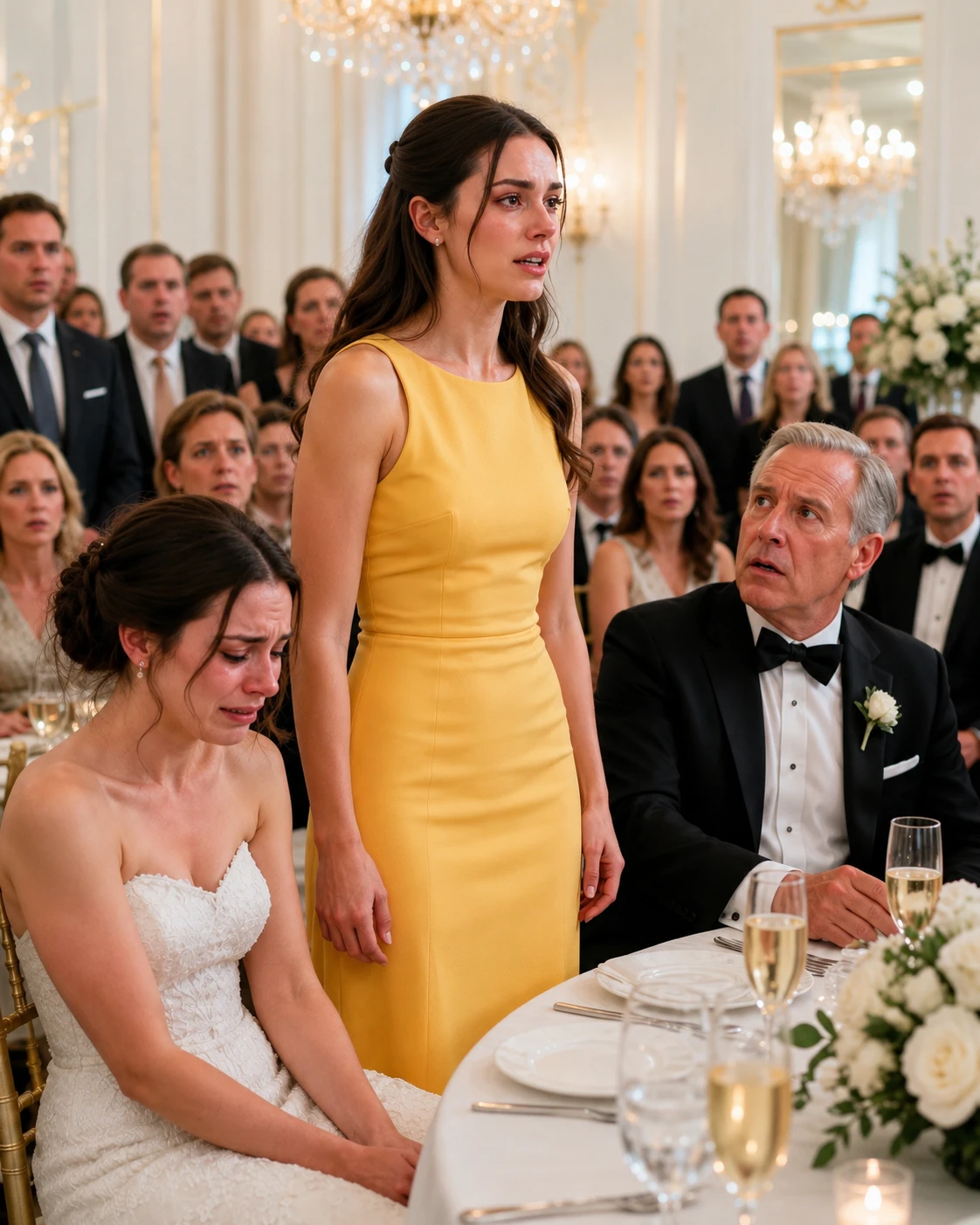
During the reception, Richard rose with a crystal glass in his hand.
The room quieted instantly.
He praised Daniel.
Welcomed Grace.
Thanked the guests.
Then his eyes found me.
“And of course,” he said smoothly, “we must acknowledge Victoria, the sister who raised our beautiful bride.”
A polite murmur passed through the room.
Grace’s smile faded.
Richard continued.
“A remarkable story, really. Such humble beginnings.”
A few people laughed nervously.
My fingers tightened around my napkin.
“Every family needs someone,” he added, “to remind them where they came from.”
The laughter died.
Daniel stood halfway from his chair.
Grace whispered, “Please don’t.”
But Richard was enjoying himself now.
He looked me up and down, his smile sharpening.
“When Daniel first described you, Victoria, I imagined someone a little less… prominent.”
The ballroom froze.
Forks stopped.
Glasses lowered.
Hundreds of eyes turned toward me.
He wanted me embarrassed.
Small.
Grateful to have been allowed inside.
For one long second, I saw every night I had gone hungry so Grace could eat.
Every birthday I had worked through.
Every sacrifice no one in that room knew.
Then I slowly stood.
The chair scraped against the marble like a warning.
Richard’s smile twitched.
I looked straight at him.
“Mr. Montgomery,” I said calmly, “do you have any idea who you’re talking to?”
The color drained from his face.
Because ten years ago, before he became the powerful Richard Montgomery everyone feared, he had signed one document.
A document with my name on it.
And if I opened the envelope inside my purse, his entire empire would begin to collapse.
PART 2
Richard Montgomery’s face went pale before the room understood why.
I reached into my purse slowly, and his hand tightened around the crystal glass until it trembled.
“Victoria,” he said, his voice suddenly thin, “this is neither the time nor the place.”
I smiled, but there was no warmth in it.
“You chose the place, Mr. Montgomery. You chose the audience.”
Grace stood frozen beside Daniel, her bouquet shaking in her hands.
Daniel looked from his father to me, confusion turning into alarm.
“What document?” he asked.
Richard didn’t answer.
So I did.
“Ten years ago, your father bought a struggling diner outside Nashville. Quietly. Through a shell company.”
A murmur rippled across the ballroom.
Richard’s jaw clenched.
“He didn’t buy it for business,” I continued. “He bought it because the owner had evidence that could ruin him.”
The old man took one step toward me.
“Enough.”
But I had survived worse men than him.
I opened the envelope and pulled out a yellowed agreement, its edges soft from years hidden beneath floorboards, then bank vaults, then finally my purse tonight.
“My boss was dying,” I said. “He had no family. He trusted me. Before he passed, he gave me this.”
Daniel’s face hardened.
“What is it?”
I looked at Grace, and my voice softened.
“It is proof that Richard Montgomery paid off a woman named Eleanor Hayes to disappear after she gave birth.”
The ballroom went silent.
Grace’s lips parted.
Daniel went still.
Richard whispered, “You don’t know what you’re doing.”
“I know exactly what I’m doing,” I said.
Then I turned to Daniel.
“Ask your father why your mother never held your birth certificate. Ask him why Eleanor Hayes’ name was erased from every record.”
Daniel’s face drained of color.
Richard backed away, but his wife, seated near the head table, suddenly stood.
Her hand flew to her mouth.
“No,” she breathed. “Richard… tell me that isn’t true.”
Before he could speak, Grace looked down at the document in my hand.
Then she gasped.
Because beneath Eleanor Hayes’ signature was another name.
A witness.
My mother’s.
PART 3 — END PART: The Ghost at the Wedding Door**
**My father stood beneath a chandelier worth more than every home we had ever lost, holding a black drive like it weighed more than his own sins.**
For years, I had imagined what I would say if Thomas Bennett ever came back.
I imagined anger.
I imagined screaming.
I imagined asking him why nine-year-old Grace had waited by the window until midnight, hugging her backpack because she thought if she stayed ready, someone would come take her home.
But when he stood there, thin and shaking, all I felt was cold.
“Don’t call me Vicky,” I said.
He flinched.
Grace stepped behind Daniel, her wedding dress brushing the marble. “What do you mean, what he did to Mom?”
Richard Montgomery moved first.
Not toward my father.
Toward the black drive.
Daniel blocked him.
For the first time in his life, Richard looked at his son as if Daniel were a stranger.
“Move,” Richard said.
“No,” Daniel replied.
The room held its breath.
My father lifted the drive. **“Everything is on this. Recordings. Bank transfers. Letters. The trust documents Richard buried. And the messages from your mother.”**
My throat closed.
“Messages?” Grace whispered.
Thomas nodded, tears gathering in his tired eyes. “She tried to reach you.”
“No,” I said immediately. “No, she didn’t.”
Because if she had tried, then every birthday without a card had a different meaning.
Every silent Christmas.
Every empty mailbox.
Every year I taught myself not to hope.
Thomas looked at me with a pain I did not want from him. “Richard’s people intercepted them.”
Richard laughed once, sharp and ugly. “This is pathetic.”
Eleanor Whitcomb stepped forward. “Then you won’t mind if we play it.”
Richard’s hand tightened around the table edge.
That was answer enough.
Eleanor took the drive from my father and handed it to one of her assistants. Within minutes, a screen near the ballroom’s stage flickered on. The guests, who had come to watch a wedding toast, now watched the fall of a dynasty.
The first file opened.
My mother’s voice filled the room.
“Victoria, sweetheart, I don’t know if you’ll ever hear this. Richard Montgomery says if I contact you, he’ll make sure the debt collectors come after you both. He says Thomas signed papers I don’t understand. I’m trying to fix this. Please tell Grace I didn’t forget her birthday. Please tell her I love her.”
Grace made a sound that broke something inside me.
Another recording played.
Richard’s voice.
Calm. Smooth. Merciless.
“Marianne, your daughters are better off if you stay quiet. You made your choices. Thomas made his. Do not drag those girls into court unless you want their lives examined by every creditor in Tennessee.”
My mother sobbed on the recording. “They’re children.”
“And children need stability,” Richard said. “Something you and your husband failed to provide.”
The file ended.
The ballroom had become a grave.
Richard looked around, but his kingdom had changed shape. The same men who once laughed at his jokes now avoided his eyes. The women who had praised his taste now whispered behind jeweled hands.
Grace turned to me, trembling. “Vicky…”
This time, I didn’t correct her.
Because when she said my childhood name, I heard the little girl who used to crawl into my bed during storms.
My father spoke again. “Your mother remarried, yes. She was ashamed. She thought if she became someone respectable, she could fight for you from the outside. But Richard kept threatening her. Then Paul—her new husband—got sick, and she had no money left to fight anyone.”
I stared at him. “And you? Where were you?”
His face collapsed.
“Running,” he said. “Like always.”
At least he did not lie.
Then Richard’s voice cut through the room.
“You all enjoy this performance?” he asked, spreading his arms. “A failed father, a bitter daughter, a runaway mother. And you want to blame me for your family’s rot?”
I stepped toward him.
“No,” I said. **“I blame you for seeing the rot and deciding to profit from it.”**
For the first time that night, he had no answer.
—
## **PART 4 — The Mother Who Wasn’t Gone**
Eleanor’s assistant clicked another file.
This one was video.
The screen showed a woman sitting at a kitchen table, older than my memories, thinner than the photographs I had hated. Her hair was streaked with silver. Her hands shook around a mug.
My mother.
Marianne Bennett.
Grace covered her mouth with both hands.
The video had been recorded only three months earlier.
“Victoria,” my mother said on the screen, “I don’t deserve forgiveness. I know that. I left before Richard ever threatened me. That part is mine. I was tired, selfish, scared, and I let you become the adult I was supposed to be.”
Tears blurred my vision, but I refused to look away.
“But when I tried to come back,” she continued, “Richard’s lawyers showed me papers saying Thomas had sold the archives, taken an advance, and named me responsible for family debts. They said if I challenged him, the court could take Grace from you. They knew that was the only threat that would silence me.”
Grace whispered, “No…”
My mother’s voice cracked.
“I watched you from far away. Graduation photos. Newspaper clippings. A picture of Grace at the science fair. I sent money twice. It came back. I sent letters. They disappeared. I told myself staying away was protecting you, but the truth is, I was afraid you would look at me and see exactly what I was.”
She swallowed hard.
“A mother who failed.”
The video ended.
No one spoke.
Then Grace turned slowly to Thomas. “Where is she?”
My father’s eyes shifted toward the ballroom doors.
“She’s outside.”
My heart kicked once.
Hard.
“No,” I said.
But Grace was already moving.
Daniel followed her, then me, then Eleanor, then half the room like the wedding had become a procession.
Outside, the night air was heavy with jasmine and rain. Beyond the glowing entrance, near the line of black cars, stood a woman in a plain blue dress.
My mother.
Not smiling.
Not posing.
Just waiting.
Grace stopped ten feet from her.
For a moment, mother and daughter stared at each other across ten stolen years.
Then Grace ran.
My mother caught her and folded around her, both of them crying so hard their bodies shook.
I stood frozen.
Thomas moved beside me. “She wanted to come sooner.”
“Don’t,” I said.
He nodded and stepped back.
My mother looked over Grace’s shoulder at me.
“Victoria,” she said.
That one word nearly ruined me.
I wanted to be cruel. I wanted to ask whether she knew how many nights I had held Grace while she cried for her. I wanted to list every bill, every fear, every birthday candle I could barely afford.
Instead, I said, “You left me.”
She nodded, tears streaming down her face. “Yes.”
“You left me with a child.”
“Yes.”
“You let me believe I wasn’t worth coming back for.”
Her face crumpled.
“Yes.”
That honesty hurt more than denial.
She stepped closer but did not touch me. **“I cannot ask you to forgive me tonight. I only came because Thomas found proof, and because you deserved the truth before Richard buried it again.”**
Behind us, Richard appeared at the doorway, surrounded by silence.
He looked at my mother and smiled faintly.
“You always were dramatic, Marianne.”
My mother’s fear flashed across her face.
Then Grace turned around in her wedding dress, tears on her cheeks, Daniel’s hand in hers.
“Don’t speak to my mother.”
Richard laughed. “Your mother abandoned you.”
Grace’s voice shook, but it did not break.
“And you used that abandonment like a weapon.”
Daniel looked at his father with an expression I had never seen before.
Grief.
Not for Richard.
For the father he had thought he had.
“Dad,” Daniel said, “go inside. Say nothing else.”
Richard’s eyes narrowed. “You forget who you are talking to.”
Daniel straightened.
“No. I finally remember.”
—
## **PART 5 — The Empire’s Last Lie**
By midnight, the wedding estate looked less like a celebration and more like a courthouse without walls.
Board members whispered in corners. Guests vanished into cars. Richard’s lawyers arrived with tight faces and expensive shoes. Eleanor stood in the middle of them like a blade.
But Richard Montgomery had one final card.
And he played it in front of everyone.
“You think you’ve won?” he said to me. “You think paperwork and tears make you an owner?”
He turned to the board members.
“Ask her what she signed five years ago.”
Eleanor went still.
I felt the floor shift beneath me.
Richard smiled. “Yes, Victoria. Tell them.”
Grace looked at me. “What is he talking about?”
My chest tightened.
Five years ago, when Eleanor first found me, we had no money to fight. No firm would take us without security. No bank would lend to a waitress with old patents and a folder of ghosts.
So I had done the only thing I could.
“I placed my claim into a trust,” I said.
Richard’s smile widened. “Not just any trust.”
Eleanor closed her folder softly.
I looked at Grace.
“For you,” I whispered.
Her eyes widened.
“What?”
**“On your eighteenth birthday, I signed the beneficial interest of the Bennett claim into a protected trust in your name.”**
Grace stared at me as if I had spoken another language.
Richard’s smile vanished.
He had expected shame.
Instead, he had handed me the truth.
I turned to the room. “Everything Richard stole from the Bennett family legally belongs to the Bennett Family Restoration Trust. Grace is the primary beneficiary.”
Daniel slowly looked at his bride.
Grace stood in the moonlight, mascara streaked, wedding gown wrinkled, holding a power no one had prepared her for.
The poor girl Richard thought he was welcoming into his family had just become the one person who could break it open.
Richard’s voice dropped. “You stupid girl. You put a fortune into the hands of a child?”
I stepped closer.
“No,” I said. **“I put it into the hands of the person I spent my life protecting.”**
Grace shook her head, overwhelmed. “Vicky, why would you do that?”
“Because everything I fought for was never just mine.”
Her lips trembled.
Daniel laughed once under his breath, not with humor, but disbelief. “Dad… you humiliated the woman who handed your daughter-in-law your empire’s throat.”
Richard snapped, “Do not speak to me like that.”
Daniel’s answer was quiet.
“I’m done speaking to you like a son begging for approval.”
That wounded Richard more than the lawsuit.
For one second, he looked old.
Then he reached into his jacket and pulled out his phone. “You will regret this.”
Eleanor’s assistant stepped forward. “Mr. Montgomery, before you make any calls, you should know the court order includes preservation notices. Any attempt to move, destroy, or conceal relevant records after 4:02 p.m. may be treated as obstruction.”
Richard’s hand froze.
Grace stepped toward him.
For the first time all night, she spoke not as a bride, not as a daughter-in-law, not as my little sister.
She spoke as herself.
“You looked at my sister like she was dirt,” Grace said. “But she was the ground under my feet.”
Richard’s jaw worked, but no words came.
Then Grace asked one question.
**“How much does a stolen childhood cost?”**
No one breathed.
Even Eleanor’s eyes shone.
Richard looked away first.
—
## **PART 6 — The Price of Silence**
The next six weeks became a storm.
Not the kind with thunder.
The kind with headlines.
**MONTGOMERY INDUSTRIAL FACES PATENT FRAUD CLAIM.**
**BILLIONAIRE PATRIARCH ACCUSED OF CONCEALING TRUST FOR ABANDONED SISTERS.**
**FORMER CHIEF COUNSEL RETURNS AS WHISTLEBLOWER ATTORNEY.**
Richard denied everything, of course.
He called us opportunists.
He called my father unreliable.
He called my mother unstable.
He called me vindictive.
But he never called the documents fake.
That was the first thing people noticed.
The second was that Eleanor had been building the case for years. Quietly. Patiently. She had copied records before leaving Montgomery Industries. She had found engineers who remembered the Bennett mechanism. She had traced shell companies designed to hide profits.
And the third thing people noticed was Daniel.
He did not stand beside his father.
He stood beside his wife.
Every morning, cameras crowded outside Grace and Daniel’s apartment. Every night, Grace cried in my kitchen, wearing sweatpants instead of silk, trying to understand how her wedding had turned into a war.
“I feel guilty,” she admitted one evening.
“For what?”
“For being happy with Daniel while his family hurt us.”
I took her hand.
“Daniel didn’t hurt us.”
“I know. But Richard is his father.”
I looked across the room where Daniel was washing dishes beside Thomas, both men silent and awkward, neither knowing what to do with the other.
“Sometimes,” I said, “family is not who made you. It’s who refuses to leave when the truth gets ugly.”
Grace leaned her head on my shoulder.
My mother came over twice a week.
At first, I hated how carefully she moved through my apartment, as if every chair belonged to a judge. She never asked for affection. She never defended herself. She brought groceries, folded laundry, and cried only when she thought no one saw.
One night, I found her standing in front of the old school photo of Grace and me.
I was twenty-two in the picture, wearing my diner uniform. Grace was nine, missing two front teeth, smiling like I had hung the moon.
My mother touched the frame.
“You look so tired,” she whispered.
“I was.”
“I should have been there.”
“Yes.”
She nodded.
Then she said the words I had needed for ten years.
**“You were a better mother to her than I was.”**
I thought that would satisfy me.
It didn’t.
It only made me sad.
Because I had not wanted to be a better mother.
I had wanted to be a sister.
The settlement conference happened in a federal building on a rainy Monday.
Richard arrived in a black suit, surrounded by attorneys.
Grace sat beside Eleanor.
Daniel sat beside Grace.
I sat across from Richard.
My father and mother waited outside.
For hours, lawyers argued numbers so large they stopped sounding real. Back royalties. Penalties. Trust damages. Ownership interest. Licensing rights.
Richard said almost nothing.
Until Eleanor placed one final document on the table.
It was not from my grandfather.
It was not from my father.
It was from Daniel.
Richard read the first page and went rigid.
Daniel’s voice was steady. “I signed a statement confirming you knew about the Bennett claim before Grace and I ever married.”
Richard looked up slowly. “You betrayed me.”
Daniel swallowed.
“No. I told the truth.”
Richard stared at his son, and for one breath, I saw something human in him.
Pain.
Then it disappeared.
“You were always too soft,” Richard said.
Daniel nodded, eyes wet.
“Maybe. But I can still sleep.”
That ended it.
By evening, Richard Montgomery agreed to resign from executive control of Montgomery Industrial, surrender disputed assets, fund the Bennett trust, and submit to an independent review.
But the biggest shock came last.
Eleanor slid a pen toward Grace.
“Ms. Bennett-Montgomery,” she said, “the board has agreed to create a new voting seat representing the Bennett trust.”
Grace blinked. “Me?”
Eleanor smiled.
“You asked what a stolen childhood costs. Apparently, the answer begins with a seat at the table.”
—
## **PART 7 — The Wedding That Finally Happened**
Grace refused to let the first wedding be the only memory.
Three months later, she and Daniel married again.
Not at an estate.
Not under chandeliers.
At sunrise, in the small garden behind the Nashville diner where I had worked most of my twenties.
The owner cried when Grace asked.
“We can’t afford fancy,” Grace said.
Daniel smiled. “Good. Fancy went badly.”
So we hung white lights across the fence. My mother baked lemon cakes until midnight. Thomas fixed the broken garden gate with hands that still remembered machines. Eleanor arrived in a navy dress and scared the florist into delivering early without raising her voice.
Grace wore a simple white dress.
Daniel wore a gray suit.
I walked Grace down the aisle.
Halfway there, she stopped.
“What?” I whispered.
She looked at me, tears shining.
“I need to say something.”
The guests quieted.
Grace turned to everyone.
“When I was little, I thought family meant the people who were supposed to stay,” she said. “Then people left. And Victoria stayed. She packed my lunches. She scared off landlords. She made birthday cakes from boxed mix and pretended they were fancy. She gave me every good thing she had, even when she had almost nothing.”
My vision blurred.
Grace took my hand.
**“So before I become Daniel’s wife again, I want everyone to know I became myself because Victoria Bennett refused to let me disappear.”**
I broke.
Not beautifully.
Not quietly.
I cried like the twenty-two-year-old girl I had never been allowed to remain.
Daniel hugged me first.
Then Grace.
Then, after a long hesitation, my mother stepped forward.
She did not ask.
She waited.
And for the first time in ten years, I let her hold me.
It was not forgiveness.
Not fully.
But it was a beginning.
During the vows, Daniel looked at Grace with such tenderness that even Eleanor dabbed her eyes.
“I cannot promise my family will never hurt you,” he said. “But I promise I will never hide behind their name. I choose you. In truth. In ordinary days. In hard ones. In every room where you need someone beside you.”
Grace smiled through tears.
“I choose you too,” she said. “But you still have to wash dishes.”
Everyone laughed.
It was the first honest laughter we had heard in months.
After the ceremony, Thomas approached me near the old diner sign.
“I’m leaving tomorrow,” he said.
I stiffened. “Running again?”
“No,” he said softly. “Rehab program in Knoxville. Work placement after that. Eleanor helped arrange it.”
I looked at him for a long time.
He looked smaller than my anger.
“I can’t promise I’ll be proud of you,” I said.
He nodded.
“But I hope you become someone Grace can visit without hurting.”
His eyes filled.
“That’s more than I deserve.”
“Yes,” I said. “It is.”
Then he smiled faintly.
“Your grandfather would have liked you.”
For some reason, that nearly undid me.
—
## **PART 8 — The Question That Built a New Life**
One year later, I walked into Montgomery Industrial’s glass headquarters wearing a navy suit I bought with money I had earned, not borrowed, not begged for, not stolen.
People turned when I passed.
Not because I looked poor.
Not because I looked out of place.
Because they knew my name.
**Victoria Elaine Bennett.**
Shareholder representative.
Founder of the Bennett Restoration Fund.
The woman Richard Montgomery had tried to humiliate at a wedding and accidentally introduced to the world.
Richard was gone from the company by then. Not ruined in the way fairy tales demand. Men like Richard rarely vanish completely. But he had lost the thing he loved most.
Control.
His portrait had been removed from the lobby.
In its place hung a black-and-white photograph of my grandfather’s original workshop in Tennessee.
Bennett Machine.
The first board meeting under the new structure was crowded. Lawyers lined the walls. Executives sat stiffly around the table.
Grace sat at the head.
That had been her surprise.
Not mine.
After months of training, studying, and refusing to be treated like a decorative heiress, Grace had accepted the Bennett trust’s voting seat.
Daniel sat behind her, proud and quiet.
Eleanor sat beside me.
My mother watched from the back row.
Thomas watched through a video call from Knoxville, wearing a clean shirt and the nervous expression of a man rebuilding himself one honest day at a time.
Grace opened a folder.
“I have reviewed the proposed payout,” she said. “The numbers are acceptable.”
The CFO relaxed.
Then Grace smiled.
“But money alone does not restore what was taken.”
The room went still.
She looked at me.
I nodded.
Grace continued. “The Bennett trust will accept the settlement on one condition. Montgomery Industrial will establish a permanent scholarship and housing fund for young adults raising siblings, caring for family members, or aging out of support systems.”
The CFO blinked. “That was not in the draft.”
“No,” Grace said. “It is in the future.”
A board member cleared his throat. “And if the board declines?”
Grace folded her hands.
Then she asked the question that made the room remember exactly whose granddaughter she was.
**“Would you prefer the public trial?”**
The vote was unanimous.
That evening, we returned to the diner garden where Grace and Daniel had remarried. The lemon tree my mother planted had started to bloom. The air smelled sweet and clean.
Grace leaned against my shoulder.
“Do you ever miss who you might have been?” she asked.
I thought about the girl I lost at twenty-two.
The one who might have gone to college, fallen in love without fear, slept late on Sundays, bought herself shoes without checking the bank account first.
“Yes,” I said. “Sometimes.”
Grace’s face fell.
I squeezed her hand.
“But I like who survived.”
Across the garden, Daniel was helping my mother hang lights. Thomas was telling the diner owner how to fix the ice machine. Eleanor was arguing with a caterer on the phone like national security depended on appetizers.
And then Grace laughed.
Not politely.
Not carefully.
The laugh of a woman who had made it out.
The laugh of a girl who had finally stopped waiting by windows.
A car pulled up near the curb.
For one wild second, every old fear in me woke.
Then the door opened, and a little girl stepped out with a backpack bouncing against her shoulders. She was eight, maybe nine, with wary eyes and shoes too small.
Behind her stood a social worker.
Grace looked at me, confused.
The woman approached. “Victoria Bennett?”
“Yes?”
She smiled gently. “This is Lily. Her older brother just turned twenty-one. He’s raising her alone. Your new foundation approved their housing grant this morning. Lily asked to meet the person who made it happen.”
The little girl stepped forward.
“Are you Miss Victoria?”
My throat tightened.
“I am.”
She studied me. “My brother says you helped us keep our apartment.”
I knelt so we were eye level.
“I had some help.”
She looked past me at Grace, Daniel, my mother, Thomas, Eleanor, the glowing garden, the diner that had once held every fear I owned.
Then she said, “He says now I don’t have to change schools.”
That was the moment.
Not the courtroom.
Not the headlines.
Not Richard’s pale face under the chandeliers.
This.
**A child with a backpack, standing in a garden, getting to stay.**
Grace knelt beside me and smiled at Lily.
“I know someone who is very good at school lunches,” she said.
Lily looked at me.
“Is it you?”
Grace laughed. “It is definitely her.”
I wiped my eyes.
For years, I thought justice would feel like watching Richard Montgomery lose everything.
But justice was quieter than that.
It was Grace happy.
It was Daniel free.
It was my mother trying.
It was my father staying.
It was a child who would not have to learn silence before she learned algebra.
And it was me, finally understanding that my life had not only been a story of what was stolen.
It was also a story of what I built with the pieces.
That night, under the white lights, Grace raised a glass of cheap sparkling cider.
“To Victoria,” she said.
Everyone turned toward me.
I shook my head. “No. To us.”
Grace smiled.
“To us,” she agreed.
And for the first time since I was twenty-two, I believed the future was not a bill waiting on the table.
It was an open door.
**The End.**