The expression on her face made my stomach drop.
Because I knew whatever she was about to say next would change my life forever.
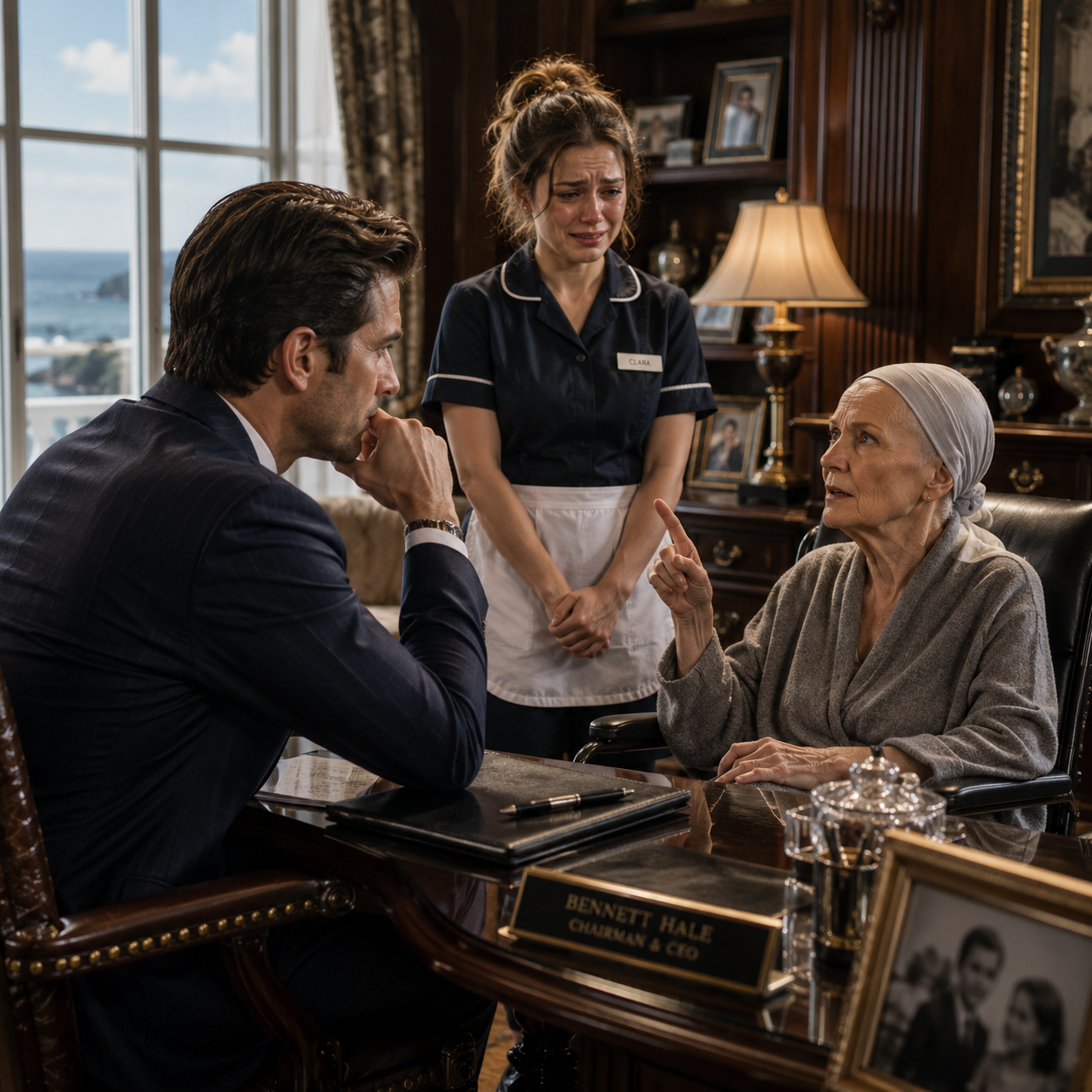
My mother’s fingers tightened around the armrest of her wheelchair. For a moment, the sharpness in her eyes faded, and I saw what the illness had done to her. Not just to her body. To her pride. To the woman who had once walked into boardrooms with my father and left seasoned investors stumbling over their own words.
She looked small now beneath the soft cashmere blanket Clara had tucked across her knees.
But her voice was steady.
“Do you remember the blue teacups?”
The question was so unexpected that I almost frowned.
“The what?”
“The blue teacups,” she repeated. “The ones with the gold rim. Your grandmother’s.”
I shifted uncomfortably. “I remember them.”
“No, you don’t,” she said quietly. “You remember seeing them in the china cabinet. You don’t remember what they meant.”
Clara stood near the door, hands clasped in front of her, looking like she wanted to disappear into the wall. The nurse had paused behind my mother’s chair, uncertain whether to continue rolling her out.
My mother raised one hand. “Leave us, please.”
The nurse glanced at me.
I nodded.
Clara turned to go with her, but my mother’s voice stopped her.
“Not you.”
Clara froze.
Something passed between them then. Not words. Not even a glance I fully understood. A thread of trust. Familiarity. Something deep enough to make my chest tighten with a feeling I could not name.
When the nurse closed the door, the office seemed larger than before. Colder, too.
My mother looked at me.
“When you were little,” she said, “your father worked late most nights. Do you remember?”
I gave a short, humorless laugh. “That’s putting it mildly.”
“He believed he was building something for you.”
“He built an empire and missed half my childhood.”
Her expression softened, but not with agreement. With sadness.
“Yes,” she said. “And then you grew up and did the same thing.”
The words landed too cleanly for me to defend against them.
I looked away, toward the floor-to-ceiling windows that faced the Atlantic. The ocean was steel gray that morning, the waves rolling under a sky that seemed ready to split open. I had always liked this view because it made everything feel controlled from a distance. Wildness reduced to scenery. Storms safely behind glass.
“I’m here now,” I said.
My mother gave me a tired smile. “Are you?”
I had no answer.
She leaned back, catching her breath. Clara moved instinctively, taking the glass of water from the side table and holding it out. My mother accepted it without looking, as if she knew exactly where Clara would be.
That small gesture disturbed me more than I wanted to admit.
How many routines existed in this house that had nothing to do with me?
How many comforts?
How many sorrows?
My mother drank slowly, then set the glass down.
“The blue teacups,” she said again, “belonged to my mother. She was not a wealthy woman. There were only three cups left from a set of six. One had a crack. One had a stain that never washed out. One was perfect.”
She paused.
“When your father and I were first married, I used to serve tea in them whenever someone came to the house upset. Neighbors. Friends. Your aunt, after her first miscarriage. Your father, when his first company almost failed. You, when you were seven and convinced the world had ended because a boy at school called you strange.”
I remembered that.
Not clearly, but in fragments.
A rainy afternoon. My mother’s hand smoothing my hair. Steam rising between us. Her telling me that strange people often saw the world before everyone else did.
“You told me I was special,” I murmured.
“I told you that you were loved,” she corrected gently. “You heard special because that is what you wanted to hear.”
My mouth went dry.
My mother looked at Clara then.
“Clara found those teacups in the back pantry. Do you know where they were?”
“No.”
“In a box marked miscellaneous.”
I had no memory of that box. No memory of packing it away. No memory of deciding those cups were no longer worth space in a cabinet.
But I knew I must have done it.
After my father died, I had renovated the mansion from top to bottom. New kitchen. New staff quarters. New security systems. New art. I had wanted the house to feel modern, efficient, free of grief.
Apparently, I had removed its heart and labeled it miscellaneous.
“Clara cleaned them,” my mother said. “She brings me ginger tea in one every afternoon.”
Clara’s cheeks colored.
“It was nothing,” she said softly.
My mother snapped her eyes toward her. “Don’t you dare make yourself smaller in this room.”
Clara lowered her gaze, but I saw the flicker of emotion across her face.
My mother turned back to me.
“People show you who they are by what they notice, Bennett. Clara noticed the cups. She noticed I stopped eating peaches but still liked the smell of them. She noticed I kept turning my wedding ring when I was in pain. She noticed the nurse said my chart was stable when I was holding back tears.”
She swallowed.
“You did not notice I was lonely.”
The silence that followed was worse than anger.
For most of my adult life, I had built a reputation on anticipating needs. Investors called me precise. Rivals called me obsessive. My companies operated because I could see weakness before it became collapse.
But in my own house, my mother had been disappearing in plain sight.
“I didn’t know,” I said.
The sentence sounded pathetic even before it left my mouth.
My mother closed her eyes briefly. “No. You didn’t ask.”
Clara shifted slightly, uncomfortable now. “Mrs. Hale, maybe—”
“No.” My mother opened her eyes again. “No, Clara. He needs to hear it while I still have enough breath to say it.”
The bluntness of that sentence struck me hard.
While I still have enough breath.
The office blurred at the edges. I gripped the side of my desk.
“I’m trying,” I said, though it came out rough.
My mother studied me for a long moment. Then the hardness in her face loosened.
“I know,” she whispered. “That may be what hurts most.”
There it was.
Not condemnation.
Grief.
It moved through the room slowly, like a tide.
Clara looked down, blinking fast.
My mother reached for her hand. Clara went to her immediately.
“Bennett,” my mother said, “Clara is not just a housekeeper to me.”
I looked from my mother to Clara.
Clara’s face changed. A flash of alarm. Then pain.
“What does that mean?” I asked.
My mother did not answer at once. Instead, she drew in a careful breath, one that seemed to cost her.
“It means there are things I should have told you years ago. Things I delayed because I thought there would be a better time. Then the better time became next month. Then next month became after treatment. Then after treatment became…” She glanced toward the blanket over her knees. “This.”
My heart began to beat harder.
Clara pulled her hand back gently.
“Mrs. Hale,” she whispered, “you don’t have to do this today.”
“Yes,” my mother said. “I do.”
I stared at them both.
“What am I missing?”
My mother’s eyes fixed on mine.
“Everything that matters, apparently.”
Before I could respond, she turned her wheelchair slightly toward the window. The gray light touched her face, revealing the fine lines at the corners of her mouth, the soft hollows beneath her cheekbones.
“I want the garden room opened again,” she said.
The abrupt change threw me.
“The garden room?”
“Yes.”
“It’s been closed for years.”
“Then open it.”
“That wing has storage, old furniture, things from before the renovation. It isn’t suitable for you.”
My mother gave me a look I recognized from childhood, the one that meant I had said something foolish and she was considering whether it deserved correction.
“I am dying, Bennett. I am not hosting a gala.”
The sentence should have hurt.
It did.
But it also made Clara bite the inside of her cheek as though fighting a smile. My mother noticed and smiled too.
For the second time in twenty-four hours, I saw the version of Eleanor Hale that had raised me. Not the patient. Not the fragile figure in medical updates. My mother.
“What’s in the garden room?” I asked.
“Sunlight in the morning. The sound of rain on the glass roof. A view of the hydrangeas your father planted badly and insisted were thriving.”
Despite myself, I remembered those hydrangeas.
My father had planted them one spring with the confidence of a man who had never read instructions. Half had wilted. My mother had refused to let the gardener fix them for months because, as she said, failure was entitled to bloom too.
“I want to sit there,” she said. “With tea. With Clara. And perhaps, if he can spare an hour from ruling the world, with my son.”
I looked at Clara.
She looked away.
“I’ll have it opened,” I said.
“Not by a crew,” my mother replied. “By you.”
I blinked. “Me?”
“You know where the keys are?”
“No.”
“Exactly.”
She turned the wheelchair toward the door. This time, she did not wait for the nurse. Clara stepped behind her naturally, releasing the brake with practiced ease.
At the threshold, my mother glanced back.
“And Bennett?”
My stomach tightened again.
“Yes?”
“Find the third teacup.”
Then she left.
For a long moment, I stood alone in the center of my office while the ocean threw itself again and again against the shore.
Find the third teacup.
It was ridiculous.
It was impossible.
It was clearly not about a teacup.
And for the first time in years, I had no idea what to do.
That afternoon, I canceled three calls, ignored eleven emails, and walked into the west wing of the mansion for the first time in nearly a decade.
The hallway was colder than the rest of the house. Not physically, though the air did have a damp chill to it. It was the kind of cold that comes from abandonment. Dust lay along the baseboards. White sheets covered furniture shapes like sleeping ghosts. The lights flickered when I turned them on.
The west wing had been my mother’s favorite part of the estate when I was young. Back then, it smelled like lemon oil, earth after rain, and whatever flowers she had cut that morning. After my father died, she stopped going there. I assumed it hurt too much.
Or perhaps I had not asked.
The garden room doors were at the end of the hall, tall and arched, painted a green so dark it looked almost black in the dim light. I tried the handles.
Locked.
Of course.
I checked the drawer in the old sideboard nearby. Empty except for a stack of yellowed place cards from some dinner party I did not remember. I checked a porcelain bowl on the console table, then behind framed photographs, then beneath the rug because that was the sort of thing people did in old movies.
Nothing.
I was about to call the estate manager when I stopped.
Not by a crew.
By you.
My mother knew exactly how to make humiliation feel like instruction.
I went downstairs to the pantry.
Clara was there, arranging a tray with tea, sliced pears, and a tiny vase of white flowers. She turned when I entered, surprise flashing across her face.
“Mr. Hale.”
“Where are the keys to the garden room?”
Her eyes moved toward the tray.
“I don’t know.”
“You hesitated.”
“I was thinking.”
“You know.”
“I know where Mrs. Hale keeps some old keys,” she admitted.
“Show me.”
She glanced past me toward the hall. “She’s waiting for her tea.”
“I’ll take it.”
That startled her more than anything I had said that day.
“You?”
“Yes, me.”
“The tray is heavy.”
“I own four companies and a helicopter.”
“That doesn’t make you good with hot liquids.”
I stared at her.
Then I laughed.
It came out rusty and unexpected, like something pulled from storage and not properly dusted.
Clara seemed startled by it too. She lowered her gaze quickly, but the corner of her mouth moved.
“I’ll carry the tray,” she said. “You can carry the keys.”
She crossed to a cabinet near the back of the pantry, opened a tin marked shortbread, and lifted out a ring of old brass keys.
“My mother keeps keys in a cookie tin?” I asked.
“Your mother keeps emergency chocolate in a medical supply drawer,” Clara said. “She is not predictable.”
Again, that thread between them.
Not just caregiver and patient.
Not just employer and employee.
I followed Clara upstairs, carrying the keys like some awkward offering.
My mother was in bed now, propped against pillows. A pale blue scarf covered her head. When she saw me enter behind Clara, her eyebrows rose.
“Well,” she said, “look at that. The master of the house has discovered stairs.”
“I’ve always known where the stairs are.”
“Knowing and using are not the same thing.”
Clara set the tray on the small table beside her. My mother’s eyes immediately went to the cup.
Blue porcelain.
Gold rim.
A hairline crack near the handle.
I sat in the chair beside the bed because there did not seem to be anywhere else to stand that didn’t make me feel like a visitor.
Clara poured the tea. Ginger, honey, lemon. The fragrance filled the room.
My mother took the cup in both hands and closed her eyes for a moment before drinking.
It occurred to me then that I had spent tens of thousands of dollars on nutrition consultants and had no idea what tea brought her comfort.
“Did you find the keys?” she asked.
“Clara did.”
“Of course she did.”
“Mother.”
She opened one eye.
“What is really in the garden room?”
“Dust, probably.”
“Why do you want it opened?”
“Because I want one room in this house that does not smell like antiseptic or ambition.”
I looked down at the key ring.
“And the third teacup?”
Her expression changed.
Clara noticed first. She always seemed to notice first.
“I should check the laundry,” Clara said.
“No,” my mother said.
Clara stopped.
My mother set the cup down. Her hands trembled slightly, and I hated that I had noticed too late how often that happened.
“The third teacup,” she said, “was perfect. Your grandmother saved it for guests she wanted to impress. I hated that. I always used the cracked one because it reminded me that beautiful things can survive damage.”
She looked at me.
“The perfect cup disappeared the summer you were thirteen.”
I tried to remember that summer. There had been camps, tutors, sailing lessons, my father traveling constantly, my mother quieter than usual.
“I don’t remember.”
“I know.”
The way she said it made my pulse quicken.
“Why should I?”
“Because that was the summer Clara’s mother lived in this house.”
Clara went very still.
I turned toward her slowly.
“Your mother?”
She looked at my mother, and for once, the courage I had seen in her seemed to waver.
“My mother worked here,” Clara said softly. “A long time ago.”
The room shifted around me.
“What was her name?”
“Marian Reed.”
The name brushed against something buried in my memory.
Marian.
A woman with dark hair pinned low. A quiet laugh. Flour on her apron. Hands that smelled faintly of vanilla. A song hummed in the kitchen. Someone who gave me cinnamon toast when my parents argued.
I gripped the key ring.
“She was the cook,” I said.
Clara nodded.
Not just a housekeeper.
The daughter of someone who had known this family before marble counters and private nurses and automated reports. Before I had learned to treat every human relationship like an operational category.
“I remember her,” I said.
Clara’s eyes lifted to mine.
For a fraction of a second, something hopeful appeared there.
Then it vanished.
“She remembered you too,” she said.
The words were not accusing. That made them worse.
“What happened to her?”
Clara looked down.
My mother answered.
“She left.”
“That’s not an answer.”
“No,” my mother agreed. “It isn’t.”
The air changed again. This time, even the machines beside my mother’s bed seemed louder.
Clara’s hand tightened around the edge of the tray.
“My mother died four years ago,” she said. “Before that, she was sick for a long time.”
“I’m sorry,” I said.
She nodded once.
I had said those words thousands of times in business settings. Sorry for your loss. Sorry for the delay. Sorry we couldn’t make the numbers work. But standing there in my mother’s room, looking at the daughter of a woman who had once fed me cinnamon toast, I felt the thinness of the phrase.
My mother looked exhausted now, but determined.
“Marian was my friend,” she said.
This surprised me.
“The cook?”
My mother’s eyes sharpened.
“Listen carefully to yourself, Bennett.”
Heat rose in my face.
Clara did not look at me.
My mother continued. “She was my friend. She was one of the few people in this house who told me the truth. She was kind to you when your father and I were too busy being wounded by each other to notice how often you were alone.”
I stared at the floor.
Old memories began surfacing, not like clean pictures but like broken glass.
My father’s raised voice behind closed doors.
My mother crying in the garden room.
Marian handing me toast and saying, “Some storms pass slow, Benny. Doesn’t mean the sun forgot you.”
Benny.
No one had called me that in decades.
Clara must have seen my expression change, because hers softened before she could stop it.
“She called me Benny,” I said.
“My mother called everyone by the name she thought their heart answered to,” Clara replied.
My mother smiled faintly. “She called me Ellie when I was being stubborn.”
“You hate being called Ellie.”
“I know. That was why it worked.”
A strange ache settled inside me. Not grief exactly. Something closer to recognition.
I looked at Clara again.
“How did you end up working here?”
She opened her mouth, then closed it.
My mother answered for her.
“I hired her.”
I turned back. “You?”
“Yes.”
“I approve all household staffing.”
My mother actually rolled her eyes. “You approve numbers on a spreadsheet. I hired Clara.”
Clara shifted. “I applied through the agency. Mrs. Hale recognized my last name.”
“And you didn’t think to tell me?”
“You weren’t home,” my mother said.
“I’m home every week.”
“You sleep here sometimes. That is not the same thing.”
I pressed my fingers against my temple.
“Why keep it secret?”
Clara’s voice was quiet.
“It wasn’t a secret, Mr. Hale. You never asked my last name.”
I wanted to argue.
I could not.
Because she was right.
The first time I had seen her, truly seen her, had been with tears on her face and my mother’s silver hair falling onto a towel.
Before that, she had been part of the machinery of the house. A uniform moving through polished rooms. Someone whose presence made comfort possible, yet whose name had meant nothing to me.
My mother leaned back, spent now.
“Open the garden room,” she whispered. “Then we’ll talk more.”
“About Marian?”
“About many things.”
Clara stepped forward. “You need to rest.”
“For once,” my mother murmured, “I agree with you.”
Clara helped settle the blanket, adjusted the pillows, and checked the water glass. Every movement was gentle but practical, without the false sweetness some nurses used around the dying. My mother’s eyes drifted closed.
I stood there uselessly, holding keys.
At the door, Clara looked at me.
“She won’t have much strength later,” she said softly. “The mornings are best.”
“How do you know?”
“I pay attention.”
She did not say it cruelly.
She did not have to.
In the hallway, I followed her toward the west wing. Neither of us spoke at first. The mansion was quiet around us, but not silent. Somewhere below, someone loaded dishes into a cabinet. Outside, rain began to tap against the windows.
At the garden room doors, Clara took the key ring from my hand.
Her fingers brushed mine.
The contact was brief, ordinary, and yet it made me aware of how rarely anyone touched me without wanting something.
She tried the first key. Nothing.
The second. Nothing.
The third stuck halfway.
“You have to lift the handle,” I said suddenly.
Clara glanced over. “Do you remember?”
I did.
Not consciously until that moment.
My mother telling me, lift the handle, darling, the door is old and proud.
Clara lifted the handle and turned the key.
The lock clicked.
She pushed one door open.
The smell came first.
Dust, dried leaves, old wood, and beneath it all, the faintest trace of earth.
The garden room was larger than I remembered, with glass panels forming the ceiling and three walls overlooking the overgrown gardens beyond. Rain patterned softly overhead. White sheets covered wicker chairs and small tables. A cracked terra-cotta pot sat in one corner, spilling dry soil across the floor. Vines pressed against the outside glass like fingers.
At the far end stood a piano.
I had forgotten the piano.
My mother used to play on rainy days. Nothing complicated. Old songs, mostly. My father would pretend not to listen from the doorway.
Clara stepped inside carefully.
“It’s beautiful,” she said.
“It’s neglected.”
“Both can be true.”
I looked at her.
She moved through the room slowly, lifting one sheet from a chair, then another from a small round table. Dust swirled in the gray light.
I should have called someone. A cleaning crew. A restoration company. Anyone better suited for the task.
Instead, I took off my suit jacket, rolled up my sleeves, and picked up the other end of a sheet.
Clara watched me with obvious skepticism.
“I can lift fabric,” I said.
“I didn’t say anything.”
“You thought something.”
“I thought the chair might be heavier than your confidence.”
There it was again. That humor, dry and careful, appearing at the edges of sorrow.
We worked for an hour.
At first, I was terrible at it.
I dragged instead of lifted. I sneezed into the dust. I nearly knocked over a lamp. Clara corrected me without apology, and strangely, I found I did not mind being corrected by her. She knew the difference between walnut and mahogany, between mildew and age, between what could be restored and what needed to be let go.
There was a lesson there, but I was not ready to name it.
By the time the room began to emerge from beneath its shrouds, the rain had softened into a mist. Clara opened two windows just enough to let in air. The room breathed.
A strange sensation moved through me.
Memory.
Not one dramatic recollection, but dozens of small ones.
My mother laughing with dirt on her gloves.
My father sitting at the piano, playing badly with one finger.
Marian bringing lemonade.
Me curled beneath a table with a book, pretending not to listen as adults spoke in low voices about things I did not understand.
Clara was wiping dust from the piano bench when she stopped.
“What is it?” I asked.
She pointed beneath the piano.
A small wooden box sat pushed far back against the wall.
I crouched down and pulled it out.
It was about the size of a shoebox, made of dark wood with a brass latch dulled by time. There was no lock. On the lid, in faded ink, someone had written one word.
Ellie.
My mother.
Clara’s face went pale.
“Maybe we should bring it to her,” she said.
But something about the box held me still.
The handwriting was not my mother’s.
I recognized it without knowing how.
Marian’s.
I opened the latch.
Inside were letters tied with a blue ribbon, a pressed hydrangea, two photographs, and a porcelain teacup wrapped in yellowed cloth.
The third cup.
Perfect. Blue with a gold rim. Not a chip, not a crack.
Clara inhaled sharply.
I lifted the cup with care and set it on the piano.
Then I picked up the photographs.
The first showed my mother and Marian in the garden room, both much younger. My mother wore white linen trousers and a sleeveless blouse, laughing at something outside the frame. Marian stood beside her with one hand over her mouth, eyes bright.
They looked less like employer and employee than sisters caught in private joy.
The second photograph made the room tilt beneath me.
It showed me at thirteen, standing in the garden, taller and thinner than I remembered. My hair was windblown. I was scowling at the camera with the practiced annoyance of a boy trying to look older than he was.
Beside me stood Marian.
And in her arms was a little girl.
A toddler with dark curls, round cheeks, and wide solemn eyes.
I looked at Clara.
She was staring at the photograph as though it had opened a door inside her.
“That’s you,” I said.
She swallowed. “Yes.”
“You were here?”
“I don’t remember it.”
But I did.
Not clearly.
A baby crying in the kitchen.
Marian humming.
My mother saying, Bennett, be careful, she’s smaller than you.
Me handing a child a wooden sailboat and pretending it didn’t matter if she drooled on it.
My chest tightened.
“How old were you?”
“Two, maybe.”
I turned the photograph over.
On the back, written in Marian’s hand, were the words:
Bennett and Clara, summer rain, before everything changed.
Before everything changed.
“What changed?” I asked.
Clara did not answer.
She was looking at the letters.
Her face had gone so still it frightened me.
I picked up the bundle. The ribbon nearly fell apart when I touched it.
“Mr. Hale,” she said.
Not Bennett.
Not anything warmer.
Mr. Hale.
“We should ask your mother.”
But my fingers had already slipped the first letter free.
I told myself I only meant to check the date.
June 17.
No year.
Ellie,
I know you believe silence is mercy, but silence is only another kind of room to lock someone inside. Bennett is old enough to notice absence even if he is not old enough to name betrayal. Clara will not remember this house, but one day she may need to know she was loved here.
I stopped reading.
The word betrayal seemed to pulse on the page.
Clara’s hand covered her mouth.
Rain moved softly over the glass ceiling.
Somewhere far down the hall, a clock chimed once.
I folded the letter carefully, but my hands were not steady.
“What does that mean?” I said.
Clara shook her head.
“I don’t know.”
But there was fear in her voice.
Not surprise.
Fear.
I looked at her. “You know something.”
“My mother didn’t talk about this house much,” Clara said. “When she did, she only said there were kind people here. And mistakes.”
“What mistakes?”
She hesitated.
The pause told me more than her words would have.
“Clara.”
She looked toward the windows, where the mist blurred the garden into shades of green and gray.
“When my mother was dying,” she said, “she asked me to make her one promise.”
“What promise?”
“That I wouldn’t come here looking for answers.”
The room seemed to shrink.
“And yet you did.”
“No,” she said. “I came here because I needed work. Because medical debt does not care about promises. Because the agency sent me three addresses and this was the one that called back.”
“But when my mother recognized your name…”
Clara’s eyes filled.
“She cried,” she whispered. “Mrs. Hale cried before she even asked how my mother died.”
I thought of Eleanor Hale, who had faced illness with sharp wit and stubborn dignity, breaking down at the sound of a name.
Marian Reed.
Friend.
Cook.
Keeper of teacups.
Mother of Clara.
A woman tied to my family in ways I had never bothered to learn.
I set the letters back in the box.
“We need to ask her now.”
Clara touched my arm.
The gesture stopped me.
“She’s tired,” Clara said.
“I’m tired of not knowing.”
“She is dying, Mr. Hale. Whatever this is, it has waited years. It can wait until morning.”
I wanted to reject that.
I wanted to storm into my mother’s room with the box and demand the truth like a man entitled to every answer the moment he wanted it.
But Clara’s hand was still on my sleeve.
And beneath the urgency in me, there was something else.
Fear of hurting my mother.
Fear of learning that the story I had told myself about my family was not merely incomplete, but wrong.
Slowly, I nodded.
“In the morning,” I said.
Clara released my arm.
We stood in silence beside the piano, the perfect teacup between us like a witness.
That evening, I did something I had not done in years.
I ate dinner at home.
Not at my desk. Not standing over my phone. Not in the city with people whose names mattered to quarterly reports.
At home.
The dining room table could seat twenty-four, which made the three place settings at one end look almost ridiculous. My mother insisted on coming down, though the nurse warned she might not last long. Clara argued for a tray in her room. My mother threatened to sing until Clara gave in.
I watched the exchange with quiet astonishment.
“You are both very bossy,” my mother announced as Clara adjusted the blanket around her shoulders.
“You raised one of us,” Clara said.
My mother’s eyes flicked to me. “Apparently not enough.”
I almost smiled.
Dinner was simple. Soup, bread, roasted carrots. Food chosen not by a nutritionist but by someone who knew what my mother could actually bear to eat.
For the first few minutes, I did not know how to behave.
I had negotiated mergers worth billions. I had testified before committees without sweating. But I could not remember the last time I had sat across from my mother with no agenda except being there.
She sipped soup from a spoon Clara had warmed first in hot water.
“Why do you do that?” I asked.
Clara looked up.
“Do what?”
“Warm the spoon.”
“My mouth gets sensitive,” my mother answered before Clara could. “Cold metal hurts.”
I stared at her.
“You never told me.”
“You never fed me soup.”
There was no anger in it this time. Just fact.
The simplicity of it undid me.
I looked down at my own bowl.
“I’m sorry,” I said.
My mother said nothing for a long moment.
Then she reached across the table.
Her hand trembled halfway.
I met it.
Her fingers were light in mine. Too light.
“I know you are,” she said.
That was almost worse than if she had refused me.
Clara stood suddenly.
“I’ll get more tea.”
“You just sat down,” my mother said.
“I forgot the honey.”
“You did not.”
“I might have.”
My mother watched her leave with a tenderness that made something twist in my chest.
“She’s protecting you,” I said.
“She protects everyone. It’s a terrible habit.”
“How much do you know about why she came here?”
My mother’s face changed.
“Enough.”
“Mother.”
She turned back to her soup. “Morning, Bennett.”
“You keep saying morning as if time is something we can schedule.”
Her spoon paused.
When she looked up, there was fear in her eyes.
Not of death, perhaps. I had seen her face that with surprising steadiness. This fear was different. Older.
“I have kept certain truths quiet for a long time,” she said. “Not because they were unimportant. Because once spoken, they cannot be made gentle again.”
Before I could answer, Clara returned with honey she clearly did not need.
My mother accepted the cup without comment.
Dinner ended after twenty minutes. My mother’s strength faded quickly. Clara and the nurse helped her upstairs, and I remained alone at the long table, staring at the empty chair where my father used to sit.
For the first time, I wondered what secrets he had taken with him.
Later that night, I could not sleep.
The mansion felt different after midnight. Less like a possession. More like a body with old aches. Pipes whispered in the walls. Wind pressed against the windows. The sea breathed in the dark.
I found myself walking back to the garden room.
The box was still on the piano where we had left it. I had meant to bring it to my mother in the morning. I had meant to be patient.
Instead, I turned on a small lamp and untied the letters.
There were nine.
All from Marian to my mother.
Some were brief.
Ellie, I left Clara’s blanket in the bottom drawer. Please do not throw it away. It smells like the house, and I am foolish enough to think that matters.
Some were angry.
You can tell yourself you had no choice, but choices made under pressure are still choices. I do not hate you. That almost makes it harder.
Some were tender.
Clara laughed today. A real laugh. She has two little teeth now and thinks spoons are hilarious. I wish you had seen her.
I read each one slowly, my understanding becoming less clear rather than more.
My father was mentioned only twice.
Once as Mr. Hale.
Once as Arthur.
The second time made my stomach clench.
Arthur came again. I did not let him in. You were right about one thing: he is better at regret than honesty.
My father?
Regret?
Honesty about what?
I kept reading until I reached the final letter.
It was undated.
Ellie,
I am going to stop writing after this. Not because I have forgiven anyone completely, and not because I have forgotten. I simply cannot keep living with one foot in that house. Clara deserves a mother who looks forward more often than back.
If Bennett ever asks about that summer, tell him the truth. Not the clean version. Not the version that saves Arthur’s name. The truth.
He was a child, but children grow. One day he may become a man who believes money can arrange the world into silence. Do not let him.
I have kept the cup because you gave it to me the day I left. You said perfect things are usually the easiest to break. You were right.
Take care of the boy if he lets you.
And if he doesn’t, take care of the part of him that still remembers cinnamon toast.
Marian
I sat down hard on the piano bench.
The house was utterly still.
My father’s name sat on the page like a stain.
Not the clean version. Not the version that saves Arthur’s name.
I had spent my whole life measuring myself against Arthur Hale. His discipline. His ambition. His impossible standards. I resented him. I admired him. I blamed him for teaching me distance and then became fluent in it.
But I had never wondered what else he had done.
Outside the glass, the rain stopped.
I folded the letter with care and returned it to the box.
Then I noticed something I had missed before.
Beneath the lining at the bottom, one corner of paper stuck out.
I hesitated.
Then I lifted the fabric.
There was an envelope hidden underneath.
Unlike the others, this one was addressed in my mother’s handwriting.
For Bennett, when I am brave enough.
My throat tightened.
I stared at it for a long time.
I did not open it.
Some small mercy or cowardice stopped me.
Instead, I placed everything back exactly as it had been, carried the box to my office, and locked it in the drawer beside contracts worth more than most people would earn in a lifetime.
For the first time, those contracts looked absurd.
Morning came pale and quiet.
I was outside my mother’s room before the nurse finished checking her vitals. Clara arrived moments later carrying tea on a tray. She stopped when she saw me.
“You’re early,” she said.
“I didn’t sleep.”
“Neither did I.”
We stood there, both pretending not to understand why.
The nurse left with a polite nod. Inside, my mother was awake, looking toward the window. The blue scarf had slipped slightly, and sunlight lay thin across her face.
“You opened the box,” she said without turning.
I went still.
Clara looked at me.
“I didn’t read all of it,” I lied.
My mother gave a faint smile. “You were always a poor liar when frightened.”
I stepped into the room.
“Tell me what happened.”
Clara remained near the doorway.
My mother looked at her. “Come in, Clara.”
“I shouldn’t be here.”
“You are already in it, child.”
The word child broke something in Clara’s expression. She came in slowly and sat in the chair by the window.
I stood at the foot of the bed.
My mother took her time. Each breath seemed measured, rationed.
“Marian came to work for us when you were ten,” she said. “Your father hired her after your previous cook left. I liked her immediately. She had no patience for nonsense and no fear of rich people, which made her rare in this house.”
Clara smiled faintly through her tension.
“She was proud,” my mother continued. “Not loud about it. Quietly proud. She believed work had dignity, but she never confused employment with ownership. That irritated your father.”
Of course it did.
Arthur Hale liked the world arranged by hierarchy. People in their places. Doors closed. Accounts balanced. Emotions inconvenient.
“When Marian became pregnant, she was unmarried,” my mother said. “That mattered more then than it should have, especially in houses like this where people pretend morality is something expensive families invented.”
Clara’s hands tightened in her lap.
“My mother never told me much about my father,” she said.
My mother’s eyes filled.
“No. I don’t imagine she did.”
The room grew fragile.
I heard my own voice before I meant to speak.
“Was it my father?”
Clara looked at me sharply.
My mother closed her eyes.
The silence lasted only seconds, but it felt like an entire life.
“No,” she said.
The breath left my body.
Then she opened her eyes again.
“But Arthur let people believe it might be.”
Clara’s face went pale.
I gripped the bed rail.
“Why?”
“Because the real man was someone with power over Marian’s future,” my mother said. “Someone connected to your father’s business. A client. A man whose family could have ruined her. Arthur believed scandal would damage the company. He convinced himself that paying Marian to leave was protection.”
My hands curled into fists.
“He paid her to leave?”
“He tried.”
“And you let him?”
My mother flinched.
There it was. The question she had feared.
“I was weaker than I knew,” she whispered. “And angrier than I admitted. Your father and I were already breaking in ways no one could see. I told myself Marian would be safer away from this house. I told myself money would help. I told myself many things that sounded reasonable because I could not bear the simpler truth.”
“What truth?”
“That I failed my friend.”
Clara turned toward the window, tears slipping silently down her cheeks.
My mother reached for her, but Clara was too far away.
“I wanted to visit,” my mother said to her. “I wrote. Your mother wrote back for a while. Then she stopped. I thought perhaps she wanted the past closed.”
“She kept your letters,” Clara whispered. “In a tin under her bed.”
My mother’s face crumpled.
Clara wiped her cheek quickly, almost angrily.
“She didn’t hate you,” she said. “I think that made it harder for her.”
My mother nodded, tears shining in her eyes.
“I know.”
Something inside me was moving too fast to grasp.
My father had protected a client.
My mother had lost a friend.
Marian had left with a child.
Clara had returned unknowingly—or perhaps by some design none of us yet understood.
“And the third teacup?” I asked.
“I gave it to Marian the day she left,” my mother said. “I thought it was a keepsake. An apology. A useless, pretty thing when she needed courage from me and did not receive it.”
“But it was in the garden room.”
My mother frowned.
“What?”
“The cup was in the box. With the letters. In the garden room.”
Clara looked at me.
My mother’s confusion seemed genuine.
“That’s impossible,” she said.
“Why?”
“Because Marian took it with her.”
“She must have sent it back.”
“No.” My mother shook her head weakly. “No, I would have known.”
I thought of the hidden envelope in the box. My mother’s handwriting.
For Bennett, when I am brave enough.
“Mother,” I said carefully, “did you ever put anything in that box for me?”
She looked at me as if the words had reached her from very far away.
Then her face changed.
Not confusion now.
Recognition.
Fear.
“You found it,” she whispered.
Clara looked between us.
“Found what?”
I did not answer.
My mother’s breathing quickened. I moved closer, alarmed.
“Get the nurse,” I said.
“No,” my mother said, gripping my wrist with surprising strength. “No. Bennett, listen to me.”
“You need rest.”
“Listen.”
Her eyes were fierce now, burning through the weakness.
“The man who hurt Marian’s life was not your father,” she said. “But your father was not innocent. And neither was I.”
“Mother—”
“There is a file,” she whispered. “Not in your office. Not in the company records. Arthur hid it before he died.”
“What file?”
She swallowed, struggling.
“The settlement. The names. The proof.”
Clara stood slowly.
“What proof?” she asked, her voice barely audible.
My mother looked at her then, and the sorrow in her expression was almost unbearable.
“Proof of who your father was.”
The room went utterly silent.
Clara’s lips parted, but no sound came.
I felt the floor vanish beneath everything I thought I understood.
“Who?” I asked.
My mother’s eyes moved from Clara to me.
Before she could answer, the door opened.
The estate manager stepped inside, pale and uneasy.
“Mr. Hale,” he said, “I’m sorry to interrupt, but there’s someone at the front gate asking for Ms. Reed.”
Clara stiffened.
“For me?”
He nodded.
“A man. He says his name is Daniel Voss.”
My mother made a small sound.
Not surprise.
Recognition.
Clara turned toward her.
“Mrs. Hale?”
My mother’s face had gone white.
The estate manager continued, uncertain.
“He says Ms. Reed needs to come with him. He says it concerns her mother.”
Clara shook her head. “My mother is dead.”
The estate manager hesitated.
“Yes, miss. He knows.”
I looked at my mother.
Her eyes were fixed on the doorway, wide with a fear I had never seen in her before.
Then she whispered four words that changed the room completely.
“Do not let him in.”
END OF PART 2 – LIKE, SHARE AND COMMENT “THE ENTIRE STORY” IF YOU WANT TO READ THE FULL STORY